Klaviyo vs Mailchimp for Creator Launches: 2026 Guide
Klaviyo vs Mailchimp for Creator Launches: 2026 Guide

For high-revenue digital product launches, Klaviyo wins. For simple newsletters and speed-to-market, Mailchimp gets you live faster. If you want neither the learning curve nor the monthly tool bill, Money Plug Lab’s revenue-share model skips the platform decision entirely.
Here’s the short version of why:
- Klaviyo uses a profile-based data model with predictive analytics and behavioral segmentation built for revenue-driven lifecycle flows, which is exactly what a product launch needs.
- Mailchimp offers a richer visual editor, faster onboarding, and a broader marketing feature set, making it the better call when design speed matters more than data depth.
- Money Plug Lab removes the tool-selection problem entirely: a managed, revenue-share launch where you pay nothing upfront and the agency handles every layer from sales copy to paid ad post-production.
One qualifier: if you’re already deep in a Mailchimp setup with a small, non-ecommerce list and no plans to scale, switching costs may outweigh Klaviyo’s advantages.
Table of Contents
- How do Klaviyo, Mailchimp, and Money Plug Lab compare for launches?
- How do you decide between a DIY tool and a managed launch?
- What are the real feature differences that affect launch revenue?
- How does Money Plug Lab run launches for creators?
- What Money Plug Lab does instead of DIY platform selection
- Key Takeaways
How do Klaviyo, Mailchimp, and Money Plug Lab compare for launches?
| Money Plug Lab | Klaviyo | Mailchimp | |
|---|---|---|---|
| Best for | Creators who want full-service launches with no upfront cost | Data-driven launches, Shopify stores, behavioral segmentation | Solo creators, newsletters, speed-to-market |
| Pricing model | Revenue share | Per active profile; ~$350/month at 15,000 contacts | Per contact; ~$200/month at 15,000 contacts |
| Data model | Agency-managed, full audience research | Behavioral profiles, predictive analytics | List-based, contact counting |
| Automation | Done-for-you lifecycle flows, VSLs, launch campaigns | Multi-channel (email, SMS, RCS, WhatsApp, push) | Email + SMS add-on; visual Customer Journey Builder |
| Ecommerce integrations | Payment infrastructure built per launch | Deep Shopify sync, checkout tracking, product recs | Shopify/WooCommerce/Square; discovery-led marketplace |
| Ease of setup | Handled entirely by agency | Steeper learning curve; detailed field mapping | Faster onboarding; 100+ templates |
| Deliverability & reporting | Agency-managed sender health | Comprehensive toolkit: health scoring, IP warmup | Basic auth and bounce suppression |
| Support | Dedicated agency team | Trial support; paid tiers after | 30-day trial support; paid tiers after |
| Cost model | Managed, revenue-share | DIY tool | DIY tool |
Pricing pitfall to know: Mailchimp counts a subscriber once per Audience, so the same contact on multiple Audiences gets billed multiple times. Klaviyo’s profile model avoids this, but its per-profile billing climbs fast when SMS is added.
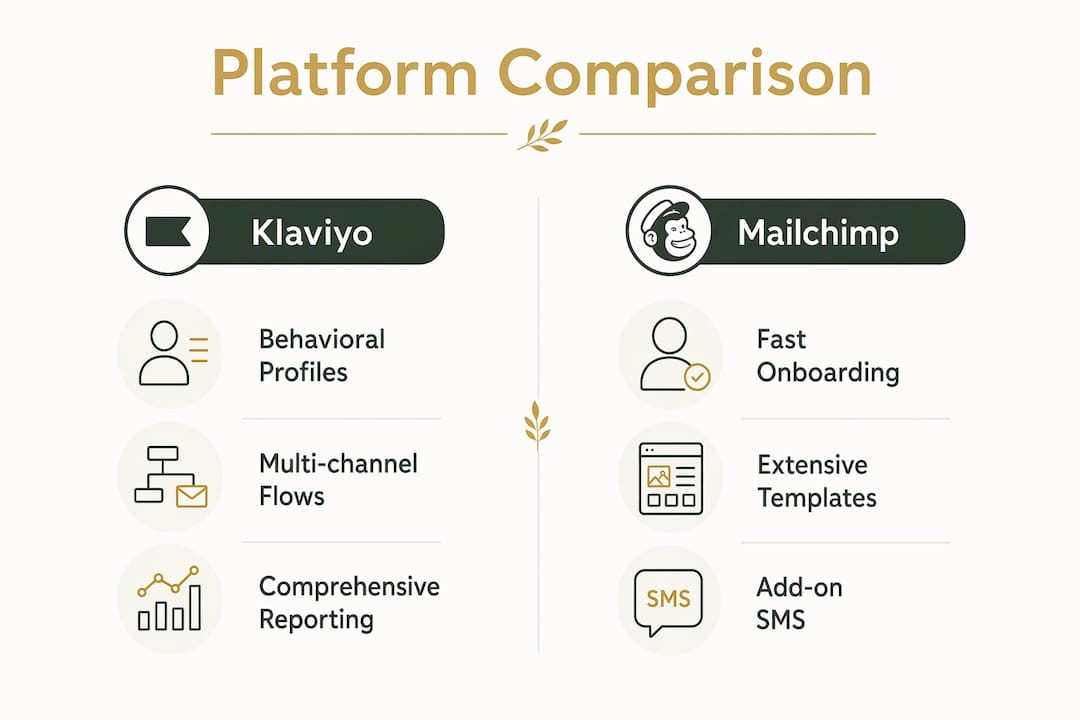
For a solo creator launching a newsletter, Mailchimp’s onboarding speed and template library are hard to beat. For a high-ticket product launch with behavioral triggers and Shopify checkout tracking, Klaviyo’s data depth justifies the higher cost. For creators who want a tested launch playbook without touching either platform, Money Plug Lab is the direct path.

How do you decide between a DIY tool and a managed launch?
Work through these in order:
- What’s your list size? Under 500 contacts, Mailchimp’s free plan (500 contacts, 1,000 emails/month) covers basic sends. Klaviyo’s free tier handles up to 250 profiles. Neither costs anything at this stage.
- What’s your revenue target? A $10,000 launch on a 500-person list is achievable with either tool. A $100,000 launch needs behavioral segmentation, lifecycle flows, and conversion-optimized copy, which is where Klaviyo or a managed agency earns its cost.
- Do you have in-house copy, design, and ad management? If yes, a DIY platform makes sense. If not, tool costs stack on top of contractor fees fast.
- How complex is your funnel? Single opt-in to purchase? Mailchimp handles it. Multi-step with upsells, checkout abandonment, post-purchase sequences, and paid ad attribution? Klaviyo or a managed launch.
Cost shape at key list sizes:
- ~500 contacts: Mailchimp Essentials at $13/month; Klaviyo free tier. Both workable. Tool cost is not the decision.
- ~5,000 contacts: Mailchimp Standard at $100/month; Klaviyo roughly comparable. Add contractor fees for copy and ads and you’re approaching $1,500–$2,000/month in total launch costs.
- ~15,000 contacts: Klaviyo around $350/month vs Mailchimp around $200/month for email only. At this scale, the gap in behavioral data quality starts driving measurable revenue differences.
Pro Tip: Before modeling costs, audit your list architecture. If you’ve been running multiple Mailchimp Audiences with overlapping contacts, your actual billable count may be 30–50% higher than your real subscriber count. Clean and deduplicate before migrating anywhere.
When to start with a tool: you have in-house creative capacity, a list under 5,000, and a clear funnel mapped out. When to hire Money Plug Lab: you want a launch in weeks, not months, you need full-stack delivery (copy, video, ads, payment infrastructure), and you prefer paying from revenue rather than upfront.
What are the real feature differences that affect launch revenue?
Pricing mechanics
Klaviyo bills per active profile. One person, one charge, regardless of how many lists they’re on. Mailchimp bills per contact per Audience, which means duplicate contacts across multiple Audiences inflate your bill without adding reach. At 5,000 contacts with a segmented funnel, this can push your effective Mailchimp cost well above the listed plan price.
Data model and segmentation
Klaviyo’s behavioral profile depth is the clearest advantage for launch teams. Predictive fields like customer lifetime value, churn risk, and next-order date let you build segments that respond to where a subscriber is in their buying cycle, not just when they joined your list. Mailchimp’s segmentation is solid for basic use cases but doesn’t reach that level of predictive granularity.
Automation and multi-channel flows
Klaviyo supports email, SMS, RCS, WhatsApp, and mobile push in a single platform. Mailchimp sells SMS as a paid add-on with geographic limits on MMS. For a launch sequence that needs coordinated email and SMS touchpoints, Klaviyo’s native multi-channel setup is meaningfully cleaner to manage.
Mailchimp’s Customer Journey Builder handles complex branching logic well, including purchase-based triggers and A/B splits within flows. For creators running three to five sequences, Mailchimp’s builder is more than enough. For agencies managing 20-plus automated journeys with conditional logic, Klaviyo’s architecture scales better.
Ecommerce integrations
Both platforms list roughly 300+ integrations, but the depth differs. Klaviyo’s are organized around ecommerce data flows: Shopify sync pulls purchase history, browse behavior, and checkout events directly into profiles. Mailchimp’s integrations cover a broader discovery-led marketplace, which suits general small-business needs but lacks Klaviyo’s Shopify-native depth. For physical-product creators who also need logistics coordination, platforms like ParcelPlanet’s ecommerce integrations can extend either platform’s fulfillment visibility.
Deliverability and reporting
Klaviyo provides a comprehensive deliverability toolkit including sender health scoring, IP warmup guidance, and bounce suppression. Mailchimp covers authentication basics but offers more limited deliverability reporting. For a launch where inbox placement on day one directly affects revenue, that gap matters.
Migration timeline
Migrating from Mailchimp to Klaviyo typically takes two to four weeks when done properly: field mapping, consent and permission handling, tag/event recreation, and a warmup period for the new sender domain. Klaviyo’s import tooling gives more granular control over field mapping and consent setup, which reduces post-migration cleanup. Budget an additional week for testing flows before going live. A managed launch with Money Plug Lab sidesteps migration entirely since the agency builds the infrastructure from scratch.
How does Money Plug Lab run launches for creators?
Money Plug Lab has generated over $500,000 in tracked revenue across seven launched programs, including a single launch that produced more than 3,000 sales in ten days and a campaign that returned 18x on ad spend. Those numbers come from a specific approach: the agency handles every layer so the creator focuses on content, not operations.
The launch workflow covers:
- Audience research and product architecture before a single email is written
- Sales copy and video sales letters built to the specific offer and audience
- Launch campaign management including email sequences, lifecycle flows, and paid ad post-production
- Payment infrastructure setup so checkout and revenue tracking are live from day one
- ROAS attribution and revenue reporting throughout the campaign
Platform choice inside that workflow depends on the creator’s product type and list architecture. For creators selling digital programs with behavioral triggers and upsell sequences, Klaviyo’s profile model and predictive analytics align with the agency’s revenue-per-email optimization approach. For creators launching simpler newsletter-first products, Mailchimp’s speed-to-market advantage can cut setup time significantly.
The practical note on third-party tools: neither Klaviyo nor Mailchimp covers every layer of a launch stack. Payment infrastructure, video hosting, and ad attribution often require additional tools. Money Plug Lab handles that integration work as part of the engagement, which removes a common point of failure for solo creators trying to stitch together a launch stack independently.
What Money Plug Lab does instead of DIY platform selection
Choosing between Klaviyo and Mailchimp is a real decision with real cost implications. But for many creators, the bigger risk isn’t picking the wrong platform. It’s spending three months configuring one while the launch window closes.
Money Plug Lab is the alternative for creators who want a launch, not a software project. The agency works on a pure revenue-share basis with zero upfront cost: no monthly tool bill, no contractor invoices, no setup fees. In return, Money Plug Lab takes a share of the revenue each sale generates. Every service layer, from audience research and pricing strategy to sales copy, video sales letters, paid advertising, and payment infrastructure, is covered.
The result is a tested launch playbook applied to your specific audience, with tracked ROAS outcomes from day one. Creators who’ve gone through the process have seen campaigns return 18x on ad spend and individual launches clear 3,000 sales in ten days.
If that model fits where you are, start the conversation at Money Plug Lab and get a launch plan built around your audience and offer.
Key Takeaways
Klaviyo’s behavioral profile model and Mailchimp’s speed-to-market each serve distinct creator needs, but a managed revenue-share launch with Money Plug Lab removes the platform decision entirely for creators prioritizing time-to-revenue.
| Point | Details |
|---|---|
| Klaviyo wins for revenue-driven launches | Behavioral profiles, predictive analytics, and deep Shopify sync make it the stronger choice for high-ticket product launches. |
| Mailchimp wins for speed and simplicity | Faster onboarding, 100+ templates, and a broader feature set suit solo creators and newsletter-first strategies. |
| Mailchimp’s pricing has a hidden trap | Duplicate contacts across multiple Audiences are billed separately, inflating costs as list architecture grows. |
| At 15,000 contacts, Klaviyo runs approximately $350/month while Mailchimp is around $200/month for email only. Adding SMS can increase Mailchimp’s cost further, but for standard email marketing at this scale, Mailchimp is typically less expensive. | |
| Money Plug Lab removes the platform decision | Revenue-share model, $0 upfront, and full-stack launch delivery let creators skip tool selection and go straight to revenue. |