Creators: Offer Validation in 7–14 Days, Sell Before You Build
Creators: Offer Validation in 7–14 Days, Sell Before You Build

Offer validation means real buyers hand over money, not compliments. If you want a straight answer, run a minimal paid test, price it at what you actually plan to charge, and see if strangers commit within 7 to 14 days. No sale means no validation, no matter how many people said they loved the idea.
TL;DR:
- Validating an offer requires actual buyer commitments like deposits or pre-sales within 7 to 14 days, not just positive feedback or expressed interest.
- Set clear thresholds for success, such as a conversion rate of 2 to 10 percent and a minimum sample size, before running your test to avoid false positives.
- Use methods like soft pitches, landing pages for pre-sales, fake-door tests, or small paid pilots to measure real demand without building the full product.
- Red flags include conversion rates below 1 percent or no purchases despite engaged comments, indicating messaging or audience mismatches rather than lack of interest.
- If a validation test fails, adjust your messaging, target audience, or offer format before considering further attempts or building the complete product.
Table of Contents
- What Offer Validation Actually Means
- Tactical Methods to Validate Your Offer This Week
- Green Lights vs. Red Flags in Offer Validation
- What to Do When Your Validation Test Fails
- Designing an MVO or Beta That Proves Demand First
- A Note From Money-plug on What Actually Validates a Creator Offer
- Let Money-plug Run the Validation Test for You
- Sources
- FAQ
What Offer Validation Actually Means
Positive feedback is cheap. Anyone can tell you your course idea “sounds amazing” without ever reaching for a credit card. Real validation happens when someone commits money or a scheduled slot — a pre-sale, a deposit, a “when can I sign up?” message sent unprompted. That distinction separates creators who launch to actual demand from creators who launch to a room full of nodding heads.
This is where the Minimum Viable Offer (MVO) earns its place next to the more familiar Minimum Viable Product (MVP). An MVP tests whether you can build something functional. An MVO tests whether anyone will pay for the outcome before you build anything at all. You sell the promise first, then build only what you’ve already sold.
Before you launch any test, write down the numbers that will make the decision for you:
- Conversion rate band: what counts as a pass (often 2 to 10% depending on traffic warmth)
- Minimum sample size: how many visitors or leads before the number means anything
- Timeline: the exact day you’ll stop and read the results, not “whenever it feels done”
Deciding these thresholds after you see the data is how founders talk themselves into false positives.
Tactical Methods to Validate Your Offer This Week
You don’t need a finished product to run a real test. You need a claim, a price, and a way to collect money or commitment.
- Soft pitches. Message 15 to 20 people from your warmest audience segment with a specific offer and price, not a vague idea. A script like “I’m opening 10 spots for [outcome] at [price], starting [date] — want in?” tells you more in one afternoon than a month of surveys, because you’re recording actual replies, not opinions.
- Pre-sales. Build a simple landing page with the offer, the price you intend to charge at full launch, a start date, and a capped number of spots. Include a clear refund policy so buyers feel safe committing. Testing at or near your target price matters here; heavy discounting only measures how much people love a deal, not whether they want your product.
- Smoke tests and fake doors. Run paid ads or a coming-soon page that leads to a checkout button, then measure how many people click “buy” before anything actually exists behind it. Fake-door tests reveal genuine purchase intent without you writing a line of course content.
- Live pilots and beta cohorts. Recruit a small paying group, define one activation metric (did they show up, did they finish module one), and run it for two to four weeks before opening to everyone else.
Stack these into a 7 to 14 day sprint: pick one method, define your pass/fail number on day one, drive traffic for a week, and make the call before you talk yourself into extending “just a little longer.”
Pro Tip: Use a waitlist first to build social proof and sharpen your messaging, then convert that list into a limited, full-price pre-sale — that two-step sequence usually beats jumping straight to a cold pre-sale.

Green Lights vs. Red Flags in Offer Validation
Numbers tell you what happened. Words tell you why. You need both.
Green lights that mean go:
- People ask “when can I sign up?” before you’ve pitched them
- Buyers pay full price with no discount prompt
- Existing customers refer friends unprompted
Red flags that mean stop and rework:
- Warm, engaged comments with zero purchases
- A sharp drop-off right at checkout, which usually means price or trust, not interest
When the qualitative feedback and the conversion data disagree, trust the money. If people say they’re excited but nobody buys, the offer, not the audience, is usually the problem.
What to Do When Your Validation Test Fails
A failed test tells you where to look next, not that you should quit. Start by triaging traffic quality: if people never clicked your ad or opened your message, that’s a targeting problem, not an offer problem. If they clicked and then bounced at the page or checkout, that’s message or price.
Run these experiments before touching the actual product:
- Swap the headline to name a sharper, more specific outcome
- Change who you’re pitching to (same offer, different segment)
- Test a lower-commitment format, like a workshop instead of a full course
- Try full price against a short trial or a payment-plan option
Give yourself one clear decision rule: if two consecutive message rewrites still land under your threshold, the audience or the core promise is wrong, not the copy. At that point, shelve the idea or rebuild the offer from scratch rather than running a fifth variation of the same page.
Pro Tip: Change only one variable per test cycle. If you rewrite the headline and swap the price at the same time, you’ll never know which one moved the number.
Designing an MVO or Beta That Proves Demand First
Pick the format that matches your risk. A cohort works for group coaching offers. A one-time workshop tests a single promise cheaply. A paid pilot or a capped pre-sale tests full-price commitment directly. Defining the claim, the price, and the decision window up front keeps you from moving the goalposts once the numbers come in.
Set your pass/fail threshold before traffic hits the page, something like 2 to 5% conversion or a fixed number of pre-sales inside 14 days. Beta cohorts should track activation rate, day-7 retention, and how many participants turn into vocal advocates, with activation above 30% and roughly 10 to 30 advocates counted as a strong signal to move to public launch.
| Step | Action | What you’re measuring |
|---|---|---|
| 1 | Define the claim, price, and timeframe | Clarity of the offer itself |
| 2 | Build a simple landing page or pre-sale page | Whether people click and commit |
| 3 | Drive traffic (list, ads, or DMs) | Conversion rate against your threshold |
| 4 | Decide within 14 days | Go, iterate, or shelve |
A Note From Money-plug on What Actually Validates a Creator Offer
Every one of those started as a pre-sale, MVO, or short beta, never a finished product. The lesson that repeats most: creators lose more launches to vague pricing and a fuzzy promise than to a bad idea.
— Money
Let Money-plug Run the Validation Test for You
Running a proper pre-sale, MVO, or beta pilot takes real hours: audience research, a landing page that converts, ad creative, payment setup, and someone reading the numbers honestly instead of hoping. An agency can build the entire structure for creators, from offer architecture and pricing strategy to pre-sale funnels, payment infrastructure, and the launch campaign that drives traffic to test it.
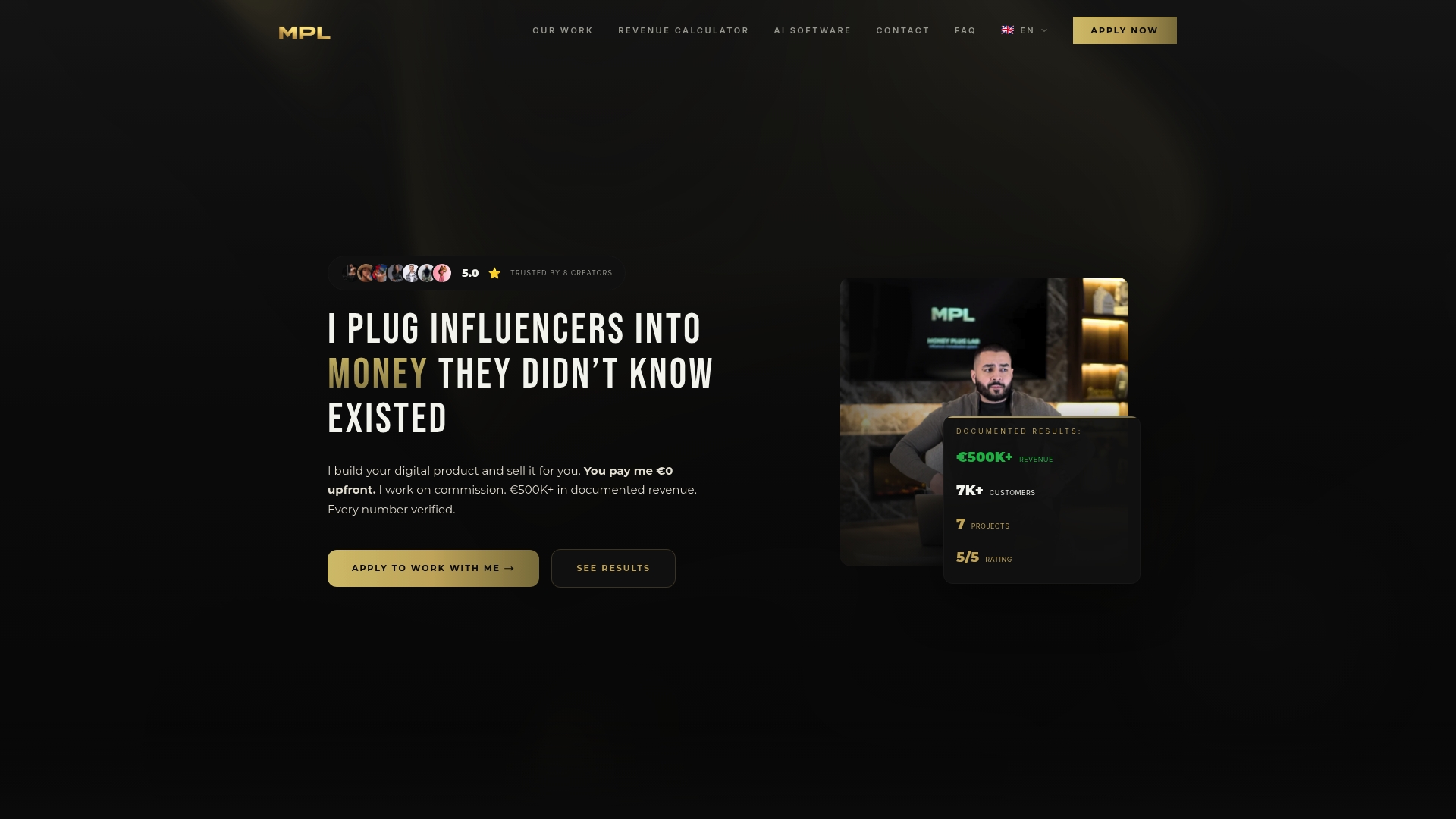
Some agencies work on revenue share, so there’s no upfront cost while you find out whether your offer actually sells, though this is not a universal guarantee. If your test on a Shopify storefront needs cleanup first, the Shopify optimization checklist is worth a pass before you drive paid traffic. When you’re ready to hand off the research, the pricing, and the launch mechanics, book a consult with Money-plug and get a plan built around your specific audience.
Sources
- Minimum Viable Offering Mvo Framework | Startup to Scaleup
- Beta Launch Guide: Run a Successful Beta | Better Launch
- How to Validate Offers Before You Launch Them
FAQ
How Do You Validate Your Customers?
You validate customers by watching what they pay for, not what they praise. Run a soft pitch or pre-sale to a defined audience segment and count actual purchases or deposits against a pass/fail number you set in advance, not after you see the results.
Does “Validate” Mean “Confirm”?
In the offer validation sense, yes, but confirmation has to come from money or a scheduled commitment, not agreement in conversation. Compliments and interest without payment don’t confirm demand; a pre-sale or deposit does.
How Do I Confirm an Offer Is Worth Building?
Set a conversion threshold before you launch, commonly 2 to 5% for an MVO test, then run a pre-sale or smoke test for 7 to 14 days. If you clear the threshold on a reasonable sample size, build the full version; if not, revisit the message or the audience first.
How Do I Say I Accept a Pre-Sale Offer as a Buyer?
If you’re the one selling and a buyer wants in, a simple confirmation works: “You’re locked in for [date] at [price] — I’ll send access details by [date].” Keeping that reply consistent across every buyer also gives you a clean record of exactly how many people actually said yes.
What’s the Difference Between an MVO and an MVP?
An MVP is a stripped-down version of the actual product, built to test function. An MVO is a sales page and a price tag testing whether anyone will pay before you build anything, which is why creators use it to test demand cheaply before committing real production time.