$7–$47 Tripwire Offers That Convert: Steps and Revenue Share Launch
$7–$47 Tripwire Offers That Convert: Steps and Revenue Share Launch

A tripwire offer is a low-cost, high-value product, usually priced between $7 and $47, designed to convert cold prospects into paying customers within minutes of meeting your brand. It exists to flip someone from “just browsing” to “already bought something from you,” which changes every metric that follows. Creators, coaches, and small productized service owners see the biggest lift because the tripwire also offsets ad costs and filters out people who were never going to buy anyway.
TL;DR:
- Most successful tripwires are priced between $7 and $47, with the ideal offer delivering quick, tangible results in minutes and requiring simple delivery.
- The funnel flow includes a landing page, checkout with an order bump, one-click upsell, optional downsell, and a follow-up email sequence to nurture buyers and warm up leads.
- Validating the offer with a small ad spend or community poll before building reduces the risk of poor performance and ensures market fit.
- Key metrics to monitor include conversion rate, order bump take rate, upsell acceptance, average order value, and return on ad spend, with a focus on traffic quality.
- Building or launching a tripwire is best for creators with an existing audience and clear core offers, or via a managed agency to reduce upfront risk and speed to market.
Table of Contents
- What Is a Tripwire Offer and Why Does It Work?
- Formats, Price Range, and What Makes a Great Tripwire
- How Does a Tripwire Funnel Actually Flow?
- How to Validate, Build, and Launch a Tripwire Funnel
- Tripwire Offer Examples and Inspiration
- Metrics to Track and How to Optimize a Tripwire Funnel
- Common Mistakes and How to Fix Them
- Agency Playbook: How Managed Tripwire Launches Work
- When Should You Prioritize Tripwires Over Other Tactics?
- How Money Plug Lab Helps Creators Launch Tripwires Without the Upfront Risk
- Sources
- FAQ
What Is a Tripwire Offer and Why Does It Work?
A tripwire is not a lead magnet, and it’s not a free trial. A lead magnet costs the buyer nothing and asks for an email. A tripwire costs real money, even a small amount, and that small transaction changes the buyer’s psychology entirely. Once someone pulls out a card and completes a purchase, they’ve mentally reclassified themselves from “prospect” to “customer.” That shift is the entire mechanism behind foot-in-the-door psychology: people who agree to a small request are far more likely to agree to a bigger one later.
Tripwires deliver three business outcomes that lead magnets can’t touch:
- They qualify buyers. Anyone willing to pay $17 has already shown intent that a free download never proves.
- They self-liquidate ad spend. Selling a low-cost product can offset your acquisition cost before you ever pitch the core offer.
- They raise lifetime value. A customer who buys once is statistically far more likely to buy again than someone who only opted in for a freebie.
That third point is the one most marketers underrate. A $27 tripwire that breaks even on ads isn’t a loss leader. It’s a customer list full of people who already trust you with their money.
Formats, Price Range, and What Makes a Great Tripwire
Most winning tripwires fall into a handful of proven formats: mini-courses, template packs, checklist bundles, free-plus-shipping physical items, $1 trials, and short paid consults. These work because they’re splinters of a core offer, not standalone products invented from scratch.
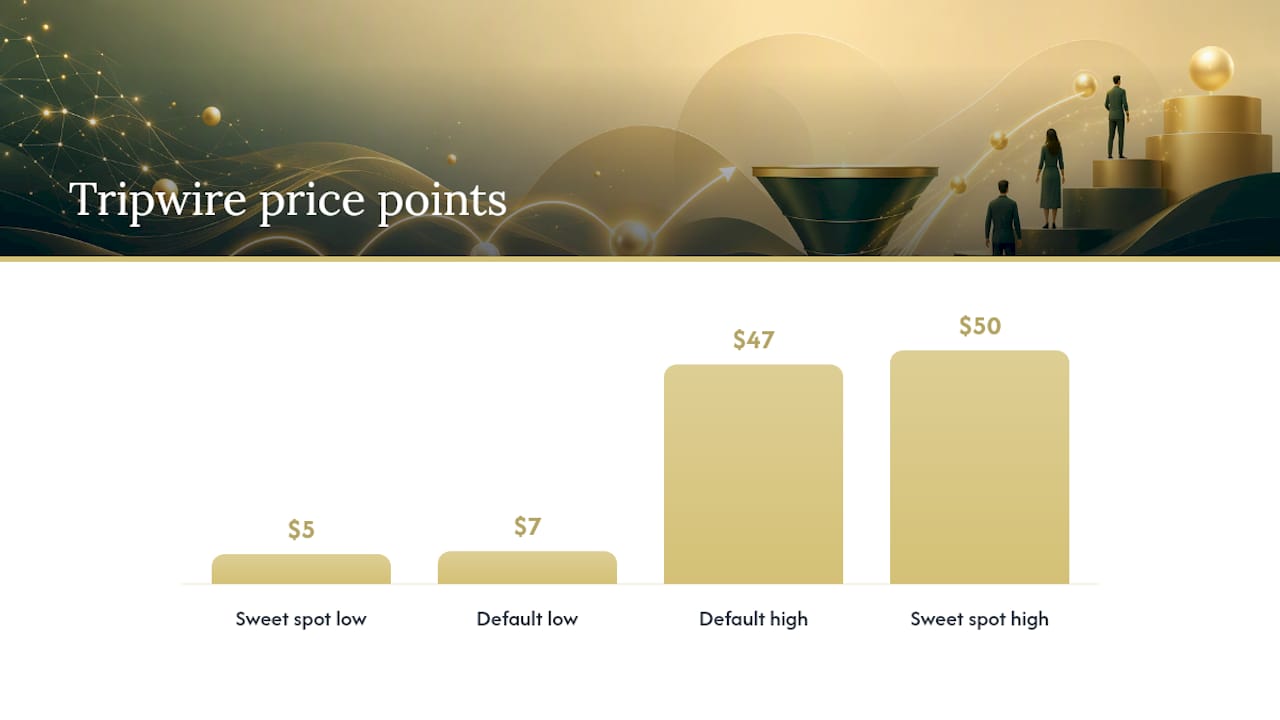
Pricing matters more than most people assume. The sweet spot sits between $5 and $50, with $7 to $47 being the range most experienced funnel builders default to. Below that, you’re leaving money on the table. Above it, you cross into “considered purchase” territory, where buyers pause, compare, and abandon.
A genuinely good tripwire hits three marks:
- Immediate outcome. The buyer gets a result in minutes, not days.
- Simple delivery. No complicated onboarding, no waiting on manual fulfillment.
- Alignment with the core offer. It previews or solves a slice of the exact problem your bigger program fixes.
Skip the trend chasing. Building an offer because a competitor’s did well, instead of because it matches your own audience’s specific pain point, is one of the fastest ways to kill conversions before the funnel even launches.
How Does a Tripwire Funnel Actually Flow?
A tripwire funnel is a sequence, and each step has a job. Miss one, and you leave money on the table even if the offer itself is great.
- Landing or ad page. This is where cold traffic lands, usually from a paid social ad or an opt-in redirect. Its only job is to sell the tripwire, not the core offer.
- Checkout page. The buyer enters payment details. This is where the order bump lives, a single checkbox offering a related add-on (a template, a bonus module, an extra session) at a reduced price, added with one click before the buyer finishes checking out.
- One-click upsell. Immediately after purchase, before the thank-you page, the buyer sees a higher-ticket offer they can add without re-entering payment info. This is where funnels typically shift from break-even to profitable.
- Downsell (optional). If the buyer declines the upsell, a scaled-down or limited-time version appears once more before moving on.
- Thank-you and delivery page. The buyer gets instant access to what they bought, plus a clear next step, whether that’s a calendar link, a Facebook group invite, or an email sequence trigger.
- Follow-up email sequence. The days that follow matter as much as the funnel itself. This is where you nurture non-buyers of the upsell and warm tripwire buyers toward your core program.
The offer ladder logic behind all of this is simple: each step should feel like a natural next purchase, not a jump. A $17 template pack leading straight into a $997 coaching package usually falls flat. A $17 template pack leading into a $97 mini-course, which then leads into the $997 program, gives buyers a bridge they can actually justify climbing.
How to Validate, Build, and Launch a Tripwire Funnel
Skipping validation is the single most expensive mistake in this process. Here’s the order that actually works.
- Validate before you build. Run a poll in your community, post a soft “would you buy this” offer, or spend $20 to $50 on a small ad testing the headline and price point before writing a single line of course content.
- Splinter your core offer. Take one high-value module, template, or workflow from your existing program and package it as a standalone win.
- Build the delivery files. Keep them simple: a PDF, a short video, a Notion template, a Google Sheet. Complexity kills speed to purchase.
- Set up the landing page. Focus the copy on one promise and one outcome. Avoid listing five benefits when one strong one converts better.
- Build checkout with the order bump attached. A two-step checkout (info, then payment) can lift completion rates slightly for higher-friction offers, but a one-step checkout is fine for anything under $30.
- Add the one-click upsell. Price it two to five times higher than the tripwire, and make sure it logically extends what they just bought.
- Connect payment and fulfillment. Test the entire path yourself with a real card before sending a dollar of traffic.
- Launch with tracking in place. Install your pixel, set your conversion goal to “purchase” rather than “lead,” and run two ad variations testing only the headline or the price, never both at once.
Pro Tip: Run your validation ad for 48 to 72 hours before building anything. If the click-through rate on the offer headline is weak, no amount of design polish on the sales page will save it.
Tripwire Offer Examples and Inspiration
The fastest way to find your own tripwire is to look at what’s already sitting in your content archive.
- Creators: Turn a popular Instagram carousel into a $9 swipe-file PDF, or bundle three of your best-performing recipes or workout routines into a $17 “starter pack.”
- Coaches and service providers: Sell a $27 “audit template” that walks a prospect through diagnosing their own problem, priming them for your paid coaching.
- Ecommerce: A free-plus-shipping sample kit, where the buyer pays $6.95 shipping, gets your product in hand, and becomes a warm lead for the full-size purchase.
- SaaS and agencies: A $1 trial for 7 to 14 days filters out tire-kickers while letting real prospects feel the product’s value before the full price kicks in.
The script that works across all four categories is the same: promise one specific, fast outcome, deliver it without friction, and make the next step obvious. “Get your first 100 email subscribers this week” sells better than “Learn email marketing,” because it names the result instead of the topic.
Metrics to Track and How to Optimize a Tripwire Funnel
Five numbers tell you whether your funnel is working: conversion rate on the tripwire page, order bump take rate, upsell acceptance rate, average order value (AOV), and return on ad spend (ROAS).
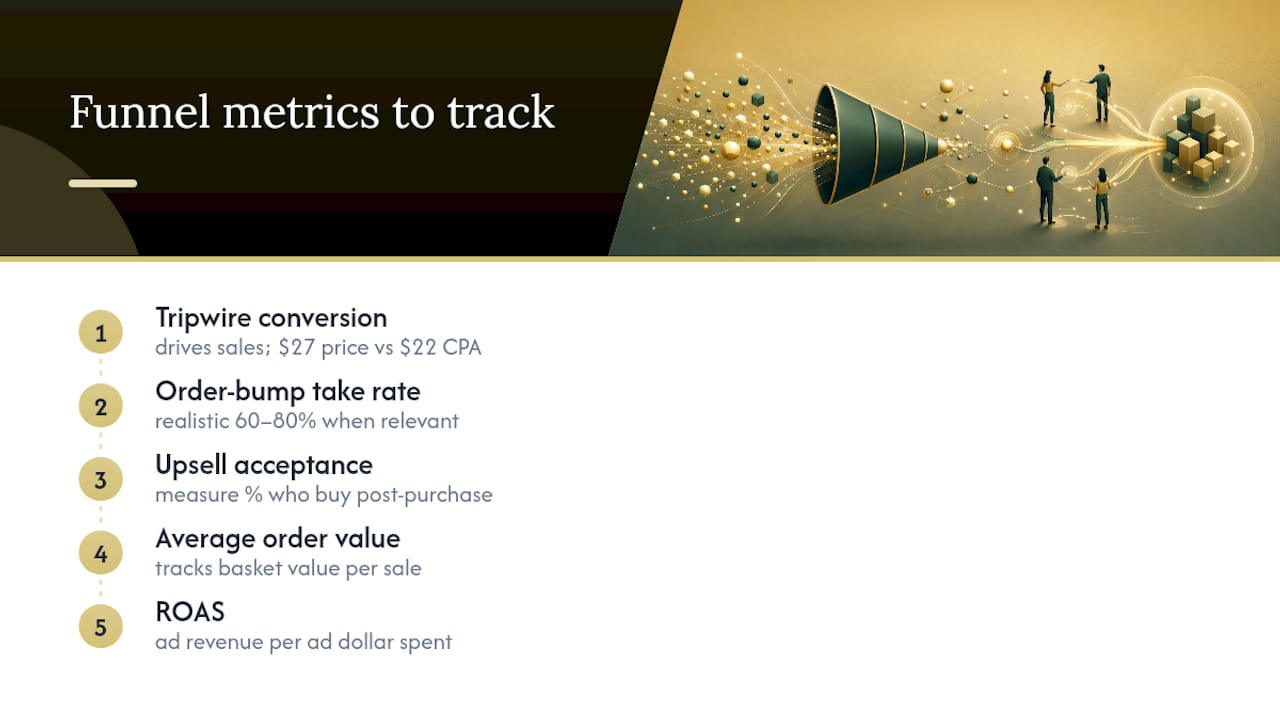
An order bump take rate between 60% and 80% is realistic when the add-on is cheap, obviously relevant, and presented as a single checkbox rather than a second sales pitch. That single lever often decides whether a funnel merely breaks even or turns a real profit on cold traffic.
Here’s the self-liquidation math in practice: say your tripwire costs $27 and your average cost per acquisition on paid ads runs $22. Without an order bump, you’re clearing a thin $5 margin per sale, which barely covers processing fees.
Once the math works, optimize in this order: traffic quality first (are you targeting people who actually match your core offer?), then page clarity, then price testing, then checkout friction, and only then your follow-up email sequence. Fixing email copy on a funnel with weak traffic quality is optimizing the wrong end of the pipe.
Common Mistakes and How to Fix Them
Most tripwire funnels underperform for the same handful of reasons, and each one has a quick fix.
- Kitchen-sink offers. Cramming five bonuses into one tripwire confuses the promise. Fix: cut it down to one core deliverable and one clear result.
- Misalignment with the core offer. A tripwire about social media growth won’t lead naturally into a nutrition coaching upsell. Fix: map the tripwire to the exact next step in your ladder before building it.
- Underpricing out of fear. Pricing at $3 to save the sale often signals low value instead of high accessibility. Fix: test $17 or $27 before assuming lower always converts better.
- Skipping validation. Fix: never skip the poll or small ad test, even when you’re confident.
- Clunky checkout experience. Fix: test the buy flow on mobile yourself before launch.
Pro Tip: If you use urgency or scarcity, make it real. A countdown timer that resets every time someone revisits the page destroys trust faster than any pricing mistake ever could.
Agency Playbook: How Managed Tripwire Launches Work
A revenue-share agency model removes the biggest barrier for creators building their first tripwire: upfront cost and the guesswork of doing it solo. An agency can handle product architecture, sales copy, checkout setup, and paid ad management for creators in exchange for a share of the revenue generated, with zero cost to the creator before launch.
The decision test is simple: build in-house if you already have design, copywriting, and ad-buying skills on your team. Consider an agency partner when you have the audience but not the hours or specialized skills to execute the full funnel yourself.
When Should You Prioritize Tripwires Over Other Tactics?
Tripwires earn their place once you already have an audience, however small, and a core offer worth building a ladder toward. If you have neither yet, spend your energy on audience growth first. The quick test: if a stranger would pay $20 for a slice of your knowledge today, you’re ready to build the tripwire.
— Money
How Money Plug Lab Helps Creators Launch Tripwires Without the Upfront Risk
Building a tripwire funnel from scratch means writing sales copy, setting up checkout, wiring order bumps, and managing ad accounts, all before a single dollar comes in. Money Plug Lab handles that entire build for creators on a pure revenue-share basis, meaning there’s no upfront cost, no retainer, and no risk if the launch underperforms.
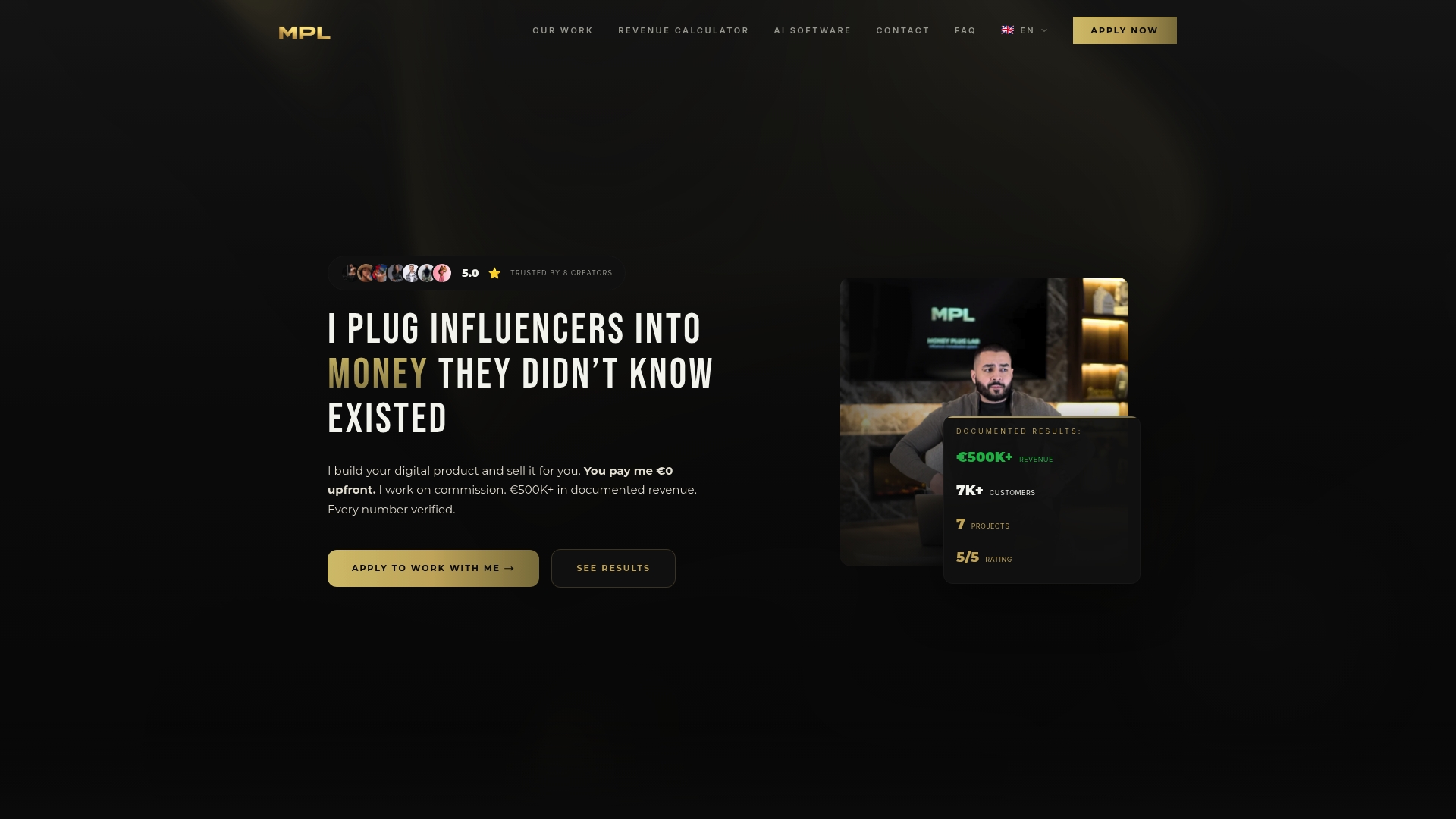
This setup fits creators, coaches, and small service owners who already have an audience but not the internal team to execute audience research, pricing strategy, video sales letters, and paid ad management simultaneously. Early outcomes typically show up fast: a validated tripwire, a working order bump, and a launch campaign running within weeks rather than months. If you want a team that has already run this exact playbook across seven launched programs, visit Money Plug Lab to see how a managed launch could work for your audience.
Sources
- How to create a tripwire funnel | OptinMonster
- Low-ticket offers: seven essential ideas and mistakes to avoid | Ty Cohen
- How to build a low-ticket offer funnel | Maria Wendt
- Tripwire funnel: what it is & how to build one | FunnelKit
FAQ
What Does Tripwire Mean in Marketing?
A tripwire is a low-cost, high-value offer, typically $7 to $47, sold immediately after a prospect opts in or clicks an ad. It converts cold traffic into paying customers and works as the first rung of a larger offer ladder rather than a standalone product.
Who Acquired Tripwire?
This question usually refers to Tripwire Inc., a cybersecurity software company unrelated to marketing tripwire offers, which was acquired by Belden some years ago. In marketing, “tripwire” describes a funnel strategy and technique, not a company or product with an ownership history.
What Are Some Effective Offers That Attract Customers?
Effective low-cost offers solve one specific problem fast: template packs, checklist bundles, mini-courses, free-plus-shipping physical products, and short paid trials. The common thread is a narrow, achievable outcome rather than a broad, feature-heavy bundle.
Can You Give an Example of a Sales Funnel?
A typical funnel runs landing page to tripwire purchase to one-click upsell to optional downsell to thank-you page, followed by an email sequence. This structure is the standard four-part tripwire funnel used across ecommerce, coaching, and SaaS businesses.
How Much Does It Cost to Work With Money Plug Lab?
Money Plug Lab operates on a pure revenue-share basis, meaning there’s no upfront fee for creators. Pricing and partnership details are available directly on the Money Plug Lab site.