Upsell Ideas for Course Creators That Actually Lift AOV
Upsell Ideas for Course Creators That Actually Lift AOV

The fastest, highest-ROI upsell ideas for courses are a checkout bump and a one-click post-purchase offer. Start with those two this week. A checkout bump is a low-ticket add-on (a PDF workbook, a swipe file, a resource kit) placed directly on the checkout page before the buyer clicks “pay.” A one-click post-purchase offer appears on the confirmation page and charges the same card already on file, requiring zero re-entry. Both require minimal assets, convert without friction, and produce measurable results within days.
Brands using multiple upselling techniques — tier anchoring, feature comparison, and urgency-based upgrades — can see 20–35% lifts in average order value (AOV) within 60 days. Money-plug’s creator partnerships have generated significant tracked revenue across multiple programs, including a launch that achieved several thousand sales within days.
Stat to know: Combining checkout bumps with a post-purchase one-click offer is the fastest path to a 20–35% AOV lift without touching your core course’s price.
Two starter upsells, step by step:
- Checkout bump: Create a single PDF or short video add-on priced at roughly 10–20% of your course price. Place it as a checkbox on the checkout page. Track attach rate (target: 15–30% of buyers).
- Post-purchase one-click offer: Build a complementary mini-course or live Q&A session. Present it on the confirmation page. Track conversion rate (target: 8–15% of buyers).
Table of Contents
- What are the best upsell ideas for courses you can launch in 14 days?
- Which mid- and high-ticket upsells are worth building in 2–8 weeks?
- How should you price and package upsells to maximize attach rates?
- How do you write upsell copy that converts without feeling pushy?
- What tools do you need to run upsells in the U.S.?
- How do you measure whether your upsells are working?
- When should you hire an agency instead of doing it yourself?
- What results has Money-plug seen from upsell and launch strategies?
- How do you personalize upsells based on learner behavior?
- How do you connect upsells across multiple courses or product lines?
- How do you segment upsell offers for different buyer types?
- What are the most common upselling mistakes course creators make?
- Key Takeaways
- The upsell mistake most creators never catch
- Money-plug helps creators build and scale upsell systems
- Sources and further reading
What are the best upsell ideas for courses you can launch in 14 days?
Four offers you can build and ship in under two weeks, ranked by effort:
- Checkout bump (Day 1–3): A templates pack, swipe file, or cheat sheet. Hook: “Add the done-for-you templates — $27 more.” Assets needed: one PDF, one checkbox on checkout.
- Post-purchase one-click offer (Day 3–7): A 60-minute live Q&A or a short bonus module. Hook: “Get direct feedback on your first week — one click, no re-entry.” Assets needed: a scheduling link or a short video.
- Downloadable resource bundle (Day 7–10): Group three existing content pieces into a named bundle. Hook: “Everything you need to go faster, in one place.”
- Quick live Q&A add-on (Day 10–14): A 30-minute group call for recent buyers. Hook: “Stuck? Bring your questions live.”
Who to target first:
- New buyers (within 48 hours of purchase) for the checkout bump and post-purchase offer
- Recent completers (finished 80%+ of the course) for the Q&A add-on
- Cart abandoners via email for the resource bundle
Run a simple A/B test: show the post-purchase offer to 50% of buyers for two weeks. If attach rate clears 8%, keep it. If not, change the price or the hook before scaling.
Pro Tip: Write the checkout bump copy in one sentence. “Add [specific asset] for $[price] more” outperforms longer descriptions every time — buyers are mid-checkout and need zero friction.
Which mid- and high-ticket upsells are worth building in 2–8 weeks?
Higher-margin offers take more setup but produce the revenue that actually changes a creator’s business. The four worth your time:
- Private coaching (1:1 or small group): Converts best when offered right after course completion, when the learner’s motivation peaks. Charge 3–5x the course price.
- Cohort-based group program: A live, time-limited version of your course with community access. Converts well to buyers who want accountability. Price at 2–4x the core course.
- Certification or credential add-on: A graded assessment plus a shareable certificate. Works especially well for professional-skills courses. Charge 30–60% on top of the base price.
- Done-for-you service: You (or your team) implement what the course teaches. Highest ticket, lowest volume. Price at 5–10x the course or on a retainer basis.
| Week | Task |
|---|---|
| 1–2 | Define the offer, set capacity limits, draft the sales page |
| 3–4 | Record or prepare delivery assets; set up payment and scheduling |
| 5 | Write launch emails and confirmation sequences |
| 7–8 | Open cart, run ads or organic push, onboard first cohort |
Before you open any high-ticket offer, confirm three things: you have the calendar capacity to deliver, a refund policy is written and visible, and fulfillment does not depend on a single tool that could break.

Pro Tip: Cap your first cohort at 10–15 students. A smaller group lets you deliver a better experience, collect testimonials, and raise the price for the next round.
How should you price and package upsells to maximize attach rates?
Good–Better–Best tier anchoring is the most reliable packaging pattern for course upsells. The top tier makes the middle feel reasonable; the bottom tier makes the middle feel like the obvious choice. Your goal is to make the middle tier the default decision.
| Tier | Example offer | Price range |
|---|---|---|
| Good | Core course only | $97 |
| Better | Course + templates + Q&A | $147 |
| Best | Course + templates + Q&A + coaching call | — |
Keep upsells priced within a 20–30% comfortable range of the base product. An upsell priced above 30% of the core course starts to feel like a separate buying decision, which kills impulse acceptance.
Frame the price as an increment, not a total. “$50 more” lands better than “$147.” Per-day framing (“less than $2 a day”) works well for subscription upgrades or ongoing community access.
Pro Tip: Limit the number of upsell choices at any single moment. One offer at checkout, one on the post-purchase page. More than that and buyers freeze.
How do you write upsell copy that converts without feeling pushy?
The one-line messaging formula that works: outcome + time savings + social proof. Every upsell headline should answer: “What will the buyer achieve, how much faster, and who else has done it?”
Sample microcopy:
- Checkout button: “Yes, add the [Asset Name] — I want faster results”
- Post-purchase modal headline: “One more thing before you start — most students who add this finish 40% faster”
- Decline link: “No thanks, I’ll figure it out on my own”
Two short email templates:
Post-purchase offer (send 10 minutes after purchase): “You’re in. Before you open Module 1, here’s what the top 10% of students add to their order — and why it cuts the learning curve in half. [CTA button]”
Milestone trigger (send when buyer completes Module 3): “You’ve hit the halfway point — that’s where most people stall. Here’s the one thing that keeps momentum going. [CTA button]”
HubSpot’s guidance on value-first upselling is clear: time the offer after you’ve delivered something the buyer found useful, not before. Zendesk’s experts add that avoiding feature-sell language and coercive urgency preserves the trust that makes repeat purchases possible.
Pro Tip: Never use countdown timers on post-purchase pages unless the scarcity is real. Fake urgency erodes trust faster than any bad offer.
What tools do you need to run upsells in the U.S.?
Four tool categories, each with a specific job:
- Checkout and one-click upsells: ThriveCart, SamCart, or Shopify with a post-purchase app handle one-click offers without requiring buyers to re-enter payment details.
- Membership and LMS platforms: Kajabi, Teachable, or Thinkific manage course delivery, progress tracking, and behavioral triggers for mid-course upsell emails.
- Payment processors: Stripe and PayPal both support one-click post-purchase charges in the U.S. Confirm your processor supports “payment intent reuse” before building the flow.
- Email and automation: ConvertKit, ActiveCampaign, or Klaviyo handle behavioral triggers (module completion, milestone reached) that fire upsell sequences at the right moment.
Integration checklist:
- Assign a unique product ID to every upsell offer
- Set up webhooks between your checkout tool and your email platform
- Tag buyers by purchase (e.g., “bought-core,” “bought-bump”) for segmentation
- Test the full purchase flow end-to-end before going live
- Confirm tax collection settings (U.S. digital product sales tax varies by state — consult a tax professional or use a tool like TaxJar)
Pro Tip: Build the simplest possible stack first: one checkout tool, one email platform, one LMS. Add complexity only after your first upsell converts consistently.
How do you measure whether your upsells are working?
| Metric | What it measures | Target range |
|---|---|---|
| Attach rate | % of buyers who take the upsell | 15–30% (bump), 8–15% (post-purchase) |
| AOV lift | Revenue per order vs. baseline | 20–35% with 3+ techniques |
| Upsell conversion rate | % who see the offer and buy | 10–20% depending on placement |
| LTV uplift | revenue per buyer vs. control | Track monthly |
Experiment plan:
- Split buyers 50/50 into test and control groups
- Show the upsell only to the test group for 14 days minimum
- Require at least 200 buyers per group before drawing conclusions
- Compare AOV and attach rate between groups; do not compare revenue totals until sample sizes are equal
- Change one variable at a time (price, copy, or placement) before running the next test
Monitor attach rate and AOV daily for the first week. Switch to weekly reviews once the offer stabilizes. The 20–35% AOV lift benchmark applies when you’re running three or more techniques simultaneously — a single checkout bump alone will produce a smaller but still meaningful lift.
When should you hire an agency instead of doing it yourself?
Three hard signals that DIY is costing you more than an agency would:
- Your attach rate is below 8% after two full A/B tests
- You’ve spent more than 20 hours building upsell flows and haven’t shipped yet
- Your onboarding sequence is inconsistent and learner completion rates are dropping
Decision checklist:
- Revenue above $3,000/month from your course? An agency can likely 2–3x that faster than you can alone.
- No dedicated copywriter or funnel builder on your team? The cost of bad copy exceeds most agency fees.
- Launching a new offer in under 60 days? External execution capacity matters more than cost.
What a revenue-share agency like Money-plug typically handles: audience research, product architecture, pricing strategy, sales copy, video sales letters, launch campaigns, and paid advertising. What the creator keeps: content delivery, community relationships, and brand voice.
Before signing with any agency, ask: What is the revenue-share percentage? Who owns the customer data? What happens if the launch underperforms?
Pro Tip: A zero-upfront revenue-share model aligns agency incentives with yours. If they don’t earn, you don’t pay. That structure filters out agencies that aren’t confident in their own work.
What results has Money-plug seen from upsell and launch strategies?
Money-plug’s documented results from creator partnerships:
- Over $500,000 in tracked revenue across seven launched programs
- One launch produced 3,000+ sales in ten days
- One campaign returned 18x on ad spend
The highest-volume launch used a combination of a pre-launch waitlist, a checkout bump, and a post-purchase coaching upsell. The checkout bump and post-purchase offer together accounted for a meaningful share of incremental revenue beyond the core course price.
Results were tracked through purchase-level data and compared against pre-launch baselines. Money-plug operates on a pure revenue-share model, meaning the agency earns only when creators earn. That structure is worth naming as context when reading any performance claim.
This article reflects general information about upselling strategies. Results vary by audience, niche, and execution. Consult a qualified professional for tax, legal, or financial decisions specific to your business.
How do you personalize upsells based on learner behavior?
Behavioral data is the most reliable signal for upsell timing. A buyer who completes Module 3 is more ready for a coaching upsell than someone who opened the course once. A buyer who downloaded the bonus workbook is signaling they want more resources.
Three personalization triggers worth setting up:
- Module completion: Fire a coaching or cohort upsell when a buyer finishes a key module
- Resource download: Trigger a templates bundle offer after a buyer grabs a specific asset
- Inactivity: Send a re-engagement offer (a live Q&A or accountability session) when a buyer goes seven days without logging in
Tag buyers in your email platform by behavior, not just by purchase. “Completed Module 3” is a more useful segment than “bought the course.”
How do you connect upsells across multiple courses or product lines?
A product ladder is the structure that makes cross-course upsells work. Each course should have a clear “next step” that is either a deeper version of the same topic or an adjacent skill the buyer needs next.
Map your product line as a sequence: free lead magnet → entry course → mid-tier course → high-ticket program or service. Every upsell should move the buyer one step up that ladder, not sideways into an unrelated topic.
For creators with multiple courses, a bundle offer (two or three courses at a discount) converts well when presented at checkout or post-purchase. The key is framing: “You’re already learning X — here’s what 80% of students add next.”
How do you segment upsell offers for different buyer types?
Not every buyer is ready for the same next offer. Three personas to build segments around:
- The quick-win seeker: Bought because of a specific outcome promise. Responds to templates, checklists, and done-for-you assets. Price sensitivity is moderate.
- The deep learner: Engages with every module and downloads every resource. Responds to advanced content, certification, and cohort programs. Less price-sensitive.
- The accountability buyer: Enrolled but stalls. Responds to live calls, coaching, and community access. Needs a reason to re-engage before any upsell lands.
Segment by behavior (completion rate, login frequency, downloads) rather than by demographics. A 45-year-old professional and a 22-year-old student can both be “deep learners” — the behavior is what matters, not the profile.
What are the most common upselling mistakes course creators make?
Pitfall 1: Offering too many upsells at once. Three offers on a single checkout page creates decision fatigue and drops conversion on all of them. One offer per moment.
Pitfall 2: Pricing the upsell too close to the core course price. A $97 upsell on a $99 course feels like a second full purchase. Keep upsells within the 20–30% range of the base price for low-friction acceptance.
Pitfall 3: Upselling before delivering value. Pitching a coaching package before the buyer has opened Module 1 reads as predatory. Time offers after a clear win — a completed module, a downloaded resource, a milestone reached.
Pitfall 4: Ignoring refund policy clarity. Buyers who feel trapped by an upsell they can’t return will dispute the charge. State the refund window on the upsell page, not buried in terms.
Pitfall 5: Never testing. Running the same upsell offer for six months without an A/B test means you’re leaving money on the table or burning goodwill without knowing which.
Key Takeaways
The most effective course upsell strategy combines a checkout bump and a one-click post-purchase offer, priced within 20–30% of the base course, timed after value delivery, and measured by attach rate and AOV lift.
| Point | Details |
|---|---|
| Start with two offers | Launch a checkout bump and a post-purchase one-click offer before building anything else. |
| Price within range | Keep upsells within 20–30% of the base course price to maintain low-friction acceptance. |
| Time after value | Present upsells after a completed module or milestone, not at the moment of first purchase. |
| Measure attach rate | Track attach rate (target 15–30% for bumps) and AOV lift weekly from day one. |
| Money-plug handles execution | Money-plug manages the full upsell stack on a revenue-share basis, with $500,000+ in tracked creator revenue as proof. |
The upsell mistake most creators never catch
Most creators focus on the offer itself and ignore the moment. They build a great coaching package, price it well, write decent copy, and then place it on the wrong page at the wrong time. The offer fails, and they conclude that upselling doesn’t work for their audience.
What actually happened: the timing was off. A buyer who just handed over their credit card is not ready to hand it over again for a $500 coaching program. But that same buyer, three days later, after finishing Module 2 and getting their first result? They’re primed.
The creators who build real upsell revenue treat their post-purchase sequence as a separate product. They map every touchpoint — confirmation page, welcome email, Module 1 completion, Module 3 completion, graduation — and assign a specific offer to each moment based on what the buyer just accomplished. That’s not aggressive selling. That’s knowing your audience well enough to show up with the right thing at the right time.
The ethical line is simple: if the upsell genuinely helps the buyer go further, offer it. If it’s there because you need the revenue, the buyer will feel that, and you’ll pay for it in refunds and lost trust.
Money-plug helps creators build and scale upsell systems
Creators who have an audience but haven’t built a product ladder yet are leaving the most money on the table. Money-plug works with digital creators on a pure revenue-share basis, meaning zero upfront cost. The agency handles audience research, product architecture, pricing strategy, sales copy, video sales letters, launch campaigns, and payment infrastructure from start to finish.
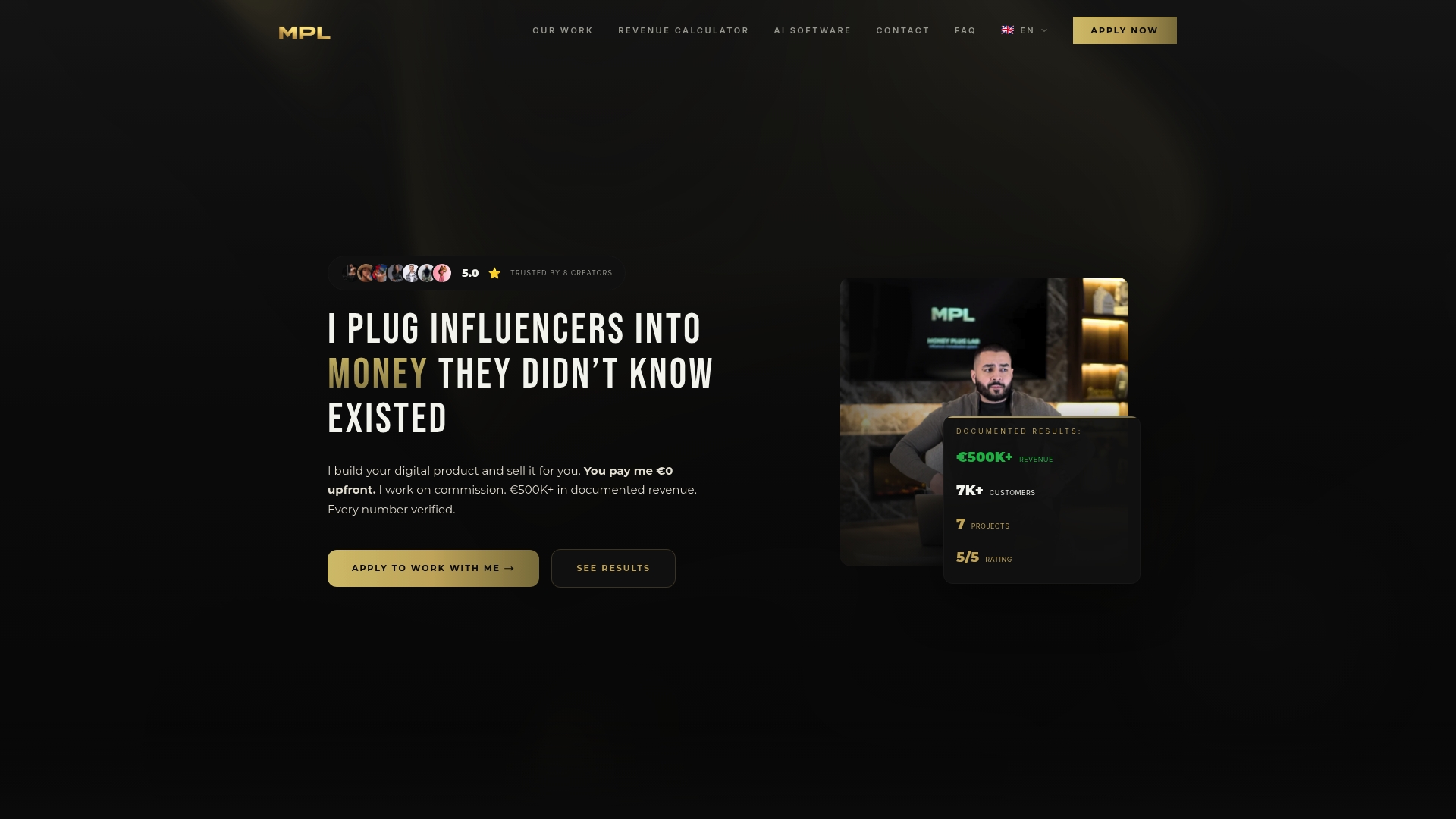
The ideal fit: a creator with an engaged audience in fitness, wellness, coaching, food, beauty, or an adjacent niche, who wants to launch or scale a digital product without hiring a full in-house team. Money-plug’s track record includes $500,000+ in tracked creator revenue, a 3,000-sale launch in ten days, and an 18x ad ROAS campaign. The agency specializes in Southeast European and Balkan diaspora markets, with workflows built for U.S.-compatible payment infrastructure and global ad platforms.
To get started, prepare your audience size, any existing sales data, and a short description of the product you want to launch or scale. Then reach out to Money-plug to see whether your situation fits the revenue-share model.
Sources and further reading
The sources below back the data and recommendations in this article:
- Upselling: 7 Proven Strategies to Boost AOV | Shopify — Timing guidance for product page, cart, checkout, and post-purchase placements
- 10 Upselling Strategies That Don’t Feel Salesy | HubSpot — Value-first timing and customer-goal framing
- How to Upsell: Tips from the Pros | Zendesk — Rapport-building, trial offers, and avoiding coercive tactics
- Good–Better–Best | Wikipedia — Anchoring psychology and mid-tier conversion mechanics
- Money Plug™ | Creator Monetization Systems — Agency proof points: $500,000+ tracked revenue, 3,000-sale launch, 18x ROAS