Video Sales Letter: The Conversion Playbook That Works
Video Sales Letter: The Conversion Playbook That Works

A video sales letter (VSL) is a scripted, conversion-first video built to drive one specific action: buy, book, or sign up. Treat it as a short-form sales funnel, not brand content. The single most important thing you can do right now is write the hook before anything else.
Three immediate next steps:
- Lock the hook first. Write three opening lines that name your viewer’s exact situation, pain, or misconception. Test them before you film anything.
- Pick one outcome. Decide whether the VSL ends with a purchase, a call booking, or an opt-in. One action only. A single, unambiguous CTA consistently outperforms multiple choices.
- Set your timing. VSL script lengths vary by use case: outbound and retargeting videos are often 60–90 seconds, while landing-page VSLs for colder or higher-priced offers typically run several minutes or more. Know your audience temperature before you write word one.
Table of Contents
- What a video sales letter is and when to use one
- Why VSLs convert: the psychological levers that actually matter
- Key components of a high-converting VSL script
- VSL formats and recommended lengths by use case
- Production essentials: what you actually need by budget tier
- Step-by-step production process from brief to publish
- Practical script templates and timing blueprints
- Hands-on production tips for camera, voiceover, and editing
- How to craft the offer and present a single, high-converting CTA
- How to test VSLs and interpret the metrics that matter
- When to hire an agency: a decision checklist and what to expect
- Key Takeaways
- What actually works in creator VSL launches
- Money-plug builds VSLs that convert, not just videos that look good
- Useful sources and further reading
What a video sales letter is and when to use one
A VSL is a structured sales asset that uses video to create desire, reduce uncertainty, and ask for a specific conversion. It controls the order in which a viewer encounters the hook, proof, offer, risk reversal, and close — the same job a long-form direct-response sales letter used to do in print. The format works because it removes the viewer’s ability to skip to the price before they understand the value.
VSLs are conversion assets, not awareness pieces. That distinction matters in practice: a VSL belongs at the decision stage of the funnel, not the discovery stage. Primary use cases include cold-traffic landing pages, paid-ad landing pages, outbound email sequences, high-ticket proposal walkthroughs, and re-engagement campaigns for warm audiences who stalled before buying.
Where a VSL wins over other formats:
- Vs. a short social ad: A social ad tests hooks and angles fast but has no room for proof or risk reversal. A VSL closes the deal.
- Vs. a webinar: Webinars build deep trust and handle live objections, but they require scheduling and high viewer commitment. A VSL is always-on.
- Vs. an explainer video: Explainers educate. VSLs sell. An explainer that ends with “learn more” is not a VSL.
- Vs. a testimonial clip: Testimonials add proof but carry no persuasion sequence. A VSL wraps proof inside a complete decision path.
A static landing page can outperform a VSL when traffic is already warm and the decision is simple. A retargeted visitor who knows your brand may only need pricing, a few testimonials, and a fast form. Save the VSL for situations where the buyer needs education before the offer makes sense: supplements with mechanism-based positioning, coaching programs, software with a workflow change, or any offer where skepticism is the main barrier.
One compliance note: Every claim in a VSL must be truthful and substantiated. If you cite results, include a brief disclosure (e.g., “results not typical”) near the claim. The FTC’s endorsement guidelines apply to video the same way they apply to written copy.
Why VSLs convert: the psychological levers that actually matter
89% of businesses now use video, and 87% of viewers report being convinced to buy after watching a brand’s video. VSLs capture that persuasive power because they combine the structure of direct-response copy with the credibility of a real human voice.
The conversion levers, in order of impact:
- Hook / pattern-interrupt: Stops the scroll and earns the next 30 seconds.
- Audience identification: Names the viewer’s exact situation so they feel seen.
- Mechanism: Explains why your solution works when other things failed.
- Proof stack: Layered evidence (demo, case stat, micro-testimonial) that builds belief progressively.
- Offer stack: Makes the value feel concrete and the price feel logical.
- Risk reversal: Removes the fear of being wrong (guarantee, trial, transparent cancellation).
- Single clear CTA: One action, stated plainly, with no competing choices.
The first 10–15 seconds determine whether anyone keeps watching. Direct-response copywriters consistently identify the pattern-interrupt hook as the single most influential element in VSL performance — more than production quality, more than offer structure.
Scripts written for the ear outperform scripts written for the eye. Short sentences. Conversational rhythm. Deliberate pauses. When someone reads copy, they can re-read a confusing sentence. When someone watches a VSL, they get one pass. Writing for spoken delivery reduces early drop-off and improves comprehension in a way that polished prose simply cannot.
Pro Tip: Map your primary emotional trigger to the offer before you write a word. Utility offers (“save time, save money”) need a mechanism-first hook. Status offers (“be the person who…”) need an identity-first hook. Fear-of-missing-out offers need a stakes-first hook. Picking the wrong trigger is why technically correct VSLs still flatline.

Key components of a high-converting VSL script
The seven-stage script architecture gives you a reliable skeleton. Here is what each stage does and how long to spend on it.
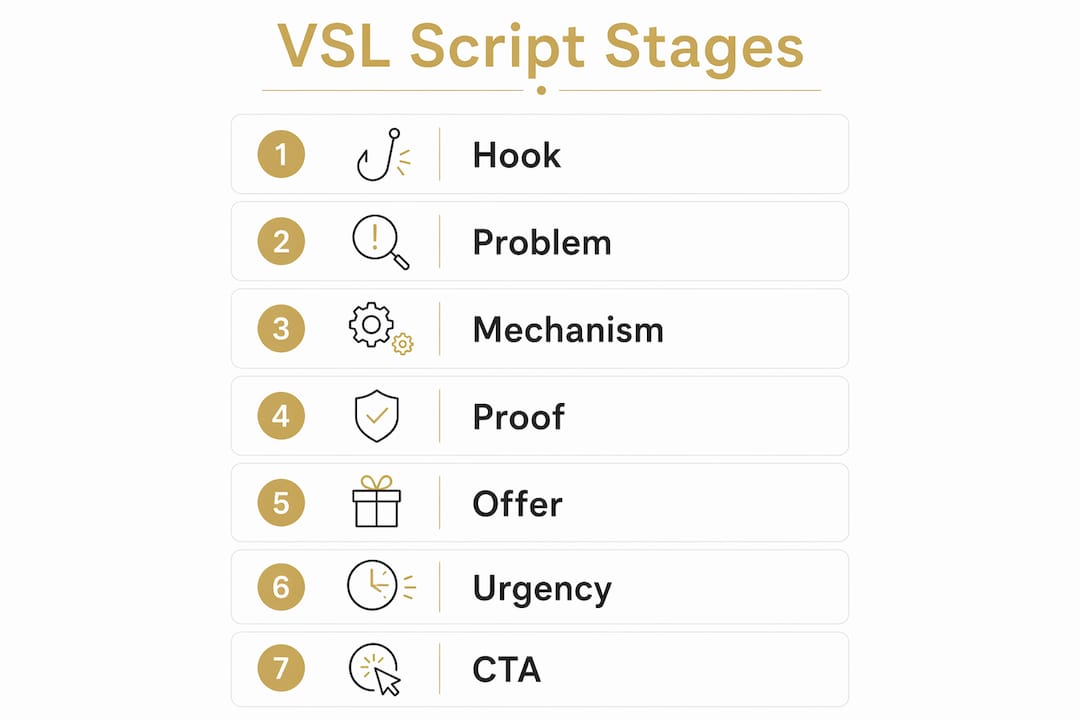
| Stage | Purpose | Suggested Timing (8 min VSL) | Common Mistake |
|---|---|---|---|
| Hook | Earn the next 30 seconds | 0:00–0:30 | Logo animation, slow intro |
| Problem | Prove you understand the viewer | 0:30–2:00 | Describing symptoms, not root cause |
| Credibility bridge | Establish why you can solve it | 2:00–3:00 | Résumé-style bio, no relevance to viewer |
| Mechanism | Explain why your approach works | 3:00–5:00 | Skipping straight to the offer |
| Proof stack | Build belief with specific evidence | 5:00–7:30 | Vague testimonials, no specifics |
| Offer stack | Make the value concrete | 7:30–9:30 | Feature dumping, no value framing |
| Close + CTA | One action, stated plainly | 9:30–end | Multiple CTAs, weak urgency |
Dos and don’ts by component:
- Hook: Do name a specific situation, pain, or misconception. Don’t open with your company name or a generic question like “Are you tired of…?”
- Problem: Do use the viewer’s own language. Don’t manufacture fear that doesn’t match the real pain.
- Mechanism: Do explain why your approach works differently. Don’t skip this stage. A VSL without a mechanism reads as a generic ad.
- Proof stack: Do layer proof types — a before/after demo, a case stat, a short client quote. Don’t stack five vague testimonials in a row.
- Offer stack: Do present comparative value (what it would cost to solve this another way). Don’t list features without translating them into outcomes.
- CTA: Do state exactly what happens after the click. Don’t offer two options.
For cold traffic, place your first proof element before the offer — ideally right after the mechanism. For warm traffic, you can move proof later because belief is already partially established.
VSL formats and recommended lengths by use case
Choosing the wrong format for your audience temperature is one of the most common production mistakes. Here is how the main formats stack up.

| Format | Best Use Case | Recommended Length | Traffic Temperature |
|---|---|---|---|
| Talking-head / direct-to-camera | Coaching, high-ticket services, personal brand offers | 6–15 min | Cold to warm |
| Demo / screen recording | SaaS, software, workflow tools | 3–8 min | Warm to hot |
| Animated explainer | Complex concepts, B2B, compliance-sensitive offers | 2–5 min | Cold to warm |
| Hybrid (talking-head + demo) | Online courses, fitness programs, digital products | 8 min | Cold |
| AI-assisted personalization | Outbound sequences, ABM, retargeting | 60–90 sec | Warm |
Script length should match offer complexity and audience temperature. VSL script lengths vary by use case and offer type, ranging from short clips for outreach to longer videos for complex or higher-priced offers.
Format selection checklist:
- Audience: Does your viewer know you? Cold audiences need more proof and a longer mechanism section.
- Offer price: Higher price = more proof needed = longer format.
- Budget: Talking-head costs less than animated. Hybrid sits in the middle.
- Creative assets: Do you have screen recordings, demo footage, or client results you can cut to? If yes, hybrid or demo formats amplify those assets.
- Distribution channel: Paid ad landing pages favor hybrid or talking-head. Email outreach favors short AI-assisted clips. Product pages can support longer formats.
A full video marketing strategy maps each video format to a specific funnel stage and ties it to a revenue KPI. A VSL belongs at the conversion stage. Awareness content belongs earlier. Mixing the two in one video dilutes both.
Production essentials: what you actually need by budget tier
Good audio matters more than good video. A viewer will tolerate a slightly soft image. They will click away from muffled audio in under 10 seconds.
Basic tier (under $500 total):
- Camera: iPhone 13 or newer, or any recent Android flagship. Shoot in 1080p, good light, locked focus.
- Microphone: Rode Wireless GO II or a wired lavalier like the Rode SmartLav+. Either eliminates room echo better than any built-in mic.
- Lighting: One ring light or a window with natural light behind the camera, not behind you.
- Backdrop: Plain wall, bookshelf, or a neutral-colored fabric. Avoid busy backgrounds.
- Teleprompter: PromptSmart Pro (iOS/Android) or Teleprompter Premium. Both let you control scroll speed with your voice.
- Editing: DaVinci Resolve (free) handles cuts, color, and captions at zero cost.
Mid tier ($500–$2,500):
- Camera: Sony ZV-E10 or Canon EOS M50 Mark II with a 16mm or 24mm lens.
- Microphone: Rode VideoMic NTG or a Shure MV7 for desk-based recording.
- Lighting: Two-point softbox setup (Elgato Key Light or Godox equivalent).
- Editing: Adobe Premiere Pro or Final Cut Pro. Add Descript for transcript-based editing and filler-word removal.
- Captions: Rev.com for accurate human captions, or Descript’s auto-caption with a manual review pass.
Pro tier ($2,500+):
- Camera: Sony FX3 or Blackmagic Pocket Cinema Camera 6K.
- Microphone: Sennheiser MKH 416 boom or Neumann TLM 103 for studio voiceover.
- Lighting: Three-point setup with a key, fill, and hair/separation light.
- Hosting and analytics: Wistia or Vimeo for embedded VSLs with heatmap and watch-percentage data. Both integrate with most landing page builders.
- Screen recording: Loom or Camtasia for demo footage. Export at 1080p minimum.
When outsourcing editing, request these deliverables in writing:
- Master file (H.264 or ProRes, 1080p minimum)
- Captions file (.SRT format)
- Short-form cut (60–90 sec) for paid ads
- Raw footage archive
- Thumbnail frame exports (3–5 options)
Step-by-step production process from brief to publish
Pre-production
- Define the single outcome. Write it in one sentence: “The viewer will click to book a 30-minute call.” Everything else serves that sentence.
- Build the customer persona. Name the specific situation, the failed attempts, and the emotional cost of staying stuck.
- Write the value proposition. One sentence: what it is, who it’s for, and what changes after they buy.
- Draft the mechanism. Write two to three sentences explaining why your approach works when other things haven’t.
- Storyboard the hook. Write three hook variants. Pick the sharpest one. Save the other two for A/B testing.
- Complete the script draft. Read it aloud. If you stumble, rewrite the sentence. Time the read-through.
- Get script approval. One round of feedback before filming. Changes after filming cost more.
Production
- Run two full read-throughs before recording.
- Capture multiple angles if possible (wide and medium at minimum).
- Record B-roll: product demos, screen recordings, before/after visuals.
- Capture testimonial clips separately if using them.
- Do an audio check before every take. Listen back on headphones, not speakers.
Post-production QA
- Captions: Review every line manually. Auto-captions average 80% accuracy; errors in the offer section destroy credibility.
- Pacing: Cut any pause longer than 1.5 seconds that doesn’t serve emphasis.
- Proof order: Place the strongest proof element right after the mechanism, not at the end.
- Offer visuals: Use on-screen text overlays to reinforce the offer stack (price, bonuses, guarantee).
- Export specs: H.264, 1080p, stereo audio at -14 LUFS for web delivery.
Publishing and tracking
- Add UTM parameters to every CTA link.
- Set up video events in Google Analytics 4 or your analytics platform: 25%, 50%, 75%, and 100% watch milestones, plus CTA click.
- Install a heatmap tool (Hotjar or Microsoft Clarity) on the landing page to track scroll depth and click behavior.
- Confirm the post-click page matches the VSL’s language and offer framing exactly.
Practical script templates and timing blueprints
Short-form template (60–120 seconds / 150–250 words)
Best for cold outreach, paid ad landing pages, or free lead magnets.
- Hook (0:00–0:15): “If you’re a [specific role] who [specific problem], the next 90 seconds will show you [specific outcome].”
- Problem (0:15–0:30): Name the root cause, not just the symptom. One sentence.
- Mechanism (0:30–0:50): “The reason [common approach] doesn’t work is [reason]. What does work is [your approach], because [why].”
- Proof (0:50–1:05): One specific result. A number, a name (with permission), or a before/after.
- Offer + CTA (1:05–1:20): “Here’s what you get: [deliverable]. Click below to [action]. Takes 30 seconds.”
Long-form template (8–15 minutes / 1,200–2,500 words)
Best for cold-traffic landing pages, high-ticket offers, or complex digital products.
- Hook (0:00–0:30): Pattern-interrupt. Name the exact situation. No logo, no intro music.
- Problem + stakes (0:30–2:00): Root cause and cost of inaction. Use the viewer’s language.
- Credibility bridge (2:00–3:00): Why you specifically can solve this. Keep it relevant to the viewer’s problem.
- Mechanism (3:00–5:00): The “aha.” Why your approach works when others haven’t.
- Proof stack (5:00–7:30): Demo footage, case stat, short testimonial. Layer them. Don’t stack five vague quotes.
- Offer stack (7:30–9:30): Core product, bonuses, scarcity, guarantee. Present comparative value.
- Close + CTA (9:30–end): One action. Restate the risk reversal. Stop selling.
Sample script A: 90-second cold VSL
Sample script B: 6-minute landing page VSL (compressed outline)
- 0:00–0:20: “You’ve built an audience. You post consistently. But your income doesn’t reflect the trust your followers have in you. That gap is what we fix.”
- 0:20–1:30: Problem: creators monetize late, undercharge, or launch without a sales asset that converts cold traffic.
- 1:30–2:30: Mechanism: a VSL-first launch sequence that converts audience trust into product sales before you spend a dollar on ads.
- 2:30–4:30: Proof: tracked revenue outcomes, launch results, ad spend returns.
- 4:30–5:30: Offer: full launch stack, revenue-share model, zero upfront cost.
- 5:30–6:00: CTA: “Book a 20-minute call. We’ll map your launch live. If it’s not a fit, you leave with the plan anyway.”
Pro Tip: The hook is the only part of your script worth testing before you film the full VSL. Record three 15-second hook variants on your phone, run them as short paid ads to a cold audience, and pick the one with the highest watch-through rate. You’ll know your winning angle before you spend a day in production.
Hands-on production tips for camera, voiceover, and editing
On-camera checklist
- Eye-line: Look directly into the lens, not at your own image on screen. Place your teleprompter as close to the lens as possible.
- Framing: Eyes at the upper third of the frame. Leave a small amount of headroom. Don’t center your face.
- Clothing: Solid colors. Avoid fine patterns (moiré effect on camera) and colors that match your background.
- Energy: Speak slightly louder and more deliberately than you would in conversation. Camera flattens energy. What feels exaggerated on set reads as confident on screen.
- Teleprompter pacing: Set scroll speed slightly slower than your natural reading pace. Pause at periods. The viewer needs a beat to absorb each point.
Voiceover direction
Write for the ear: short sentences, active verbs, no stacked clauses. Read every line aloud before recording. If you need a breath mid-sentence, the sentence is too long. Emphasize the mechanism and the offer, not the filler transitions. Pauses before a key claim create anticipation. Pauses after a key claim let it land.
Editing to reduce drop-off
- Tighten the first 15 seconds ruthlessly. Cut any frame before the hook lands. No countdown, no music fade-in, no “Hey, welcome back.”
- Remove filler words (“um,” “you know,” “basically”) in post. Descript makes this a one-click process.
- Cut on action. Switch angles or cut to B-roll at the start of a new sentence, not mid-word.
- On-screen reinforcement: Display the mechanism and offer key points as text overlays. Viewers who are half-watching still absorb the core message.
- Caption every video. A significant share of viewers watch without sound, especially on mobile and in paid social placements.
How to craft the offer and present a single, high-converting CTA
The offer section fails when it lists features instead of outcomes. Every line in the offer stack should answer: “What does this mean for the viewer’s life or business?”
Offer-stack checklist:
- Core product: State what it is and what specific outcome it produces.
- Bonuses: Add two to three bonuses that remove the most common objections or accelerate the result.
- Comparative value: “If you hired someone to do this individually, it would cost $X. You’re getting it for $Y.”
- Scarcity: Only use real scarcity. Fake countdown timers erode trust faster than they create urgency.
- Guarantee: State it plainly. “30-day money-back guarantee, no questions asked” removes the biggest barrier for cold traffic.
CTA dos and don’ts:
- Do state exactly what happens after the click: “Click the button below to book a free 20-minute call. You’ll get a confirmation email with a calendar link.”
- Do place the CTA button visually on screen at the moment you say it.
- Don’t offer two options (“book a call or download the guide”). Pick one.
- Don’t bury the CTA after a long re-summary. State the offer, state the guarantee, give the CTA, stop.
- Do restate the risk reversal immediately before the CTA. It’s the last objection in the viewer’s head.
For price presentation, show the full value first, then the actual price. Never lead with price. The viewer needs to believe the value exceeds the cost before the number means anything.
How to test VSLs and interpret the metrics that matter
Vanity metrics (total views, likes) tell you nothing about conversion performance. Track the VSL as a funnel.
Metrics to track and what they reveal:
- Start rate: Percentage of page visitors who press play. Low start rate = weak thumbnail, headline, or page context.
- 25% completion: Whether the hook held. If this drops sharply, rewrite the opening 90 seconds.
- 50% completion: Whether the problem and mechanism held attention. Drop-off here usually means the mechanism is unclear or the pacing is slow.
- 75% completion: Whether the proof stack is working. Low 75% completion often means proof feels generic or unbelievable.
- CTA click rate: Percentage of viewers who click after watching. This is your primary conversion signal.
- Post-click conversion rate: Lead, booking, or sale quality. If CTA clicks are high but post-click conversion is low, the landing page or checkout experience is the problem.
- Cost per acquisition (CPA): The number that tells you whether scaling creates profit.
A/B test priority order:
- Hook variants (first 15 seconds). This is the highest-leverage test. Two hooks with the same body can produce dramatically different completion rates.
- CTA copy. “Book a free call” vs. “See how it works” vs. “Get the plan” can shift click rates meaningfully.
- Proof placement. Test moving your strongest proof element earlier in the sequence.
- Offer structure. Test adding or removing a bonus, or changing the guarantee framing.
Tracking implementation: Fire events at 25%, 50%, 75%, and 100% watch milestones, plus a CTA click event. In Google Analytics 4, set these as custom events tied to your video player. Wistia and Vimeo both have native heatmap and engagement data that eliminate the need for manual event setup.
Common attribution pitfall: Don’t attribute a sale to the VSL if the buyer also received a follow-up email sequence. Use multi-touch attribution or at minimum track the last-click source alongside the VSL watch data to understand the actual conversion path.
When to hire an agency: a decision checklist and what to expect
DIY works when you have time, basic production skills, and a warm audience that already trusts you. Hire an agency when any of these apply:
Decision checklist:
- You’re launching to cold traffic and have no proven hook or script.
- Your launch timeline is under 6 weeks and you don’t have a production workflow.
- Your offer is priced above $500 and requires a long-form VSL with layered proof.
- You have an engaged audience but no experience converting it into product sales.
- You want to run paid ads and need ad creative, landing page, and VSL to work as a system.
- You’re willing to share revenue rather than pay a large upfront fee.
Agency deliverables to expect (full-service):
- Audience research and customer persona development
- Offer architecture and pricing strategy
- VSL script (written for the ear, tested hook variants included)
- Recording direction (on-camera coaching or voiceover briefing)
- Editing, captions, and on-screen proof overlays
- Landing page integration and UTM setup
- Ad creative (short-form cuts from the VSL)
- Tracking implementation (watch events, CTA clicks, CPA reporting)
- Optimization based on post-launch data
Questions to ask a prospective agency:
- What is your typical timeline from brief to published VSL?
- Can you share two or three examples of VSLs you’ve produced with tracked outcomes?
- How many revision rounds are included?
- What does your reporting cadence look like post-launch?
- How is your revenue-share structured, and what are the success metrics that trigger optimization?
Money-plug operates on a pure revenue-share basis with zero upfront cost to the creator. The agency handles the full launch stack: audience research, product architecture, pricing strategy, sales copy, VSL production, launch campaigns, payment infrastructure, and paid advertising post-production. Creators who have worked with Money-plug have generated over $500,000 in tracked revenue across seven launched programs, including a single launch that produced more than 3,000 sales in ten days and a campaign that returned 18x on ad spend.
Pro Tip: Before signing with any agency, ask for the raw watch-through data from a recent VSL launch, not just the revenue number. An agency that can show you 50%+ completion rates on cold traffic and a CPA below the offer’s contribution margin has actually solved the hard problem. Revenue numbers without funnel data can mean anything.
Key Takeaways
A high-converting video sales letter lives or dies on the first 15 seconds, a clear mechanism, and a single CTA — everything else is execution.
| Point | Details |
|---|---|
| Hook is the highest-leverage element | Write and test three hook variants before filming; the first 10–15 seconds determine viewer retention. |
| Script before production | Write for the ear, read aloud, and lock the script before spending anything on filming or design. |
| Match length to audience temperature | VSL script length should match the traffic: cold audiences often need 6–15 minutes to educate and persuade, while warm retargeting can close in 60–90 seconds or several minutes depending on familiarity. |
| Layer proof, not just testimonials | Combine demo footage, case stats, and short client quotes for a proof stack that builds belief progressively. |
| Money-plug handles the full stack | For creators ready to launch, Money-plug builds, scripts, and optimizes VSLs on a revenue-share basis with no upfront cost. |
What actually works in creator VSL launches
The most consistent mistake creators make is treating the VSL as a production problem. They spend weeks on lighting, thumbnails, and background music, then write the script in an afternoon. The result is a polished video that says nothing a skeptical viewer hasn’t heard before.
What actually moves conversion in creator launches is the mechanism. Not the production value, not the testimonials, not the offer bonuses. The mechanism is the moment in the script where the viewer thinks, “Oh, that’s why what I tried before didn’t work.” Without it, the VSL is just another pitch. With it, the purchase feels logical rather than pressured.
The second pattern worth naming: creators who launch with a VSL they wrote themselves, without ever reading it aloud to another person, consistently underestimate how much the pacing matters. A script that reads well on paper often sounds robotic on camera because the sentences are too long and the transitions are too formal. The fix is simple: read the script to a friend before you film it. If they look confused at any point, rewrite that section. If they look bored, cut it.
Money-plug’s approach starts with the script and the hook, not the camera. Every launch begins with audience research and a mechanism draft before a single frame is recorded. That sequence is why the tracked outcomes look the way they do.
Money-plug builds VSLs that convert, not just videos that look good
Most creators who come to Money-plug have an audience that trusts them and an offer they believe in. What they’re missing is the conversion infrastructure: a VSL with a tested hook, a mechanism that makes the purchase feel logical, and a launch system that turns that video into tracked revenue.
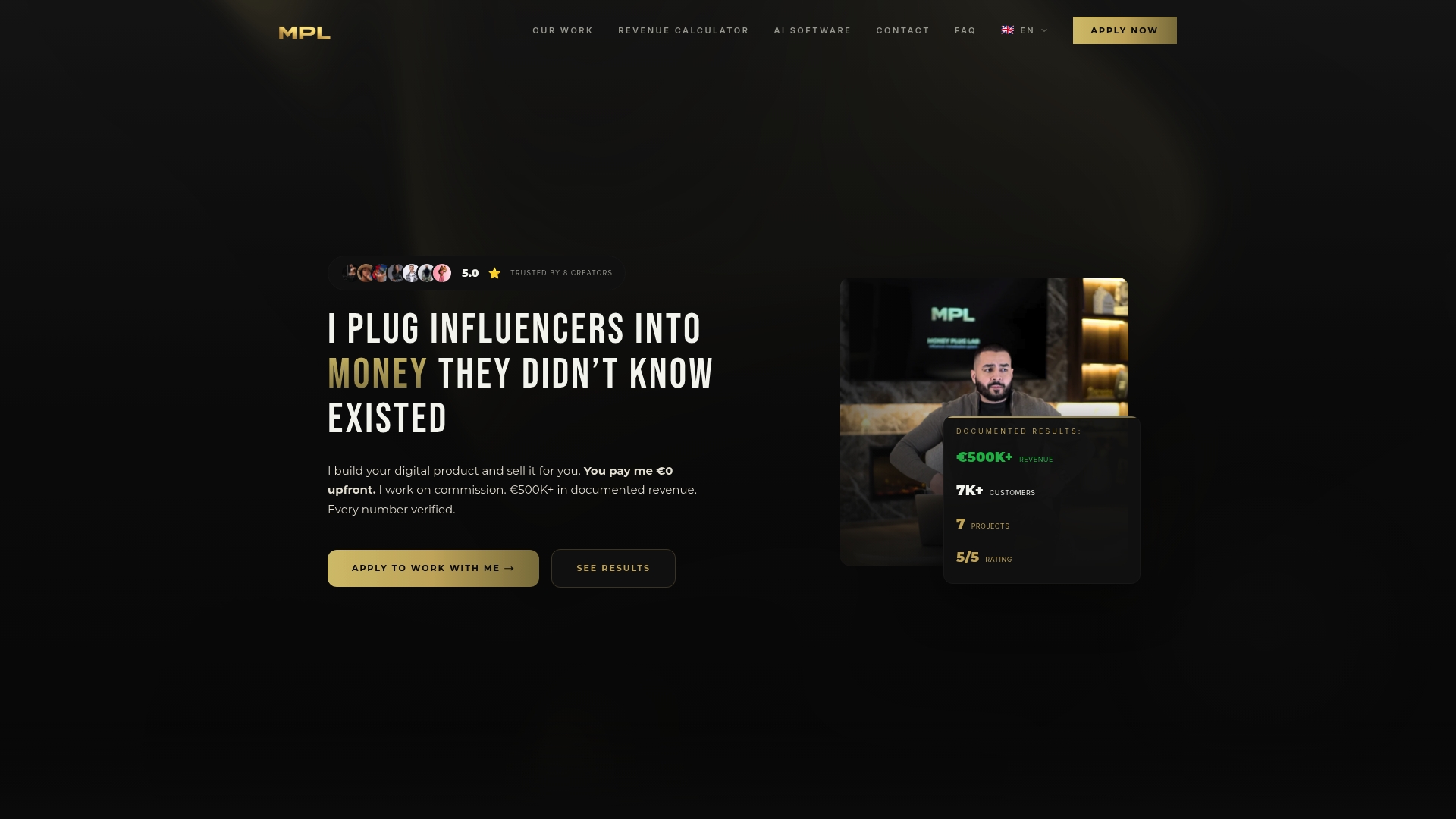
Money-plug works on a pure revenue-share basis, meaning there’s no upfront cost and no retainer. The agency handles everything from audience research and script development to VSL production, landing page setup, paid ad creative, and post-launch optimization. Creators in the Balkans and diaspora have used this system to generate over $500,000 in tracked revenue across seven programs. If you’re ready to turn your audience into a product business, book a call with Money-plug and we’ll map your launch live in the first conversation.
Useful sources and further reading
- What Is a VSL? Video Sales Letter Guide for Affiliate Funnels — Daily Intel Service: Practical breakdown of VSL structure, funnel placement, and measurement for direct-response marketers.
- VSL Script Structure: 6-Part Framework + Examples — Verlua: Beat-by-beat script framework with example lines across SaaS, local service, coaching, and B2B.
- The Beginner’s Guide to Video Sales Letters — HubSpot: Overview of VSL creation, software options, and distribution channels.
- Sales Video Script Template — The Founder Drop: Hook-focused script guidance with pattern-interrupt examples and timing advice.
- VSL Copywriting — Rob Palmer: Practitioner-level guidance on writing for the ear and layering proof types.
- Video Sales Letter Script Template — Shootsta: Word-count and duration benchmarks by use case and offer type.
- Step-by-Step Guide to Building a Video Marketing Strategy — AdRoll: Funnel-mapping framework for video formats tied to business KPIs.
- Money-plug — Creator Monetization Systems and Revenue Engineering: Agency reference for full-stack VSL production and creator launch services on a revenue-share model.