Early Bird Pricing for Creators: Design, Time, and Convert
Early Bird Pricing for Creators: Design, Time, and Convert

Early bird pricing is a time-limited or quantity-capped discount (or bonus) from a real standard price that rewards buyers who commit early. The single best practice: treat it as a short cash-flow and demand-sensing tactic, set a hard cap, and never extend the window. This guide covers how to design the tiers, set the timing, read the metrics, write the copy, and avoid the mistakes that quietly kill launch margins.
Table of Contents
- Why early bird pricing works for digital product launches
- How to design an early-bird offer that protects your margin
- What timing and quota mechanics actually create urgency
- What early-bird sell-through tells you about your launch
- Copy and page elements that move early-bird buyers
- Mistakes that quietly kill early-bird launches
- Your early-bird launch checklist
- Key Takeaways
- What most creators get wrong about early-bird offers
- Money-plug runs early-bird launches so you don’t have to figure it out alone
- Useful sources
Why early bird pricing works for digital product launches
Done right, an early-bird offer does four things at once. It pulls in immediate revenue before you’ve spent heavily on ads. It creates social proof — early enrollments make a program look real and in-demand to the fence-sitters who arrive later. It generates urgency that moves warm leads who would otherwise wait indefinitely. And it gives you the first honest read on whether your price, positioning, and audience size are calibrated correctly.
- Cash flow: Early sales fund ad spend for the standard-price phase without requiring upfront capital.
- Social proof: A visible enrollment count signals credibility to later buyers.
- Urgency: A hard deadline or seat cap forces a decision from people who are already interested.
- Demand signal: Sell-through pace in the first 48–72 hours tells you whether to hold course or adjust messaging and spend before the main launch window.
Pro Tip: Turn early-bird buyers into program ambassadors. Give them a short feedback prompt at enrollment and ask for a one-sentence reaction you can use as social proof in the standard-price phase.
Early-bird pricing should seed momentum, not just fill seats at a discount. When it’s built off a genuine standard price and capped tightly, it funds the launch and validates the market at the same time. Treat extensions as a failure mode, not a safety net.
Money-plug has tracked over $500,000 in creator revenue across seven launched programs, including one campaign that returned 18x on ad spend. The early-bird tier was the first conversion checkpoint in every one of those launches.
How to design an early-bird offer that protects your margin

The core decision is whether to offer a price discount, a bonus deliverable, or both. A straight discount is simpler to communicate and easier for buyers to evaluate instantly. A bonus package (extra module, live Q&A session, a downloadable resource) preserves the headline price and adds perceived value without cutting margin as deeply. For digital programs priced above $200, a bonus-plus-modest-discount combination tends to outperform a deep discount alone because it signals quality rather than clearance.
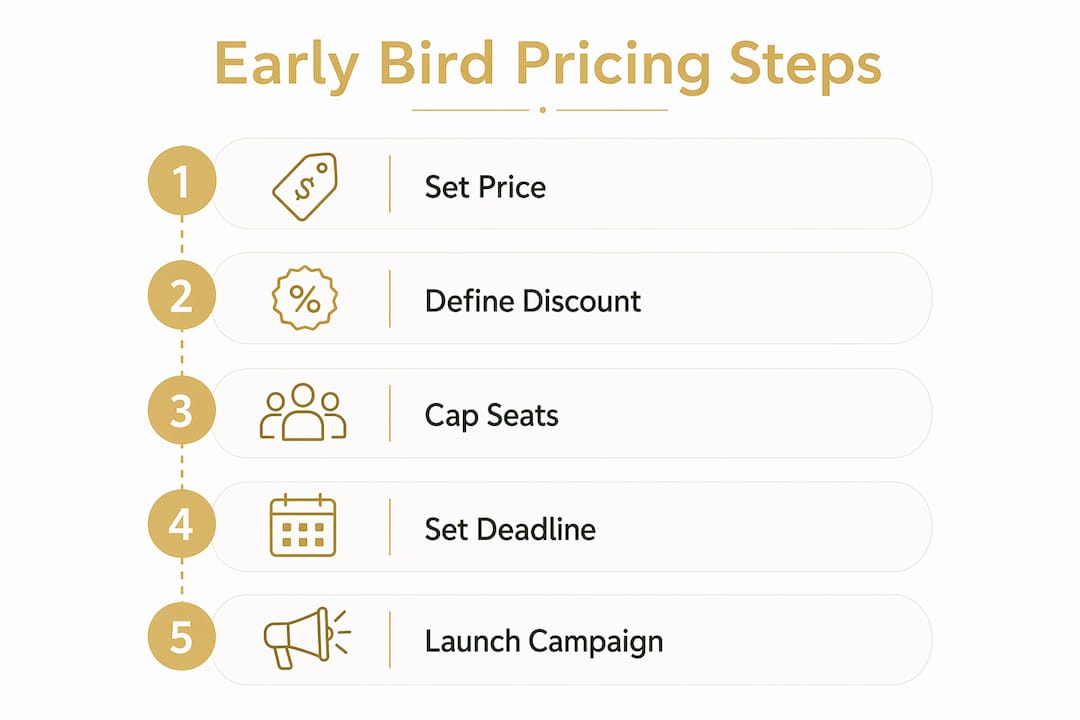
Industry benchmarks place the sweet spot at 20–25% off standard price, within a broader acceptable band of 15–30%. Below 15%, the savings rarely feel worth committing early. Above 30%, you start training buyers to expect deep discounts and you compress margin on your highest-intent customers.
Sample three-tier structure
A typical three-tier early-bird pricing structure divides available seats into proportionate groups with escalating prices: a smaller share at the lowest price to create urgency, a majority at a mid-level discount, and the remainder at full price. This approach balances early revenue with scarcity and margin preservation.
Pro Tip: Cap early-bird seats as a fixed percentage of total enrollment, not as an open pool. “First 20 seats” is a real constraint. “Early-bird pricing available until Friday” with no seat limit is just a sale.
Combining a price discount with extras — VIP access, a bonus module, or a live session — increases perceived value without requiring a deeper cut to the base price.
What timing and quota mechanics actually create urgency
Three cutoff mechanics exist: a hard date, a quantity cap, or a hybrid of both. The hybrid approach is the safest default. “Early-bird closes March 15 or when the first 20 seats fill, whichever comes first” gives you a marketing rhythm regardless of sales pace. If seats sell fast, the quantity cap closes the tier and creates a genuine sellout moment. If sales are slow, the date backstop keeps your promotional calendar intact.
For a typical online course cohort, a 7–14 day early-bird window is sufficient. A multi-week program launch with a larger warm audience can support a two-tier structure over 21–25 days. Evergreen pre-sales work best with a quantity cap alone, since a recurring date deadline loses credibility after the first cycle.
Pro Tip: Schedule your email and SMS outreach to align with the final 48 hours before the cutoff. A “last chance” sequence sent 48 hours out, then 24 hours out, then the morning of close consistently drives a disproportionate share of early-bird conversions. Reserve a visible “sold out” or “tier closed” notification for the moment the cap hits — that signal builds urgency for the next tier.
What early-bird sell-through tells you about your launch
The early-bird tier is the first real-time demand signal in any launch. Watch these metrics in the first 48–72 hours:
- Sell-through rate: Seats sold as a percentage of early-bird inventory. Below 30% in 48 hours means something is off — price, messaging, or audience size.
- Landing page conversion rate: Visitors to enrollments. Under 2% on warm traffic is a red flag.
- Cost per acquisition (CPA): Ad spend divided by enrollments. Compare against your early-bird price to confirm positive margin.
- Average order value (AOV): Relevant if you’re offering upsells or bonus tiers at checkout.
| Sell-Through at 48h | Signal | Recommended Action |
|---|---|---|
| Under 30% | Weak demand or messaging mismatch | Revise headline copy, increase ad spend on warm audiences |
| 30–70% | On track | Hold course, send reminder sequence |
| Over 70% | Strong demand | Pull forward next-tier messaging, consider tightening remaining inventory |
Don’t wait until the early-bird window closes to act. A 48-hour read gives you enough data to adjust ad creative, swap the landing page headline, or shift budget before you’ve burned through your launch spend.
Copy and page elements that move early-bird buyers
Three copy swipes that work for digital program launches:
- Landing page headline: “Enroll now at the founding rate — [X] seats left at $[price].”
- Price callout: “Early-bird price: $[X] (regular price $[Y] after [date]).”
- Scarcity microcopy: “Only [N] spots remain at this rate. After that, the price goes up — no exceptions.”
A tight 72-hour email and SMS sequence for launch day:
- Hour 0 (launch): Announce the offer, state the price, show the standard price, name the deadline and seat cap.
- Hour 24: Share one piece of social proof (early enrollment count, a buyer reaction). Restate the deadline.
- Hour 48: “Last 48 hours” subject line. Emphasize what buyers get, not just what they save.
- Hour 68–70: Final warning. State exact seats remaining if you have that data.
On the page itself: show the standard price crossed out next to the early-bird price, display a live or static seat counter, and link clearly to your refund policy and bonus terms and conditions. Buyers who can’t find the refund policy or can’t tell what the bonus actually includes will abandon at checkout.
Prioritize warm audiences in the first 72 hours. Retargeting and email lists convert at a fraction of the CPA of cold traffic. Hold cold paid traffic until day 3 of the launch at the earliest.
Mistakes that quietly kill early-bird launches
- Inflating the standard price to fake a bigger discount. Buyers notice, and it destroys trust permanently.
- Extending the window when sales are slow. One extension trains every future buyer to wait for the extension.
- Open-ended early-bird pools with no cap. Without scarcity, there’s no urgency — it’s just a permanent discount.
- Over-discounting your most loyal audience. If your warmest buyers always get the deepest cut, you compress lifetime value on the people most likely to buy again.
- Undersizing or oversizing the tier. Too few early-bird seats and you leave cash on the table. Too many and you dilute the standard-price phase.
One sentence on legal hygiene: publish clear refund terms and bonus delivery timelines before launch day — vague or missing policies are the most common source of chargebacks on digital product launches.
Pro Tip: Publish your bonus terms and conditions before you open the cart. State exactly what the bonus is, when it’s delivered, and what happens if a buyer requests a refund after receiving it. Early-bird buyers who feel respected become your loudest advocates.
Your early-bird launch checklist
- Lock your standard price and calculate your early-bird tiers (15–30% discount band).
- Set seat caps for each tier as a percentage of total enrollment.
- Choose your cutoff mechanic: quantity cap, hard date, or hybrid.
- Build the landing page with standard price visible, seat counter, and refund/bonus policy linked.
- Test payment flow end-to-end (Stripe or equivalent) before opening the cart.
- Prepare your email and SMS sequence (launch, 24h, 48h, final warning).
- Set your 48-hour sell-through threshold and define what action you’ll take if you miss it.
- On launch day: send the first email, activate retargeting on warm audiences, monitor sell-through every 12 hours.
- At tier close: send a “sold out” or “tier closed” notification, activate the next tier immediately.
- Post-close: survey early-bird buyers, collect social proof, and use sell-through data to size the next tier.
30-day pre-launch: Complete steps 1–5 by day 20, steps 6–7 by day 28, go live on day 30. 60-day pre-launch: Run a waitlist from day 1–45, open early-bird on day 45, close by day 55, standard price from day 55 to launch.
Key Takeaways
Early bird pricing works when the discount is real, the cap is firm, and the window closes on schedule — treat the sell-through rate in the first 48 hours as your most important launch metric.
| Point | Details |
|---|---|
| Discount off a real price | Set your standard price first; the early-bird rate is 20–25% below it, within the recommended 15–30% band, never inflated. |
| Cap the tier tightly | Size early-bird seats at 15–25% of total enrollment to create genuine scarcity. |
| Enforce the cutoff | Never extend the window; extensions train buyers to wait and erode future urgency. |
| Read sell-through early | Monitor pace at 48 hours and adjust messaging or ad spend before the window closes. |
| Money-plug handles this end-to-end | Money-plug designs pricing tiers, writes launch copy, and manages campaigns on a revenue-share basis with no upfront cost. |
What most creators get wrong about early-bird offers
The conventional wisdom treats early-bird pricing as a simple discount mechanic. Set a lower price, add a deadline, watch sales come in. The reality is messier. The discount is the least important variable. What actually determines whether an early-bird tier works is the relationship between seat cap, audience size, and the warmth of the people you’re reaching first.
A creator with 500 warm email subscribers and 20 early-bird seats will outsell a creator with 5,000 cold followers and 200 early-bird seats almost every time. The MVA rule of thumb for consumer launches — roughly one lead per $25–$40 of revenue goal — exists precisely because audience size and warmth determine whether your tier sells out or sits empty.
The other thing most guides skip: the moment the early-bird tier closes matters as much as the moment it opens. A visible “sold out” notification, sent to everyone who didn’t buy, is one of the highest-converting pieces of copy in a launch sequence. It proves the scarcity was real. That proof is what makes the next tier feel urgent instead of arbitrary.
Money-plug runs early-bird launches so you don’t have to figure it out alone
Money-plug is a creator monetization agency that works on a pure revenue-share basis — no upfront fees, no retainer. For creators ready to launch an online program or paid community, the agency handles every piece of the early-bird launch: pricing architecture, sales copy, email and SMS sequences, video sales letters, payment infrastructure, and paid advertising. The team has generated over $500,000 in tracked creator revenue across seven programs, with one launch closing more than 3,000 sales in ten days. If you want a launch built around real demand data and a pricing structure that protects your margin, book a discovery call at Money-plug to start the conversation.
Useful sources
- Early Bird Pricing: Discounts, Tiers, and Cutoffs — TickPick Organizer: Primary source for discount bands (15–30%), tier sizing by inventory percentage, and cutoff mechanics.
- Early Bird Pricing Guide: Strategy & Best Practices — Engineerica: Detailed breakdown of tier structures, duration guidelines, and the 20–25% sweet spot.
- Product Launch Strategy: The 90-Day Framework — Jay23: Source for warm-audience prioritization in the first 72 hours and MVA audience-sizing rules.
- Product Launch Strategy That Actually Drives Revenue — Alex Berman: Agency expert argument for time-limited early-adopter offers over permanent price reductions.
- Early Bird Pricing Strategy: Boost Ticket Sales & Turnout — Eventgroove: Examples of combining discounts with VIP access and bonus bundles to increase perceived value.
- Pre-Launch & Launch Strategies — AI Author Skool: Operational checklist items including payment testing, FAQ sheets, and refund policy setup.