High Ticket Coaching Funnel: Map 5 Stages for Creators
High Ticket Coaching Funnel: Map 5 Stages for Creators

A high ticket coaching funnel turns a clear, outcome focused offer into qualified sales conversations by combining an education led front end with a qualification first sales process. The highest leverage first step is nailing down your exact outcome promise and your ideal client profile before you touch a single landing page. Everything else in this guide, from architecture to traffic to follow up, builds on that foundation.
TL;DR:
- Use webinars for explainable offers in the low to mid five figures, calls for bespoke coaching, and paid entry offers for cold audiences.
- Write a promise that names the result, timeframe, and proof, then price for the transformation and use one payment plan instead of discounting.
- Webinar leads cost $75 to $150 at the top of the funnel; well optimized events turn 25% to 35% of attendees into sales qualified leads.
- Qualify leads on budget, timeline, and current situation, then send an immediate confirmation and same day reminder; long booking delays contribute to no shows.
- Track cost per lead, booking rate, show rate, close rate, and revenue per lead weekly; review lifetime value and return on ad spend monthly.
Table of Contents
- One-Glance Funnel Roadmap: Stages, Outcomes, and Metrics
- Design the Premium Coaching Offer: Promise, Packaging, and Pricing
- Pick the Funnel Architecture That Fits Your Offer
- Tactical Build: Landing Pages, VSLs, Sales Pages, and Checkout
- Where to Get Qualified Traffic and How to Run a Launch Cadence
- Follow-Up and Qualification Playbook: Converting Leads Into Booked Calls
- KPIs, A/B Tests, and the Optimization Cadence for Sustainable Scaling
- Money Plug Lab Proof Points and How Managed Support Maps to the Funnel
- Editorial Perspective: Priorities and Common Launch Pitfalls
- How Money Plug Lab’s PlugReach Can Help You Launch
- FAQ
- Sources
One-Glance Funnel Roadmap: Stages, Outcomes, and Metrics
A high ticket coaching funnel moves a stranger through five distinct stages, and each one has a different job. Confusing those jobs is why most funnels underperform: coaches try to sell on a landing page meant for attraction, or they qualify on a call meant for closing.
Here is the shape the funnel should take:
- Attract: get the right people (not just more people) into your world through content, ads, or partnerships.
- Qualify: filter for fit and intent using a form, quiz, or application before anyone talks to a human.
- Close: run the actual sales conversation, usually a call, that converts a qualified lead into a paying client.
- Deliver: onboard and coach the client so the result promised in your marketing actually happens.
- Retain: extend, upsell, or get referrals from clients who got results.
Each stage needs its own metric, not a single blended number that hides where the leak is:
| Stage | Primary goal | Metric to watch |
|---|---|---|
| Attract | Cost-efficient reach to the right audience | Cost per lead (CPL) |
| Qualify | Filter for genuine fit and buying intent | Lead-to-call booking rate |
| Close | Convert the conversation into a sale | Show rate and close rate |
| Deliver | Produce the promised transformation | Completion rate, client satisfaction |
| Retain | Extend lifetime value | Lifetime value (LTV), renewal rate |
Channel choice shifts by stage too. Attraction typically runs on paid social, organic content, SEO, or creator partnerships. Qualification lives on your landing page, application form, or a short quiz. Closing happens on a call, sometimes preceded by a webinar or video sales letter. Delivery runs through whatever platform hosts your coaching, and retention depends on email, community, or a dedicated client success touchpoint.
The mistake to avoid here is optimizing one stage in isolation. A funnel with a brilliant ad campaign and a weak qualification step just produces more unqualified calls, not more sales. Map your weakest stage first, then fix that one before investing further upstream.
Design the Premium Coaching Offer: Promise, Packaging, and Pricing
Before any funnel architecture or ad spend matters, your offer has to earn a high ticket price. That means a specific transformation promise, packaging that matches how people actually want to buy, and pricing that signals value instead of apologizing for it.
Start with the promise. A strong transformation promise names the result, the timeframe, and some form of proof. “Lose weight” is not a promise. “Drop two clothing sizes in 12 weeks without giving up your current diet” is closer, assuming you can back it with a track record. The clearer and more specific the promise, the easier it becomes to justify a premium price, because the buyer can picture exactly what they are paying for.
Pricing itself should reflect the depth of transformation and the level of access, not just market averages. A few practical guidelines:
- Anchor to outcome, not time: price based on the value of the result, not the number of hours you spend.
- Offer one payment plan, not five: a single clean split (often two or three installments) preserves perceived value better than a menu of options.
- Avoid discounting the core price: add bonuses or extended support instead of cutting the number itself.
- Test price increases before you test price decreases: many coaches underprice relative to what their audience will pay.
Packaging decisions follow from your delivery capacity and your promise. One-on-one coaching suits highly bespoke outcomes where personalization drives results, and it commands the highest per-client price. Small cohort models (6 to 15 people) let you charge a meaningful price while sharing your time across several clients, and they add peer accountability that many buyers value. Hybrid models, where group curriculum is paired with limited one-on-one touchpoints, often give you the best of both: scalable delivery with enough personalization to justify a premium.
Pro Tip: Write your transformation promise as a single sentence a client could repeat back to a friend. If it takes a paragraph to explain, it is not sharp enough yet.
Your ideal client profile has to be concrete enough to filter leads, not just a vague persona. Useful traits to define before you build any funnel asset:
- Budget reality: can this person pay your price without a hardship conversation?
- Urgency: do they have a problem that is costing them something right now?
- Prior investment: have they paid for coaching, courses, or tools before, showing they believe in paid solutions?
- Decision authority: can they say yes without needing approval from someone else?
Skipping this step is the single most common reason coaches end up on calls with people who were never going to buy. The offer and the ICP define everything downstream, including which funnel architecture actually fits.
Pick the Funnel Architecture That Fits Your Offer
Not every high ticket offer needs the same funnel shape. The right architecture depends on your price point, how bespoke your delivery is, and how big (or cold) your audience currently is.
- Webinar led funnels work well when your offer can be explained and sold through a structured presentation. A webinar builds authority, handles objections at scale, and pre-sells the offer before a call ever happens, which shortens the sales conversation that follows. This architecture suits offers in the low to mid five figures where the buying decision benefits from education.
- Call first (sales call) funnels are superior for highly bespoke, high ticket offers where the price or the delivery varies by client. If your coaching requires understanding someone’s specific situation before you can even describe how you would help them, skip the webinar and go straight to a qualified application and call. This is the standard architecture for premium one-on-one coaching.
- Group or cohort funnels work when your offer is standardized and delivered to a cohort rather than customized per client. These funnels often use a webinar or challenge as the front end, then move straight to enrollment rather than a one-on-one call, because the offer does not change person to person.
- Micro-commitment and tripwire funnels warm up cold audiences by asking for a small, low-risk action first, like a paid workshop or a low-cost guide, before ever presenting the high ticket offer. This architecture suits coaches without an existing warm audience, since it builds trust and buyer intent before asking for a bigger decision.
A simple decision checklist: if your offer is standardized and your audience is already warm, a webinar or cohort funnel is usually fastest. If your offer is bespoke and expensive, go call first. If your audience is cold and your brand is new, start with a micro-commitment step before attempting either of the above.
Tactical Build: Landing Pages, VSLs, Sales Pages, and Checkout
Once you know your offer and architecture, the asset build determines whether traffic actually converts. Each piece has a specific job, and getting the priorities wrong inside each asset wastes the traffic you are paying for.
Your landing page exists to do one thing: get the visitor to take the next qualifying action, whether that is booking a call, registering for a webinar, or filling out an application. The hero section should state the outcome promise in plain language within the first few seconds of scroll, and the form or button should be visible without excessive scrolling. Every element that does not support that single action is a distraction.
If your architecture uses a video sales letter or a live webinar, the script needs a predictable structure: open with a hook tied to the pain point, establish credibility briefly, teach a genuine insight that shifts how the viewer sees their problem, then transition into the offer with a clear call to action. Webinars built this way typically run 45 to 75 minutes, long enough to build trust and handle objections without losing the room.
Your sales page, if you use one before a call, should reduce friction rather than oversell. For high ticket buyers, that means:
- Clear pricing or pricing range: ambiguity about cost filters out serious buyers before they waste your time.
- Specific proof: named results or concrete before-and-after descriptions beat vague testimonials.
- An explicit next step: one button, one action, not three competing calls to action.
- FAQ section addressing hesitation: payment plans, time commitment, and refund policy answered before they are asked.
Pro Tip: Put your calendar booking link directly on the sales page instead of routing through an extra confirmation page. Every added click between interest and booking costs you leads.
Checkout and calendar flow matter more than most coaches expect. If you are selling via application and call, the calendar tool should only release open slots after the application is submitted, keeping your time protected from unqualified bookings. If you are selling directly without a call, the checkout should support your chosen payment plan natively and confirm the purchase immediately, without redirect delays that create doubt.
Tracking has to be set up before launch, not after. At minimum, install a pixel for whichever ad platform you are using, apply consistent UTM parameters across every link so you know which channel and campaign produced each lead, and define conversion events for each funnel stage (lead capture, call booked, call attended, sale closed). Without this, you cannot calculate CPL, lead-to-call rate, or close rate accurately, and every optimization decision downstream becomes a guess.
Where to Get Qualified Traffic and How to Run a Launch Cadence

Traffic quality matters more than traffic volume in a high ticket funnel, since a single sale often covers the cost of dozens of unqualified leads. Channel choice should reflect where your ideal client already pays attention and how much friction that channel requires before a conversation can happen.
Paid social tends to produce fast volume at a moderate cost, and email marketing typically delivers some of the lowest cost per lead when paired with an existing list and automated nurture, often in the range of $25 to $75 per lead early in a sequence. Webinars generate higher quality prospects but carry a higher acquisition cost, typically $75 to $150 per lead and $250 to $500 as leads move closer to a booked call, with well optimized webinars converting 25% to 35% of attendees into sales qualified leads.
| Channel | Typical CPL range | Lead quality |
|---|---|---|
| Email marketing (existing list) | $25 to $75 | High, with strong nurture |
| Webinar (top of funnel) | $75 to $150 | Moderate to high |
| Webinar (near demo/call stage) | $250 to $500 | High |
| Creator partnerships | Reduced about 30% vs. paid ads | High, trust-driven |
Creator partnerships can significantly cut cost per lead compared to cold paid acquisition, because the audience already trusts the creator making the introduction. This is particularly useful for coaches entering a new niche or market where they have no existing reputation.
Launch cadence depends on your architecture. A few patterns:
- Live cohort launches: run a defined enrollment window (often 1 to 2 weeks) with a hard close date, which creates urgency and concentrates your marketing push into a short, intense period.
- Webinar series: run the same webinar on a weekly or biweekly schedule, letting you test and refine the pitch while building a predictable lead flow.
- Evergreen funnels: automate the webinar or VSL to run continuously, trading launch intensity for steady, lower-maintenance lead flow once the funnel is proven.
Whichever cadence you choose, mixing upper-funnel awareness content with lower-funnel direct offers consistently outperforms relying on bottom-funnel tactics alone. Full-funnel strategies achieve roughly six times higher conversion rates and cut the time to convert a lead into a sales meeting nearly in half compared to bottom-funnel-only approaches, which is a strong argument for pairing paid ads with organic content and partnerships rather than betting on one channel alone.
Follow-Up and Qualification Playbook: Converting Leads Into Booked Calls
What happens in the minutes and days after someone becomes a lead often determines whether your funnel converts at all. A lead that sits untouched for even an hour cools fast, and a lead with no clear qualification step turns into wasted calls.
- Trigger an immediate automated sequence the moment someone opts in: a confirmation email within minutes, a text message if you collect phone numbers, and a CRM task alerting your team to a new lead.
- Score the lead using a short set of qualification questions on the opt-in form itself, covering budget range, timeline, and current situation, so you can route high-fit leads differently from low-fit ones.
- Send pre-call assets before the scheduled conversation, such as a short video explaining what to expect, a case study relevant to their situation, or a simple worksheet that gets them thinking about their goals ahead of time.
- Follow up again close to the call time with a reminder that reinforces the value of showing up, since no-shows are one of the most common leaks in a call-first funnel.
Pro Tip: Ask one qualification question that only a serious buyer would bother answering thoughtfully, like “what have you already tried to solve this?” The quality of the answer tells you more than the answer itself.
If your show rate is low, the fix is rarely a better closer, it is usually a weaker qualification step or a gap between booking and the call date that is too long. Tightening that gap and adding a same-day reminder is often the fastest lever available.
Close rates depend heavily on how qualified the lead was before the call even happened, which is why the automated sequence and scoring questions above matter as much as anything your closer says live. A two-track approach, automated nurture for everyone plus direct outreach for your highest-scoring leads, tends to improve both show rate and close rate while keeping overall cost per lead manageable, since your team’s time is concentrated where it matters most.
KPIs, A/B Tests, and the Optimization Cadence for Sustainable Scaling
A high ticket funnel only improves when you measure the right numbers and test the right variables, in that order. Reporting on vanity metrics like impressions or click-through rate without tracking revenue per lead gives you activity without insight.
The KPIs worth reviewing weekly are the ones tied directly to revenue: cost per lead, lead-to-call booking rate, show rate, close rate, and revenue per lead generated. Monthly, add lifetime value and return on ad spend, since those numbers take longer to stabilize but tell you whether the funnel is actually profitable once delivery costs and client retention are factored in.
High impact tests to run first, roughly in order of expected payoff:
- Headline and hook variations on your landing page or ad, since this is the first filter a visitor applies.
- Call to action wording and placement, testing direct asks (“Book your call”) against softer framing (“See if this fits”).
- Webinar or VSL length, since a shorter version sometimes converts better once your pitch is tight enough to not need extra runtime.
- Price presentation, testing whether showing the price upfront versus revealing it on the call changes lead quality and close rate.
Scaling ad budgets should follow stability, not enthusiasm. A common rule is to only increase spend on a channel once it has produced a consistent close rate across enough calls to trust the number, rather than scaling off a single strong week. Cutting a channel too early, before it has had a fair sample, is just as costly as scaling a channel too aggressively on thin data.
Aligning sales and marketing around a single always-on, full-funnel program is one of the clearest levers for improving conversion performance, according to HubSpot and LinkedIn benchmarking research, which found that full-funnel strategies cut the time to convert a lead into a sales meeting from roughly 46 days to 25 days. For a coaching funnel, that translates into shorter gaps between first contact and a booked call, which compounds across every stage downstream.
Money Plug Lab Proof Points and How Managed Support Maps to the Funnel
Running every stage of this funnel well, offer design, asset build, traffic, qualification, and optimization, takes real bandwidth, which is why some coaches choose a managed partner instead of building alone.
A digital creator monetization agency can partner with content creators to build, launch, and scale digital products across niches such as fitness, coaching, wellness, beauty, and food communities. This type of model may run on pure revenue share with zero upfront cost to the creator, covering audience research, product architecture, pricing strategy, sales copy, launch campaigns, payment infrastructure, and paid advertising managed by a dedicated team.
A fully managed, specialized execution team can produce results when offer, funnel, and traffic are built to work together from day one rather than assembled piecemeal.
Deciding whether to build this yourself or bring in managed support comes down to a few honest questions:
- Do you have the time to build and test every funnel asset while also delivering client coaching?
- Have you run paid ads before, and do you know how to read CPL and ROAS without guessing?
- Is your offer and pricing already validated, or still unclear?
- Would a revenue-share model, with no upfront cost, reduce your financial risk during launch?
Coaches who answer “no” to the first two and “yes” to the last two are typically the best fit for a managed partner rather than a solo build.
Editorial Perspective: Priorities and Common Launch Pitfalls
The biggest mistake we see in early high ticket launches is overcomplicating the offer before it has even been tested once. Coaches add bonuses, tiers, and payment options to a product that has never closed a single sale, when the real fix is usually a sharper promise and a tighter ICP, not more packaging.

The second mistake is skipping qualification entirely because it feels like it slows down momentum. It does the opposite: an unqualified call wastes thirty to sixty minutes that a tighter form or application question would have saved, and it demoralizes a new coach far faster than a slower lead flow would.
The third, and most underestimated, is weak follow-up. Most of the revenue sitting in a coach’s funnel is not in the next ad campaign, it is in the leads who already raised their hand and were never followed up with properly. A short, honest corrective checklist: tighten your one-sentence promise, add one real qualification question to every opt-in, and build a same-day follow-up sequence before you spend another dollar on traffic.
— Money
How Money Plug Lab’s PlugReach Can Help You Launch
We built PlugReach around a simple idea: creators should not need to front cash or master paid advertising to launch a high ticket coaching offer that actually sells. Our revenue-share model means we only get paid when your launch does, which removes the upfront risk that keeps a lot of good coaches from ever building the funnel their offer deserves.
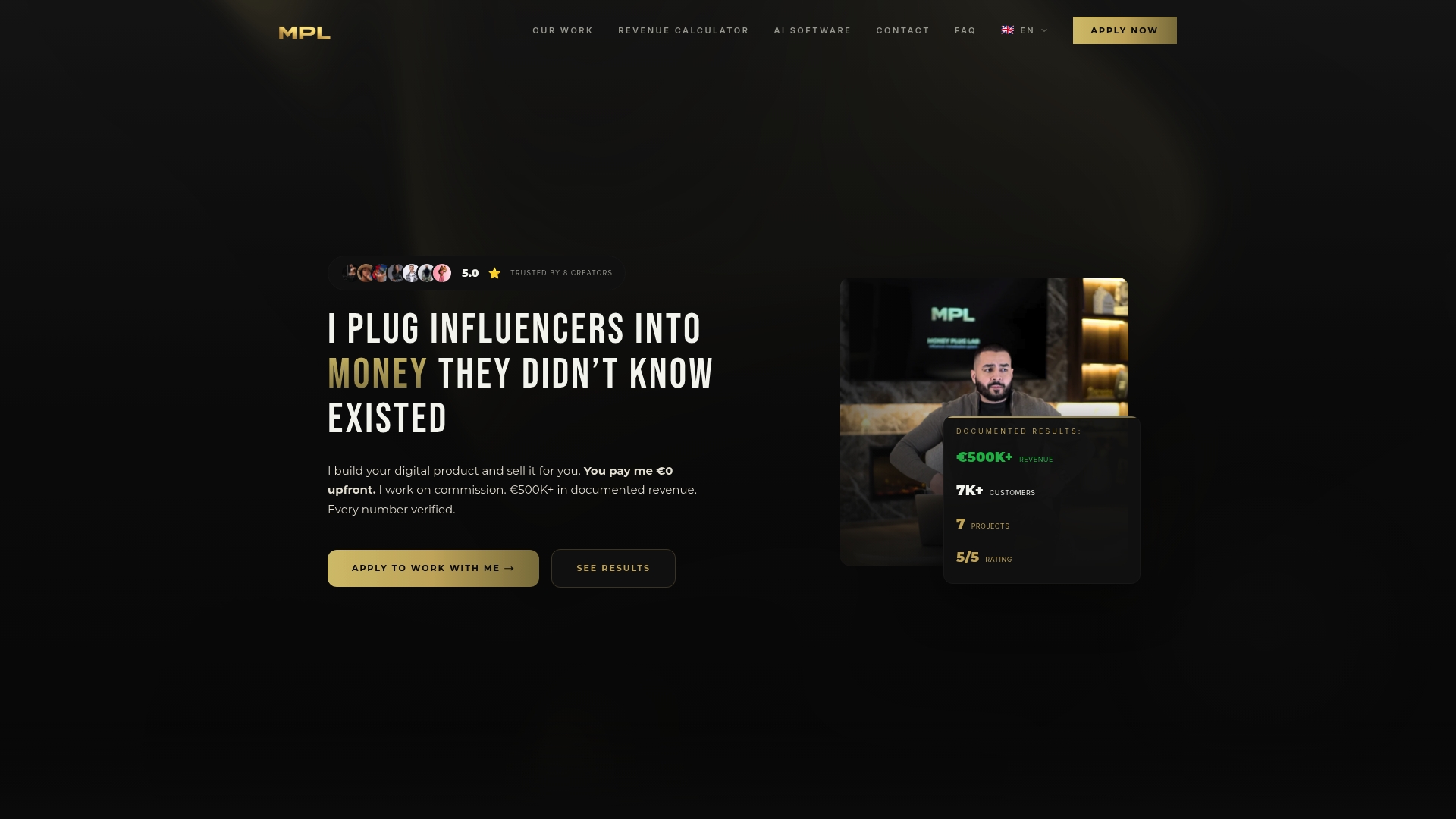
From there, we handle the parts most coaches dread: audience research, offer architecture, sales copy, video sales letters, payment infrastructure, and the paid advertising that drives qualified traffic into your funnel. You keep coaching your clients while we build and run the system that brings them to you.
If you want to see whether your offer and audience are ready for a managed launch, you can explore digital product monetization services offered by a creator monetization agency and request an exploration call to talk through what a launch could look like for you.
FAQ
What is the 70/30 rule in coaching?
There is no single standardized “70/30 rule” recognized across the coaching industry, and definitions vary depending on who is teaching it.
What are the 5 stages of the sales funnel?
The five stages commonly used in a high ticket coaching funnel are attract, qualify, close, deliver, and retain, each with its own goal and metric. Attraction brings in the right audience, qualification filters for fit, closing converts the conversation into a sale, delivery produces the result, and retention extends the relationship.
Does high ticket affiliate marketing really work?
High ticket affiliate marketing can work, but it depends heavily on audience trust and the quality of the offer being promoted, not on the commission size alone. It operates on different mechanics than a coaching funnel, since the affiliate is not responsible for delivery or client results, only for driving a qualified introduction.
How do I actually get into high ticket sales?
Getting into high ticket sales starts with developing a specific, provable transformation promise and learning to run a qualification-first sales conversation rather than a generic pitch. Many coaches build this skill by running their own funnel first, using the qualification and follow-up sequence described above, before ever selling on behalf of someone else.