Hyros vs Triple Whale: Which Fits Creator Launches?
Hyros vs Triple Whale: Which Fits Creator Launches?

Pick Triple Whale for Shopify-first DTC creator stores. Pick Hyros for high-ticket, multi-step funnels with phone calls, email nurtures, and CRM handoffs. The deciding factor is funnel architecture, not channel mix. If your creator client sells a low-cost fitness program through a Shopify checkout with direct Meta-to-purchase funnels, Triple Whale installs in hours and surfaces daily P&L immediately. If they sell a high-priced coaching program through a ClickFunnels opt-in, a call with a sales rep, and a Kajabi checkout, Hyros is the only tool that stitches that journey together. For agencies managing both types, the right call is to pilot each tool against the funnel it was built for rather than forcing one platform across every client.
Table of Contents
- Hyros vs Triple Whale: side-by-side comparison for creator agencies
- How the attribution models actually differ for creator funnels
- Setup complexity and operational load for agencies
- What each platform actually connects to in practice
- Reporting and dashboards: what your team will actually use daily
- Which tool fits each creator business model
- Agency implementation checklist for creator client pilots
- Pricing expectations and ROI framing
- Common mistakes and guardrails
- How Hyros and Triple Whale handle customer support
- Data privacy and compliance differences
- Scalability under heavy data loads
- User interface and ease of use for non-technical team members
- Real-world outcomes: what agencies report with each platform
- Money-plug handles the attribution pilot so your creator can focus on the launch
- Key Takeaways
Hyros vs Triple Whale: side-by-side comparison for creator agencies
| Dimension | Hyros | Triple Whale |
|---|---|---|
| Best for | High-ticket coaching, multi-checkout funnels, CRM/phone sales | Shopify DTC, low-to-mid ticket products, fast creative testing |
| Attribution model | Individual lead-level multi-touch, identity stitching | Blended ROAS, cohort metrics, Triple Pixel server-side |
| Setup complexity | High (several days, developer + analytics lead required) | Low-to-medium (Shopify app install, hours to live) |
| Integrations | ClickFunnels, Kajabi, HubSpot, Keap, call tracking, ESPs | Shopify-native, Klaviyo, 30+ marketing platforms |
| Dashboards / P&L | Analyst-grade MTA outputs, journey maps | Operator-first: daily P&L, Creative Cockpit, Moby AI |
| Pricing model | Custom/revenue-based; reported entry around $230–$500/mo+ | GMV-tiered; entry from $129/mo, scales with revenue |
| Operator-friendliness | Analyst-focused; steeper learning curve | Founder and media buyer-friendly out of the box |
| Reconciliation fit | Strong for multi-step, multi-platform revenue | Strong for Shopify order-level reconciliation |
| Support / docs | Dedicated onboarding, video tutorials, documentation | Community support, practical guides, vendor onboarding |
Once you confirm which funnel type a creator client runs, stop evaluating the other platform. Both tools produce modeled estimates, not accounting-grade figures. Use them for media and creative decisions only.
Neither Hyros nor Triple Whale replaces your bookkeeper. Both use server-side capture and probabilistic matching to recover post-iOS signal. Neither fully restores pre-iOS deterministic certainty. Wrong data at scale is worse than no data — set that expectation with every creator client before you install anything.
How the attribution models actually differ for creator funnels
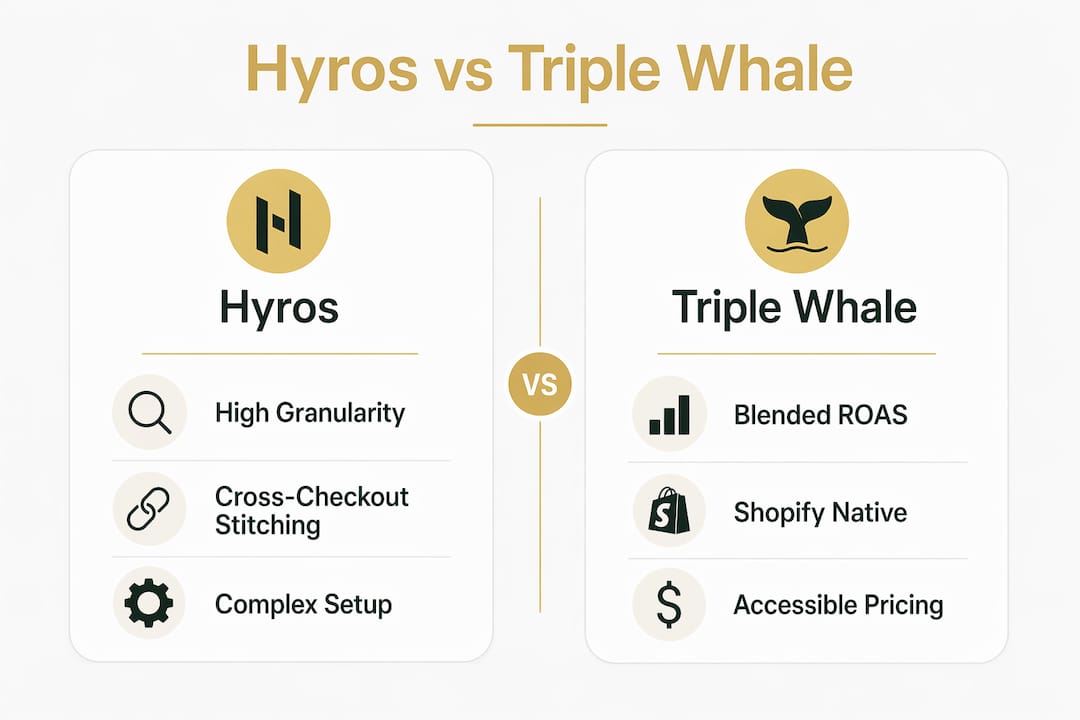
The most important difference is data granularity. Hyros tracks individual leads across every touchpoint, linking identities across calls, emails, and multiple checkouts using first-party scripts and AI matching. For a coaching funnel where a lead clicks a YouTube ad, downloads a PDF, joins a webinar, books a call, and pays three weeks later, Hyros connects all of those dots to the original ad. Triple Whale cannot do that.
Triple Whale’s approach centers on blended ROAS and cohort-level metrics via its Triple Pixel server-side tracking. That model is exactly right for a Shopify DTC creator selling a $97 course: the ad-to-checkout path is short, the data volume is high, and Creative Cockpit gives the media buyer a fast read on which ad creative is pulling. Speed and operator clarity are the product.
Pro Tip: Set your canonical media-decision metric before you install either tool. For Shopify DTC clients, use blended ROAS and cost-per-purchase by creative cohort. For high-ticket clients, use cost-per-qualified-call and cost-per-closed-deal attributed back to the originating ad. Neither metric reconciles to your books, and that is fine.
Attribution outputs depend on UTM hygiene, server-side event capture quality, and how long the tool has been installed. Both platforms start tracking from install date only, so historical data gaps are normal. Build that caveat into your client reporting from day one.
Setup complexity and operational load for agencies
Hyros is higher-touch and slower to validate. Triple Whale is faster for Shopify-first clients.
Pre-install checklist for any creator client:
- Map every channel driving paid traffic (Meta, Google, TikTok, YouTube).
- Confirm checkout type: Shopify native, ClickFunnels, Kajabi, WooCommerce, or custom.
- List all off-Shopify revenue streams (calls, upsells, affiliate programs).
- Audit UTM hygiene across every active campaign.
- Identify CRM and ESP integrations needed (HubSpot, Keap, Klaviyo, ConvertKit).
| Platform | Typical time to live | Required roles |
|---|---|---|
| Hyros | 3–4 weeks | Developer, analytics lead, paid-media operator |
| Triple Whale | Hours to 1 day | Paid-media operator (developer optional) |
Triple Whale’s GMV-based billing can trigger mid-contract price increases when a creator’s revenue crosses a band threshold. Interrogate those triggers before signing. Hyros uses custom/revenue-based pricing, so negotiate scope and scale terms upfront, especially for creators with seasonal launch spikes.
What each platform actually connects to in practice
Triple Whale is Shopify-native with deep Shopify and Klaviyo support. Hyros is platform-agnostic with stronger CRM, call tracking, and ESP integrations.
Integration checklist before committing to either platform:
- Store type: Shopify, WooCommerce, ClickFunnels, Kajabi, or custom
- Multi-checkout footprint: does the creator sell across more than one platform?
- CRM: HubSpot, Keap, or custom CRM for lead management
- ESP: Klaviyo, ConvertKit, ActiveCampaign
- Phone/call tracking: required for coaching and consultative sales funnels
- Ad platforms: Google Ads, Meta, TikTok (both tools cover these)
- Server-side endpoints: confirm pixel firing for each checkout type
- Affiliate programs and payment processors: Stripe, PayPal, ThriveCart
Hyros handles cross-checkout identity stitching that Shopify-native tools cannot match when a creator’s funnel spans ClickFunnels, Kajabi, and a phone close. Triple Whale connects to 30+ marketing platforms but is most reliable when the entire revenue flow runs through Shopify. If a creator uses multiple checkouts, confirm Hyros compatibility with each one before the pilot starts.
Reporting and dashboards: what your team will actually use daily
Triple Whale is operator-first. Hyros is analyst-focused.
Day-to-day features to verify before onboarding:
- Creative-level reporting (ad-level ROAS, thumb-stop rate, hook rate)
- LTV cohorts and repeat purchase tracking
- Profit reporting including COGS and shipping
- Daily P&L summary
- Call and email attribution
- Multi-touch attribution outputs and journey maps
Triple Whale’s Creative Cockpit and Moby AI give a paid-media lead fast answers on which ad creative is working. A media buyer can open the dashboard at 8 AM and make budget decisions before the first call of the day. Hyros requires an analytics lead to interpret multi-touch journey outputs, but those outputs are far more useful when a creator’s sales cycle runs two to four weeks.
Expect 2–4 weeks of data before either tool’s attribution signals stabilize enough to act on. Support quality differs: Hyros provides dedicated onboarding and video tutorials; Triple Whale leans on community resources and practical guides. For agencies onboarding multiple creator clients simultaneously, Hyros’ dedicated support reduces troubleshooting time during the critical first weeks.

Which tool fits each creator business model
Quick mapping for agency intake:
- Shopify DTC creator (physical or digital products, direct checkout): Triple Whale. Fast install, daily P&L, creative analytics built for high-volume launches.
- Low-ticket info product ($27–$197, high volume, Shopify or ThriveCart): Triple Whale, especially for brands spending under $20k/month on ads.
- High-ticket coaching ($1,000+, call-close, multi-step funnel): Hyros. Individual lead tracking and CRM/phone attribution are non-negotiable here.
- Subscription or paid community (recurring billing, mixed acquisition): Hyros if acquisition runs through a consultative funnel; Triple Whale if it runs through a Shopify checkout.
For hybrid cases where a creator sells both a low-ticket Shopify product and a high-ticket coaching program, run a dual pilot for 30–60 days. Let the majority revenue stream determine the primary platform. Forcing Triple Whale into a multi-checkout coaching funnel produces incomplete attribution data. Forcing Hyros onto a pure Shopify DTC store adds cost and complexity where blended cohort metrics would be sufficient.
Agency implementation checklist for creator client pilots
Use a 30–60 day pilot with pre-defined hypothesis tests before committing to full rollout.
- Discovery and mapping: complete the pre-install checklist above; confirm funnel architecture and checkout types.
- Install and smoke tests: deploy pixel or scripts, verify event firing for every conversion point, confirm UTM parameters are passing correctly.
- Holdout or creative split test design: define a control group or creative split to validate that attribution signals match actual revenue changes.
- Reconciliation checks at day 14: compare attributed revenue to Shopify or CRM records; flag gaps above 15% for investigation.
- Roll-to-scale criteria: if modeled attribution aligns with known revenue trends and creative signals match media buyer intuition, expand to full account.
Roles matrix:
- Developer: pixel/script install and server-side endpoint setup
- Analytics lead: event validation, reconciliation checks, MTA interpretation (Hyros)
- Paid-media operator: daily dashboard review, creative decisions, budget shifts
- Account lead: client reporting, expectation setting, pilot sign-off
Money-plug runs this exact pilot framework for creator clients, handling funnel mapping, tracking implementation, and paid ad post-production under a revenue-share model with no upfront cost.
Pricing expectations and ROI framing
Hyros’ custom pricing makes sense when precise attribution changes five-figure media allocations. If a creator is spending $30,000 per month on ads and misattributing 20% of conversions to the wrong channel, the cost of Hyros pays for itself in one corrected budget decision. At lower spend levels, the math rarely works.
Triple Whale’s GMV-tiered model is accessible early. An entry plan at $129/month suits a creator doing under $1M in annual revenue. As GMV grows, so does the bill, and high-volume, lower-margin creators can find the scaling costs uncomfortable. Calculate the GMV band triggers before signing any annual contract.
Common mistakes and guardrails
The most damaging mistake is treating attribution outputs as accounting truth. Both platforms produce modeled estimates. Reconciling them to Shopify revenue or bank statements will always show gaps, because both tools start tracking from install date and rely on probabilistic matching.
Three guardrails every agency should enforce:
- Never shift a creator’s entire media budget based on a single week of attribution data from a new install.
- Never use either tool’s revenue figures in creator financial reporting or tax preparation.
- Never force a Shopify-native tool into a multi-checkout funnel and expect clean data.
How Hyros and Triple Whale handle customer support
Hyros provides dedicated onboarding, comprehensive documentation, and video tutorials. For agencies managing complex high-ticket funnels, that structured onboarding matters. Expect a more involved buying process and a longer ramp before the platform delivers reliable signals.
Triple Whale emphasizes community support and self-serve guides. For Shopify-first teams, the install is simple enough that community resources usually suffice. Vendor onboarding is lighter, which is fine when the tool is live in hours rather than days.
Data privacy and compliance differences
Both platforms use server-side tracking to reduce dependence on browser cookies and recover signal lost to iOS privacy changes. Hyros uses first-party scripts deployed on the creator’s domain. Triple Whale’s Triple Pixel operates server-side via Shopify’s infrastructure. Neither approach eliminates privacy compliance obligations. Agencies operating creator campaigns targeting EU audiences must confirm GDPR-compliant data handling with each vendor directly, regardless of which platform they choose.
Scalability under heavy data loads
Triple Whale is built to handle Shopify-scale transaction volumes and processes a significant share of Shopify sales during peak periods. For a creator running a launch that generates thousands of orders in 10 days, the infrastructure holds. Hyros scales differently: its strength is identity resolution across long funnels, not raw transaction throughput. For high-volume Shopify launches, Triple Whale’s architecture is the better fit. For complex multi-step funnels with lower transaction volume but higher deal values, Hyros handles the load without issue.
User interface and ease of use for non-technical team members
Triple Whale wins on accessibility. A creator’s in-house social media manager can open the dashboard and read yesterday’s numbers without training. Hyros requires more context to interpret correctly. Multi-touch journey maps and identity-stitched attribution outputs are powerful, but they need an analytics-literate person to act on them. For agencies with lean teams, that distinction shapes which tool you can actually hand off to a client versus which one you need to own internally.
Real-world outcomes: what agencies report with each platform
Operators using Triple Whale consistently cite fast time-to-value and the Creative Cockpit as the features that change daily decisions. Media buyers report catching underperforming ad creatives faster and reallocating budgets with more confidence. The daily P&L view is particularly useful during live launches when a creator needs real-time read on profitability.
Hyros users highlight attribution accuracy on long-cycle coaching funnels as the primary value. Knowing which YouTube ad or email sequence closed a $5,000 coaching client three weeks after first contact changes how agencies allocate budget across channels. The cross-channel identity stitching is the feature that justifies the higher cost and setup time for high-ticket creator businesses.
Money-plug handles the attribution pilot so your creator can focus on the launch
Choosing between these platforms is only one part of the problem. Running the pilot, validating the data, and translating modeled attribution signals into actual media decisions takes time most creator teams do not have during a live launch. Money-plug manages the full process: funnel architecture, tracking implementation, paid ad post-production, and launch campaign management, all on a revenue-share basis with no upfront cost to the creator.
The agency has generated over $500,000 in tracked revenue across seven launched programs, including a campaign that returned 18x on ad spend. That track record comes from treating attribution as a decision-support tool, not a bookkeeping system, and building launch infrastructure around what the data can actually tell you.
If you want an experienced team to run the pilot and act on the signals, work with Money-plug.
Key Takeaways
Funnel architecture determines the correct attribution tool: Hyros for multi-step high-ticket funnels, Triple Whale for Shopify-first DTC launches.
| Point | Details |
|---|---|
| Funnel type decides the tool | High-ticket coaching funnels need Hyros; Shopify DTC creators get faster value from Triple Whale. |
| Setup time differs significantly | Hyros takes 3–4 weeks with a developer and analytics lead; Triple Whale goes live in hours for Shopify stores. |
| Neither tool is accounting truth | Both produce modeled estimates; use them for media decisions only, never for financial reporting. |
| Pricing scales with your client’s revenue | Triple Whale entry starts at $129/month on GMV tiers; Hyros entry ranges from $500/month to $2,500+/month depending on scale and custom terms. |
| Money-plug manages the full pilot | Money-plug runs attribution setup, funnel architecture, and launch campaigns on a revenue-share basis with no upfront cost. |