Paddle vs Stripe for Creators: Which Should You Pick?
Paddle vs Stripe for Creators: Which Should You Pick?

Pick Paddle if you want to sell digital products globally without touching a tax filing. Pick Stripe if you have engineering support, sell mostly in the US, and want lower headline fees with full technical control. For creators who’d rather skip both platforms entirely and hand off payment infrastructure to a team, Money Plug Lab handles the whole stack on a revenue-share basis.
- Solo founder selling globally: Paddle. It becomes the legal seller of your product, collecting and remitting VAT, GST, and US sales tax across jurisdictions so you never register in dozens of countries.
- US-focused creator with a developer on the team: Stripe. The base rate of 2.9% + $0.30 per domestic transaction is lower, and the API surface gives you checkout and billing control Paddle can’t match.
- Creator who wants to outsource everything: Money Plug Lab. Revenue-share model, no upfront cost, and they wire up the payment infrastructure for you.
Pro Tip: Payout timing is an operational constraint many creators overlook. Stripe pays out faster, while Paddle’s cycle varies depending on your plan. If you’re on thin runway, that gap matters more than a half-point difference in processing fees.
Table of Contents
- Paddle vs Stripe: Side-by-Side Comparison for Creators
- How to Choose Between Paddle and Stripe
- The Details That Actually Move the Needle
- Money Plug Lab Handles the Whole Infrastructure Decision for You
- Key Takeaways
Paddle vs Stripe: Side-by-Side Comparison for Creators
| Dimension | Paddle | Stripe | Money Plug Lab |
|---|---|---|---|
| Best for | Solo founders selling digital products globally | Creators with dev support, US-centric or high-volume | Creators who want full done-for-you launch + payments |
| Pricing & fees | ~5% (MoR all-in) | 2.9% + $0.30 base; ~4.5%–5.4% effective with Tax + intl. | Revenue-share; no upfront cost |
| Taxes & compliance | Paddle remits VAT, GST, sales tax in 200+ countries | Creator remains liable; Stripe Tax adds ~0.5% per transaction | Handled via agency partners and platform selection |
| Developer control | Moderate; pre-built checkout, webhooks, subscription APIs | Extensive; broad API surface and deep customization | Managed for you |
| Checkout & subscriptions | Built-in: trials, proration, dunning, customer portal | Modular: Stripe Billing + custom logic required | Configured and maintained by agency |
| Integrations & ecosystem | Multiple markets, Apple Pay, Google Pay, PayPal, regional methods | Largest ecosystem; connects to almost any analytics, email, or CRM tool | Agency selects and wires integrations per launch |
| Onboarding / account risk | Generally more accepting for digital product sellers globally | Can be restrictive for certain jurisdictions or business types | Agency navigates platform selection and onboarding |
| Time to launch | 2–5 days to working checkout | 2–4 engineering weeks for full billing flow | Agency-managed; timeline set by launch plan |
| Payouts & reporting | 7–30 days; built-in revenue reporting | 2–7 days; modular reporting via Stripe Sigma | Payout reporting handled by agency |
What the fee math actually looks like
At typical SaaS revenue volumes, Stripe’s effective rate with tax tooling and international surcharges can approach Paddle’s all-in Merchant-of-Record rate. The fee differences may be offset by the cost of accounting, compliance, and engineering efforts involved.
Biggest advantages and drawbacks:
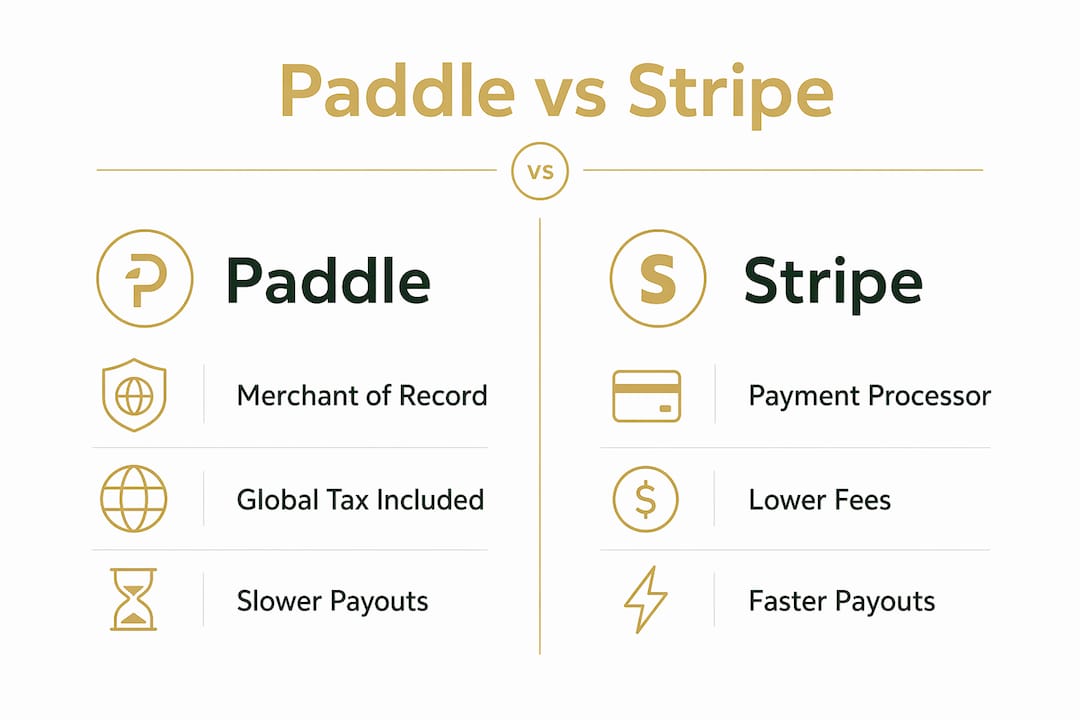
- Paddle: Removes multi-jurisdictional tax entirely. Drawback: slower payouts and less checkout flexibility.
- Stripe: Lower headline fees, faster payouts, deeper integrations. Drawback: you own every tax obligation in every jurisdiction where you have nexus.
How to Choose Between Paddle and Stripe
Work through these questions in order. Most creators land on a clear answer by step four.
- Where are your customers? If more than 20–30% are outside the US, Paddle’s MoR model removes a compliance burden that compounds fast as you scale.
- Do you have engineering capacity? Stripe’s full billing flow takes 2–4 weeks to build properly. If you’re a solo creator or a small team without a developer, that’s a real cost.
- What’s your current MRR? Below $50k, the time savings of an MoR service often outweigh the fee premium. Above $100k with an established compliance setup, Stripe’s lower rates start to matter more.
- How much chargeback risk do you carry? Paddle bundles chargeback handling into its MoR fee. With Stripe, dispute management is your problem unless you add tools.
- What are your payout needs? If cash flow is tight, Stripe’s 2–7 day payout window beats Paddle’s 7–30 day cycle.
- Do you need a custom checkout? Stripe wins here. Paddle’s checkout is solid but less flexible.
- Are you planning to migrate later? Switching from Paddle to Stripe means re-establishing tax registrations, updating invoices to your legal entity, and reconfiguring subscription identifiers. Plan that window carefully.
Decision flow
- Selling globally + no dev + want fast launch → Paddle
- US-focused + have a developer + want control → Stripe
- Want to outsource the whole infrastructure decision → Money Plug Lab
- Stripe account rejected or restricted for your market → Paddle (it’s more accepting for certain business types)
Questions to ask any vendor or agency before you commit:
- Who is the merchant of record, and who files taxes in each jurisdiction?
- What are the exact payout terms and any holding periods?
- How are disputes and chargebacks handled, and who absorbs the cost?
- Can you export subscription data and customer records if you migrate?
- What happens to active subscriptions during a platform switch?
The Details That Actually Move the Needle
Merchant of Record vs. payment processor
The distinction is legal, not just operational. When Paddle is your MoR, it becomes the seller on record to your customer. Your name may appear on the product, but Paddle’s entity is on the invoice and tax filing. That means Paddle registers for VAT in the EU, collects GST in Australia, and handles US sales tax nexus across states — none of which touches your books.
Stripe is a payment processor. You remain the merchant. Every jurisdiction where you trigger nexus is your registration to file. Stripe Tax helps calculate the right amount, but at an additional ~0.5% per transaction, and you still register and remit yourself. That’s a meaningful operational difference for a creator selling a $49 fitness program to customers in Germany, Canada, and Texas simultaneously.
The hidden costs of Stripe
The 2.9% + $0.30 base rate looks clean. The real number includes Stripe Tax at ~0.5%, international card surcharges and currency conversion adding roughly 1%–1.5% more on cross-border transactions, plus recurring accountant fees, tax registration costs across jurisdictions, and engineering time for dunning and billing logic. Those recurring hours are the cost most creators forget to model.
Developer and integration depth
Stripe’s API surface and integration ecosystem are broader than Paddle’s by a significant margin. If you need usage-based billing, complex trial logic, or tight integration with tools like Klaviyo, Segment, or a custom CRM, Stripe is the more natural fit. Paddle’s integrations cover the essentials well, including Apple Pay, Google Pay, PayPal, and regional methods like iDEAL and Pix, but it’s built for simplicity over extensibility.
Payout timing and cash flow
| Platform | Typical payout window | Reporting |
|---|---|---|
| Stripe | 2–7 days | Modular via Stripe Sigma |
| Paddle | 7–30 days | Built-in revenue dashboard |

For a creator running paid ads to a launch, a 30-day payout delay against a weekly ad spend can create a real cash crunch. Stripe’s faster cadence is a genuine operational advantage for anyone running performance marketing.
Pro Tip: If you’re choosing Paddle for the MoR benefits but worried about payout timing, negotiate your payout schedule during onboarding. Some plans offer faster cycles at higher volume.
Money Plug Lab Handles the Whole Infrastructure Decision for You
If reading this comparison made you realize you’d rather not own any of it, that’s exactly the situation Money Plug Lab was built for. Creators who are selling digital products — fitness programs, coaching offers, wellness courses, paid communities — and don’t want to spend weeks wiring up payment infrastructure or managing tax compliance across markets get the most out of a managed approach.

Money Plug Lab handles payment setup, platform selection (including the MoR vs. processor decision), checkout and subscription configuration, dunning, reconciliation, payout reporting, and launch integrations. The agency works on a pure revenue-share basis with zero upfront cost, so there’s no retainer to justify before you’ve made a dollar. Across seven launched programs, Money Plug Lab’s creators have generated over $500,000 in tracked revenue, including one launch that produced more than 3,000 sales in ten days.
If you want to skip the infrastructure decisions and go straight to launching, start the conversation at money-plug.com.
Key Takeaways
Paddle removes global tax liability entirely; Stripe gives you lower headline fees and faster payouts but leaves every compliance obligation with you.
| Point | Details |
|---|---|
| MoR vs. processor | Paddle is the legal seller and files taxes for you; Stripe leaves all tax obligations with the creator. |
| Effective fees converge | At $50k MRR, Stripe’s all-in rate approaches Paddle’s MoR rate once Tax and international costs are added. |
| Payout timing matters | Stripe pays out in 2–7 days; Paddle runs 7–30 days — a real cash-flow factor for creators running paid ads. |
| Time to launch | Paddle can reach a working checkout in 2–5 days; Stripe’s full billing flow typically takes 2–4 engineering weeks. |
| Money Plug Lab option | For creators who want the infrastructure decision handled end-to-end, Money Plug Lab manages platform selection, payments, and launches on a revenue-share basis. |