Social Proof Strategy for Creators: Launch-Ready Playbook
Social Proof Strategy for Creators: Launch-Ready Playbook

A launch-ready social proof strategy turns hesitant followers into buyers by matching the right proof type to the exact trust gap at each decision point. Generic testimonial pages don’t do that. Proof placed at pricing, checkout, and your video sales letter does.
Before your next launch, do these three things in the next 48 hours:
- Pull your three strongest existing testimonials and tag each one to a specific objection (price, difficulty, or legitimacy).
- Identify the two highest-anxiety pages in your funnel (usually pricing and checkout) and note what proof is currently there.
- Draft one outcome-based testimonial ask to send to a past buyer or beta tester.
Done right, this approach produces measurable outcomes: higher conversion rates at decision points, lower refund rates because buyers self-select more confidently, and faster purchase decisions that compress your launch window.
Table of Contents
- What does social proof actually do for a digital product launch?
- Which type of social proof should you use, and when?
- How do you collect testimonials that actually convert?
- How should you structure proof so the right visitor sees the right thing?
- How do you test social proof during a launch and know what’s working?
- What are the U.S. legal requirements for using testimonials and endorsements?
- How Money-plug runs social proof in a real creator launch
- Agency brief and copy-ready templates
- Key Takeaways
- The part most creators get wrong about social proof
- Money-plug runs your proof pipeline on revenue share
- Useful sources
What does social proof actually do for a digital product launch?
Social proof reduces friction at the exact moments buyers talk themselves out of purchasing. It works by replacing internal doubt with external evidence. When a follower lands on your pricing page and sees someone like them describing a specific result they got, the cognitive load of the decision drops.
72% of customers say positive reviews and testimonials directly influence their trust in a company. That figure matters because trust, not awareness, is what stalls most creator launches. Your audience already knows you. They’re on the fence about whether the product delivers.
Track these outcomes during a launch to know if your proof is working:
- Conversion rate lift at pricing and checkout pages (baseline vs. launch week)
- Customer acquisition cost reduction when proof-backed ads lower cost per click
- Refund rate as a proxy for buyer confidence (high refunds often signal mismatched expectations, not bad products)
- Trial-to-paid rate for membership or subscription launches
One important caveat: trust in individual reviews has declined significantly in recent years. Volume, recency, and response rate now carry as much weight as the star rating itself. A single glowing quote from 2022 won’t move anyone in 2026.
Which type of social proof should you use, and when?
Match proof type to the trust gap it needs to close, not to what you happen to have available. Generic praise (“I loved this course!”) closes almost nothing. Specific, outcome-tied proof closes price objections, capability doubts, and security fears.
- Testimonials with names and titles: Close capability and relevance objections. Best at hero sections and VSL intros.
- Case studies with before/after metrics: Close price objections. Best near pricing tiers and in email sequences.
- User-generated content (UGC): Closes legitimacy doubts. Best in retargeting ads and social campaigns.
- Press mentions and third-party badges: Close security and credibility objections. Best at checkout.
- Influencer endorsements: Close relevance objections for cold traffic. Best in top-of-funnel ads.
- Real-time dynamic notifications (“14 people joined this week”): Create urgency during launch week. Use only when the numbers are real; frequency should mirror actual traffic to avoid looking fabricated.
| Funnel Stage | Proof Type | Primary Objection Closed |
|---|---|---|
| Hero / landing page | Named testimonial + outcome | “Is this for someone like me?” |
| Video sales letter | Case study with metrics | “Will it actually work?” |
| Pricing section | Before/after quote + badge | “Is it worth the price?” |
| Checkout | Trust badge + UGC count | “Is this safe/legitimate?” |
| Retargeting ads | UGC clip or short quote | “Why should I come back?” |
| Email sequence | Case study story | “What will I actually get?” |
How do you collect testimonials that actually convert?
Ask for outcome, role, and timeframe in a single sentence. “I lost 12 pounds in six weeks using the program” from a named person with a job title or life context is worth ten times “Great content, highly recommend.”

The SBA’s guidance on testimonials is clear: specific, relatable details (name, title, the problem solved) improve credibility and lower purchase barriers. Build your collection process around those fields.
Email ask template:
Survey questions that pull before/after metrics:
- What was your biggest challenge before joining?
- What specific result have you seen, and in what timeframe?
- Would you recommend this to a friend? If yes, who specifically?
Video testimonial prompts:
- Introduce yourself and your situation before the program.
- Describe one specific change you’ve noticed.
- Who would you tell to sign up?
Pro Tip: Record consent explicitly. A short reply email saying “Yes, you can use my name and quote” is sufficient for most purposes, but store it with the testimonial file. For video, a written or on-camera verbal consent statement is cleaner.
For U.S. FTC compliance, store the person’s name, their relationship to the product (paid buyer, beta tester, gifted access), the date of the testimonial, and the exact quote or video file. More on disclosure requirements in the legal section below.
How should you structure proof so the right visitor sees the right thing?
Segment by traffic source AND the trust gap the visitor is likely to carry. A cold Facebook ad visitor and a warm email subscriber have different objections, so they need different proof.
Audit checklist by page:
- Hero: Does it show a named, outcome-specific testimonial within the first scroll?
- Pricing: Is there proof adjacent to each price tier that addresses “is this worth it?”
- VSL: Does the video open or close with a case study result?
- Checkout: Are trust badges and a short UGC count visible without scrolling?
- Ad landing pages: Does the proof match the ad’s claim exactly?
- Email sequences: Does each email in the launch sequence carry at least one proof snippet tied to that email’s objection?
Build a modular proof inventory: a spreadsheet with columns for proof type, the objection it closes, the traffic source it fits, and the exact copy snippet. When your agency needs to populate a new page or ad, they pull from the inventory instead of starting from scratch.
Pro Tip: If your platform supports conditional content blocks (many email tools and landing page builders do), show different testimonials to cold vs. warm segments. A cold visitor needs social validation from someone relatable; a warm subscriber needs a specific result that matches their hesitation.
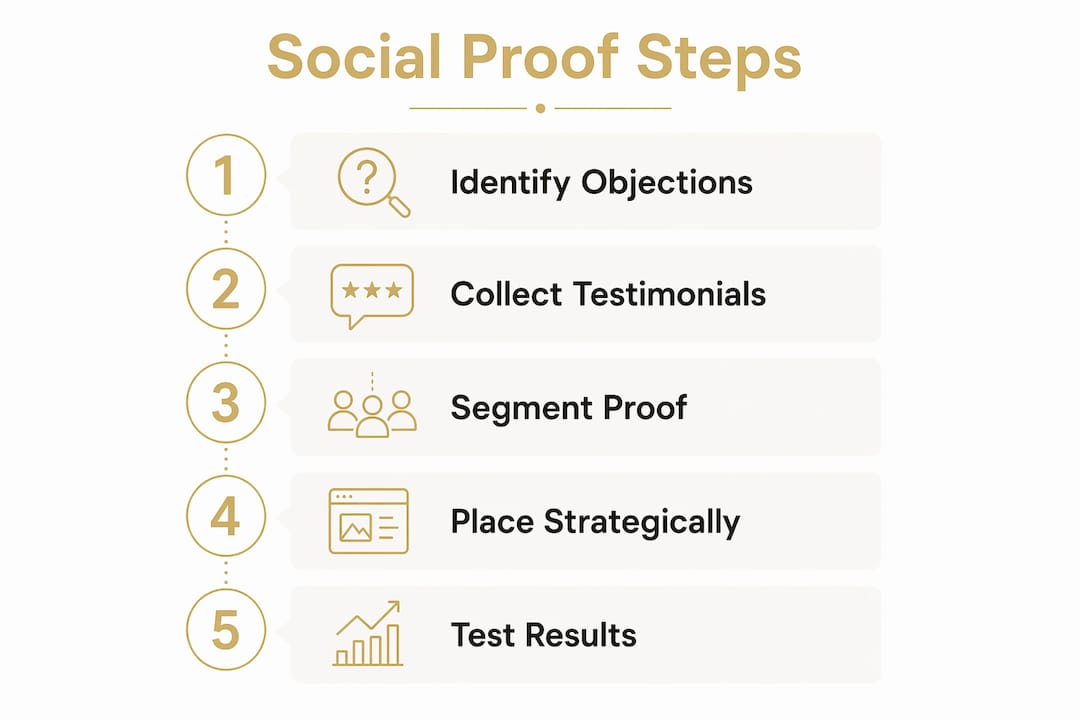
Placing proof at pricing, CTAs, and checkout drives disproportionate conversion lifts compared with a centralized testimonial page. Most creators do the opposite. Fix that first.
How do you test social proof during a launch and know what’s working?
Run hypothesis-driven tests at the three highest-anxiety touchpoints: hero, pricing, and checkout. Don’t test everything at once.
| Hypothesis | KPI | Duration / Sample Note | Decision Rule |
|---|---|---|---|
| Adding a case study quote near the price tier increases checkout clicks | Click-through rate to checkout | Minimum 500 visitors per variant | Lift >5% = ship it |
| Video testimonial on hero outperforms text quote | Time on page + conversion rate | Run full launch week | Higher CVR wins |
| Trust badge at checkout reduces cart abandonment | Abandonment rate | — | Lower abandonment = keep badge |
Timeline:
- Pre-launch (2–3 weeks out): Collect and verify testimonials, build proof inventory, set up A/B test variants.
- Launch week: Run tests at pricing and checkout; monitor conversion rate and refund rate daily.
- 30-day post-launch: Analyze which proof placements drove the highest lift; refresh any testimonial older than 90 days; document winning variants for the next launch.
Define your metrics clearly before launch: conversion rate (purchases divided by unique visitors), refund rate (refunds divided by total sales), and LTV impact (do proof-backed buyers stick longer in memberships?).
What are the U.S. legal requirements for using testimonials and endorsements?
Disclose material connections and keep written permission. The FTC’s endorsement guidelines require that any material connection between an endorser and a brand be clearly disclosed, including gifted access, affiliate commissions, or paid placements.
FTC compliance checklist:
- Disclose if the testimonial came from someone who received free or discounted access.
- Use clear language: “Paid partnership,” “I received free access,” or “#ad” on social posts.
- Do not present atypical results as typical. If one buyer lost 30 pounds, note that results vary.
- Keep records of all endorsement agreements, consent forms, and the original testimonial content.
Sample disclosure language:
- On a landing page: “Results shown are from real customers. Individual results vary. Some participants received complimentary access in exchange for their honest feedback.”
- In an email: “[Name] is a paid program participant. Results are not guaranteed.”
- On social: “#ad” or “Paid partnership with [Brand]” in the first line of the caption.
Store all consent records and testimonial files for a minimum of three years. Refresh testimonial content at least every 90 days to avoid signaling a stagnant product. Stale proof can reduce trust as much as no proof at all.
How Money-plug runs social proof in a real creator launch
One Money-plug campaign generated substantial returns on ad spend, numerous sales in a short period, and significant tracked revenue across multiple launched programs. The proof pipeline was a core driver.
The process runs in five stages:
- Audience research: Identify the top three objections from comments, DMs, and competitor reviews.
- Testimonial collection: Send structured ask templates to beta users and early buyers; capture name, role, result, and timeframe.
- Placement modules: Build a proof inventory and populate hero, pricing, VSL, checkout, and email sequences with segmented proof snippets.
- Testing: Run A/B tests at pricing and checkout during launch week with clear decision rules.
- Optimization: Refresh underperforming proof within 30 days; document winners for the next launch.
Deliverables the agency provides: proof inventory spreadsheet, placement map by funnel stage, tested ad creative with embedded social validation, and a post-launch performance report with conversion lift by placement.
For creators who want to understand how detailed client success stories influence buyer decisions, the structure above mirrors what high-performing B2B and creator campaigns use consistently.
Agency brief and copy-ready templates
Hand this brief to your agency and they can run the proof pipeline without a lengthy onboarding call.
Agency brief template:
- Audience: [Describe your followers: age, interest, primary platform]
- Primary objections: [List your top 3: e.g., price, time commitment, skepticism about results]
- Key metrics: [Conversion rate goal, refund rate ceiling, ROAS target]
- Proof inventory: [List existing testimonials with name, result, and date]
- Channels: [Landing page, email, paid ads, social]
Push-ready DM script:
Push-ready email script:
Three testimonial snippet formats:
- Hero: “[Name], [role]: ‘I went from [problem] to [result] in [timeframe].’”
- Pricing: “[Name]: ‘I almost didn’t buy because of the price. Three weeks in, I’d already [specific outcome].’”
- Checkout: “[Name], [location]: ‘I was nervous to buy online. The process was straightforward and the results were real.’”
Before your next launch, confirm you have at least one proof snippet for each of these three formats and each of the five funnel stages in the placement map.
Key Takeaways
A launch-ready social proof strategy requires segmented, placement-specific proof at pricing, checkout, and your VSL to convert followers into buyers at the highest-anxiety moments.
| Point | Details |
|---|---|
| Match proof to the trust gap | Select testimonials by the objection they close (price, capability, legitimacy), not by how positive they sound. |
| Place proof at decision points | Pricing, checkout, and VSL placements drive the highest conversion lifts; centralized testimonial pages underperform. |
| Collect outcome-based testimonials | Ask for name, role, before/after result, and timeframe; store consent records for FTC compliance. |
| Test at three touchpoints | Run A/B tests at hero, pricing, and checkout during launch week with a clear decision rule before you start. |
| Money-plug handles the full pipeline | Money-plug builds proof inventories, places segmented proof across the funnel, and runs tests on a revenue-share basis with no upfront cost. |
The part most creators get wrong about social proof
The conventional advice is to “collect more testimonials.” That’s not wrong, but it misses the actual problem. Most creators have enough proof. They just put it in the wrong place, in the wrong format, for the wrong visitor.
A fitness creator with 200 five-star reviews buried on a testimonials page is leaving conversion on the table. The buyer who’s about to click away from the pricing page doesn’t need to find your testimonials page. They need to see one sentence from someone like them, right next to the price, right now.
The other thing worth saying plainly: authenticity in marketing isn’t a soft value. It’s a performance variable. Transparency builds trust in ways that manufactured social proof never can, and audiences in 2026 are better at spotting the difference than most creators assume. The creators who win launches consistently are the ones who treat proof collection as an ongoing system, not a last-minute scramble before cart open.
For creators working with an agency, the brief matters more than the budget. An agency can execute a proof pipeline in days if you hand them a clear objection list, an existing proof inventory, and your funnel map. Without that, the first two weeks of any engagement go to discovery that you could have done yourself.
Money-plug runs your proof pipeline on revenue share
Zero upfront cost. Money-plug takes a share of what your launch earns, so the agency’s incentive is exactly aligned with yours: more sales, better proof, higher conversion.
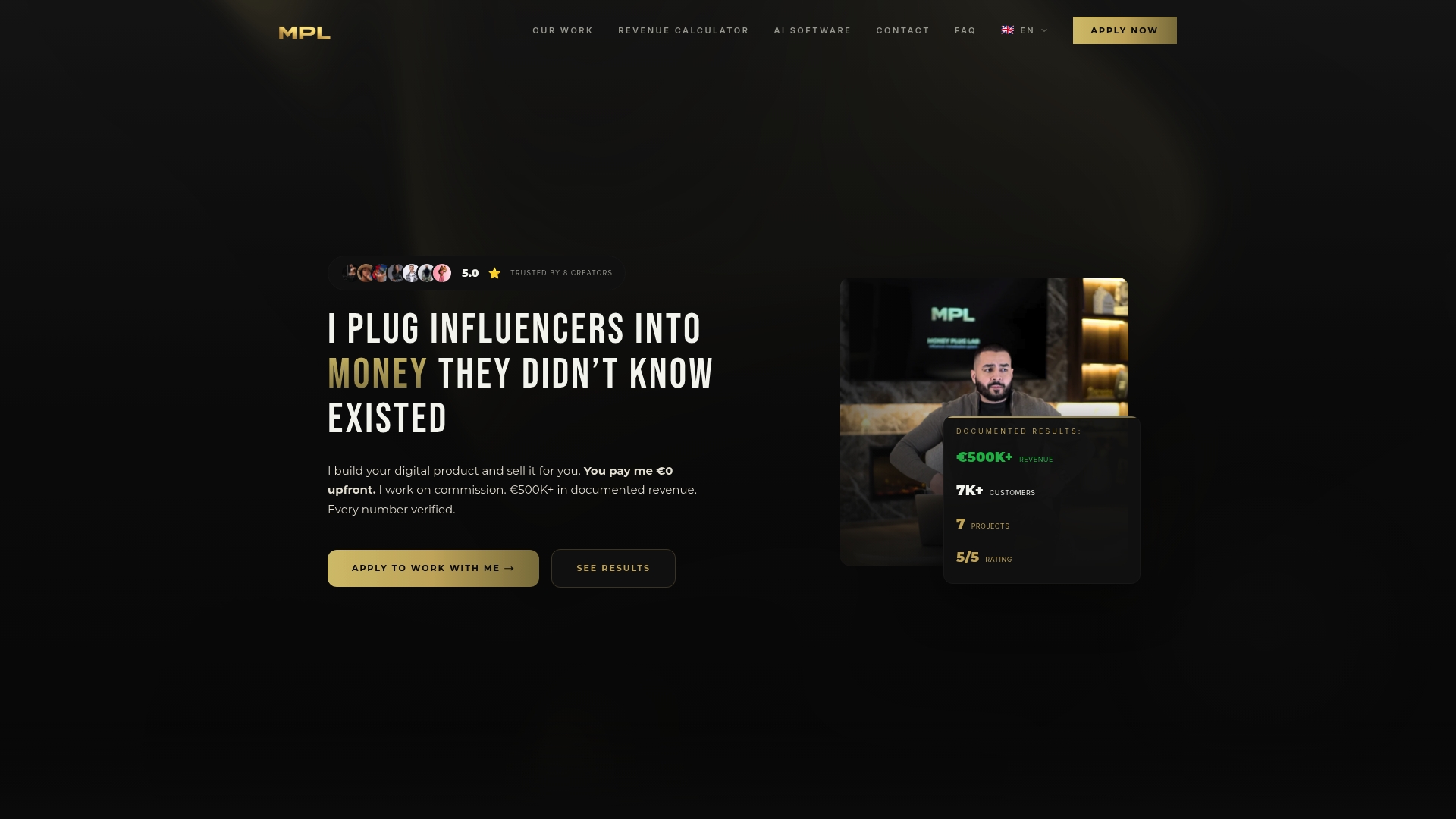
Money-plug handles everything from audience research and testimonial collection to placement, A/B testing, and post-launch optimization. Creators who’ve worked with the agency have generated over $500,000 in tracked revenue across seven programs, including one campaign that returned 18x on ad spend.
Before your first call, prepare three things: your current audience size and primary platform, your top three buyer objections, and whatever proof you already have (screenshots, DMs, reviews). That’s enough to start.
Book a conversation with Money-plug and bring those three items. The agency will map your proof pipeline from there.
This article is general information, not legal or financial advice. Confirm current FTC endorsement requirements with a qualified attorney or the FTC’s official guidance for your specific situation.
Useful sources
- Customer testimonials: maximize their marketing impact (SBA): Primary guidance on what makes testimonials credible, including the name/title/problem/outcome framework.
- Social Proof: The Complete Marketing Guide (Marketful): Covers placement strategy, review trust trends (2020–2025 data), and the 90-day refresh recommendation.
- Social proof that converts: a framework for increasing conversions (BDOW): Trust-gap framework for matching proof type to visitor objection and dynamic notification best practices.
- Social proof strategies: building trust and high-converting examples (Authencio): 2026 guidance on traffic-source segmentation and building a trust architecture.
- The Complete Guide to Social Proof Marketing (SocialBooster): Practitioner advice on video testimonials, before/after prompts, and proof inventory management.
- Customer testimonials and trust (Zendesk/BigCommerce): Source for the 72% trust-influence statistic used in the conversion rationale section.