Balkan Language Localization for Course Creators
Balkan Language Localization for Course Creators

Balkan language localization means adapting an online course, sales page, or checkout flow so it reads, teaches, and sells the way a Bosnian, Serbian, Croatian, Albanian, Bulgarian, or Romanian buyer expects. That’s translation plus instructional-design changes plus payment and UX work, not just swapping English words for local ones. If you’re a creator or coach eyeing this market, the single best next move is a small pilot: one sales page, one module, one checkout flow, tested before you commit a full course budget.
Before you build anything, plan around three moving pieces:
- Instructional-design adaptation — reworking pacing, examples, and assessment style so the course fits how the local audience actually learns, something regional research on Southeast European online pedagogy backs with real classroom data.
- Sales and launch copy transcreation — rewriting your VSL and offer copy so the persuasion logic lands, not just the vocabulary.
- Payment and checkout localization — aligning currency, tax display, and local payment rails with what buyers in that specific country trust, an area where EU regulatory alignment shapes what actually works.
Agencies with tracked case results, like Money Plug Lab’s Southeast Europe launches, exist because doing all three well is a different discipline than hiring a freelance translator off a marketplace.
Key Takeaways
Balkan language localization succeeds when instructional-design adaptation, transcreated launch copy, and payment localization happen together, not when translation alone tries to carry the launch.
| Point | Details |
|---|---|
| Pick one country first | Localize one sales page, one module, and checkout for a single country before expanding to others. |
| Run a micro-pilot | Test a 10-minute module with five native beta users before committing to a full course budget. |
| Confirm your payment mix | Offer cards plus at least one local rail or COD fallback based on checkout drop-off data by country. |
| Lock a glossary early | Build terminology and tone rules before translation starts to avoid costly rework later. |
| Consider revenue-share partners | Agencies like Money Plug Lab defer cost against future sales, useful for testing demand before scaling. |
Table of Contents
- What Balkan Languages and Content Should You Localize First?
- Why Doesn’t Straight Translation Work for Online Courses?
- What Does a Full Localization Workflow Look Like?
- How Do You Localize Payments and Checkout for Balkan Buyers?
- What Does Balkan Course Localization Actually Cost?
- Should You Hire a Localization Agency or Build In-House?
- How Does Money Plug Lab’s Regional Experience Show Up in Results?
- How Do You Handle Regional Dialects Within Balkan Languages?
- What Legal Factors Affect Localization in Balkan Countries?
- What Technical Issues Come Up in Balkan Language Localization?
- What’s Overrated and What Actually Moves the Needle?
- How Money Plug Lab Handles Balkan Launches for Creators
- Frequently Asked Questions
- Sources
What Balkan Languages and Content Should You Localize First?
Don’t try to localize “the Balkans” as one language. That’s the single most expensive mistake creators make before they even start.
Serbian, Croatian, and Bosnian share enough grammar and vocabulary that a single base translation can work for text-heavy material like emails or terms of service, with light per-country editing for spelling conventions and script (Serbian readers often expect Cyrillic in formal contexts, Croatian and Bosnian stay in Latin script). But treat marketing copy differently. A joke or idiom that lands in Belgrade can feel flat or even politically loaded in Zagreb or Sarajevo, so your sales page and VSL still need country-specific review even when the base draft is shared. Albanian, Bulgarian, Macedonian, Romanian, and Greek are separate languages with no shortcuts. Each needs its own translation pass and its own reviewer.
Content type matters more than most creators assume. Start with the assets that touch revenue directly: your sales page, VSL, and checkout flow. Course modules and onboarding emails come next, since a buyer has to convert before they ever open lesson one. Ads and community moderation content trail behind, useful once you’ve validated demand in that specific language.
Localization experts warn against treating the Balkans as a single audience with one voice. Successful projects target country-level nuances, because a shared regional history does not mean a shared way of reading a sales pitch.
Prioritize by where your diaspora audience actually clusters. Serbian and Croatian diaspora communities are large in Germany, Austria, Switzerland, and parts of the US Midwest. Albanian diaspora audiences concentrate heavily in Switzerland, Germany, and Italy. If your ad spend is already reaching those cities organically, that’s your signal to localize before you scale spend further.
Why Doesn’t Straight Translation Work for Online Courses?
Translation gets the words right and still loses the sale. That gap is the entire reason instructional-design-first localization exists as a discipline.
A study of educators across seven Southeast European universities found that online course content needs adaptation for cultural dimensions like uncertainty avoidance and power distance, not just accurate vocabulary. Learners in higher uncertainty-avoidance cultures often want more structured step-by-step guidance and clearer grading criteria than a loosely structured American-style course provides. Skip that adjustment and engagement drops even when every sentence is grammatically perfect.
The failures show up in predictable places. A humor beat built around an American pop-culture reference falls flat when translated word for word. An example using US tax brackets or a Walmart checkout confuses a Bulgarian learner who has never seen either. Group project formats that assume individualist classroom norms can clash with more collectivist learning expectations in parts of the region. Practitioner observations on Balkan localization note that even closely related languages carry different idioms and cultural interpretations, so a phrase that reads naturally in Serbian can feel stiff or unintentionally funny in Bosnian.
Shared history across Balkan countries does not equal shared interpretation. A reference that plays well in one market can backfire entirely two borders away.
Pro Tip: Test one micro-module, not the whole course, before you commit a full localization budget. Translate a single 10-minute lesson, run it past five native-speaking beta users in your target country, and watch where they pause the video or reread a slide. That’s cheaper feedback than a failed launch.
What Does a Full Localization Workflow Look Like?
A localization project without a sequence turns into rework. Here’s the order that avoids it:
- Audience research and market scoping (3 to 5 days) — confirm language priority, diaspora concentration, and competitor pricing. Creator owns this with agency input.
- Glossary and style guide (2 to 4 days) — lock terminology, tone, and formality level before any translator touches the sales copy.
- Instructional-design adaptation (1 to 2 weeks per course) — remap module pacing, examples, and assessments to local learning expectations, informed by findings on cultural dimensions and e-learning preferences.
- Translation and transcreation (per module, 2 to 4 days; full course, 3 to 6 weeks) — native linguists handle sales copy and scripts separately from technical or legal text.
- Multimedia localization (subtitles, dubbing, captions) — budget 1 to 2 days per video hour for subtitles, longer for dubbing.
- Payments and checkout configuration (3 to 7 days) — engineer-owned, tested against real local cards before launch.
- QA and linguistic review (2 to 3 days) — a second native reviewer, not the original translator, checks tone and accuracy.
- Pilot test and iterate (1 to 2 weeks) — soft-launch to a small list segment before full ad spend.
Pro Tip: Run your pilot launch to an email list segment first, not cold ads. You’ll catch checkout and copy problems on warm traffic before you pay to discover them at scale.
How Do You Localize Payments and Checkout for Balkan Buyers?
Get the checkout wrong and everything upstream, the translation, the VSL, the ad spend, gets wasted at the last step.
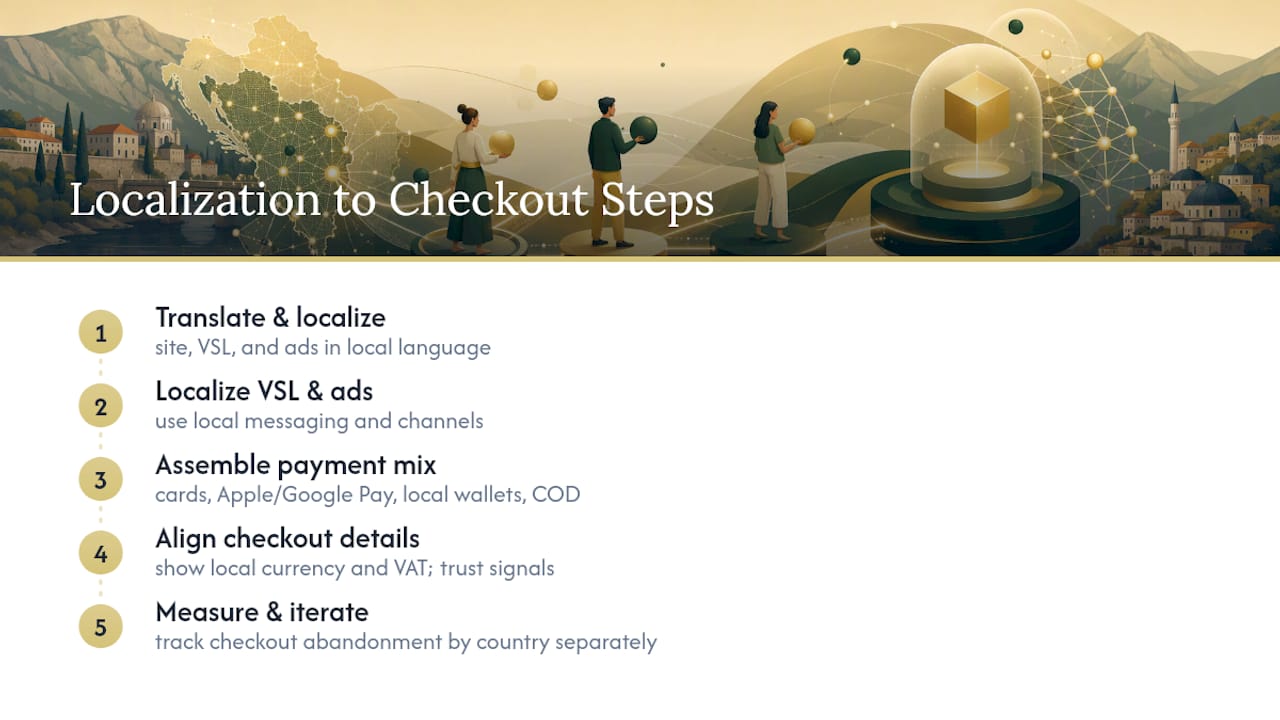
Start with cards, Apple Pay, and Google Pay as your baseline everywhere. Then add local rails selectively based on the country: instant national payment schemes, popular regional wallets, and in some markets, cash-on-delivery still converts meaningfully better than card-only checkout. Practitioner guidance on the region is blunt about this shift: Balkan digital payments are moving from cash-first to choice-first, which means merchants who offer a real payment mix, cards plus local methods plus a COD fallback, consistently out-convert those who force a single option.
Currency display matters more than it seems. Show local currency at checkout even if you settle in euros or dollars internally, and make sure your VAT or tax line matches what buyers expect to see on a receipt in that country. Regulatory alignment isn’t cosmetic either: a multi-criteria study of Southeast Europe found EU legislative alignment is the top factor determining which digital payment systems actually work in a given country, with Romania scoring highest for implementation readiness among the countries studied.
Merchants who build a real payment mix, cards, local wallets, and a cash-on-delivery fallback, consistently see fewer abandoned checkouts than those who force a single payment path.
Trust signals close the gap the payment method opens. Local-language receipts, a recognizable local bank name on the payment page, and a support phone number in the reader’s own country code all reduce hesitation at the final step. So does a clearly stated refund window in the local language, not buried in an English terms page.
Pro Tip: Track checkout abandonment by country separately, not in aggregate. If one market’s drop-off spikes at the payment step specifically, that’s usually a missing local method, not a copy problem.
What Does Balkan Course Localization Actually Cost?
Pricing varies by how much instructional redesign the course needs, not just word count.
- Per-word translation typically covers static text: emails, terms, FAQ pages. Fine for low-stakes content, weak for sales copy.
- Per-hour instructional design and media work covers module restructuring, subtitle timing, and voiceover direction, usually the biggest line item on a full course localization.
- Per-module packages bundle translation, instructional adaptation, and QA into a flat fee per lesson, useful for budgeting a phased rollout.
- Revenue-share arrangements let an agency defer cost against future sales, which matters most for creators who don’t want to front a full localization budget before validating demand.
A single sales page plus checkout localization can realistically turn around in one to two weeks. A full multi-module course with dubbing and instructional redesign typically runs four to eight weeks. Decide your rollout pace using a simple trigger: if your pilot module shows a meaningful lift in watch-through or checkout completion versus your English baseline, greenlight the rest of the course. If it doesn’t move, fix the instructional design before translating anything else.
Should You Hire a Localization Agency or Build In-House?
The honest answer depends on how many of these five things you already have solved: speed to market, payment integration experience, instructional-design skill, media production capacity, and budget flexibility.
If you’re a solo coach with one course and no engineering support, an in-house attempt usually stalls at the payment integration step, exactly the point where a mapping of platform-mediated creator ventures in Serbia found core technical infrastructure exists regionally, but the skills to configure it well are unevenly distributed. That gap is where most DIY localization projects quietly die.
When vetting any vendor, ask to see sample deliverables from a past course launch, not just a translation sample. Ask about their QA process: does a second native reviewer check the translator’s work? Ask whether they’ve run a pilot test before a full launch, and ask for payment integration experience specific to the countries you’re targeting, not just “the Balkans” generically.
A vendor with no pilot-testing process and no local-language reviewer separate from the original translator is a red flag regardless of how polished their pitch deck looks.
Watch for fixed-price, translation-only proposals that never mention instructional design or checkout configuration at all. That’s usually a sign you’re buying words, not a launch.
How Does Money Plug Lab’s Regional Experience Show Up in Results?
Money Plug Lab’s creators have generated substantial tracked revenue across several launched programs, including a single launch with thousands of sales in a short period and a campaign that achieved a high return on ad spend. Those are agency-published proof points, verifiable through Money Plug Lab’s own case material, not third-party audited figures, and worth stating plainly as such.
What produced those numbers wasn’t translation alone. Instructional-design adjustments, restructured module pacing, reworked assessment formats, localized examples, paired with payment-flow changes tailored to the buyer’s country, are what moved conversion and completion rates in past launches. That combination mirrors what the Back to the Future MOOC initiative found running cross-border courses across six Western Balkan universities: courses that adapted instructional design for local context outperformed ones that simply translated existing material for a regional audience of more than 1,800 students.
Southeast Europe rewards region-specific execution over generic regional strategy. A creator who treats Serbia, Bosnia, and Croatia as three distinct buyer psychologies, not one Balkan market, converts more reliably than one running a single translated funnel across all three.
Money Plug Lab’s regional focus on Southeast Europe reflects a market where acquisition costs run a fraction of Western equivalents and engagement tends to run high, conditions that make instructional-design investment pay back faster than in saturated Western funnels.
How Do You Handle Regional Dialects Within Balkan Languages?
Dialect handling is where creators either save money smartly or lose credibility fast. Serbian, Croatian, and Bosnian are mutually intelligible enough that a shared base draft works for neutral, low-emotion content: legal terms, technical documentation, plain informational emails. Marketing copy is different territory. Word choice, regional slang, and even preferred script (Cyrillic versus Latin) signal in-group belonging, and getting it wrong reads as outsider content immediately.

Within Albanian, the Gheg dialect spoken in Kosovo and northern Albania differs enough from standard Tosk Albanian (the official written standard) that formal course content can use standard Albanian broadly, but sales copy aimed specifically at Kosovo audiences benefits from a native Kosovo Albanian reviewer. The same logic applies to Romanian audiences in Moldova versus Romania proper: near-identical written language, meaningfully different everyday register and cultural reference points in spoken and casual content.
What Legal Factors Affect Localization in Balkan Countries?
Regulatory status varies sharply by country here, and it isn’t optional homework. EU member states, Bulgaria, Romania, Greece, Croatia, operate under EU consumer protection and VAT rules, which set specific requirements for refund windows, price display, and distance-selling disclosures. Non-EU Balkan countries, Serbia, Bosnia and Herzegovina, Albania, North Macedonia, Montenegro, run their own national consumer protection and tax frameworks, and cross-border payment processing rules differ accordingly.
This is general information, not legal advice: confirm current VAT thresholds, consumer protection disclosure rules, and payment licensing requirements for each specific country with a qualified local advisor before launch, since these rules change and vary by entity structure. What’s consistent regionally is the direction of travel: EU legislative alignment is the strongest predictor of which countries can support modern digital payment infrastructure smoothly, which is worth factoring into which country you prioritize first if you’re choosing between several with similar audience size.
What Technical Issues Come Up in Balkan Language Localization?
Character encoding trips up more launches than creators expect. Serbian Cyrillic, Croatian and Bosnian Latin script with diacritics (č, ć, š, ž, đ), Albanian’s own diacritic set, and Bulgarian and Macedonian Cyrillic all require your course platform, email tool, and payment gateway to fully support UTF-8 encoding, not partial support that renders fine in a browser but breaks in a PDF export or an SMS notification.
Font support is the quieter failure point. Many design-forward fonts popular in Western course platforms simply don’t include the glyphs for Balkan diacritics, so a heading that looks polished in English renders with missing characters or fallback boxes once translated. Test every template, checkout page, and PDF certificate in the actual target language before launch, not just the body text. For creators managing multilingual mobile experiences alongside course content, platforms built for multilingual support at the app level, like Logivo’s driver app architecture, show what full UTF-8 handling across an entire app stack looks like when done right.
What’s Overrated and What Actually Moves the Needle?
Most localization advice online still treats this as a translation problem with a cultural garnish on top. That framing is backwards, and it’s the reason so many creator localization attempts underperform even after spending real money on native translators.
The instructional design is the leverage point, not the language. A course that’s translated flawlessly but keeps its original pacing, its original assessment style, and its original assumption about how learners engage will underperform a rougher translation wrapped around content genuinely rebuilt for local learning expectations. That’s not a minor nuance, it’s the entire gap between a launch that converts and one that quietly stalls at module three.
The other overrated idea is treating “the Balkans” as a single go-to-market decision. It isn’t. A creator who picks one country, gets the payment flow, the dialect, and the instructional pacing right for that specific market, then expands, will consistently outperform a creator who launches five languages at once with shallow adaptation across all of them. Depth in one market beats breadth across five underbuilt ones, almost every time.
If there’s one thing worth prioritizing above everything else in this article, it’s the pilot. Not the full course, not the full language list. One module, one country, tested against real buyers before you scale spend. Everything else, the glossary, the payment rails, the dialect decisions, gets cheaper to fix when you catch it at pilot scale instead of after a full launch.
How Money Plug Lab Handles Balkan Launches for Creators
If you’re weighing whether to hire a freelance translator, build an in-house localization team, or find a specialist partner, here’s the honest tradeoff: freelancers translate words but rarely touch instructional design or payment infrastructure, and an in-house build usually stalls exactly at the checkout integration step. Money Plug Lab exists for the gap between those two options, and works on a pure revenue-share basis, meaning creators pay nothing upfront to test whether their offer converts in a Balkan market.
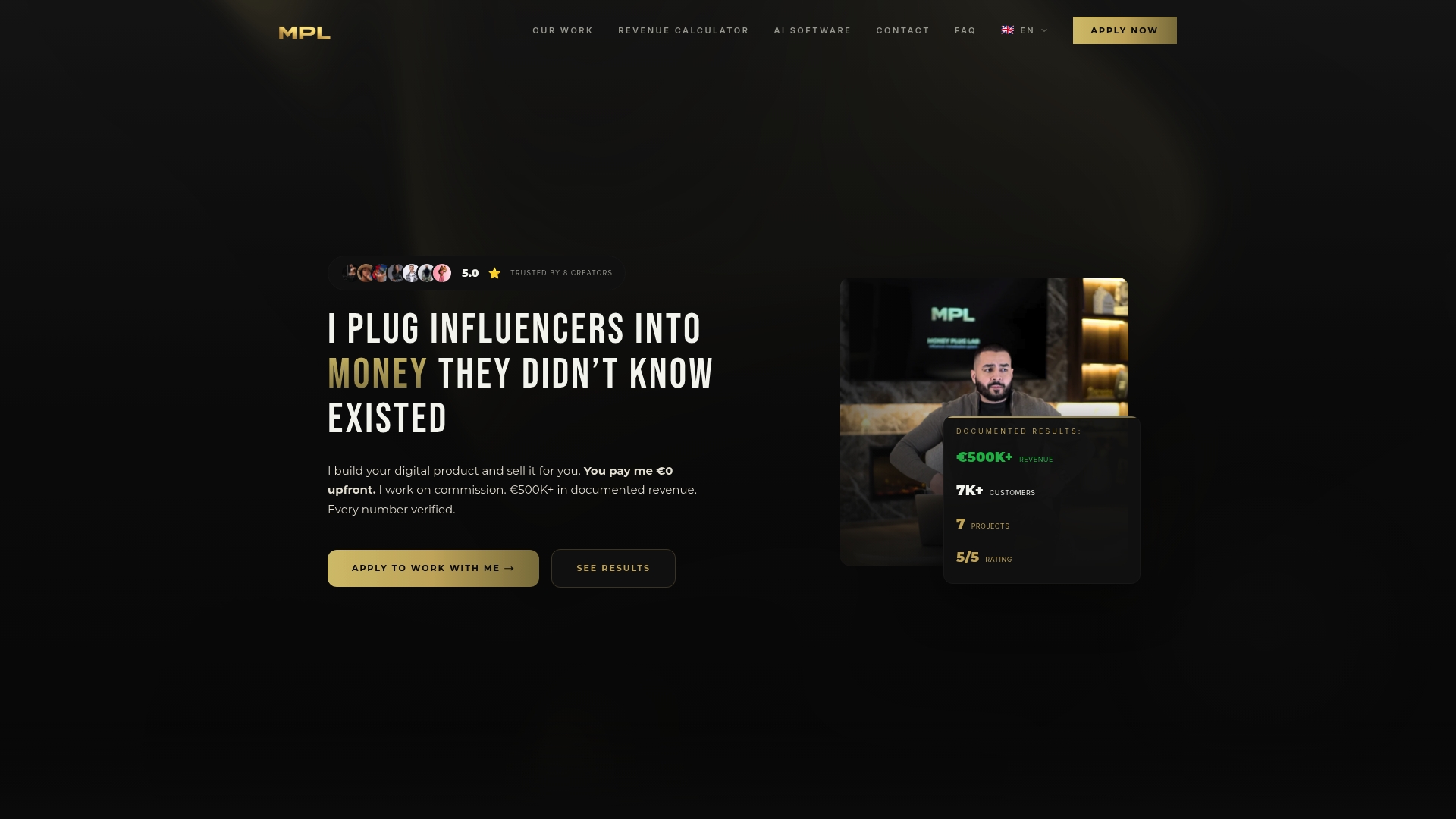
What that looks like in practice: audience research to confirm which country and language to prioritize first, course architecture and instructional-design adaptation for the specific market, localized sales copy and VSL production, full payment infrastructure setup including local rails, and a controlled pilot launch before scaling ad spend. Money Plug Lab specializes in Southeast Europe, where creator audiences are highly engaged and acquisition costs run a fraction of Western markets, and typically structures engagements as revenue share with zero upfront cost for qualifying creators.
If you’re a creator or coach sitting on an English-language course that’s already proven and wondering whether it would sell in Serbia, Bosnia, Croatia, or across the diaspora, the next step is a discovery call. Visit Money Plug’s site to see current case results and request a pilot conversation.
Frequently Asked Questions
Do Serbian, Croatian, and Bosnian need separate translations? For neutral technical content, one base translation can work with light per-country edits. For sales copy and VSLs, each market benefits from its own native reviewer since word choice and script signal in-group belonging.
How long does a full course localization take? A single sales page and checkout setup can turn around in one to two weeks. A full multi-module course with dubbing and instructional redesign typically takes four to eight weeks.
What’s the minimum viable pilot for testing a Balkan market? One sales page, one course module, and a working checkout with at least one local payment method. That’s enough signal to decide whether to invest in the full course.
Do I need a local payment method or is a card checkout enough? Cards plus Apple Pay and Google Pay work as a baseline, but adding a local rail or cash-on-delivery fallback consistently reduces checkout abandonment in several Balkan markets.
Should I hire an agency or build a localization team in-house? It depends on whether you already have payment integration experience, instructional-design skill, and media production capacity. Most solo creators stall at the payment step and benefit from a specialist partner.
Sources
Building an RFP, a glossary, or a pilot plan gets easier with a few vetted references on hand rather than generic search results.
- Pedagogical Innovation Amidst Adversity: Exploring Online Pedagogical Practices in Southeast Europe
- Back to the Future: Enhancing futures literacy through interactive MOOCs in the Western Balkans
- Digital transformation and monetary policy in Southeast Europe (multi-criteria analysis)
- Mapping platform-mediated knowledge entrepreneurship in Serbia
- Balkan Digital Payment Adoption: Current Trends, Solutions, and Growth Opportunities