CPM Rates Across the Balkans: 2026 Platform Benchmarks
CPM Rates Across the Balkans: 2026 Platform Benchmarks

Balkan CPMs typically run between $1 and $8 on Facebook and Instagram, and mostly under $5 on YouTube, well below Tier 1 Western European averages. Those numbers look cheap, and often they are, but a low CPM only tells you traffic is inexpensive, not that it converts. The real work is benchmarking against comparable inventory, then optimizing toward cost per acceptable conversion or ROAS instead of chasing the lowest number on the page.
TL;DR:
- Low Balkan CPMs of $1 to $8 on Facebook and Instagram, and under $5 on YouTube, primarily reflect market liquidity rather than conversion efficiency.
- CPM rates vary significantly by country, platform, ad format, and seasonality, with notable jumps during holidays, elections, and industry-specific peaks such as tourism.
- Benchmarks must be normalized carefully by inventory type, currency, and timing, as mismatched comparisons can lead to misleading conclusions.
- Focusing on cost per accepted conversion rather than raw CPM yields better profit, especially in markets with limited volume or low purchase rates.
- Combining creative tested with local influencers and pooling budgets across similar Balkan markets enhances statistical significance and campaign effectiveness.
Table of Contents
- CPM Rates Balkans: Country and Platform Benchmarks
- Why CPM Rates Vary Across the Balkans and Platforms
- How to Build a Fair Cross-Country CPM Comparison
- Turning Cheap CPM Into Real Profit in Balkan Markets
- Economic Conditions Shaping Balkan Digital Advertising
- Seasonal and Industry Swings in Balkan CPM Rates
- How Audience Targeting Changes CPM in the Balkans
- Balkans vs. Western Europe: How the CPM Gap Breaks Down
- What Southeast Europe Has Taught Us About Reading These Numbers
- Let Money-plug Handle Your Balkan Media Strategy
- Sources
CPM Rates Balkans: Country and Platform Benchmarks
Public CPM data for Southeast Europe is scattered across ad network reports, creator payout dashboards, and agency case notes, so no single source gives you a clean, apples-to-apples table. What follows stitches together the most credible published figures, with the platform and measurement basis noted so you know exactly what you’re comparing.
Facebook and Instagram CPMs across Balkan markets commonly fall in the 2 to 8 EUR range depending on country and vertical, according to Influexus’s regional advertising data. YouTube tells a different story. Most Balkan countries sit in the lower CPM tiers, generally under $5, compared to $15 to $40 or more in Tier 1 markets like the US, UK, or Norway, based on YouTube’s published country CPM guide.
A few things jump out once you sit with these figures. Croatia and Romania tend to price somewhat above their neighbors on both platforms, likely due to EU market access and larger domestic ad budgets. Serbia’s YouTube RPM figure reflects creator earnings after platform revenue share, not raw CPM advertisers pay, so treat it as a directional signal rather than a direct comparison. All countries cited remain below Western European or North American benchmarks, per the country comparison data at FroggyAds.
- Facebook and Instagram CPMs across the region cluster tighter than YouTube’s, largely because auction dynamics on Meta platforms respond more quickly to local demand shifts. YouTube CPM data is less granular for smaller Balkan markets, so treat any single-country figure as an estimate rather than a fixed rate.
- Currency matters: EUR-denominated Facebook estimates and USD-denominated YouTube estimates should never be blended into one number without converting at a stated exchange rate.
Why CPM Rates Vary Across the Balkans and Platforms
CPM isn’t a fixed price. It’s the output of an auction, and auctions respond to whoever else is bidding at that moment. Advertiser demand shifts by season, vertical, and even day of the week: e-commerce brands crowd into November and December, insurance and finance advertisers spike around tax season, and political advertising can distort an entire country’s average for weeks.
Statistic to watch: YouTube CPMs in Tier 1 countries can run $15 to $40 or higher, while most Balkan markets sit under $5, a gap of roughly 3x to 8x depending on niche, according to YouTube’s country CPM benchmarks.
Inventory type moves the number just as much as geography. A few factors that shift CPM independent of country:
- In-stream video ads on YouTube typically carry different (often higher) CPMs than display or bumper formats.
- Mobile feed placements on Facebook often price lower than desktop right-column or Instagram Stories inventory.
- Viewability standards, ad fraud filtering, and platform fees all get baked into the price you’re quoted, even when the raw exposure is identical.
- A thin sample window, say a campaign running three days with 2,000 impressions, can post a CPM that looks great on a report and means almost nothing statistically.
A cheap CPM in a low-liquidity market can hide a real problem: not enough volume to know if the audience actually converts.
How to Build a Fair Cross-Country CPM Comparison
Comparing a Serbian YouTube CPM to a German one only works if you’re comparing the same kind of ad, on the same kind of screen, measured the same way. Skip this step and you’ll draw conclusions from noise.
- Define the inventory first. Lock in platform, placement (feed, in-stream, Stories), device (mobile vs desktop), creative format, and the viewability standard you’re using before pulling a single number.
- Normalize the economics. Pick one currency for the whole comparison, decide whether platform fees are included in the CPM you’re quoting, and be explicit about your numerator (spend) and denominator (impressions, or thousands of impressions).
- Keep a decision log. Record the date range, total impressions, which conversion events counted as “accepted,” typical conversion delay for your vertical, and a note on sample size for every country in the comparison.
- Apply a floor rule. Exclude any country or segment that hasn’t accumulated enough impressions to be statistically meaningful, and flag campaigns still inside their learning phase rather than treating early numbers as final.
The FroggyAds benchmarking framework makes a similar point: a ranking built on mismatched inventory or currency isn’t a benchmark, it’s a coincidence.
Pro Tip: Build your decision log as a shared spreadsheet before launch, not after. Retrofitting normalization rules onto data you’ve already pulled almost always introduces bias you won’t notice until the numbers stop making sense.
Turning Cheap CPM Into Real Profit in Balkan Markets
A $2 CPM that produces zero sales is worse than an $8 CPM that produces twenty. Balkan advertisers get this backward constantly, chasing the lowest number on a benchmark table instead of the lowest cost per customer who actually pays.
Budget sizing matters more than most media buyers admit. Spending €50 across a full week in a small market like Montenegro rarely generates enough signal for the algorithm to optimize toward anything meaningful. A better approach: concentrate early testing budget into a shorter window with a clear conversion goal, then scale once you’ve got enough accepted conversions to trust the pattern, generally dozens rather than a handful.
Creative is where the region actually shows its edge. According to Influexus’s analysis of Balkan ad performance, repurposed influencer UGC consistently outperforms polished studio ads here, both on click-through rate and downstream cost per acquisition. Audiences in Serbia, Bosnia, and Croatia respond to creators they already trust far more than to a brand’s own production.
- Test unified Western Balkans campaigns (Serbia, Bosnia and Herzegovina, Montenegro) before splitting into single-country buys. Shared language and cultural overlap mean pooled budgets often hit statistical significance faster, a pattern TG Ads Spy’s regional market report documents for co-targeted campaigns.
- Prioritize cost per accepted conversion, not raw CPM, as your primary optimization signal.
- Track 7 day and 30 day retention alongside first-purchase rate. In creator monetization, the second sale tells you more about product fit than the first ever will.
Pro Tip: If you’re testing a new offer in the region, run it against a Western Balkans cluster first. Splitting a small budget three ways by country almost always produces slower, noisier data than pooling it.
Economic Conditions Shaping Balkan Digital Advertising
Digital ad spend in the Balkans has grown steadily, but the region still trails Western Europe in absolute advertiser competition, which is the core reason CPMs stay low. Smartphone penetration is high across Serbia, Croatia, and Bosnia, yet average disposable income remains a fraction of EU averages, so advertiser categories skew toward affordable consumer goods, mobile services, and financial products rather than luxury or high-ticket categories that drive premium CPMs elsewhere.

Currency and EU membership status create real divides within the region itself. Croatia’s adoption of the euro and EU market integration pull its ad prices slightly above its non-EU neighbors. Serbia, Bosnia and Herzegovina, and North Macedonia operate outside the eurozone, which keeps local currency volatility as a variable advertisers need to factor into budget planning, not just an afterthought.
Advertiser category concentration also shapes the picture. North Macedonia’s market data shows a notably heavy presence of crypto and forex advertisers, categories known for aggressive bidding that can push CPMs up in specific ad placements even while the broader market stays cheap. That’s a useful reminder: a country-level average can mask a vertical-level spike that has nothing to do with general demand.
Seasonal and Industry Swings in Balkan CPM Rates
CPM in the Balkans moves with the calendar almost as much as it moves with geography. November and December bring the same global e-commerce surge that drives up CPMs everywhere, and Balkan markets aren’t insulated from it, Black Friday campaigns from regional retailers compete for the same feed placements as everyone else.
Summer months tend to soften CPMs across most consumer verticals as travel and tourism dominate ad budgets while other categories pull back. Tourism-heavy markets like Croatia and Montenegro actually see the opposite pattern in their own vertical: hospitality and travel advertisers spike spending from March through August, pushing category-specific CPMs up even as general retail cools.
Political cycles matter too. Election periods in any Balkan country can distort national CPM averages for weeks, as political advertisers flood the auction with spend that has nothing to do with typical commercial demand. Finance and insurance advertisers cluster around tax season and year-end, a pattern consistent with what Hpanov-Digital’s Bulgaria cost analysis notes about Q4 budget flushes across regional markets. If you’re benchmarking CPM for a launch, always check what month the reference data was pulled. A November figure and a July figure from the same country can differ by a meaningful margin, and treating them as interchangeable will throw off your planning.
How Audience Targeting Changes CPM in the Balkans
Narrow the audience, and the price usually moves, sometimes up, sometimes down, depending on who’s competing for that same slice of attention. Targeting affluent urban professionals in Belgrade or Zagreb tends to push CPM higher than a broad, country-wide audience, simply because more advertisers are bidding for that same demographic.
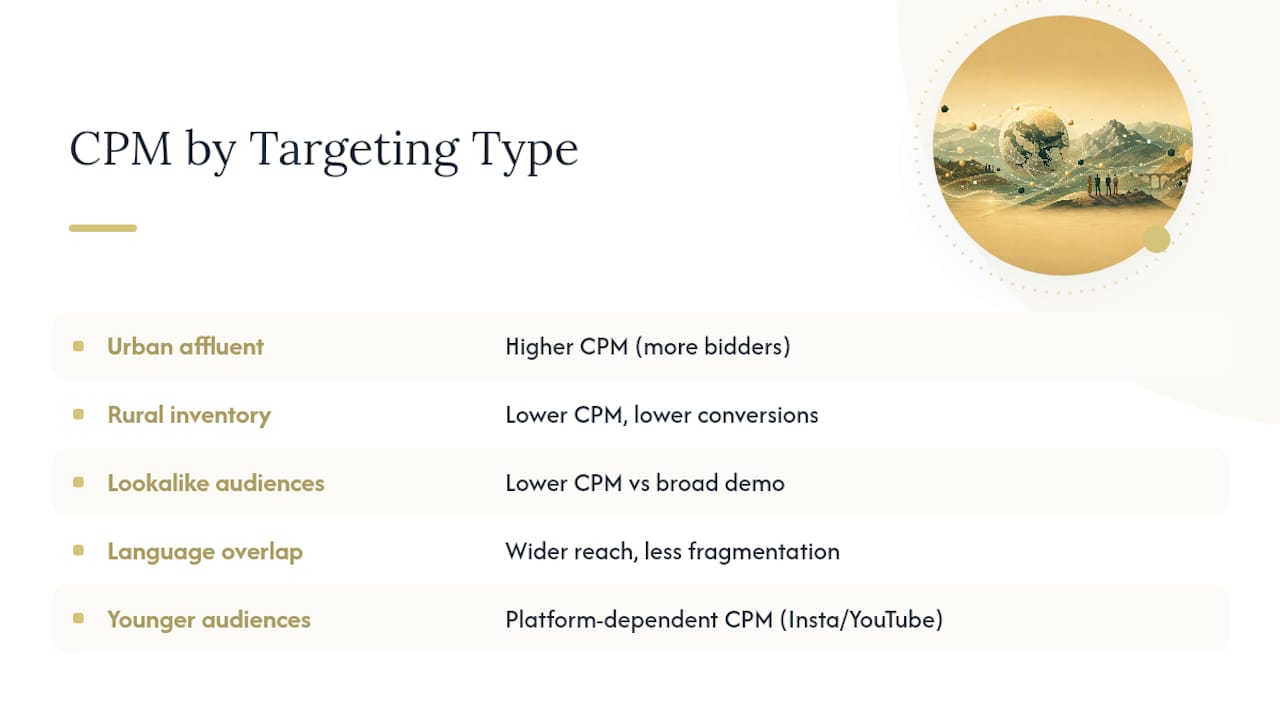
Age and platform habits split sharply across the region. Younger audiences (18 to 34) dominate Instagram and YouTube engagement in most Balkan countries, while Facebook’s user base skews slightly older, particularly outside major cities. That split changes which platform gives you cheaper reach for a given demographic, and it’s worth testing both before committing budget to one.
Language and dialect targeting is a genuinely underused lever here. Serbian, Bosnian, Croatian, and Montenegrin share deep linguistic overlap, which means creative built in one often performs across all four with minimal adaptation, letting you widen reach without fragmenting budget across near-identical audience segments. Rural versus urban targeting also swings CPM noticeably: rural inventory in most Balkan countries is cheaper and less contested, but conversion rates for premium digital products often run lower there too, so the savings on CPM don’t automatically translate into savings on cost per customer.
Interest-based and lookalike targeting built from an existing customer list tends to outperform broad demographic targeting almost everywhere in the region, largely because advertiser sophistication is still catching up, meaning fewer competitors are bidding against a well-built lookalike audience than you’d expect in a saturated Western European market.
Balkans vs. Western Europe: How the CPM Gap Breaks Down
Put a Balkan CPM next to a UK or German one, and the gap is immediate: Tier 1 markets routinely see YouTube CPMs of $15 to $40 or more, while most Balkan countries sit under $5, based on published country CPM tables.
The gap isn’t uniform across all of Southeast Europe either. Croatia and Romania, both larger or EU-integrated markets, price closer to Central European neighbors like Poland or Hungary than to Bosnia or Montenegro. Meanwhile, smaller markets like North Macedonia and Albania sit at the very bottom of the regional range, closer to what you’d see in parts of South Asia or sub-Saharan Africa than to the rest of Europe.
What explains the persistence of the gap is advertiser density, not audience quality. Western European markets have more advertisers per capita bidding in the same auctions, driven by higher average transaction values and mature e-commerce ecosystems. Balkan audiences are just as reachable and, per Influexus’s engagement data, often more responsive to creator-led content than saturated Western feeds. The opportunity for advertisers willing to test the region early is real, but it narrows every year as more brands catch on and bidding pressure rises to match.
What Southeast Europe Has Taught Us About Reading These Numbers
Cheap CPM gets treated like a discovery when it’s really just a starting point. Every Balkan CPM figure worth acting on has to survive contact with a real conversion funnel, because the region’s biggest advantage, low acquisition cost, is also its biggest trap for advertisers who stop measuring after the click.
The pattern that shows up most consistently: campaigns that lean on trusted local creator content outperform generic studio ads by a wide margin here, not because the creative is flashier, but because Balkan audiences are unusually skeptical of anything that looks like a foreign brand talking at them. A single well-chosen creator can move a launch’s numbers more than a doubled ad budget.
The caveat worth repeating: public CPM lists are a starting benchmark, not a bidding strategy. They tell you roughly where the market sits, not what your specific offer, audience, or creative will actually pay. Treat every published figure as a hypothesis to test against your own funnel, never as a number to plug directly into a media plan.
— Money
Let Money-plug Handle Your Balkan Media Strategy
Money-plug runs on pure revenue share, meaning creators and advertisers we work with pay nothing upfront while we build and launch their digital products across Southeast Europe. That structure only makes sense in a region where acquisition costs are already a fraction of Western markets, which is exactly the advantage this article just walked through.

The results speak to what’s possible when low CPM meets a properly built funnel: creators we’ve partnered with have generated over $500,000 in tracked revenue across seven launched programs, including one launch that closed more than 3,000 sales in ten days and a campaign that returned
on ad spend. We handle the audience research, product pricing, sales copy, video sales letters, and the paid media execution behind those numbers, so you’re not left guessing which Balkan CPM benchmark actually applies to your offer. If you’re a creator or advertiser looking to turn regional ad efficiency into real launch revenue, visit Money-plug to talk through what a media plan for your audience could look like.
Sources
- CPM Rates by Country: Market Comparison | FroggyAds
- ROI of influencer marketing vs. Facebook ads in the Balkans: What pays more? | Influexus Blog