Creative Testing Framework for Advertisers: Find Winners Fast
Creative Testing Framework for Advertisers: Find Winners Fast

A creative testing framework is a repeatable system for designing, running, and scaling ad experiments that replace gut-feel decisions with data-driven ones. The stages run in order: plan → design → run → analyze → scale → document. Teams that follow this structure find winning creatives significantly faster than those who test reactively.
Start here within the next 48 hours:
- Audit your current creative library. Tag every active ad by hook type, format, and offer angle.
- Write one hypothesis. Use the IF/THEN/BECAUSE template (covered below) for your single highest-priority test.
- Set your primary KPI before launching anything. CTR, CVR, CPA, or ROAS — pick one and commit.
Table of Contents
- What does a creative testing framework actually require?
- How do you design testable creative variants?
- Which testing method fits your situation?
- What are the statistical guardrails for declaring a winner?
- How do you run tests at scale without breaking your campaigns?
- How do you analyze results and decide what to do next?
- How do you scale a winning creative without losing performance?
- Templates and proof points you can use right now
- What goes wrong in creative testing and how do you fix it?
- Key Takeaways
- Why testing is a compounding asset, not a one-time project
- Ready to run cleaner tests and scale faster?
- Useful sources and further reading
What does a creative testing framework actually require?
Every reliable ad campaign testing framework rests on five non-negotiable components. Miss one and your learnings become unreliable.
1. Clear objectives and a primary KPI
Map each test to one primary metric and one secondary metric. Primary drives the go/no-go decision; secondary catches contradictory signals. Common pairings:
- Hook rate (primary) + CTR (secondary) — for early-stage concept tests
- CVR (primary) + CPA (secondary) — for offer and landing page tests
- ROAS (primary) + CPM (secondary) — for scaling decisions
Never optimize for CTR alone. A CTR lift without a corresponding CVR improvement is not a win — it is a false positive.
2. A hypothesis template
Every test brief should open with: “IF we change [X], THEN [metric Y] will improve BECAUSE [reason Z].” Required fields in the brief: hypothesis, primary KPI, minimum thresholds, variants, budget, audience segment, run duration, and tracking tags.
3. Variable isolation
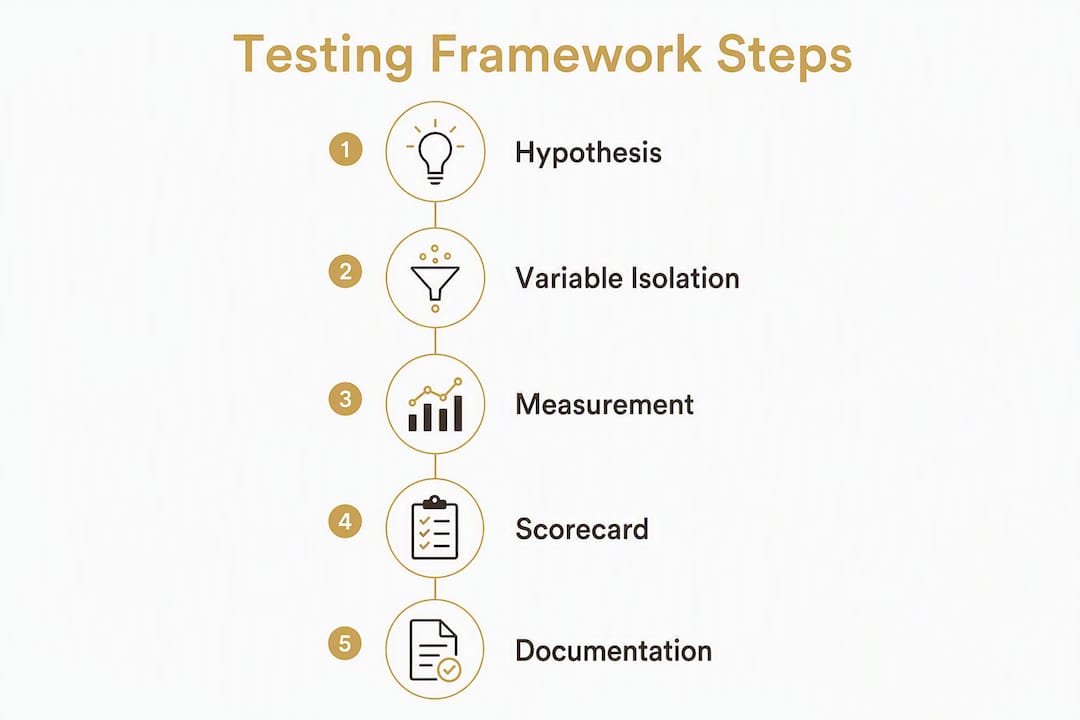
Testing one variable at a time is the rule that makes learnings reproducible. When you change the hook AND the visual AND the CTA simultaneously, you cannot attribute the result to any single element. The prioritized variable hierarchy runs: hook → angle → format → CTA → copy → visual style.
4. Measurement governance
Define your measurement setup before the test goes live. This means UTM parameters, platform-level tracking tags, and a consistent naming convention. A naming convention like [Campaign]_[Audience]_[Variable]_[Variant#]_[Date] takes two minutes to implement and saves hours of post-analysis confusion.
5. A creative scorecard as central documentation
Teams that maintain a creative scorecard and winners library preserve institutional knowledge across personnel changes. The scorecard tracks hypothesis, result, primary metric outcome, secondary metric outcome, and a pass/fail verdict. Without it, teams repeat failed experiments.
How do you design testable creative variants?
The atomic-change rule is simple: change one element per variant. When you need to test a fundamentally different concept (new angle, new offer framing), label it explicitly as a “concept test” rather than an element test — that distinction matters when you read results.
Elements worth testing, in priority order:
- Hook (first 3 seconds): opening line, opening visual, pattern interrupt, question vs. statement
- Thumbnail / opening frame: face vs. product, text overlay vs. clean image, color contrast
- Headline and primary copy: benefit-led vs. feature-led, short vs. long, social proof vs. direct claim
- CTA: button text, placement, urgency framing
- Format: static vs. video, UGC-style vs. polished, short-form (15s) vs. long-form (45s+)
- Offer framing: discount vs. value-add, free trial vs. money-back guarantee
Building a creative matrix — a grid that maps one variable across multiple values — lets you produce many testable variants efficiently without starting from scratch each time.
Example variant table:
| Variant | Hook | Visual | CTA | What changes |
|---|---|---|---|---|
| Control | “Struggling with X?” (question) | Lifestyle shot | “Shop Now” | Baseline |
| Variant A | “Here’s why X happens” (statement) | Lifestyle shot | “Shop Now” | Hook only |
| Variant B | “Struggling with X?” (question) | Product close-up | “Shop Now” | Visual only |
| Variant C | “Struggling with X?” (question) | Lifestyle shot | “Get Yours Today” | CTA only |

Each variant isolates exactly one change. When Variant A outperforms the control, you know the statement hook drove the result.
Pro Tip: Reuse existing footage and static assets across variants. Swap the opening frame, add a text overlay, or re-record a 5-second hook on a phone. Most winning variants come from small changes to proven assets, not entirely new productions.
Which testing method fits your situation?
| Method | Speed to learn | Sample size needed | Budget efficiency | Setup complexity | Best use case |
|---|---|---|---|---|---|
| A/B (two variants) | Moderate | Low-medium | High | Low | Most situations; cleanest signal |
| Split test | Moderate | Medium | High | Low-medium | Audience or placement comparisons |
| Multivariate | Slow | High | Low | High | Large accounts with abundant traffic |
| Holdout | Slow | High | Medium | Medium | Measuring true incremental lift |
| Multi-Armed Bandit (MAB) | Fast | Medium | Medium-high | Medium | Rapid optimization when speed > purity |
Recommendation rules:
- Low-traffic account (under 50 conversions/month): Run A/B tests with upper-funnel signals (hook rate, CTR) as proxies. Do not wait for conversion-level significance — you will never get there.
- High-traffic discovery phase: A/B or split tests with conversion-level KPIs. Clean, controlled, and fast enough.
- Rapid optimization with proven winners: Multi-Armed Bandit. MAB shifts budget toward better performers in real time, which accelerates learning but introduces selection bias. Accept that tradeoff consciously.
- Multivariate: Only when you have enough daily conversions to reach significance across every combination. Most accounts do not.
Statistical caution: When a platform’s algorithm shifts budget toward a leading variant mid-test, it biases the result. ABO (ad set budget optimization) gives each variant equal spend and prevents the algorithm from picking a winner before you have enough data. Use ABO for testing; switch to CBO only after a winner is confirmed.
What are the statistical guardrails for declaring a winner?
Declaring a winner too early is the most common and most expensive mistake in creative performance assessment. Here are the thresholds to enforce.
Recommended minimums before reading results:
- Hook rate / CTR tests: minimum 1,000 impressions per variant, ideally 2,000+. These are high-frequency signals and reach significance faster.
- CVR tests: minimum 30–50 conversion events per variant before drawing conclusions. Fewer than that and variance dominates the signal.
- CPA / ROAS decisions: minimum 50 conversions per variant, run across at least 7 days to smooth day-of-week effects.
- Run duration: 3–7 days minimum for hook and CTR signals; 7–14 days for conversion-level decisions. Cap tests at 21 days — beyond that, creative fatigue and seasonal drift contaminate the data.
- Statistical confidence: aim for 95% confidence before declaring a winner on conversion metrics; 90% is acceptable for upper-funnel directional tests.
Avoid “early peeking.” Checking results daily and stopping a test the moment one variant leads is the fastest way to generate false positives. Set your end date before the test launches and do not act until you hit both the time threshold and the conversion minimum.
Pro Tip: For low-volume accounts, use a two-stage approach: run upper-funnel signals (hook rate, CTR) for the first 5 days to eliminate obvious losers, then extend the surviving variants for a full 14-day conversion window. This stretches your budget further without sacrificing rigor.
Significance check: A result that looks like a 30% CPA improvement on 12 conversions is noise, not signal. Require the minimum conversion threshold before any budget decision.
How do you run tests at scale without breaking your campaigns?
Continuous testing requires an operational structure, not just a testing philosophy. Here is how to build one.

Budget allocation
Practitioners commonly divide budgets into three buckets: proven winners, active tests, and experimental concepts. The exact percentages vary by account, with some advocates for a 70%/20%/10% split and others pushing toward a more aggressive 60%/30%/10% approach, but maintaining a dedicated slice for experiments is crucial to avoid stagnation on fatigued creatives.
Campaign structure
- Use ABO for all active tests. One ad set per variant, equal budgets, same audience, same placement settings.
- Prevent audience cannibalization by running test variants inside a single campaign rather than separate campaigns. Separate campaigns compete in the same auction and skew delivery.
- After a winner is confirmed, migrate it to your scaling campaign (CBO) as a standalone ad set.
Naming convention template:
[Brand]_[Campaign type]_[Audience segment]_[Variable tested]_[Variant ID]_[Launch date]
Example: BrandX_TEST_LLA1pct_Hook_V2_20260601
Operational cadence:
- Set a weekly test pipeline meeting (30 minutes) to review live tests and queue the next batch.
- Aim for 2–4 new test variants per week at minimum. More is better if production allows.
- Rotate test focus by week: hooks one week, formats the next, offer angles the week after. This prevents the team from over-indexing on one variable.
- Keep a running test log with status: queued, live, concluded, scaled, archived.
How do you analyze results and decide what to do next?
Every test ends in one of three decisions: declare a winner and scale, iterate further, or kill the concept. Here is the decision flow.
Decision checklist:
- Primary metric hit the pre-defined threshold? If no, extend or kill.
- Secondary metric healthy (no alarming regression)? If no, investigate before scaling.
- Statistical confidence reached? If no, extend the run.
- Business outcome aligned (does the CPA fit your target margin)? If no, the creative wins the test but fails the business — do not scale.
Read metrics in funnel order:
Hook rate → hold rate → CTR → CVR → CPA/ROAS. A drop at any stage tells you where the creative breaks down. High hook rate but low CTR means the opening grabbed attention but the body copy failed to convert interest. High CTR but low CVR usually points to a landing page mismatch, not a creative problem.
Contradictory signals and how to resolve them:
- CTR up, CVR down: the creative attracts the wrong audience. Check audience overlap and landing page alignment.
- CPA improved, ROAS flat: check average order value. A lower CPA on smaller orders is not a ROAS win.
- Variant wins on mobile, loses on desktop: segment the result and scale on the winning placement only.
Reporting snippet template (include in every result summary):
- Test name and hypothesis
- Run dates and total spend per variant
- Primary metric result (with % difference and confidence level)
- Secondary metric result
- Decision: scale / iterate / kill
- Key learning in one sentence
- Recommended next test
Champion vs. challenger: once a winner is confirmed, it becomes the champion. Every subsequent test runs a challenger against it. Never retire a champion without a confirmed replacement.
How do you scale a winning creative without losing performance?
Moving a creative from test budget to scaling budget is where most teams lose the gains they just earned.
Ramp checklist:
- Increase budget in increments of no more than 20–30% every 48–72 hours. Larger jumps reset the algorithm’s learning phase and spike CPAs.
- Hold a small audience segment out of the scaled campaign for the first week. If performance holds in the holdout, the lift is real.
- Verify CPA and ROAS at each budget step before proceeding. A creative that hits $25 CPA at $100/day may deliver $45 CPA at $500/day — the algorithm needs time to find efficient inventory at scale.
- Do not change the audience and the creative simultaneously when scaling. If performance drops, you will not know which change caused it.
- Do not migrate immediately to CBO. Confirm performance in ABO at the new budget level first, then move to CBO.
Preventing creative fatigue:
Track frequency alongside performance metrics. When frequency climbs above 3–4 for a cold audience and CPA starts rising, the creative is fatiguing. Schedule a refresh test before performance collapses, not after. Feed proven winners back into the creative matrix: swap the hook, update the offer, or recut the opening frame. You are not starting over — you are extending the life of a proven concept.
Templates and proof points you can use right now
Copyable test brief template:
- Hypothesis: IF we change [element], THEN [metric] will improve BECAUSE [reason]
- Primary KPI: [metric + target threshold]
- Secondary KPI: [metric + acceptable range]
- Variants: Control + [Variant A description] + [Variant B description]
- Minimum thresholds: [impressions for upper-funnel / conversions for lower-funnel]
- Budget per variant: $[amount]/day
- Audience: [segment name + size]
- Run duration: [start date] to [end date]
- Tracking tags: [UTM parameters + platform tags]
Result summary template:
- Test name / hypothesis
- Run dates + spend per variant
- Primary metric: [result + % lift + confidence level]
- Secondary metric: [result]
- Decision: Scale / Iterate / Kill
- One-sentence learning
- Next test recommendation
Winners library schema (fields to tag every winning creative):
- Creative ID and name
- Hook type (question / statement / social proof / shock)
- Format (static / video / UGC / carousel)
- Offer angle
- Audience segment
- Primary metric result
- Date confirmed
- Current status (active / fatigued / archived)
- Notes on what made it work
Teams that document this way build a searchable asset base that accelerates every future brief. When a new campaign launches, the library answers “what has worked for this audience before?” in minutes rather than weeks.
For attribution and measurement tooling that integrates with this kind of winners library, the comparison of Hyros vs Triple Whale covers which platform fits creator launch campaigns best.
What goes wrong in creative testing and how do you fix it?
Common pitfalls:
- Testing too many variables at once: isolate one element per variant or results are unreadable.
- Stopping tests too early: enforce the minimum conversion threshold before any decision.
- Audience cannibalization: run variants inside one campaign with ABO, not across separate campaigns.
- Optimizing for CTR alone: always pair with a conversion metric or you will scale creatives that do not sell.
- Ignoring the learning phase: platform algorithms need 3–7 days to stabilize delivery; results in the first 48 hours are unreliable.
- No documentation: without a winners library, teams repeat failed experiments and lose institutional knowledge when people leave.
Quick-fix table:
| Symptom | Likely cause | Immediate action |
|---|---|---|
| Noisy, inconsistent results | Sample size too low | Extend test duration or raise minimum threshold |
| Both variants perform the same | Variable change too small | Test a more distinct element (hook vs. CTA swap) |
| Winner degrades after scaling | Budget jump too large | Roll back spend; increase in 20–30% increments |
| CPA spikes after audience change | Two variables changed at once | Revert one change; retest with single variable |
| High CTR, low CVR | Creative attracts wrong audience | Check audience targeting and landing page alignment |
| Results vary wildly by day | Day-of-week effect | Extend run to cover two full weeks |
When to stop a test: stop early only if one variant is catastrophically underperforming (CPA 3x+ the target with sufficient sample size). Otherwise, let it run to the pre-set end date. When to restart: if you discover mid-test that the audience overlapped, the naming was wrong, or a tracking tag fired incorrectly — stop, fix the structure, and relaunch cleanly. A contaminated test produces no usable learning.
Key Takeaways
A creative testing framework only compounds in value when every test is documented, every winner is tagged, and the next brief starts from what the last one proved.
| Point | Details |
|---|---|
| Isolate one variable per test | Changing one element at a time is the only way to attribute results to a specific creative decision. |
| Enforce conversion minimums | Require at least 30–50 conversions per variant before declaring a lower-funnel winner to avoid false positives. |
| Use ABO for tests, CBO for scaling | ABO gives each variant equal budget; migrate to CBO only after a winner is confirmed. |
| Build a winners library | Tagging every winning creative with hook type, format, and result turns testing into a compounding institutional asset. |
| Money-plug applies this system | Money-plug runs documented test cycles and winners-library buildouts for creator launches, including campaigns that returned 18x on ad spend. |
Why testing is a compounding asset, not a one-time project
Most teams treat creative testing as something you do when performance drops. That framing is the problem. A test run in isolation produces one data point. A test run as part of a documented, ongoing system produces a library that makes every future brief faster, cheaper, and more likely to succeed.
The organizational piece is what most guides skip. Assign one person as the testing owner — not the person who makes the creative, but the person who writes the briefs, enforces the thresholds, and maintains the winners library. When that role rotates without a handoff document, the institutional knowledge walks out the door. The library stays; the context disappears.
Protect the library with a simple rule: no test is complete until the result summary is filed. Not “filed when there’s time.” Filed before the next test launches. That discipline is what separates teams that compound learnings from teams that run the same experiment three times in two years because nobody remembered the first result.
Ready to run cleaner tests and scale faster?
Money-plug runs managed creative test cycles for digital creators and performance advertisers who need results without building the infrastructure from scratch. The agency handles the full loop: test brief writing, variant production, ABO campaign structure, statistical analysis, and winners library buildout — on a pure revenue share basis with no upfront cost.
If your account is spending more than $3,000/month on paid ads and you do not have a documented winners library, that is the audit trigger. If you are scaling a creator launch and your CPA is climbing without a clear creative hypothesis to test against it, that is the scale trigger. Money-plug’s team has managed launches that generated over 3,000 sales in ten days and campaigns returning 18x on ad spend — these results are achieved through their documented testing process.
Book a free creative audit at money-plug.com to get a structured review of your current creative setup and a prioritized test roadmap.
Useful sources and further reading
- Creative Testing Framework — Benly: — A structured overview of hypothesis-first testing, statistical thresholds, and documentation practices. Useful as a framework checklist reference.