Creator Brand Positioning: How to Own a Clear Niche
Creator Brand Positioning: How to Own a Clear Niche

Creator brand positioning is the decision about who you serve, what outcome you deliver, and why you are the credible choice over the alternatives your audience already has. You make that decision before you write a caption, shoot a video or price a program. This guide walks through the process step by step, with a positioning statement you can fill in today and tests to check it against real followers.
TL;DR
- Positioning is a choice about where you sit in your audience’s mind relative to the alternatives. It is not a logo, a bio or a tagline.
- A usable statement names one audience, one outcome, one method and one reason to believe you.
- Test it before you build on it: ask ten followers, run different angles in content for two weeks, and watch comments, saves and shares.
- Positioning comes before the paid offer. Pricing, sales copy and ads all inherit whatever clarity (or confusion) you start with.
- Broad positioning feels safe and sells poorly. Narrow it first, then expand into adjacent topics.
Table of Contents
- What creator brand positioning actually means
- Why positioning matters before you launch a paid offer
- Step 1: Find your audience, their needs and their alternatives
- Step 2: Choose a positioning type
- Step 3: Write your positioning statement
- Step 4: Test the position before you build on it
- Step 5: Put the position to work across your content
- Common positioning mistakes and how to fix them
- Work with us on your launch
- FAQ
- Sources
What creator brand positioning actually means
A creator’s position is the answer to one question: why would this specific person follow, trust and pay you instead of the other ten accounts in the same space?
The American Marketing Association describes positioning as how a brand communicates its value in a way that resonates with its audience, and recommends starting a marketing plan with positioning before you define audience segments, campaigns or channel tactics. For a creator, that order matters more than for most businesses. Your content is your marketing, so every post either reinforces a position or blurs it.
Harvard Business School Online frames positioning as connecting customer value with a credible difference. Two parts are easy to miss:
- The promise has to be distinct from what alternatives offer.
- It has to be backed by reasons to believe.
A creator who says “I help people get fit” has neither. A creator who says “I help new mothers in Munich rebuild core strength in 20 minutes a day, using the protocol that rebuilt mine after two C-sections” has both.
Positioning vs. differentiation, value proposition and messaging
These four terms get mixed up constantly, and mixing them produces muddled content. Keep them in order:
| Term | What it is | Creator example |
|---|---|---|
| Positioning | The decision about where you sit in your audience’s mind relative to alternatives | The no-nonsense strength coach for busy parents |
| Differentiation | The proof that the position is real | Your method, your results, your format |
| Value proposition | The specific benefits you promise | Three home workouts a week, no equipment, visible progress in 8 weeks |
| Messaging | The words and content that carry all of the above | Hooks, captions, sales page, video scripts |
This split follows how one agency breaks the four layers apart: positioning is the decision, differentiation is the structural proof, and branding is the impression that accumulates over time. Messaging only works once the first two are settled. When creators skip straight to messaging, they end up rewriting hooks endlessly because the foundation underneath keeps shifting.
Why positioning matters before you launch a paid offer
Free content can survive on charm. A paid program cannot. When someone hands over money, they need to know in seconds that the product is for them, what it will change, and why you are the person to trust with it.
Three things break when positioning is weak:
- Pricing. If you look interchangeable with other creators, the market sets your price at the bottom of the range. A clear position gives you a reason to charge for the outcome. For more on that decision, see our breakdown of high ticket vs low ticket offers.
- Copy. Sales pages and video sales letters need a single sharp promise. Frameworks help, and our guide to copywriting frameworks for creators shows which to use when, but no framework rescues an unclear promise.
- Ad performance. Paid traffic is brutal on vague messaging. A cold viewer gives you a couple of seconds, and they only stay if the first line speaks to them directly.
One marketing consultant observes that many organizations invest in content and campaigns before establishing a market position, which leads to inconsistent messaging and weak differentiation. Creators do the same thing at a smaller scale: they post for two years, then try to build a product on a feed that never said one clear thing.
Positioning also protects you from the wrong deals. Once you know your audience promise, saying no to a sponsor, collaboration or product idea that contradicts it becomes simple.
Step 1: Find your audience, their needs and their alternatives
Positioning is relative, so you need three inputs before you write anything: who the audience is, what they need, and what they currently use instead of you.
Know who you are talking to
The AMA’s marketing guide says effective audience research covers demographics and psychographics, meaning interests, attitudes and lifestyles, and turns them into buyer personas that represent the ideal customer. For a creator with an existing following, you do not need a survey platform. You have a research lab in your comments and DMs.
Pull these from the last 90 days:
- The ten questions you get asked most.
- The exact words followers use to describe their problem (not your words for it).
- Which posts drew saves and shares, not just likes.
- Who actually buys or enquires, as opposed to who just watches.
That last point catches many creators out. Your most active commenters are not always your buyers. A fitness creator may have a large audience of men in their twenties who love the entertainment but a smaller group of women over 30 who ask about programs. The second group is where the position lives.
Map the alternatives
Your competitors are not only other creators. A follower’s alternatives include free YouTube workouts, a local gym, a generic app, or doing nothing. List five. Next to each, write what it does well and where it leaves your audience stuck. Your position lives in that gap.
Find your angle
One creator-focused guide points out that the way you solve an audience problem can itself distinguish you from peers. Two nutrition creators can serve the same audience and hold completely different positions: one around simple meal templates, another around eating well on a tight budget while living abroad. The angle is the method, the point of view or the lived experience that nobody else can copy.
Step 2: Choose a positioning type
Published guides list different numbers of positioning types, but they overlap heavily. Capterra’s guide covers quality-based, customer-service and price-based strategies. Shopify’s guide names five: price-based, symbolic, experiential, functional and emotional. Here is how those translate for a creator:
| Type | What you stand for | Creator example |
|---|---|---|
| Functional | A specific result delivered by a specific method | “Lose the first 10 kg without cutting out bread” |
| Emotional | How people feel working with you | The coach who makes beginners feel they belong |
| Experiential | The way the program is experienced | Daily voice-note feedback, small group, live sessions |
| Symbolic | Identity the audience wants to wear | The fighter’s mindset, the disciplined athlete |
| Price-based | Access at a lower cost | Entry-level program anyone can afford |
| Audience-based | A specific group | Balkan diaspora professionals in Germany and Austria |
Most strong creator positions combine two: an audience plus a functional promise, or an experience plus an identity. Pick one as the lead. Price-based positioning is the hardest for a solo creator to sustain, because a bigger operator can always undercut you.
Step 3: Write your positioning statement
A positioning statement is an internal document. It is not your bio and nobody outside your team needs to see it. Its job is to make every later decision faster.
Harvard Business School Online offers this template: “For [target market], our brand is the only one among all [competitive set] that [unique value claim] because [reasons to believe]”. It works well for businesses and can feel stiff for an individual. A creator-friendly version follows this shape: “I help [specific audience] achieve [specific outcome] by [unique method] because [credibility].”
Shopify says effective statements normally contain four elements: target audience, category, unique value proposition and reasons to believe. HubSpot advises keeping the statement brief, distinctive, simple and truthful to your core values, and generally no more than three to five sentences.

A worked example
Take a hypothetical personal trainer with 80,000 Instagram followers, mostly Bosnian and Croatian women living in Germany.
- Weak: “I help women get healthy and feel confident.”
- Strong: “I help Balkan women in Germany who work long shifts build strength in 30 minutes a day at home, using a progression I developed over six years of coaching shift workers, because I was one.”
The strong version names the audience, the outcome, the method and the reason to believe. It also quietly excludes people (competitive lifters, men, people with ample time), which is exactly the point. A statement that excludes nobody persuades nobody.
Fill-in-the-blank checklist
Before you move on, answer these in one line each:
- Who is the one person this is for?
- What do they want to change in the next 8 to 12 weeks?
- What do they currently try instead, and why does it fail?
- What is your method, in a phrase they could repeat to a friend?
- What proof do you have (your own story, client results, credentials, years of practice)?
Step 4: Test the position before you build on it
A statement that reads well on paper can still fail in the feed. Test it cheaply.
The follower test
One creator guide suggests testing with ten followers or trying different angles in your content for two weeks, then measuring comments, saves and shares. Send your statement to ten people in your target group. Ask them to repeat it back in their own words. If they cannot, it is too complicated. If they describe a different person than you intended, the signal is blurred.
Three quick filters
A creator-offer guide lists three checks that are easy to run yourself:
- Swap test. Replace your name with another creator’s. If the statement still works, it is not a position.
- Not-for test. Can you say clearly who this is not for?
- Vocabulary test. Does it use the words your audience uses, copied from comments and DMs, rather than industry jargon?
Separate performance tests from brand tests
Testing hooks, pacing and call-to-action placement is a different job from testing your emotional premise or narrative. One 2026 storytelling guide recommends keeping these apart: performance tests run quickly, while brand tests should run longer and be reviewed for coherence. Apply the same logic to your own channel. Change one variable at a time, and judge the position over weeks, not after one post.
Stripe’s guidance on positioning adds a useful warning: positioning should evolve as the business and market change. Revisit your statement after every launch, using real buyer language to sharpen it.
Step 5: Put the position to work across your content
A position only exists if people see it repeatedly. Stripe recommends making positioning specific, clear, authentic, evidence-based and consistent across website, social media, advertising and other communications, as laid out in its positioning guide. For a creator, that translates into a few habits:
- Bio and pinned content. Your profile should say who you help and with what, in one line, and your pinned posts should prove it.
- Content pillars. Choose three or four recurring themes that all serve the position. Anything outside them is a deliberate exception.
- Signature format. A recurring series, teaching style or visual identity makes you recognizable without a name tag.
- Expansion rules. A creator-positioning guide recommends repeating the position in your bio and content, and moving into adjacent topics only after the core association is established. A trainer known for postpartum strength can move to general women’s strength later. The reverse rarely works.
Carry it into the paid program
The program name, the promise on the sales page, the first video of the course, the ad hook and the onboarding message should all use the same language. If your position is “strength in 30 minutes for shift workers,” the product should not be a generic 12-week fitness plan. Pricing is part of the position too: a premium outcome for a precise group supports a premium price, while a mass-market price needs a mass-market audience.
Common positioning mistakes and how to fix them
Being vague. “Lifestyle and wellness” describes a hundred thousand accounts. Fix it by adding an audience and an outcome, as in the worked example above.
Serving everyone. One creator guide lists trying to serve B2B and B2C audiences equally among typical mistakes. The same pattern shows up inside a single niche: a program for beginners and advanced athletes at once helps neither group.
Positioning around yourself, not the audience. “Authentic, passionate and driven” says nothing about what the buyer gets. Move the sentence’s subject from you to them.
Copying a bigger creator. If your statement could belong to someone with a million followers, the swap test fails. Your edge is specificity those larger accounts cannot afford: a city, a diaspora, a life stage, a sport.

Changing position after every slow week. Content takes weeks to compound. Evaluate over a defined window and change one thing at a time.
Launching first, positioning later. This is the most expensive mistake, because it shows up as a failed launch and gets blamed on the ad, the price or the algorithm.
Our perspective
We work with creators across the Balkans and the diaspora, and the pattern we see is consistent: the creators who struggle to sell are rarely short of audience. They are short of a sentence. Followers like them, but nobody could say in one line what they would pay for.
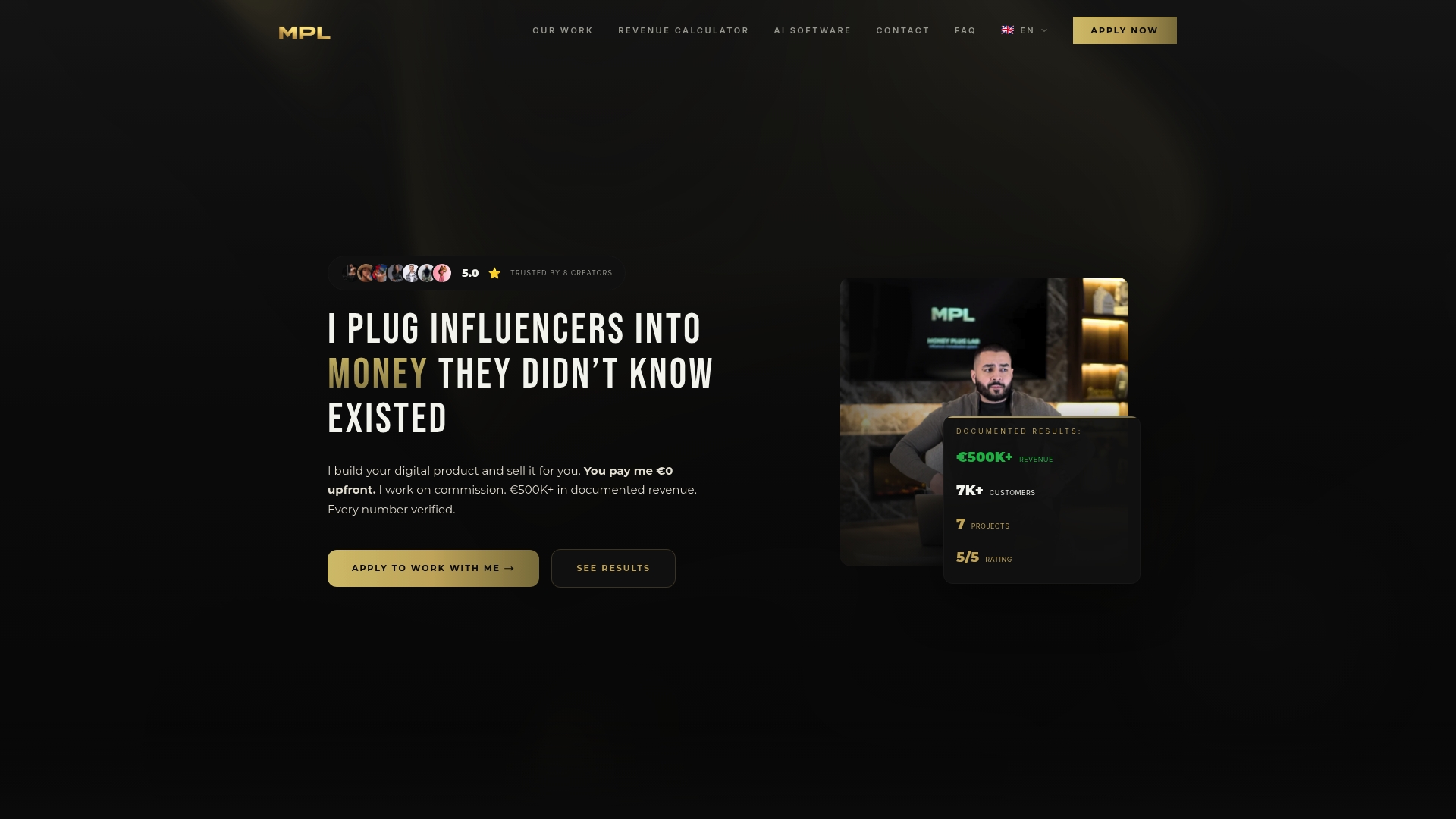
That is why we start every partnership with audience research and product architecture, before pricing, sales copy or a single ad. Our creators have generated over $500,000 in tracked revenue across seven launched programs, including one launch that produced more than 3,000 sales in ten days and a campaign that returned 18x on ad spend. We attribute that less to clever ads than to starting with a clear promise for a clearly defined audience.
We also believe the Southeast European market rewards sharp positioning. Creator audiences there are highly engaged, and a creator who speaks directly to a specific community, whether in Sarajevo, Zagreb, Munich or Vienna, can build trust fast. Our model is revenue share with zero upfront cost, so we only succeed when the position, the product and the launch all work together.
Money
Work with us on your launch
If you already have an engaged following and a sense of your niche but have never sold a product, positioning is where we begin. Money Plug Lab partners with creators on a pure revenue-share basis with zero upfront cost. We handle audience research, product architecture, pricing strategy, sales copy, video sales letters, launch campaigns, payment infrastructure and post-production for paid advertising.
If you want a partner to turn your position into a paid program, explore our digital product monetization service and PlugReach and tell us about your audience.
FAQ
What is the difference between brand positioning and a brand positioning statement?
Positioning is the strategic decision about where you sit in your audience’s mind relative to alternatives. The statement is the short written version of that decision, which guides content, pricing and sales copy. You can have a position without writing it down, but a written statement makes it far easier to stay consistent.
How long should a positioning statement be?
Short enough to remember. HubSpot’s guidance is that it should generally run no more than three to five sentences. For a creator, one or two sentences that name the audience, outcome, method and proof are usually enough.
Should I niche down if I already have a large, mixed audience?
You do not have to abandon existing followers. Pick the segment that engages most and buys most, position the paid offer around them, and keep other content running as supporting material. Expand into adjacent topics only after the core association is established.
How do I know my positioning is working?
Look for people repeating your promise in their own words, rising saves and shares on position-aligned content, and enquiries from the people you intended to reach. If followers describe you differently from how you describe yourself, revisit the statement.
When should I fix my positioning: before or after I build a product?
Before. The product, price, sales page and ad creative all inherit the position, so fixing it afterwards means rebuilding all of them. If you are weighing offer formats, our guide on affiliate commission rates for creators can help you plan how to distribute the product once it is positioned.
Sources
- AMA Marketing Plan Template
- Develop a Winning Marketing Strategy: Step-by-Step Guide (AMA)
- How to Craft the Perfect Brand Positioning Statement (Harvard Business School Online)
- Messaging and positioning strategy (Sim7 Creative)
- Positioning vs. Differentiation vs. Branding vs. Messaging
- THE BRIEF: Positioning, The Creator’s Unfair Advantage
- What Is Brand Positioning? Types & Strategies (Capterra)
- Brand Positioning: Complete Guide With Examples (Shopify)
- Positioning Statement: How to Write One + Examples (Shopify)
- 16 Examples of Positioning Statements (HubSpot)
- Personal Brand Positioning for Creators
- How to Write a Positioning Statement for a Creator Offer
- How to write a positioning statement for your startup (Stripe)
- Creator Positioning: Become Known for One Topic (Kudozz)