High Ticket vs Low Ticket: Which Offer Should a Creator Sell?
High Ticket vs Low Ticket: Which Offer Should a Creator Sell?

A low-ticket offer is a cheap product sold to many people, usually through an automated funnel. A high-ticket offer is a premium program sold to a few people, usually with more personal contact. Neither is better in the abstract. The right choice depends on your audience size, how much trust you have built, and how many hours a week you can give to customers. This guide gives you the price ranges people use, the real trade-offs, and a simple way to decide.
TL;DR
- There is no official price cutoff. Guides put “high ticket” anywhere from $500 to $5,000 and up, so define it by your own market.
- Low ticket wins on volume, speed and ease of buying. High ticket wins on revenue per customer and on how few buyers you need.
- Low ticket needs a big, warm audience and good ads or content. High ticket needs trust, a clear result, and time for support or sales calls.
- Most creators do best with a ladder: a low-ticket entry product that leads to a premium program or recurring community.
- Pick based on audience, expertise and capacity, not on what is fashionable.
Table of Contents
- What “high ticket” and “low ticket” actually mean
- Examples of each for creators
- How the two models differ in practice
- Costs, margins and customer expectations
- Which one fits you: five questions
- Combining both: the offer ladder
- Our perspective
- How we help creators launch either model
- Common mistakes when choosing a price tier
- FAQ
- Sources
What “high ticket” and “low ticket” actually mean
The words describe price, but also the kind of buying decision. A $19 template is an impulse purchase. A $2,000 coaching program is a decision someone sleeps on, asks questions about, and sometimes discusses with a partner.
There is no regulated or industry-standard line between the two. Published guides disagree, and the disagreement is the useful part:
| Source type | Low ticket | Middle | High ticket |
|---|---|---|---|
| Mainstack digital product pricing guide (2025) | Under $50 | $50 to $200 | $500 or more |
| Kit creator guide (updated 2024) | n/a | n/a | $1,000 or more as a starting point |
Other writers set high ticket at $5,000 and above, especially in consulting and B2B. Dropshipping and e-commerce writers use a much lower threshold again. So when someone says “high ticket,” ask: high compared with what, for whom?
A practical rule for creators: an offer is high ticket when the price is high enough that the buyer expects personal attention, proof and a clear outcome. Kit makes a similar point: what makes an offer high ticket is the mix of substantial value to the customer and a premium price, not price alone. Charging $1,500 for a PDF does not make it high ticket. It makes it overpriced.
Examples of each for creators
It helps to see what sits at each level. According to a Forbes roundup of digital products, typical low-ticket items include templates at $19 to $97, ebooks at $10 to $30, and mini-courses at $47 to $297. High-ticket offers include 1:1 coaching, intensive masterminds and done-for-you services in the $1,000 to $5,000-plus range.
Translated into creator niches:
Fitness and nutrition
- Low ticket: a 4-week home workout plan, a meal-prep guide, a recipe ebook.
- High ticket: a 12-week coached transformation with weekly check-ins, a small-group program with live calls.
Beauty and makeup
- Low ticket: a DIY makeup tutorial pack, a product-routine guide.
- High ticket: a certification-style course with feedback on your work, or a premium community with live sessions.
Combat sports and coaching
- Low ticket: a technique video library.
- High ticket: a training camp program, private coaching, or a paid inner circle.
Wellness
- Low ticket: a 7-day reset challenge.
- High ticket: a long-term habit program with personal accountability.
Notice that many offers can live at either level. The same knowledge can be a $29 video pack or a $1,200 guided program. What changes is the support, the specificity of the result, and the access to you.
How the two models differ in practice
The differences go beyond the price tag. They shape how you market, how you sell and how your week looks.
| Low ticket | High ticket | |
|---|---|---|
| Buyers needed for a given revenue | Many | Few |
| Typical sales path | Automated funnel, short cycle | Conversation or application, longer cycle |
| Decision speed | Minutes to days | Days to weeks |
| Support per customer | Light, mostly self-serve | Heavy, personal |
| Audience needed | Large and warm | Smaller but high-trust |
| Main risk | Low conversion, ad costs eat margin | Few leads, slow sales, burnout |
| Scalability | High if automated | Limited by your time unless you build a team |
One creator-focused guide describes low-ticket models as relying on high volume, automated funnels and short sales cycles, while high-ticket models rely on lower volume, consultative selling such as discovery calls, and more attention to each client’s transformation.
A worked example with simple numbers
These figures are illustrative, not benchmarks. Say you have 50,000 followers.
- Low-ticket route: you sell a $29 program. If 1% of followers buy, that is 500 sales and $14,500.
- High-ticket route: you sell a $1,500 coached program. Ten clients bring in $15,000.
The revenue is similar, but the work is not. The first needs a funnel, a sales page, traffic and payment infrastructure that handles hundreds of orders, plus customer service at volume. The second needs ten good conversations, ten onboarded clients, and a lot of your attention for weeks. Neither number is guaranteed. Conversion rates depend on your audience, your offer and your price.
Now change one variable. If your audience is 5,000 people instead of 50,000, the low-ticket route yields 50 sales and $1,450 at the same 1% rate. The high-ticket route might still produce a handful of clients if the trust is deep. This is why small, loyal audiences often lean high ticket, and large, casual audiences often lean low ticket.
Costs, margins and customer expectations
Price changes what customers expect. At $29, people accept a self-guided product. At $1,500, they expect answers, feedback and results. Teachable’s guide notes that premium offers should focus on saving time, increasing revenue or providing an edge, selling transformation instead of a list of features.
Compare the real costs on both sides:
- Low ticket: cheap to produce once, but acquisition cost matters a great deal. If you pay for ads, a $29 product leaves little room. Refund requests and support tickets add up with volume.
- High ticket: more of your time per customer, but fewer customers means fewer refunds to process and a bigger margin per sale. The cost is mostly hours: calls, feedback, onboarding.
Some online sources publish exact support-hour and refund-rate averages for each tier. Treat those as rough claims, since they rarely say how they were measured. Track your own numbers from your first launch instead.
The biggest cost people miss is time. If a high-ticket client takes three hours of support a month, ten clients is thirty hours. That is a part-time job on top of content creation and training clients, if you are a trainer.
Which one fits you: five questions
A creator’s choice depends on their market, their audience’s buying capacity, their ability to nurture leads and the kind of experience they want to deliver, as one guide to the two models frames it. Turn that into five questions.
- How big and warm is your audience? If you have 100,000 or more engaged followers who ask you for plans, low ticket can work well. If you have 5,000 who message you daily, high ticket may fit.
- Where does your audience live? Purchasing power differs a lot by country. A price that feels normal in Germany may be out of reach in other markets, and the reverse is also true. Price for the audience you actually have.
- Can you deliver a specific result? High ticket needs a clear promise, such as “lose 10 kg in 12 weeks” or “launch your first paid client.” A vague promise sells at low prices only.
- How many hours can you give? Be honest. If you travel, compete or train clients already, a high-touch program may not fit.
- Do you want to sell in conversations or through content? Some creators love calls. Others do their best work on camera and prefer a page that sells for them.
If you answered “large audience, little time, no love of sales calls,” start low ticket. If you answered “small loyal audience, expertise, time for people,” start high ticket. If it is mixed, build a ladder.
Combining both: the offer ladder
The either-or framing is a bit of a trap. Many creators run both, with the cheap product feeding the expensive one.

Teachable describes tiered pricing in which a $97 digital product sits beside a $500-plus package with consulting or implementation help, and a $2,000-plus done-for-you service sits at the top. A real-world version appears in a case study of a virtual assistant training business, whose program ladder runs from a $9.99 starter program through a $297 blueprint and a $397 skills course to a $544 bundle.
A creator ladder might look like this:
- Free: content, a lead magnet or a challenge.
- Entry, $19 to $49: a short plan or guide that delivers one quick win.
- Core, $97 to $297: the full self-paced program.
- Premium, $1,000 and up: coaching, a small group or a done-with-you version.
- Recurring: a paid community or membership for people who finish and want to continue.
The entry product does three jobs: it earns a little money, it shows you who is a real buyer, and it makes the next step an easy yes. Anyone who buys at $29 and gets a result is far more likely to consider $1,000 than a cold follower is.
Order matters. Do not launch the premium tier first if your audience has never bought from you. Start with the offer that proves demand, then add the next rung.
Our perspective
We work with fitness, beauty, wellness and combat sports creators in the Balkans and the Balkan diaspora, and we have watched creators agonize over this choice. Our view is simple: most first-time creators over-think price and under-think the audience.
We have seen what a well-built low-ticket launch can do with an engaged regional audience. Our creators have generated over $500,000 in tracked revenue across seven launched programs, including one launch with more than 3,000 sales in ten days and a campaign that returned 18x on ad spend. Those results came from volume at accessible prices, in markets where creator audiences are engaged and acquisition costs are a fraction of Western markets. That is why we often begin creators with a strong core digital program, then add premium and recurring layers once we see who buys.
Three things we would tell any creator:
- Test demand before you build. Audience research comes first. What your followers ask for in comments and messages tells you more than any pricing guide.
- Do not carry the whole risk alone. A launch needs product design, pricing, sales copy, a video sales letter, payment setup and ad management. That is a lot for one person who also has to create content.
- Protect your time. High ticket sounds glamorous, but if it eats your week it may pay less per hour than a well-run funnel.
The right answer is the one you can deliver well, repeatedly, to the people who already listen to you.
— Money
How we help creators launch either model
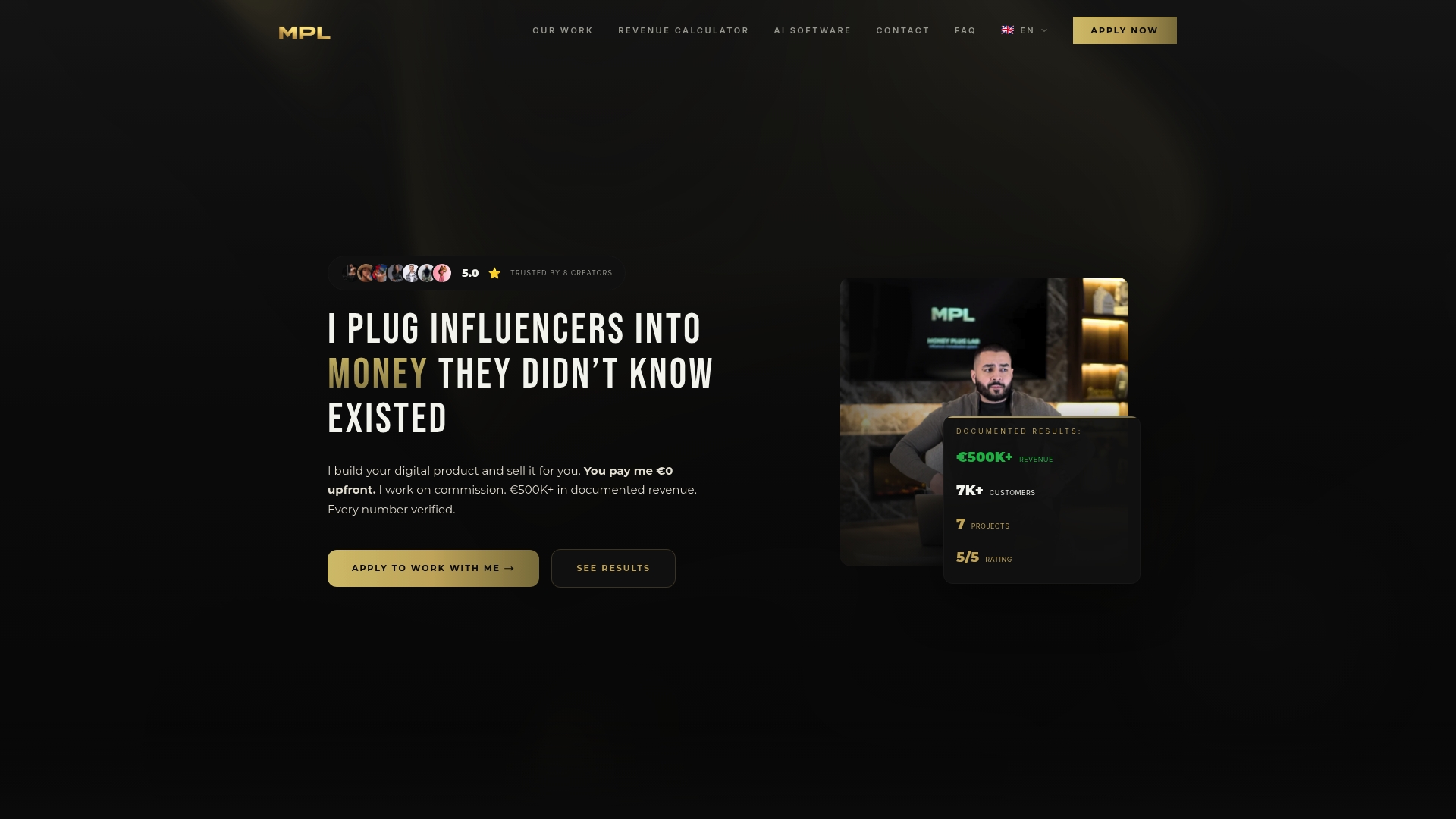
If you have an audience but have never sold a product, the hardest part is rarely the idea. It is turning the idea into a product, a price, a page and a campaign that works together. At Money Plug Lab we handle audience research, product architecture, pricing strategy, sales copy, video sales letters, launch campaigns, payment infrastructure and post-production for paid advertising. We work on a pure revenue-share basis with zero upfront cost to the creator, so we only earn when your product sells.
If you want to see whether a low-ticket launch, a premium program or a ladder fits your following, you can learn more about digital product monetization with PlugReach and tell us about your audience.
Common mistakes when choosing a price tier
- Copying another niche’s price. A fitness plan priced like a business course will not sell to the same crowd.
- Going high ticket with no proof. Premium buyers want results to look at. Collect a few testimonials first, often from a cheaper offer.
- Going low ticket with no traffic plan. A $19 product needs a lot of eyes. Without a content or ad engine, it sits unsold.
- Forgetting delivery time. Selling ten premium spots is easy to promise and hard to deliver alongside everything else.
- Treating price as the only variable. The promise, the proof and the page matter at least as much.
- Ignoring the follow-up. Whatever someone buys first, show them what comes next.
FAQ
Is there a standard price that makes something high ticket?
No. Guides range from $500 or more to $1,000 or more, and some set it at $5,000 and above. Pick a definition that matches your market: if your usual product sells for $30, a $500 program already sits at a very different level.
What are examples of low-ticket items for creators?
Common examples are templates, ebooks, short video packs and mini-courses, typically priced from about $10 to a few hundred dollars. In fitness that means a workout plan or meal guide. In beauty, a tutorial pack.
Can I sell both high ticket and low ticket?
Yes, and many creators do. A low-ticket product brings in buyers and builds trust, then a premium coaching tier or paid community serves the people who want more help. Launch the lower tier first to prove demand.
Is high ticket better for small audiences?
Often, because you need fewer buyers to reach a revenue goal. But it only works if your audience trusts you and you can deliver a clear result. A small audience that does not know you will not buy at a high price either.
Which is easier for a first-time creator?
Low ticket usually has a lower barrier for buyers, and it gives you data fast. High ticket can be quicker to profit if you have a loyal following and enjoy one-on-one work. Your capacity and audience decide it.
Sources
- Kit: Create and sell one high-ticket offer
- Mainstack: The complete guide to pricing your digital product
- Forbes: 11 digital products you can start selling now
- Teachable: The ultimate guide to selling high-ticket offers
- Teachable: How Erin Booth built a multi-program VA training business
- The complete high ticket vs. low ticket guide