How to Build a Creator Funnel Strategy That Converts
How to Build a Creator Funnel Strategy That Converts

A creator funnel strategy is a stage-based system that moves strangers from platform content into owned channels (email, DMs, paid community) and then into increasingly higher-value purchases. The one-line plan: publish short discovery content with a single CTA → capture email or DM contact with a relevant lead magnet → convert with a low-friction entry offer → scale to mid and high-ticket programs.
The four-stage framework that drives this is Discovery → Trust → Access → Purchase. Each stage has a different job, a different content format, and a different CTA. Skipping stages is the most expensive mistake a creator can make.
Here is what you need to build it:
- One discovery channel (Reels, Shorts, TikTok) with a curiosity-driven CTA on every post
- One lead magnet that earns an email address or DM reply
- A 5-email bridge sequence that warms the new subscriber before any offer
- A low-friction entry offer (paid challenge, mini-course, or template pack) to create the identity shift from follower to buyer
- A mid and high-ticket back-end for buyers who want more
Key Takeaways
A creator funnel strategy works when every stage has a specific content format, a precise CTA, and an offer that matches the trust level of the audience at that moment.
| Point | Details |
|---|---|
| Stage alignment is non-negotiable | Map every content piece to Discovery, Trust, Access, or Purchase before you publish. |
| Own the contact before you pitch | Capture email or DM in the Access stage; platform reach is rented, your list is owned. |
| Entry offers create buyers | A low-friction tripwire (paid challenge or mini-course) converts followers into buyers who are far more likely to purchase mid-ticket offers. |
| Measure one stage at a time | Run the weekly diagnostic table and fix the leakiest stage before adding new content or offers. |
| Money-plug builds it for you | Money-plug’s revenue-share model covers end-to-end funnel build and launch with zero upfront cost to the creator. |
Table of Contents
- Why a creator funnel strategy matters more than follower count
- The 4-stage creator funnel: what to publish and what to say at each stage
- How to run an Instagram-native funnel from feed to sale
- How to design an offer stack that matches trust at every stage
- What to measure at each stage of your funnel
- Your 90-day sprint to launch a working creator funnel
- Trust velocity: why DM conversations convert faster than landing pages
- Money-plug’s take on what actually works in creator funnels
- Money-plug builds the funnel so you can focus on the content
- Sources
Why a creator funnel strategy matters more than follower count
Follower count is a vanity metric. Revenue per follower is the number that actually tells you whether your content is working as a business. A creator with 8,000 highly engaged email subscribers will consistently out-earn a creator with 200,000 Instagram followers who sends all traffic to a single link-in-bio page with no capture mechanism.
The business case for building a funnel comes down to three things:
- Predictable revenue. A funnel with a working email bridge and a low-ticket tripwire produces revenue on a schedule, not just during launch spikes.
- Platform resilience. Algorithms change. Accounts get restricted. An owned email list or SMS audience is yours regardless of what Instagram or TikTok decides next quarter.
- Higher lifetime value. A buyer who entered through a $37 challenge is far more likely to purchase a $497 course than a cold follower who saw one Reel. The funnel compounds trust into dollars.
The operating principles that separate funnels that work from ones that stall are straightforward. Map every piece of content to a specific stage. Own the relationship by capturing email, DM, or SMS before you pitch anything. Design offers that match the trust level of the audience at that moment. And measure stage by stage, not just total revenue.
The most common mistake is treating the funnel as a revenue squeeze rather than a service layer. Creators who push cold followers directly to a high-ticket coaching offer skip the trust-building that makes the sale possible. The funnel’s job is to earn the right to make each successive ask.
Pro Tip: *Before you build anything, audit your current content against the four stages.
The 4-stage creator funnel: what to publish and what to say at each stage
The Discovery → Trust → Access → Purchase architecture gives every piece of content a job. Here is what that looks like in practice.
Discovery: get found by the right people
Short, free, high-volume content. Reels, YouTube Shorts, TikTok clips, X threads, and community posts. The goal is reach, not depth. Your CTA at this stage is low-friction: “Save this,” “Follow for part 2,” or “Comment ‘guide’ and I’ll send you the full breakdown.”
Do not pitch anything here. Discovery content earns attention; it does not close sales.
Trust: turn attention into belief
Longer, value-dense content. Long-form YouTube videos, podcast episodes, detailed newsletters, and blog posts. This is where you demonstrate expertise and let the audience spend real time with you. The CTA shifts: “Subscribe to my newsletter,” “Watch the full video,” or “Join my free community.”

Brainchild360’s creator funnel framework identifies the email bridge as the most common failure point in this stage. Creators either skip it entirely or write one generic welcome email and wonder why nobody buys. A 5–7 message automated sequence, sent over the first week after opt-in, is what converts a curious subscriber into a warm lead.
Access: capture ownership of the relationship
This is the conversion mechanic that most creators underestimate. Lead magnets, comment-to-DM flows, gated mini-courses, and newsletter opt-ins all serve the same purpose: they trade value for a contact you own. The CTA is explicit: “Comment ‘free guide’ below and I’ll DM it to you,” or “Drop your email and I’ll send the template.”
Capture both email and a micro-commitment at this stage. Someone who replies to your DM, answers a question, or completes a short quiz has already invested attention. That investment predicts purchase behavior better than a passive opt-in.
Purchase: convert buyers at the right price point
CommuniPass’s 2026 monetization guide makes a strong case for paid challenges (7–21 days, low cost) as the entry product of choice. They produce completion rates that translate directly into mid-ticket conversions. The CTA at this stage is a checkout or application link: “Grab the 7-day challenge for $27,” or “Apply for the group program.”
After the entry offer, mid-ticket recurring memberships and high-ticket bespoke offers follow naturally for buyers who want more.
Pro Tip: Write your CTAs before you write your content. Knowing the exact next step you want the reader to take shapes every sentence that comes before it.
How to run an Instagram-native funnel from feed to sale
Instagram is the most DM-native platform for creator sales, and the funnel architecture reflects that. The five-stage Instagram sales funnel moves from Reels awareness through comment triggers, DM capture, and human-assisted close.
Here is the operational playbook:
- Cadence: 3+ Reels per week, daily Stories, one Live per week minimum. Every piece ends with a specific comment CTA, not a generic “link in bio.”
- Comment trigger: Post a Reel with a CTA like “Comment ‘GUIDE’ and I’ll DM you the free breakdown.” When someone comments, an automated reply fires immediately.
- DM flow: The automated DM delivers the lead magnet and asks for an email address to send the full resource. Once the email is captured, the subscriber enters your bridge sequence.
- Decision stage: For low-ticket offers (under $100), automation handles the close with a checkout link in the DM sequence. For mid and high-ticket offers, a human takes over. AIGrow recommends a response SLA of under 5 minutes at the decision stage for consultative sales.
The conversion math here is meaningful. CreatorFlow’s data shows that an automated comment-to-DM funnel with email capture and a 5-day nurture sequence can push conversion rates from low single digits toward 15–25%. That gap is the difference between a creator who posts and hopes and one who posts and converts.
Tools to consider for comment automation include ManyChat (the most widely used for Instagram) and Manychat alternatives that integrate with your email platform. The tool stack for a basic Instagram funnel runs around $15–$50 per month depending on your contact volume.
Shopify’s Instagram funnel guide adds a layer most creators miss: UTM tagging on every link in your DM sequences and Stories swipe-ups. Without tracking, you cannot tell which Reel drove the most opt-ins or which DM sequence produced the most buyers.
Pro Tip: Set your comment trigger to a specific keyword, not “DM me.” A keyword trigger (like “GUIDE” or “PLAN”) filters for people who read the CTA, which means higher intent and better conversion downstream.
How to design an offer stack that matches trust at every stage
The offer architecture problem most creators face is not a lack of ideas. It is misalignment between what they are selling and how much trust the buyer has at that moment.
CommuniPass frames this as a four-level architecture: Aware, Engaged, Committed, Invested. Each level has a corresponding offer type.
Entry offers (tripwires): Paid challenges, mini-courses, and template packs priced to remove friction, not to maximize margin. Their job is to create the identity shift from follower to buyer and generate testimonials. A creator who has 200 buyers at the entry level has 200 people who are statistically more likely to purchase the next offer than any cold follower.
Mid-ticket offers: Monthly memberships, cohort courses, and group coaching programs. These work when the buyer has already experienced a result from the entry offer. Price these based on the transformation delivered, not the hours spent. A group coaching program that produces a measurable outcome commands a premium over one that just provides access.
High-ticket offers: One-on-one coaching, masterminds, and done-for-you services. These are invitation-based, not open-enrollment. You identify readiness through DM conversations, survey responses, or completion of the mid-ticket program. The application process itself is a conversion tool.
Gating approaches that work:
- Time-limited challenges (open enrollment windows create urgency without artificial scarcity)
- Gated video series accessible only to email subscribers
- Member-only Discord or Circle community for mid-ticket buyers
- Waitlist-only access for high-ticket cohorts
The balance between free and protected content is a judgment call, but the principle is consistent: free content demonstrates competence, protected content delivers transformation.
What to measure at each stage of your funnel
Measurement without a stage-aligned framework produces noise. Here is the minimal KPI set that tells you where your funnel is leaking.
Stage metrics by funnel level:
- Discovery (TOFU): Reach, video watch rate (aim for 50%+ on short-form), profile visits per post
- Trust (MOFU): Email opt-in rate from traffic sources, lead magnet conversion rate, email open rate on bridge sequence
- Access: Email-to-tripwire buyer conversion, comment-to-DM opt-in rate
- Purchase and Loyalty: Average order value (AOV), lifetime value (LTV), churn rate on memberships
Attribution setup: Tag every link with UTMs (source, medium, campaign). For Instagram DM funnels, your automation tool tracks comment-to-DM conversions natively. For email, your ESP (ConvertKit, Beehiiv, or ActiveCampaign) shows click-through rates per sequence step. For deeper attribution across paid and organic, Hyros and Triple Whale are the two tools most used by creator-focused launches.
Weekly diagnostic table:
| Stage | Metric | Flag for urgent fix |
|---|---|---|
| Discovery | Watch rate on Reels | Below 30% average |
| Trust | Email opt-in rate | Below 2% of traffic |
| Access | Lead magnet conversion | Below 20% of opt-in page visitors |
| Purchase | Tripwire conversion | Below 1% of email list |
| Loyalty | Monthly churn | Above 10% on memberships |
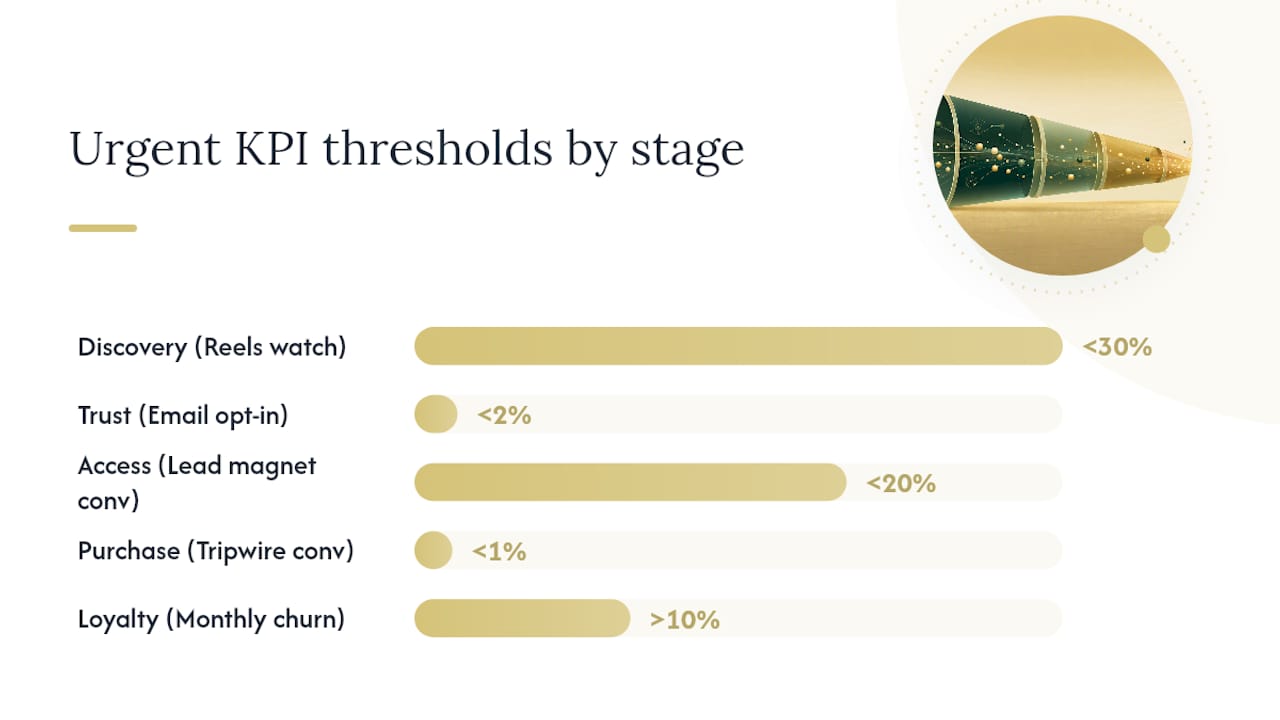
Run this diagnostic every Monday. If one row is red, that stage gets all optimization attention for the week. Do not try to fix everything simultaneously.
Your 90-day sprint to launch a working creator funnel
This plan assumes you have an existing audience on at least one platform and zero funnel infrastructure today.
- Weeks 1–2: Audience research and positioning. Survey your existing followers (DM 20 people, run a Stories poll). Identify the one problem they will pay to solve. Write your lead magnet concept around that problem.
- Weeks 3–4: Build the lead magnet and landing page. A PDF guide, a short video training, or a template pack. Keep it to one specific outcome. Set up your landing page (ConvertKit, Beehiiv, or Carrd all work). Write your 5-email bridge sequence before you launch anything.
- Weeks 5–6: Set up comment-to-DM automation. Configure ManyChat or an equivalent tool with your keyword trigger. Test the full flow: comment → DM → email capture → bridge sequence → tripwire offer link.
- Weeks 7–8: Publish 12 Discovery-stage pieces (Reels, Shorts, or threads) with your comment trigger CTA. Track which formats drive the most DM opt-ins.
- Weeks 9–10: Soft-launch your entry offer. Price it for low friction. Email your list. DM your most engaged followers personally. Aim for 20–50 buyers as a validation threshold.
- Weeks 11–12: Analyze and iterate. Review your weekly diagnostic. Identify the one leakiest stage. Fix that stage before adding any new content or offers.
Minimal tooling required: One email platform, one automation tool for DMs, one landing page builder, and a payment processor (Stripe or ThriveCart). You do not need a course platform until you have validated buyers.
Quick validation metrics after each milestone:
- Lead magnet launch: 50+ opt-ins in the first week signals a resonant topic
- Bridge sequence: 30%+ open rate on email 3 indicates the sequence is warming correctly
- Tripwire launch: 20+ buyers validates the offer concept before you build anything bigger
Pro Tip: Do not build the full course before you have buyers. Sell the entry offer first, then build the content. This is the single fastest way to avoid spending 200 hours on a product nobody wants.
Trust velocity: why DM conversations convert faster than landing pages
Trust velocity is the rate at which a prospect moves from first contact to purchase decision. In a static landing page funnel, that rate is governed by copy quality and traffic volume. In a conversational DM funnel, it is governed by response speed, message relevance, and the perceived personal attention of the creator.
The mechanism is straightforward. When someone comments on your Reel and receives a DM within seconds, they experience the creator as responsive and present. When that DM asks a qualifying question (“What’s your biggest challenge with X?”) and the answer shapes the next message, the prospect feels seen. That feeling compresses the trust-building timeline that would otherwise take weeks of email sequences.
Operational implications are specific:
- Response SLA: For high-ticket offers, a human response within 5 minutes of a DM reply materially improves close rates. Automate the first two DM steps (lead magnet delivery, email capture), then flag high-intent replies for human follow-up.
- Tagging and scoring: Your automation tool should tag DM leads by keyword response and intent signal. A lead who answers “I want to lose 20 pounds before summer” is higher intent than one who says “just curious.” Route them differently.
- Email capture in the first DM: This is non-negotiable. Platform DM access can be restricted, accounts can be limited, and message volume caps are real. Capturing the email in the first automated DM message means you own the relationship regardless of what happens to the Instagram account.
The risk of a fully automated DM funnel is that it reads like a bot. Prospects at the decision stage for anything over $200 will hesitate if every response feels templated. The fix is a clean handoff: automation handles discovery and access, a human handles decision.
Pro Tip: Write your automated DM messages in the first person, with a typo or two intentionally left in. It sounds counterintuitive, but messages that read as slightly imperfect perform better than polished copy in DM contexts.
The data point worth noting: CreatorFlow reports that adding email capture and a nurture sequence to a comment-to-DM flow can push conversion rates from low single digits toward 15–25%. The automation is not optional; it is the mechanism.
Money-plug’s take on what actually works in creator funnels
The creators who generate consistent revenue from their funnels share one trait: they built the product architecture around audience research, not around what they wanted to teach. At Money-plug, the first thing we do with any creator is map what their audience is already paying for, then design the funnel backward from that purchase behavior.
The proof points are specific. Across seven launched programs, Money-plug’s creators have generated over $500,000 in tracked revenue. One launch produced more than 3,000 sales in ten days. Those numbers come from funnel hygiene: the right cohort size, a validated entry offer, and a bridge sequence that does not leak.
What that teaches is this: the funnel is not the hard part. The hard part is the audience research that tells you what the entry offer should be, and the copywriting that makes the bridge sequence convert. Most creators DIY the funnel infrastructure and skip the research. That is why most creator funnels stall at the tripwire stage.
The signal that a creator should consider agency support is simple: if you have an engaged audience (even a small one) and you have tried to monetize it without consistent results, the problem is almost never the audience. It is the offer architecture or the bridge sequence. Those are fixable with the right framework.
Money-plug builds the funnel so you can focus on the content
Creators with engaged audiences who want predictable monetization without spending six months building funnel infrastructure have one clear option: work with a team that has already done it.
Money-plug operates on a pure revenue-share model, meaning zero upfront cost to the creator. The agency handles audience research, product architecture, pricing strategy, sales copy, video sales letters, launch campaign management, payment infrastructure, and paid advertising post-production. You bring the audience and the expertise. Money-plug builds the system that converts both into revenue.
The model works because the agency’s incentive is aligned with the creator’s. No launch, no revenue, no fee. That alignment produces a different quality of attention than a retainer-based agency that gets paid regardless of results.
If you have an engaged audience and want to see what a properly built funnel looks like for your niche, start with Money-plug and get a monetization assessment for your specific situation.
Sources
The following sources informed this guide and are worth bookmarking for deeper study on specific tactics:
- Content strategy for creators: How to grow an audience
- How To Build A Creator Funnel (Free To Paid) | Brainchild360
- Creator Monetization Funnel 2026: The Essential Guide to Recurring Revenue
- An Instagram sales funnel has 5 stages: awareness, interest, consideration, decision, retention. — AIGrow
- Instagram Sales Funnel: How to Convert Followers
- Drive sales from Instagram with this marketing funnel — Shopify