Build 5–7 Tested Fitness Program Names for Instructors
Build 5–7 Tested Fitness Program Names for Instructors

Pick a clear, audience-focused name using a simple formula like Outcome + Descriptor or Brand + Result, then write 5 to 7 variants. Test them with a small ad campaign or a quick member poll, and confirm trademark and domain availability at the USPTO before you print a single flyer. Skip that last step and you risk rebranding mid-launch, which costs more than the naming exercise ever would.
TL;DR:
- Testing multiple name variants through small ad campaigns or social media polls provides reliable data on click-through and sign-up rates before finalizing a program name.
- Choosing a name that clearly states the outcome, format, or duration reduces confusion, attracts the right audience, and minimizes no-shows and refunds.
- Avoid using legal or exaggerated language in the name, and check trademarks and domain availability to prevent costly rebranding later.
- Creating a consistent umbrella brand for multiple programs helps scale without the need for frequent rebrands, especially for studios with numerous offerings.
- Using proven naming formulas like outcome plus descriptor or audience plus outcome improves search relevance, ad targeting, and overall market response.
Table of Contents
- Why Program Names Actually Move the Needle
- Four Naming Principles That Prevent Costly Mistakes
- Naming Formulas That Sell (With Examples You Can Adapt)
- Categorized Name Bank: Ideas by Class Type
- How Do You Test a Fitness Class Name Before Committing?
- Quick Legal and Trademark Checklist Before You Launch
- The Naming Workflow: From Brainstorm to Launch-Ready
- Naming Is Part of the Launch, Not a Separate Step
- Get Your Fitness Program Named, Tested, and Launched
- Sources
Why Program Names Actually Move the Needle
A name is the first filter your program runs on. Someone scrolling Instagram at 9 p.m. decides in about two seconds whether “Iron Sisters Bootcamp” is for them. Get that filter wrong and you either scare off the right people or attract the wrong ones, which shows up later as no-shows and refund requests.
Names also do real work in search and paid discovery. A class called “Tuesday Session” tells Google nothing. A class called “45-Min HIIT for Beginners” tells both Google and a nervous first-timer exactly what they’re getting, which improves ad relevance scores and organic search matches alike.
There’s a trust dimension too. The IDEA Health & Fitness Association has flagged how gendered or body-shaming class titles quietly narrow your audience and can damage brand trust before a prospect ever reads the class description.
What a strong name accomplishes:
- Sets accurate expectations, which reduces no-shows and mid-class dropouts
- Improves ad and search relevance by including outcome, format, or duration
- Signals who belongs, so the right people self-select in
- Protects brand trust by avoiding stereotypes or exaggerated promises
Four Naming Principles That Prevent Costly Mistakes
Most naming mistakes trace back to skipping one of four basics.
- Lead with clarity. State the outcome, duration, or intensity when it’s relevant. “45-Min Strength” beats “Power Hour” because it removes guesswork.
- Signal skill level. Words like “Foundations,” “Advanced,” or “Beginner-Friendly” let people self-sort before they show up sweaty and overwhelmed.
- Skip gendered or body-shaming language. The IDEA guidance specifically warns against titles that reinforce stereotypes or misstate what a class actually does to the body.
- Build for scale, not just this launch. If you plan multiple programs, an umbrella brand plus specific product names protects you from a costly rebrand later, according to naming strategy guidance from Les Libitel.
- Watch the legal language. “Cures back pain” or “melts fat” are medical claims you likely can’t back up and shouldn’t put in a program title.
Pro Tip: Write your program name, then read it out loud to someone who has never worked out with you. If they can’t guess the format, intensity, or outcome within five seconds, the name needs another draft.
The umbrella-brand point deserves a second look if you’re a gym owner rather than a solo instructor. Naming every single class something wildly creative feels fun in year one. By year three, when you’re running fifteen formats, you’ll wish you’d built one recognizable brand word (like “Forge” or “Reset”) that stretches across all of them instead of fifteen unrelated names competing for the same social feed.

Naming Formulas That Sell (With Examples You Can Adapt)
You don’t need to be clever. You need a formula, because naming guidance from Les Libitel shows that proven templates consistently outperform names invented from scratch under deadline pressure.
- Outcome + Descriptor. Example: “Strength in 12.” This format reduces friction because the prospect knows the result and the timeframe in three words.
- Audience + Outcome. Example: “Runners’ Recovery” or “New Moms’ Reset.” This narrows your ad targeting automatically. You’re not paying to reach people the name has already excluded.
- Brand Word + Result. Example: “Foundry Fit: Build Strength.” Use this when you’re building a recognizable studio brand you plan to extend across multiple offers.
- Method or System Format. Example: “Reset Method” or “Core Flow System.” This works well for premium, higher-ticket programs because “method” and “system” imply a proprietary process, not a generic class.
One more decision point: whether to call something a Challenge, a Program, or a plain SKU. “Challenge” implies a fixed start and end date and works best for short, high-urgency offers. “Program” implies structure and progression, better suited to anything running 8 weeks or longer. A neutral SKU name (just “Strength 101”) fits recurring drop-in classes where urgency isn’t the selling point.
Including a truthful duration, like “12 Week,” can meaningfully cut decision friction at checkout, according to naming research from Genfy. Just make sure the number on the label matches the number on the calendar.
Categorized Name Bank: Ideas by Class Type
Steal these, remix them, or use them as a starting point for your own brainstorm. Each one comes with a note on who it actually fits, because the same name that lands for a 24-year-old CrossFit crowd will fall flat with a 55-year-old mobility class.
HIIT and bootcamp:
- Ignite 30 — a 30-minute, high-intensity format for time-crunched clients.
- Forge Bootcamp — implies grit and transformation, good for a gritty, no-frills studio brand.
- Sweat Sprint — clear on intensity and length, works well in paid ads.
- Metcon Mayhem — speaks directly to a CrossFit-adjacent crowd that already knows the jargon.
Strength and powerlifting:
- Strength in 12 — the Outcome + Descriptor formula in action, built for a defined program length.
- Barbell Basics — signals beginner-friendly entry into strength training without intimidation.
- Iron Foundations — solid for a progressive strength program marketed to intermediate lifters.
- PR Chase — speaks directly to competitive lifters chasing personal records.
Yoga, flow, and mobility:
- Slow Flow Sundays — tells you the pace and the day, reducing scheduling confusion.
- Mobility Reset — clear outcome word (“reset”) paired with a functional category.
- Breath & Balance — softer tone for a restorative class aimed at stress relief over athletic performance.
- Deep Stretch Society — a community-flavored name that works well for a recurring membership tier.
Beginner-friendly and inclusive:
- First Steps Fitness — removes intimidation entirely, ideal for true beginners re-entering fitness.
- Foundations 101 — academic framing that signals “start here” without condescension.
- Everyday Strength — avoids elite-athlete language, appeals to people who just want to function better.
- Move Well Basics — pairs well with a 55+ or post-rehab audience.
Challenge-format and seasonal:
- Summer Shred Challenge — high urgency, seasonal, works best as a 4 to 8 week limited offer.
- New Year Reset Challenge — leans into the January surge without over-promising a body transformation.
- 21-Day Consistency Challenge — frames the win around habit-building rather than a number on a scale.
- Holiday Hustle — light, seasonal, useful for a short November to December engagement push.
None of these need to be used exactly as written. Swap “12” for your actual program length, swap “Runners” for whatever niche you actually serve, and the formula still holds.
How Do You Test a Fitness Class Name Before Committing?
Testing beats guessing every time, and it costs almost nothing to do properly. The goal is real market data, not five people in your group chat telling you they “like it.”
- Build 3 to 7 name variants using the formulas above, keeping the offer and landing page identical across all of them.
- Run each as a headline in a small ad campaign or Instagram Story poll for a few days with matched budgets, so the comparison is fair.
- Track click-through rate and micro-conversions, not just clicks, since a name that gets clicks but no sign-ups is telling you something different than a name that converts.
- In-studio, compare RSVP and no-show rates across two sessions using different working titles before you lock one in permanently.
- Don’t let a small CTR edge override a legal or clarity red flag. A name that wins by half a percentage point but implies a medical claim isn’t worth the risk.
The Money-plug creative testing framework applies this same logic to launch creative broadly: small, cheap tests before big spend, every time.
Metrics worth tracking: click-through rate on the ad or post, sign-up rate on the landing page, and RSVP-to-no-show ratio once people commit. A name that wins on CTR but loses on no-shows isn’t actually the winner.
Quick Legal and Trademark Checklist Before You Launch
Skipping this step is how instructors end up rebranding six months into a program with real momentum behind it. It takes an afternoon to avoid that entirely.
- Run a federal trademark search at the USPTO before you finalize anything, especially if you plan to sell the program beyond your local market.
- Check domain availability and your primary social handles (Instagram, TikTok, YouTube) for the exact name or a close variant.
- Avoid regulated or medical language in the name itself, things like “cure,” “heal,” or specific disease claims, unless you have the clinical backing to support it.
- Consult an attorney if you plan to formally trademark the name, or if your search turns up an existing mark that’s close enough to cause confusion.
Most small studio and solo-trainer names clear this checklist without issue. The check exists for the rare case where it doesn’t, and that rare case is expensive to discover after launch.
The Naming Workflow: From Brainstorm to Launch-Ready
Here’s the sequence that gets you from a blank page to a legally cleared name without dragging the process out for weeks.
- Define audience, outcome, and positioning (30 to 60 minutes). Who is this for, what do they get, and how is it different from the class down the street?
- Generate 20 name candidates using the formulas above (1 to 2 hours). Don’t edit yet, just produce volume.
- Narrow to 5 to 7 finalists and run quick ad or poll tests (3 to 7 days). Let real engagement data cut the list, not internal preference.
- Run USPTO, domain, and handle checks on your top 2 to 3, then finalize and write your headline and subline.
Pro Tip: Your sales page headline should restate the program name plus its single biggest outcome in one line: “Strength in 12: Build Real Muscle Without Living in the Gym.” The subline then handles the how, the who, and the timeline.
Naming Is Part of the Launch, Not a Separate Step
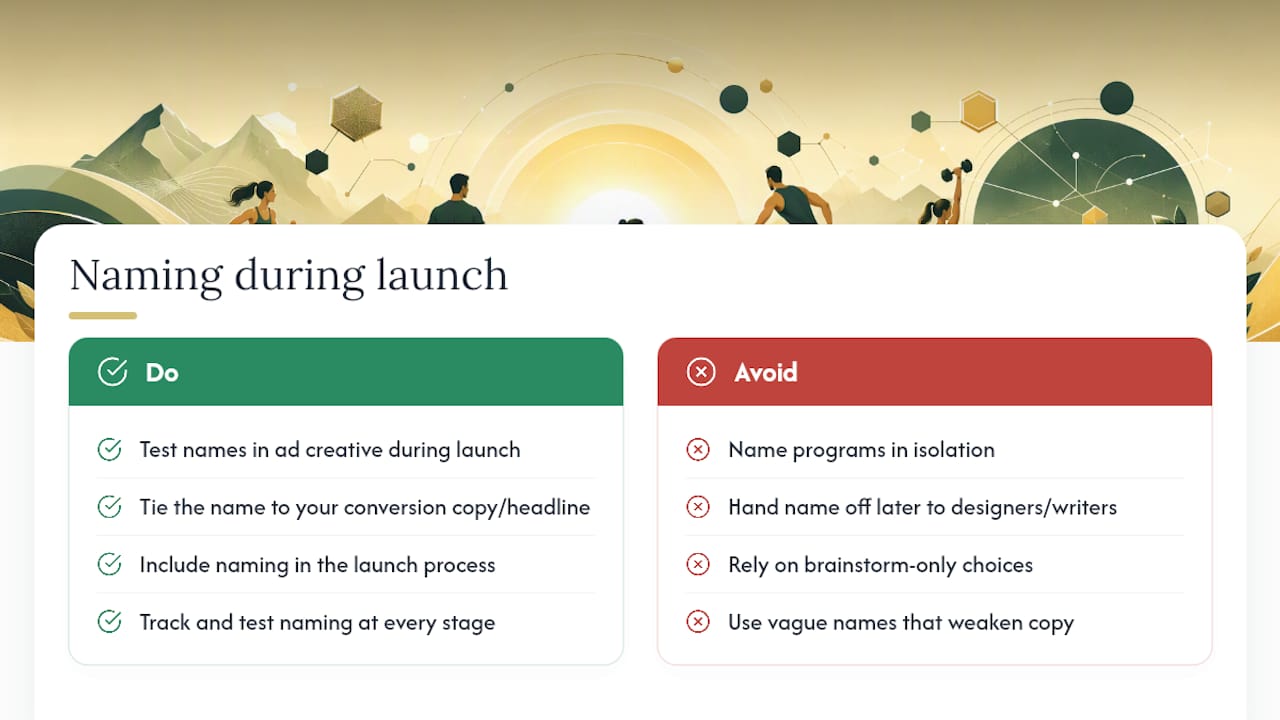
Naming a program in isolation, then handing it off to a designer or copywriter later, is backwards. Program names should be tested inside actual ad creative during a launch window, because a name that sounds smart in a brainstorm doc and a name that gets clicked by a cold audience are frequently different names.
Naming ties directly into conversion copy. The headline on your sales page usually restates the program name, so if the name is vague, every piece of copy built on top of it inherits that vagueness. Programs launched through a tested process have generated significant tracked revenue across several launches. Naming decisions were tested, not guessed, at every stage of those launches.
— Money
Get Your Fitness Program Named, Tested, and Launched
You’ve got the formulas and the name bank. What most instructors don’t have is the time to build ad creative around five name variants, run a real test, and then turn the winner into a full sales page and launch campaign. That’s the gap Money-plug closes for creators in fitness, coaching, and wellness who want to turn an audience into a paid program without doing the entire buildout solo.
Money-plug works on a pure revenue share basis, meaning there’s no upfront cost while the agency handles audience research, pricing, sales copy, video sales letters, and the paid advertising that actually tests your program name in front of real buyers. If you’re sitting on an audience and a program idea that needs a name, a sales page, and a launch plan, start with Money-plug and get the whole thing built around what actually converts.