Fitness Program Pricing for Creators: A Revenue Playbook
Fitness Program Pricing for Creators: A Revenue Playbook

The single most reliable way to maximize revenue from an online fitness program is a tiered value ladder: a low-ticket entry offer, a subscription or cohort product as your revenue base, and a premium 1:1 tier at the top. Single-price programs cap either conversion or income. A tiered structure doesn’t.
Here’s what the numbers actually look like across the market right now:
- On-demand libraries: $6–$149/month, depending on production quality and specialization
- Standard online coaching: $100–$400/month for structured programming with check-ins
- Premium 1:1 coaching: $400–$1,000+/month for high-touch, specialized transformation work
Benchmark: Gymkee’s pricing analysis shows monthly subscriptions ranging from $100 to $1,200 depending on model and specificity, while NASM’s pricing guidance urges trainers to calculate overhead and target income before setting a number, rather than copying what a competitor charges. Money-plug’s tracked launches have generated over $500,000 in creator revenue across seven programs, including one that produced more than 3,000 sales in ten days.
Key Takeaways
A tiered pricing ladder combining a low-ticket entry offer, a subscription or cohort base, and a premium 1:1 tier consistently outperforms single-price fitness programs on total revenue.
| Point | Details |
|---|---|
| Build a value ladder | Combine an entry-level offer, a subscription or cohort base, and a premium 1:1 tier. |
| Calculate your floor first | Add monthly overhead to your target income, then divide by realistic client load. |
| Price the outcome, not the hour | Specialized, niche programs consistently support higher prices than generalist offers. |
| Test launch price like an experiment | Run early-bird, then tiered launch pricing, then a capped beta before setting a public price. |
| Track CAC, LTV, and churn | These three numbers decide whether your price is viable once you scale past your first launch. |
| Work with a revenue-share partner | Money-plug builds pricing strategy, sales copy, and launch execution on a pure revenue-share basis. |
Table of Contents
- How Fitness Program Pricing Models Compare
- Calculating Your Fitness Program Price Floor
- Pricing Your Program by Outcome, Not by Hour
- Launch Pricing, Discounts, and Price Testing
- The Unit Economics Behind Fitness Program Pricing
- Packaging Your Price So Higher Tiers Feel Obvious
- What Money-Plug’s Launch Data Shows About Pricing
- Legal and Tax Considerations for Online Fitness Pricing
- Adjusting Fitness Program Pricing for Seasonal Demand
- How to Raise Your Prices Without Losing Customers
- What Fitness Creators Get Wrong About Pricing
- How Money-Plug Builds and Prices Creator Launches
- Frequently Asked Questions
- Sources
How Fitness Program Pricing Models Compare
Every program falls into one of five structural buckets, and picking the wrong one is usually why a good product underperforms.
A one-time program sale is a fixed-price product, paid once, typically $19 to $497 depending on scope. It’s simple to sell and simple to deliver, but revenue stops the day sales stop. A monthly subscription charges recurring fees for ongoing programming, community, or check-ins. It builds predictable revenue but demands constant retention work. A cohort-based master program groups a batch of clients through a fixed curriculum on a schedule, which creates urgency and lets you serve many people at once. Group training splits the cost of your time across several clients simultaneously, lowering the per-person price while keeping your margin healthy. Hybrid models combine a subscription base with paid upgrades, like an app membership that upsells to 1:1 coaching calls.
| Model | Best stage | Revenue predictability | Complexity |
|---|---|---|---|
| One-time sale | Starting out | Low | Low |
| Subscription | Scaling | High | Medium |
| Cohort | Scaling to enterprise | Medium (launch-dependent) | High |
| Group training | Scaling | Medium | Medium |
| Hybrid | Enterprise creators | High | High |
Creators just starting out should lean on one-time sales to validate demand fast. Once you have proof and repeat buyers, subscriptions and cohorts do the heavy lifting. Hybrid stacking is where the real revenue ceiling gets pushed higher, but it only works once you already have the operational muscle to run more than one offer at a time.
Calculating Your Fitness Program Price Floor
Before you price anything based on value or competitors, you need a floor: the number below which you lose money or burn out. NASM’s guidance is blunt about this. Calculate your monthly overhead and a target hourly income first, then set your price. Don’t reverse the process.
Here’s the template:
- List monthly overhead. Software (roughly $300/month for a coaching platform and email tool), advertising ($1,200/month if you’re running paid acquisition), plus insurance, continuing education, and any contractor costs.
- Add your target take-home income. Say you want $6,000/month after overhead.
- Add the two together. $7,500/month total revenue needed.
- Divide by realistic client load. If you can serve 50 clients at your current capacity, your floor is $150/month per client. If you’re running a cohort of 200 people twice a year, your floor per seat drops closer to $75.
| Overhead item | Monthly cost |
|---|---|
| Coaching software | $300 |
| Paid advertising | $1,200 |
| Target take-home income | $6,000 |
| Total revenue needed | $7,500 |
Session-based pricing gives you a sanity check here too. UseCalcPro’s data puts virtual one-on-one sessions at $30–$80 and small-group rates at $20–$50 per person, useful for reverse-engineering what a monthly subscription price should equal on a per-touchpoint basis.
Pro Tip: Cap your client-facing hours before you calculate per-session equivalence. If you back into a price that requires 60 client hours a week to hit your income target, the number is wrong, not the workload.

Pricing Your Program by Outcome, Not by Hour
Value-based pricing means your price reflects what the outcome is worth to the client, not how many hours you spent building the program. A 12-week fat-loss program that gets someone into their wedding dress isn’t priced on your time. It’s priced on what that outcome means to them.
Specialization is the biggest lever here. Gymkee’s research shows specialized trainers consistently out-earn generalists, because a niche signals expertise and reduces the buyer’s perceived risk. A postpartum strength program can charge more than a generic “get fit” program aimed at everyone, even with similar production costs.
To find your real price ceiling:
- Run a short survey asking your audience what they’d pay for a specific, named outcome
- Sell a beta cohort at a discount in exchange for testimonials and case data
- Offer a paid pilot to a handful of people before committing to a full launch price
Pro Tip: A payment plan (three installments instead of one lump sum) often lifts conversion more than a price cut does, because it lowers the friction of the decision without lowering the perceived value of the offer.
Launch Pricing, Discounts, and Price Testing
Your launch price is a test, not a permanent decision. Run it in sequence: early-bird pricing for a short window, a two-tier launch price (early adopters vs. everyone else), a capped beta cohort with a fixed seat limit, then your public price once you have proof it converts.
A/B testing price is simpler than most creators assume. Hold your offer, creative, and audience constant. Split traffic between two price points. Track conversion rate, average order value, and cost per acquisition for each group before declaring a winner.
- Use scarcity (seat limits, enrollment windows) instead of blanket percent-off discounts
- Reserve money-back guarantees for premium tiers where trust is the main barrier
- Use partial refunds or credit-based guarantees on lower-ticket offers to protect margin
A single Money-plug launch generated over 3,000 sales in ten days using a capped early-bird window followed by a public price increase, a sequence that trained buyers to act fast rather than wait for a discount.
The Unit Economics Behind Fitness Program Pricing
Two numbers decide whether your price actually works at scale: what it costs you to get a customer, and what that customer is worth over time. Track customer acquisition cost (CAC), average order value (AOV), lifetime value (LTV), churn rate, payback period, and gross margin per customer.
| Metric | Subscription model | One-time cohort |
|---|---|---|
| Revenue pattern | Recurring monthly fee | Lump sum per launch |
| Key risk | Churn erodes LTV | Requires repeatable launches |
| Cash flow | Slower to build, compounds | Fast, concentrated |
| Best for | Predictable long-term revenue | Big upfront cash needs |
A cohort launch selling 200 seats at $297 generates nearly $60,000 in a single window but requires you to fill that cohort again next quarter to keep revenue flowing.
- Subscriptions win when you have consistent lead flow and can keep churn under 10% monthly
- Cohorts win when you need concentrated cash and have an audience large enough to relaunch every 60 to 90 days
- Hybrid stacking (subscription base, cohort upsell) smooths out both weaknesses at once
Packaging Your Price So Higher Tiers Feel Obvious
Structure matters as much as the number. Build three tiers: a low-cost, low-touch entry point; a core subscription that’s clearly your best value; and a premium 1:1 tier for people who want direct access to you. Trainerize’s research confirms that offering only one price point either kills conversions or leaves revenue on the table, while a Good/Better/Best ladder captures both.
Payment plans widen your funnel without cheapening the offer. A monthly split converts price-sensitive buyers, while a modest pay-in-full incentive (a bonus module, an extra check-in) rewards the buyers who were always going to pay full price anyway.
- Anchor your premium tier first so the middle tier looks like the obvious value choice
- Use charm pricing ($197 instead of $200) on entry offers, but round numbers ($500, $1,000) read as more credible on premium coaching
- Attach a realistic transformation timeline to each tier so the price maps to a specific result, not just a feature list
Pro Tip: List your premium tier’s price on the page even if most people won’t buy it. It resets the anchor and makes your core tier look like the reasonable middle ground.
What Money-Plug’s Launch Data Shows About Pricing
Those numbers didn’t come from guessing at a price.
They came from structuring the offer first, then testing the price against real traffic.
- Lower entry prices worked best for audience-building launches meant to generate volume and social proof fast
- Higher-ticket cohort pricing worked best once a creator already had a warm list and proof from a prior launch
- The 18x ROAS campaign relied on a tight early-bird window that created urgency without training buyers to wait for a discount
The lesson generalizes: entry price gets you buyers and data, cohort or premium pricing gets you margin, and the sequencing between the two determines whether a launch merely covers ad spend or multiplies it.
Legal and Tax Considerations for Online Fitness Pricing
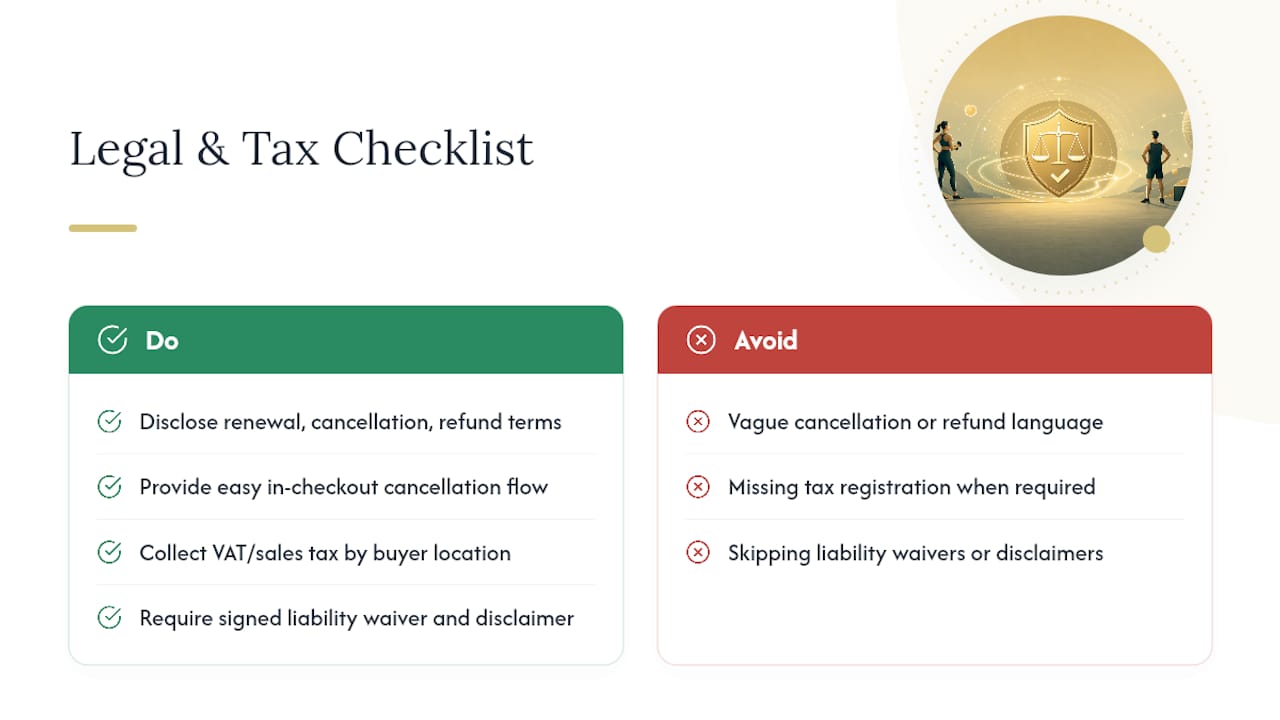
Pricing decisions carry legal weight that many creators overlook until a client disputes a charge or a tax authority asks questions. Recurring subscription billing typically requires clear disclosure of renewal terms, cancellation policy, and refund windows in your checkout flow. Several jurisdictions treat “auto-renewal” as a regulated practice, requiring an easy cancellation path and advance notice before a price increase takes effect on an existing subscriber.
Sales tax and VAT obligations vary by where your buyer lives, not just where you operate. A digital fitness program sold to a customer in the European Union may trigger VAT registration requirements once you cross a specific revenue threshold in that market, while U.S. sales tax on digital products depends on the buyer’s state. This isn’t optional paperwork. Getting it wrong retroactively can turn a profitable price point into a liability once back taxes and penalties are applied.
Liability waivers matter more for fitness programs than for most digital products, because the outcome involves physical exertion. A signed waiver and a clear disclaimer that the program isn’t personalized medical advice are standard practice before a client starts paying. Your pricing page and terms of service should state refund conditions plainly, because chargebacks on fitness subscriptions are common when cancellation policies are vague.
None of this should paralyze your pricing decisions. It should shape how you structure billing (clear terms, visible cancellation flow) and where you set aside margin for tax obligations before you count a sale as pure profit. Build these costs into your overhead calculation from the start rather than discovering them after your first big launch.
Adjusting Fitness Program Pricing for Seasonal Demand
Fitness demand isn’t flat across the calendar, and pricing that ignores this leaves money on the table twice a year. January and early February are historically the highest-intent windows for fitness purchases, driven by New Year’s resolution behavior. Demand also spikes in the months before summer, roughly April through June, as buyers target a specific event or vacation timeline.
This creates two viable pricing strategies. The first is premium pricing during peak demand, since willingness to pay rises when motivation is highest and buyers are less price-sensitive. The second is strategic discounting during low-demand months (typically August through October) to keep cash flow steady and fill cohort seats that would otherwise sit empty.
The mistake most creators make is discounting during peak season because everyone else is running a sale. Doing the opposite, holding or raising price when demand is naturally higher, usually performs better because you’re competing for attention, not for the lowest price in a crowded market.
- Raise entry-tier pricing modestly in January and pre-summer windows when demand is naturally elevated
- Use off-season months to test cohort pricing at a discount, since a full cohort at a lower price beats a half-full cohort at full price
- Build seasonal messaging around outcomes tied to the calendar (a summer-ready cohort, a post-holiday reset) rather than generic percent-off promotions
Track your own launch data across at least two seasonal cycles before locking in a permanent seasonal pricing calendar. One data point isn’t a pattern.
How to Raise Your Prices Without Losing Customers
Price increases are inevitable as your program improves, your costs rise, or your positioning shifts toward a higher-value audience. How you communicate the change matters more than the size of the increase.
Give existing subscribers advance notice, typically 30 days, before a price increase takes effect on their account. This isn’t just good practice. In several markets it’s a requirement for recurring billing relationships, and skipping it invites chargebacks and complaints.
Grandfather your existing customers at their original price for a defined period, or permanently, if retention matters more to you than short-term margin gains. This single move does more to preserve goodwill than any amount of apologetic messaging. New customers pay the new price; existing customers see the value of staying rather than a penalty for loyalty.
Frame the increase around what’s changed, not around your costs. “We’ve added weekly live coaching calls and a redesigned nutrition tracker” lands better than “Due to rising costs, prices are increasing.” The first justifies the number with new value. The second invites the customer to compare you against cheaper alternatives.
- Announce increases with enough lead time that no one feels ambushed at checkout
- Bundle the increase with a tangible new feature or service so it reads as an upgrade, not just a cost
- Offer a short window to lock in the old price for annual or upfront commitments before the new price applies
Price increases that come with silence generate refund requests. Price increases that come with a clear reason generate renewals.
What Fitness Creators Get Wrong About Pricing
The biggest mistake I see isn’t underpricing. It’s picking one price and treating it as a personality trait instead of a variable to test. A tiered ladder outperforms a single price point almost every time, because it lets your entry offer do the job of building an audience while your premium tier does the job of making the launch profitable.
Specialization is the multiplier most creators ignore until it’s too late. A generic “get fit” program competes on price. A program built for a specific outcome, audience, or life stage competes on relevance, and relevance is what lets you charge more without apologizing for it.
If you do one thing after reading this, add a low-friction entry product now. Even a $19 offer captures emails and buying intent you can convert into your core tier later.
How Money-Plug Builds and Prices Creator Launches
Getting the pricing math right is only half the job. The other half is turning that price into an offer people actually buy, which is where most solo creators lose momentum. Money-plug handles the full stack behind a launch: audience research to find your real willingness-to-pay, pricing strategy built around your specific niche, sales copy and video sales letters that justify the number, and the paid advertising execution that gets it in front of buyers.

One recent engagement restructured a creator’s single flat-price offer into a tiered funnel with a tested early-bird window, lifting both average order value and the number of buyers who upgraded to a premium tier post-purchase. That’s the difference between guessing at a number and testing one under real traffic.
Money-plug works on a pure revenue-share basis, so there’s no upfront cost before you launch. If you’re sitting on an audience and an idea for a program but haven’t nailed down what to charge, start with Money-plug’s landing page to see how a pricing and launch engagement works.
Frequently Asked Questions
How much should I charge for an online fitness program? Most standard online coaching programs price between $100 and $400 per month, while premium specialized 1:1 coaching runs $400 to $1,000 or more, according to WarriorBabe’s market data. On-demand libraries can charge as little as $6 to $149 per month depending on production value and niche depth.
What’s the difference between subscription and one-time pricing for fitness programs? A subscription charges recurring fees and builds predictable long-term revenue but requires ongoing retention work to fight churn. A one-time program sale generates cash immediately but stops producing revenue once the launch window closes, making relaunch frequency critical to sustained income.
How do I know if my fitness program price is too low? If your monthly overhead plus your target take-home income, divided by your realistic client load, produces a number higher than what you’re currently charging, your price is below your floor. Use NASM’s overhead calculation method to check this before adjusting.
Should I offer payment plans for fitness coaching programs? Yes, in most cases. A monthly payment plan typically improves conversion on mid- and high-ticket coaching offers by reducing upfront friction, without requiring you to lower the total price of the program.
How often should I raise my fitness program prices? Review pricing whenever you add meaningful new value, such as new features, more direct access, or proven outcomes from a recent cohort. Give existing subscribers at least 30 days’ notice and consider grandfathering them at their original price to protect retention.
Sources
- How to Price Personal Training | NASM Blog
- 7 Ways to Price Your Personal Training Services (With Real Math) | Gymkee
- Personal Trainer Cost Calculator — 2026 Session & Monthly Pricing | UseCalcPro
- Online Fitness Coaching Prices 2026 Data | WarriorBabe
- How much to charge for personal training? | Trainerize blog