Headline Formulas That Convert: A Creator's Swipe File
Headline Formulas That Convert: A Creator’s Swipe File

The headline formulas that consistently produce results fall into eight families: Number + Result, How-To, Benefit + Timeframe, Specificity, Curiosity Gap, Social Proof/Authority, Risk Reversal, and Urgency. Pick one, plug in your niche, and you have a working headline in under two minutes.
Here are six swipe lines you can copy right now:
- “[Number] [Niche] Mistakes That Are Costing You [Specific Result]”
- “How to [Achieve Desired Outcome] in [Timeframe] Without [Common Pain]”
- “Get [Specific Result] in [Short Timeframe] — or We [Guarantee]”
- “[Number] [Niche] Secrets [Authority/Audience] Don’t Want You to Know”
- “The [Adjective] Way [Audience] Are [Achieving Result] Right Now”
- “Stop [Doing Wrong Thing]. Do [Right Thing] Instead.”
Quick examples for a fitness creator: “7 Home Workout Mistakes That Are Costing You Muscle Gains” or “How to Lose 10 Pounds in 6 Weeks Without Giving Up Carbs.” For a digital course launch: “Get Your First 100 Paying Students in 30 Days — or We Refund Every Cent.”
Why does leading with the value matter? A MarketingExperiments case study found that moving the value point to the front of a headline, combined with reduced page friction, produced a measurable conversion lift. The reader’s first question is always “what’s in it for me?” — answer it in the first five words.
Key Takeaways
Proven headline formulas work as scaffolding, but only audience-specific testing, point-first structure, and honest promises turn them into consistent conversion drivers.
| Point | Details |
|---|---|
| Lead with the value | Place the reader’s payoff in the first five words; a MarketingExperiments case study reported a 10.4% lift from this change alone. |
| Match formula to awareness stage | Cold traffic converts better with Number + Result and Social Proof; warm traffic responds to Benefit + Timeframe and Risk Reversal. |
| Test one variable at a time | Change only the formula or the benefit in each A/B test; mixed variables produce unreadable results. |
| Keep headlines honest | A headline is a promise; overpromising destroys long-term trust faster than any CTR gain is worth. |
| Use the 30-minute framework | Generate 25 variations, filter with the clarity/specificity/promise rubric, then validate with a peer check or small email split. |
Table of Contents
- How to pick the right headline formula for your goal and channel
- The headline formula catalogue, grouped by the job each one does
- SEO and length rules that make headlines work for search and humans
- How to A/B test headlines and know when you have a winner
- 30 ready-to-use headline templates, grouped by channel
- Generate 25 headline variations in 30 minutes with this framework
- Common mistakes that kill otherwise good headline formulas
- How to tailor headline formulas to different audiences and personas
- Why formulas are a starting point, not a shortcut
- Sources
How to pick the right headline formula for your goal and channel
Not every formula fits every situation. A curiosity-gap headline that crushes it on Instagram can fall flat as a Google Ads headline, where searchers already know what they want. The right formula depends on three variables: your goal, your audience’s awareness level, and the channel.
Use this checklist before you write:
- Define your goal first. Awareness content (blog posts, social) needs curiosity or number-list formulas. Click-through goals (ads, email) need benefit-first or specificity formulas. Sign-up and sale goals need risk reversal or social proof.
- Identify your audience’s awareness stage. Cold traffic (people who don’t know you) responds to Number + Result and Social Proof because those formats signal credibility fast. Warm traffic (people who’ve seen your content) responds better to Benefit + Timeframe and Risk Reversal because they already trust you enough to weigh the offer.
- Match the formula to the channel’s constraints. Email subject lines live or die on curiosity and urgency in under 50 characters. Google Ads headlines cap at 30 characters per headline field. Blog H1s can run longer and benefit from specificity. Landing page headlines need the core promise in the first clause.
- Run the clarity test. Read your headline to someone unfamiliar with your niche. If they can’t tell what you’re offering in five seconds, rewrite it. Clarity beats cleverness every time.
- Check for benefit-first placement. The payoff for the reader should appear before any qualifier, backstory, or brand name. “Lose 15 Pounds Before Summer” beats “Our 8-Week Program Helps You Lose 15 Pounds.”
- Mirror your audience’s language. Pull exact phrases from comments, DMs, and reviews. If your fitness audience says “get lean,” use “get lean” — not “reduce body fat percentage.”
Pro Tip: Test formula families by traffic source, not just by page. Run Number + Result against Social Proof on cold paid traffic; run Benefit + Timeframe against Risk Reversal on your warm email list. Mixing traffic temperatures in one test muddies the results.
The headline formula catalogue, grouped by the job each one does
Each group below includes fill-in-the-blank templates, two niche examples, the best channels, and the psychological trigger at work. Buffer’s headline formula research recommends structuring headlines as Numbers + Adjective + Keyword + Rationale + Promise, and their SHINE rubric (Specificity, Helpfulness, Immediacy, Newsworthiness, Entertainment) is a reliable filter to apply after you draft.
Curiosity gap
Why it works: The brain hates unresolved loops. A curiosity-gap headline opens a question the reader can only close by clicking.
- “The [Adjective] Truth About [Topic] Nobody Talks About”
- “What [Authority/Audience] Know About [Topic] That You Don’t”
- “Why [Common Belief] Is Actually [Surprising Opposite]”
Examples: “The Uncomfortable Truth About Online Coaching Nobody Talks About” / “What 6-Figure Creators Know About Pricing That You Don’t”
Best channels: Social posts, email subject lines, blog posts. Audience stage: Cold to warm.
Number + Result
Why it works: Numbers signal specificity and set a concrete expectation. Readers know exactly what they’re getting.
- “[Number] [Niche] Strategies That [Specific Result]”
- “[Number] Ways to [Achieve Outcome] Without [Pain Point]”
- “[Number] [Adjective] Tips for [Audience] Who Want [Result]”
Examples: “9 Email Strategies That Doubled Our Creator’s Open Rate” / “5 Ways to Launch a Digital Course Without a Big Audience”
Best channels: Blog H1s, social posts, email. Audience stage: Cold to warm.
How-to
Why it works: Promises a clear process. Readers in problem-solving mode click because the headline implies a solution exists.
- “How to [Achieve Outcome] in [Timeframe]”
- “How to [Do Difficult Thing] Even If [Common Objection]”
- “How [Audience] Can [Achieve Result] Without [Sacrifice]”
Examples: “How to Build a Paid Community in 60 Days” / “How Fitness Coaches Can Sell Online Programs Even If They Have Zero Tech Skills”
Best channels: Blog, YouTube titles, Pinterest. Audience stage: Cold to warm.
Specificity
Why it works: Vague headlines feel like marketing. Specific ones feel like facts. Specificity builds instant credibility.
- “[Specific Number/Percentage] of [Audience] Are [Doing/Experiencing Thing]”
- “The Exact [Process/System] [Authority] Used to [Specific Result]”
- “[Specific Result] in [Specific Timeframe]: Here’s How”
Examples: “The Exact Launch System We Used to Generate 3,000 Sales in 10 Days” / “18x Return on Ad Spend: Here’s the Exact Campaign Structure”
Best channels: Landing pages, ads, email. Audience stage: Warm to hot.
Social proof / Authority
Why it works: People follow the crowd. Citing a number of users, a recognized name, or a proven result reduces perceived risk.
- “[Number] [Audience] Already [Achieving Result] With [Method/Product]”
- “The [Method] [Authority Figure] Uses to [Result]”
- “Join [Number] [Audience] Who [Achieved Outcome]”
Examples: “Join 2,400 Creators Who Launched Their First Digital Product This Year” / “The Pricing Strategy Top Fitness Influencers Use to 3x Their Revenue”
Best channels: Landing pages, paid ads, email. Audience stage: Cold to warm.
Risk reversal / Guarantee
Why it works: Removes the reader’s biggest objection — fear of wasting time or money. Especially powerful for high-ticket offers.
- “Get [Result] in [Timeframe] — or [Guarantee]”
- “[Result] Guaranteed, or [Consequence for You]”
- “Try [Product/Method] for [Period] — If You Don’t [Result], [Guarantee]”
Examples: “Get Your First 500 Subscribers in 30 Days — or We Work for Free Until You Do” / “Launch Your Digital Product in 8 Weeks, Guaranteed”
Best channels: Landing pages, sales pages, email. Audience stage: Warm to hot.
Urgency / Scarcity
Why it works: FOMO (Fear of Missing Out) is one of the most reliable purchase triggers. Urgency works when it’s real — manufactured scarcity backfires.
- “Last Chance: [Offer] Closes [Date/Time]”
- “[Number] Spots Left for [Program/Offer]”
- “Don’t Miss [Specific Outcome] — [Deadline]”
Examples: “Only 12 Spots Left for the October Creator Launch Cohort” / “Enrollment Closes Friday: Build Your Digital Product in 8 Weeks”
Best channels: Email, paid ads, landing pages. Audience stage: Hot.
Contrarian
Why it works: Challenges a widely held belief. Readers who hold that belief feel compelled to find out if they’re wrong.
- “Why [Popular Strategy] Is Actually Hurting Your [Result]”
- “Stop [Common Advice]. Do [Alternative] Instead.”
- “The [Popular Thing] Everyone Recommends — and Why It Doesn’t Work”
Examples: “Why Posting Every Day Is Actually Killing Your Creator Business” / “Stop Chasing Followers. Build a Paid Community Instead.”
Best channels: Social posts, blog, email. Audience stage: Cold to warm.
Formula families at a glance:
| Formula Family | Best Use Case | Funnel Stage | Reported Avg. CVR Lift |
|---|---|---|---|
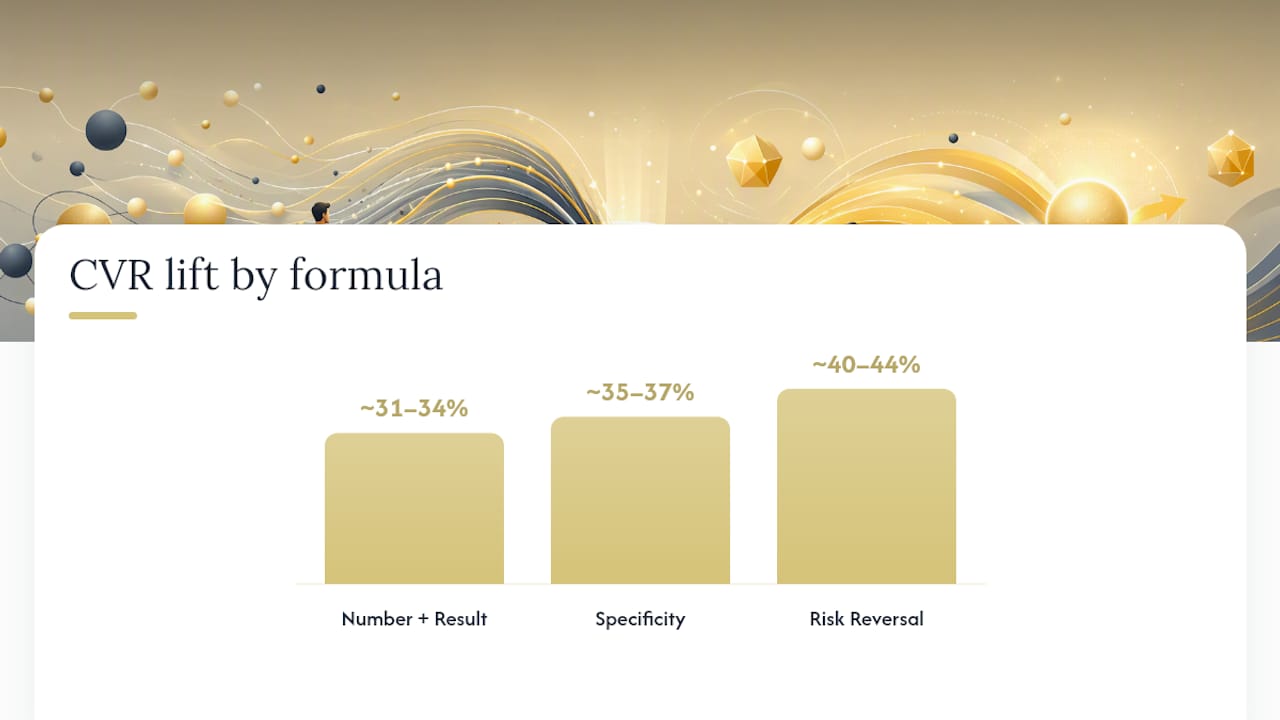
| Number + Result | Blog, social, email | Cold to warm | ~31–34% |
| Benefit + Timeframe | Email, landing pages | Warm | ~30% |
| Specificity | Landing pages, ads | Warm to hot | ~35–37% |
| Risk Reversal | Sales pages, email | Hot | ~40–44% |
| Curiosity Gap | Social, email subject lines | Cold | Varies by audience |
| Social Proof | Ads, landing pages | Cold to warm | Varies by audience |
| How-To | Blog, YouTube, Pinterest | Cold | Varies by audience |
| Urgency | Email, ads | Hot | Varies by audience |
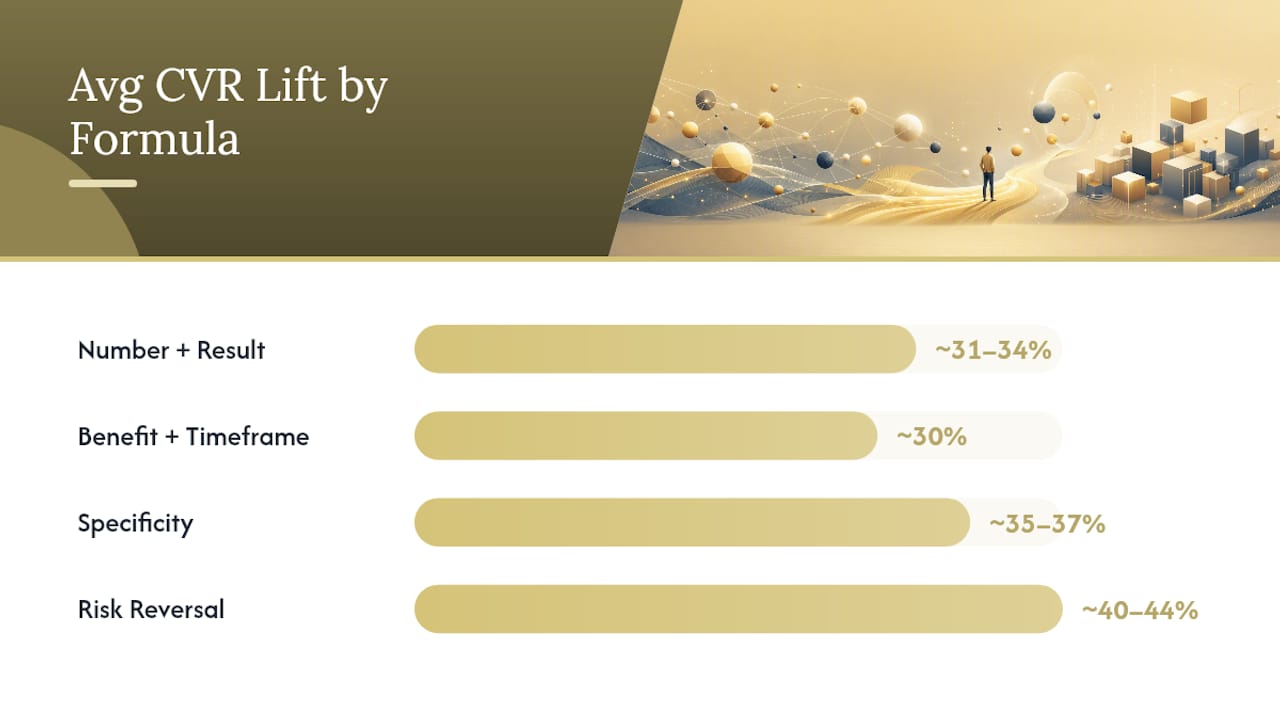
CVR lift ranges are aggregate benchmarks from ecommerce A/B tests and vary by audience, channel, and offer. Use them as directional signals, not guarantees.
SEO and length rules that make headlines work for search and humans
The WordStream guide on SEO headlines is direct: keep your title tag concise, place the target keyword close to the start, and write for the human reader first. Algorithms follow engagement signals — a headline that gets clicks and holds attention does more for rankings than one stuffed with keywords.
The point-first rule in practice:
✗ “In This Post, We’ll Show You How Our 8-Week Program Helps Creators Build a Paid Community” ✓ “Build a Paid Community in 8 Weeks: The Creator’s Step-by-Step System”
The second version puts the payoff (“Build a Paid Community in 8 Weeks”) before the descriptor. The reader knows what they’re getting before they decide to click.
Formatting checklist for different channels:
- SERP title tag: Keep it under 60 characters (roughly 580 pixels). Place the primary keyword in the first 3–5 words. Avoid terminal periods. Use title case for visual clarity, per Neil Patel’s headline formatting guidance.
- H1 on the page: Can be slightly longer than the title tag and more conversational. Should match the title tag’s core promise, not contradict it.
- Email subject line: Under 50 characters for mobile. Lead with the benefit or the curiosity hook. Avoid ALL CAPS and excessive punctuation.
- Social post headline: Match the platform’s tone. Twitter/X rewards brevity and contrarian angles. LinkedIn rewards specificity and authority. Instagram rewards emotional resonance.
- Paid ad headline: Lead with the benefit. Include a number or a specific claim where possible. Match the language of the landing page headline to reduce friction.
The Content Marketing Institute’s headline checklist recommends verifying promise, specificity, audience fit, curiosity, brevity, subhead use, and SEO compatibility before publishing. Run through that list on any headline you’re unsure about.
How to A/B test headlines and know when you have a winner
Testing without a plan produces noise. Here’s a repeatable process.
A/B testing checklist:
- Write a clear hypothesis: “Specificity formula will outperform curiosity-gap formula for warm email subscribers because they already know the topic.”
- Segment your audience: test cold traffic separately from warm traffic.
- Set your primary metric before you start: CTR for ads and search, open rate for email, conversion rate for landing pages, time-on-page for blog posts.
- Run the test long enough to reach statistical significance. For email, most lists need at least 1,000 recipients per variant to draw reliable conclusions. For paid ads, aim for 100+ conversions per variant before calling a winner.
- Declare a winner only when the result is consistent across at least two test cycles, not just one.
Metrics by channel:
| Channel | Primary Metric | Secondary Metric |
|---|---|---|
| Paid ads | CTR | Conversion rate |
| Open rate | Click-to-open rate | |
| Landing page | Conversion rate | Time on page |
| Blog / SEO | Organic CTR | Bounce rate |
| Social post | Engagement rate | Link clicks |
Aggregate A/B test data shows formula families produce meaningfully different results: Number + Result averages ~31–34% CVR lift, Specificity ~35–37%, and Risk Reversal ~40–44% for high-ticket offers. These are benchmarks from ecommerce contexts. A large-scale analysis published in Marketing Science confirms that specific textual cues do affect engagement, but the direction and magnitude depend on context — which is why testing in your own audience is non-negotiable.
Pro Tip: Low-traffic? Skip the traditional A/B split. Instead, send version A to your list on Tuesday and version B the following Tuesday to the same segment. Or use a subject-line tester like CoSchedule’s Headline Analyzer to score variants qualitatively before committing to a send.
30 ready-to-use headline templates, grouped by channel
Copy, adapt, and test. Two variations follow each template.
Social media (curiosity, contrarian, number)
- “[Number] Things [Audience] Wish They Knew Before [Doing Thing]” “9 Things New Coaches Wish They Knew Before Launching Their First Program” / “7 Things Fitness Creators Wish They Knew Before Running Paid Ads”
- “Why [Common Belief] Is Wrong — and What Actually Works” “Why More Content Is Wrong — and What Actually Grows Your Audience” / “Why Low Prices Are Wrong — and What Actually Converts”
- “The [Adjective] [Niche] Hack Nobody Is Talking About” “The Counterintuitive Pricing Hack Nobody in Fitness Is Talking About” / “The Simple Launch Hack Nobody in Coaching Is Talking About”
- “Stop [Doing X]. Start [Doing Y].” “Stop Posting for Free. Start Charging for Access.” / “Stop Chasing Likes. Start Building a Paid List.”
- “[Number] [Niche] Stats That Will Change How You [Do Thing]” “5 Creator Revenue Stats That Will Change How You Price Your Course”
Email subject lines (curiosity, urgency, benefit)
- “You’re [Doing Thing] Wrong. Here’s the Fix.” “You’re Writing Subject Lines Wrong. Here’s the Fix.” / “You’re Pricing Your Course Wrong. Here’s the Fix.”
- “[First Name], [Specific Result] Is Closer Than You Think” “[First Name], Your First 1,000 Subscribers Is Closer Than You Think”
- “Last chance: [Offer] closes [tonight/Friday/date]” “Last chance: The October cohort closes tonight” / “Last chance: Early-bird pricing closes Friday”
- “How [Audience Like Them] Got [Specific Result] in [Timeframe]” “How a fitness coach with 800 followers got 200 paying students in 6 weeks”
- “The [Adjective] email I almost didn’t send you” “The uncomfortable email I almost didn’t send you” / “The honest email I almost didn’t send you”
Paid ads (benefit-first, specificity, risk reversal)
- “Get [Specific Result] in [Timeframe] — [Guarantee or Proof]” “Get 500 New Followers in 14 Days — Backed by Real Creator Data”
- “[Number] [Audience] Already [Achieving Result]. You’re Next.” “1,200 Coaches Already Launched Their First Digital Product. You’re Next.”
- “[Specific Result] Without [Common Pain Point]” “Sell Your Course Without a Big Audience” / “Launch Your Program Without Tech Headaches”
- “Try [Product/Method] Free for [Period]. Keep the Results.” “Try the Launch System Free for 14 Days. Keep the Results.”
- “The [Adjective] [Niche] System Used by [Authority/Number] [Audience]” “The Proven Launch System Used by 500+ Digital Creators”
Blog posts / SEO (how-to, number, specificity)
- “How to [Achieve Outcome]: [Number]-Step Guide for [Audience]” “How to Launch a Digital Course: A 5-Step Guide for Fitness Coaches”
- “[Number] [Adjective] Ways to [Achieve Outcome] in [Year]” “11 Proven Ways to Monetize Your Audience in 2026”
- “The Complete [Niche] Guide to [Topic] for [Audience]” “The Complete Creator’s Guide to Pricing Digital Products”
- “What [Authority/Data] Tells Us About [Topic]” “What 3,000 Creator Launches Tell Us About Headline Testing”
- “[Topic]: What Works, What Doesn’t, and What to Do Instead” “Email Marketing for Creators: What Works, What Doesn’t, and What to Do Instead”
Landing pages (benefit, risk reversal, social proof)
- “[Specific Result] in [Timeframe] — or [Guarantee]” “Your First 100 Paying Students in 60 Days — or We Work for Free”
- “The [Adjective] System for [Audience] Who Want [Result] Without [Pain]” “The Proven System for Coaches Who Want Recurring Revenue Without Burnout”
- “Join [Number] [Audience] Who [Achieved Result]” “Join 800 Creators Who Built a Paid Community From Scratch”
- “[Audience]: Here’s Exactly How to [Achieve Result]” “Fitness Coaches: Here’s Exactly How to Sell Online Programs at Scale”
- “[Number] [Audience] Chose [Product/Method]. Here’s Why.” “2,400 Creators Chose This Launch System. Here’s Why.”
Copyblogger’s time-tested formulas like “Who Else Wants [Result]?” and “The Secret of [Achieving Outcome]” still hold up as starting points, though they need audience-specific testing before you commit to them. Crazy Egg’s broader list is worth bookmarking as a reference, with the caveat their own analysis notes: templates without testing and context are just guesses.
One legal note: Never write a headline that promises a specific outcome you can’t deliver. “Lose 30 Pounds in 30 Days” as a guarantee is a deceptive claim. Keep promises honest and achievable.
Generate 25 headline variations in 30 minutes with this framework
This is the routine experienced headline writers use before publishing anything significant.
- Minutes 1–10: Idea dump. Set a timer. Write 25–30 headline variations without editing. Pull from four formula families: Number + Result, How-To, Curiosity Gap, and Specificity. Quantity over quality at this stage. The goal is to exhaust the obvious options so the interesting ones surface.
- Minutes 11–20: Filter with the rubric. Score each headline on four criteria: Clarity (does a stranger understand the offer in 5 seconds?), Relevance (does it match the audience’s actual language?), Specificity (does it include a number, timeframe, or concrete result?), Promise (does it deliver a clear payoff?). Score 1–3 on each. Keep the top five scorers.
- Minutes 21–30: Lightweight validation. Send your top three to a peer or a small segment of your email list. Use a subject-line tester like CoSchedule Headline Analyzer or Sharethrough Headline Analyzer for a quick qualitative score. If you have a paid ad running, swap the headline and check CTR after 200 impressions.
Timebox template to copy:
[Topic/Offer]: _______________
Formula families to use: Number + Result / How-To / Curiosity / Specificity
Variations written: 25
Top 5 after filter: _______________
Test method: Email split / Ad swap / Peer review
Winner declared after: _______________
Example workflow: Topic is a new fitness coaching program. Dump 25 variations in 10 minutes. Filter to: “Lose 10 Pounds in 6 Weeks Without Cutting Carbs” (Benefit + Timeframe, scores 11/12) and “7 Fitness Mistakes That Are Keeping You Stuck” (Number + Result, scores 10/12). Test both as email subject lines to 500 subscribers each. Pick the winner in 48 hours.
Common mistakes that kill otherwise good headline formulas
Using the formula without understanding the audience. A risk-reversal headline (“Get Results or Your Money Back”) falls flat if your audience doesn’t yet trust you enough to believe the guarantee. Match the formula to the trust level, not just the funnel stage.
Overpromising. “Make $10,000 in Your First Week” is a headline that gets clicks and destroys credibility. Readers who click and find a reasonable offer feel deceived. The short-term CTR gain costs you long-term trust.
Clever over clear. Wordplay and puns feel creative in the writing but confuse readers at scroll speed. “The Mane Event for Your Hair Business” might work for a very specific audience. For cold traffic, it’s a click killer.
Ignoring the channel. A 90-character headline that works beautifully as a blog H1 gets truncated in a Google SERP title tag and loses its meaning. Always check how your headline renders in the actual channel before publishing.
Testing too many variables at once. Changing the formula, the benefit, the number, and the tone in a single A/B test tells you nothing useful. Change one element at a time.
Declaring winners too early. A headline that’s winning after 50 clicks may be losing after 500. Wait for statistically meaningful sample sizes before you commit.
How to tailor headline formulas to different audiences and personas
The same formula produces different results depending on who reads it. The fix is audience-language mirroring: pull the exact words your audience uses to describe their problem and their desired outcome, then plug those words into the formula.
For beginners (cold, low-awareness audience): Lead with the result and remove jargon. “How to Get Paid for Your Fitness Knowledge — Even If You’ve Never Sold Anything Online” works because it names the fear (“never sold anything”) and the desire (“get paid”) in plain language.
For intermediate practitioners (warm audience): They know the basics. Lead with specificity and process. “The 3-Phase Launch System That Took Our Creator From $0 to $40K in 90 Days” works because it assumes knowledge and delivers a concrete benchmark.
For advanced buyers (hot, high-awareness audience): They’ve seen every promise. Lead with proof and differentiation. “Why Our 18x ROAS Campaign Worked When Standard Funnels Failed” speaks to someone who knows what ROAS means and is skeptical of generic claims.
Persona-specific template adjustments:
- Beginner persona: Add “even if you’ve never [done X]” or “no [common barrier] required” to reduce perceived risk.
- Intermediate persona: Add a specific number, timeframe, or named method to signal depth.
- Advanced persona: Lead with a data point or a counterintuitive claim. Skip the reassurance.
For creators targeting diaspora audiences or non-English-speaking markets, mirror the emotional register of the community, not just the language. A headline that resonates in a Southeast European fitness community may need a warmer, more direct tone than the same formula used for a US audience.
Why formulas are a starting point, not a shortcut
Money-plug runs creator launches where headline and hook testing sit at the center of every campaign, not as an afterthought. Across seven launched programs generating over $500,000 in tracked revenue, including one that produced more than 3,000 sales in ten days, the pattern is consistent: the creators who ship the most winners generate the most variations first.
A formula gives you a proven structure. It does not give you the right words for your specific audience. The Number + Result formula that drove a 31–34% CVR lift in aggregate ecommerce tests may underperform for a niche coaching offer where the audience is skeptical of numbers they’ve seen overpromised before. That’s the point Crazy Egg makes about their own list of 101 formulas: breadth without testing is just a longer list of guesses.
The ethical dimension matters too. A headline is a promise. When the content or offer behind it doesn’t deliver what the headline implied, you lose the reader permanently. Short-term CTR gains from misleading headlines are real; so is the long-term cost to your brand. At Money-plug, every headline we write for a creator launch has to pass one final check: does the product actually deliver what this headline promises? If not, we rewrite the headline or we improve the product.
Prioritize long-term trust over short-term clicks. Every time.
Sources
- The Language That Drives Engagement
- Headline optimization (MarketingExperiments Web clinic)
- Headline formulas that convert
- 30+ Ultimate Headline Formulas for Tweets, Posts, and Emails
- 101 Best-Performing Headline Formulas for More Clicks
- Write headlines that hook (Content Marketing Institute)
- ULTIMATE HEADLINE FORMULA SWIPE FILE (Neil Patel PDF)