Launch Partner Meaning: What It Is and How It Works
Launch Partner Meaning: What It Is and How It Works

A launch partner is a person or company that helps a new product reach its first customers and is publicly tied to that release. Depending on the setting, that can mean a brand named alongside a new platform, a distributor that carries a new product on day one, or an agency that plans and runs the launch for the owner. If you landed here after searching the phrase, you may also have seen “soft launch” and “hard launch” results about dating. That is a different use of the word, covering how people announce a relationship online. This article is about business: products, programs and the partners behind them.
Below, we cover the definitions, how a launch partner differs from an affiliate, a sponsor or an agency, what the work looks like before, during and after a launch, how revenue is shared, and what to put in writing.
TL;DR
- A launch partner helps bring a product to market and shares in the outcome. The label is also used for organizations publicly named at a product’s first release.
- It is not the same as a sponsor (pays for visibility) or a pure affiliate (earns commission per tracked sale). A launch partner contributes work or reach and shares the result.
- The work covers research and planning before launch, execution during launch, and measurement afterward.
- Pay can be a flat fee, a commission or a revenue share. Define “net revenue”, reporting and exit terms in writing.
- For creators, the best launch partner handles the build and the selling, so you keep your focus on your audience.
Table of Contents
- What “launch” means in business
- Launch partner meaning: three common uses
- How a launch partner differs from an affiliate, sponsor or agency
- What a launch partner does before, during and after
- How launch partners get paid
- What to agree in writing
- How to tell if a launch partner is a good fit
- Perspective: why we work as launch partners
- Measuring whether a launch partnership worked
- Working with Money Plug Lab
- FAQ
- Sources
What “launch” means in business
To understand the partner, start with the launch. The Product Marketing Alliance describes a product launch as the process of bringing a new product or service to market, mainly to build anticipation and awareness among the target audience. ProductPlan’s glossary adds the practical side: a launch makes the product generally available for purchase while gathering early-user feedback and creating momentum.
A launch is not a single day. Amplitude’s guide frames it as a coordinated effort in three stages: planning, execution and analysis. A “launch partner” is anyone who takes a real role in those stages.

Launch partner meaning: three common uses
The phrase has no single legal definition. In practice you will meet it in three forms.
1. The named early participant. In technology, a launch partner is often an organization publicly associated with the first release of a product or framework. One glossary entry notes that the label signals early participation in an ecosystem. It is a marketing signal, not proof of quality. Readers who see a long list of launch partners should treat it as a sign of early involvement.
2. The distribution partner. A retailer, platform or reseller that carries a new product from day one and puts it in front of its own customers.
3. The hands-on execution partner. An agency or specialist who helps plan, build, price, promote and sell the product, often for a share of the sales. This is the version most creators mean when they search for a product launch partner, and the one we focus on below.
How a launch partner differs from an affiliate, sponsor or agency
These roles overlap in conversation, but the money and the responsibilities differ.
| Role | What they provide | How they are usually paid | Shares the outcome? |
|---|---|---|---|
| Sponsor | Visibility for their brand | A fee for a logo, mention or placement | Rarely |
| Affiliate | Referrals through tracked links or codes | Commission per sale or action | Only per sale |
| Traditional agency | Defined services | Retainer or project fee | No |
| Launch partner | Work, reach or infrastructure during the launch | Revenue share, commission, fee or a mix | Yes |
Brandwatch makes the core distinction: a sponsor pays for visibility, while a partnership involves mutual contribution and shared outcomes. On the affiliate side, Gen3 Marketing describes affiliate marketing as a performance-based subset of partnership marketing that relies on tracked links, referral codes and attribution. Pipedrive’s partner guide adds that affiliates generally use broader audiences and earn a commission per sale or action, while integration and product partners extend one another’s solutions.
If you want to see how commission-style deals work in a creator context, our breakdown of affiliate commission rates for creators covers the range and what each level means for your margins.
What a launch partner does before, during and after
Before the launch
The preparation decides most of the result. Amplitude lists audience and competitor research, goal-setting, a launch timeline, a marketing strategy and defined success metrics as pre-launch work. ProductPlan adds testing, documentation, support training, feedback collection and a pre-mortem.
For a creator selling a paid program, that translates to concrete tasks:
- Researching what your audience wants and will pay for
- Designing the product: modules, format, length, bonuses
- Setting the price and offer structure
- Writing the sales page and video sales letter
- Setting up payments and delivery
- Testing the offer with a small group first. We explain how in our guide to a beta launch course.
During the launch
This is the execution window: announcements, content, paid ads, email or messaging sequences and live support for buyers. Partners who depend on someone else’s message need clear enablement. GTM Playbook’s partner-launch guide says partners cannot be assumed to prioritize or communicate a launch automatically. They must be enabled and incentivized to carry the message accurately. The same applies between a creator and a partner: share the positioning, the offer details and the approved claims before anything goes live.
After the launch
The last stage is measurement and improvement. The Amplitude guide describes post-launch analysis as comparing data from the release window with KPIs and goals. ProductPlan points to metrics such as revenue or new users within a defined timeframe, plus user behavior and early feedback. The results then feed the next round: a price change, a new angle for the ads, a better onboarding sequence or a follow-up program.
How launch partners get paid
There are four common structures.
- Flat fee. You pay a fixed amount for defined work. The partner is paid whether or not the product sells.
- Commission. The partner earns a percentage per sale they generate.
- Revenue share. The partner takes an agreed percentage of revenue from the product, usually over a set period. Costs and risk are moved off the creator.
- Hybrid. A smaller fee plus a share of revenue.
Compensation in the creator economy is broad. An INTA committee report on influencers lists payments based on views or likes, free products or services, pay-per-click or transaction payments, and even a role as director or shareholder.
Define “revenue” before you sign
A revenue share is only as clear as its definition of revenue. Some published creator terms spell it out. For example, DYVA’s creator terms define net revenue as gross revenue minus payment-processing fees, applicable taxes and legally required withholdings, and refunds or chargebacks tied to the creator’s content. The same terms say attribution is recorded per order, showing the gross and net amounts, the processor fee and the share rate. You do not need that exact wording, but you should settle the same questions:
- Is the share calculated on gross or net revenue?
- Which costs come off before the split: processor fees, taxes, refunds?
- Who pays for ad spend, and is it recouped before the split?
- How often is revenue reported, and what does the report show?
What to agree in writing
The ISBA Influencer Marketing Code of Conduct, a UK industry document, lists what a good agreement covers: a clear brief, objectives and KPIs, disclosure duties, where and how often content is posted and for how long, fees and payment processes, exclusivity, and a sunset clause for content that stays on channels. It also says creators should keep the right to give honest opinions. Its focus is brand deals, but the checklist transfers well to a launch partnership, and the UK origin means you should check US disclosure rules separately.
Add the items that matter most when a partner builds a product with you:
- Ownership. Who owns the program content, your name and likeness, the sales copy and the customer list?
- Responsibilities. Who handles ads, payments, customer support and refunds?
- Reporting. What numbers will you see, how often, and from which system?
- Term and exit. How long does the revenue share last, and what happens to the product if you part ways?
- Claims. Who approves results, testimonials and income or health claims before they go public?
How to tell if a launch partner is a good fit
Start with fit. Threshold suggests reviewing a creator’s last 20 to 30 posts and the past 60 to 90 days of sponsor context to judge whether a collaboration feels natural. Flip that for your side: does the partner understand your niche and your audience, and can they show past work?
CreatorsJet lists warning signs on the brand side that apply just as well to any partner:
- Vague scope or unclear payment
- Unpaid extra work
- Broad or unpaid rights over your content
- Rushed deadlines
- Excessive exclusivity
- Pressure to hide sponsorships or make unsupported claims
Good signs are the reverse: an identifiable company, written deliverables, clear payment terms, and numbers from earlier launches that they can explain.
Perspective: why we work as launch partners
We built Money Plug Lab around one idea: a creator with an engaged audience should not have to fund, learn and manage a launch alone.
Most creators we meet in the Balkans and the diaspora have the hardest part already: attention and trust. What they lack is the machinery: audience research, product architecture, pricing, sales copy, video sales letters, payment setup and paid advertising. Hiring each specialist separately costs money upfront and demands time they do not have.
So we work on pure revenue share with zero upfront cost to the creator. We earn when the creator earns, and that keeps our incentives aligned from the first research call to the last optimization. We handle the whole chain, and we go as far as traveling for content production when a launch needs it.
Our own results show what this setup can do. Our creators have generated over $500,000 in tracked revenue across seven launched programs, including one launch with more than 3,000 sales in ten days and a campaign that returned 18x on ad spend. We see the Southeast European market as particularly rewarding, because creator audiences are highly engaged and acquisition costs are a fraction of those in Western markets.
That is our answer to what a launch partner should be: someone who shares the outcome, not just invoices for activity.
Money
Measuring whether a launch partnership worked
Decide the scorecard before the launch, not after. Useful measures include revenue within a defined window, number of buyers, conversion rate from page visit to purchase, refund rate, and return on ad spend if paid traffic is involved. Add qualitative feedback from early buyers, since ProductPlan highlights early-user feedback as part of a launch.

Be careful about cause. A sales spike during a campaign does not prove the campaign caused it, so compare against your own baseline: previous launches, a waitlist size or an earlier beta. Then feed the findings into the next version of the offer.
Working with Money Plug Lab
If you are a creator with an engaged following who has never sold a product, or a coach who wants a paid program or community with recurring revenue, this is the kind of partnership we run. We cover research, product design, pricing, sales copy, video sales letters, launch campaigns, payment infrastructure, ad post-production and ongoing optimization, for a revenue share and no upfront cost.
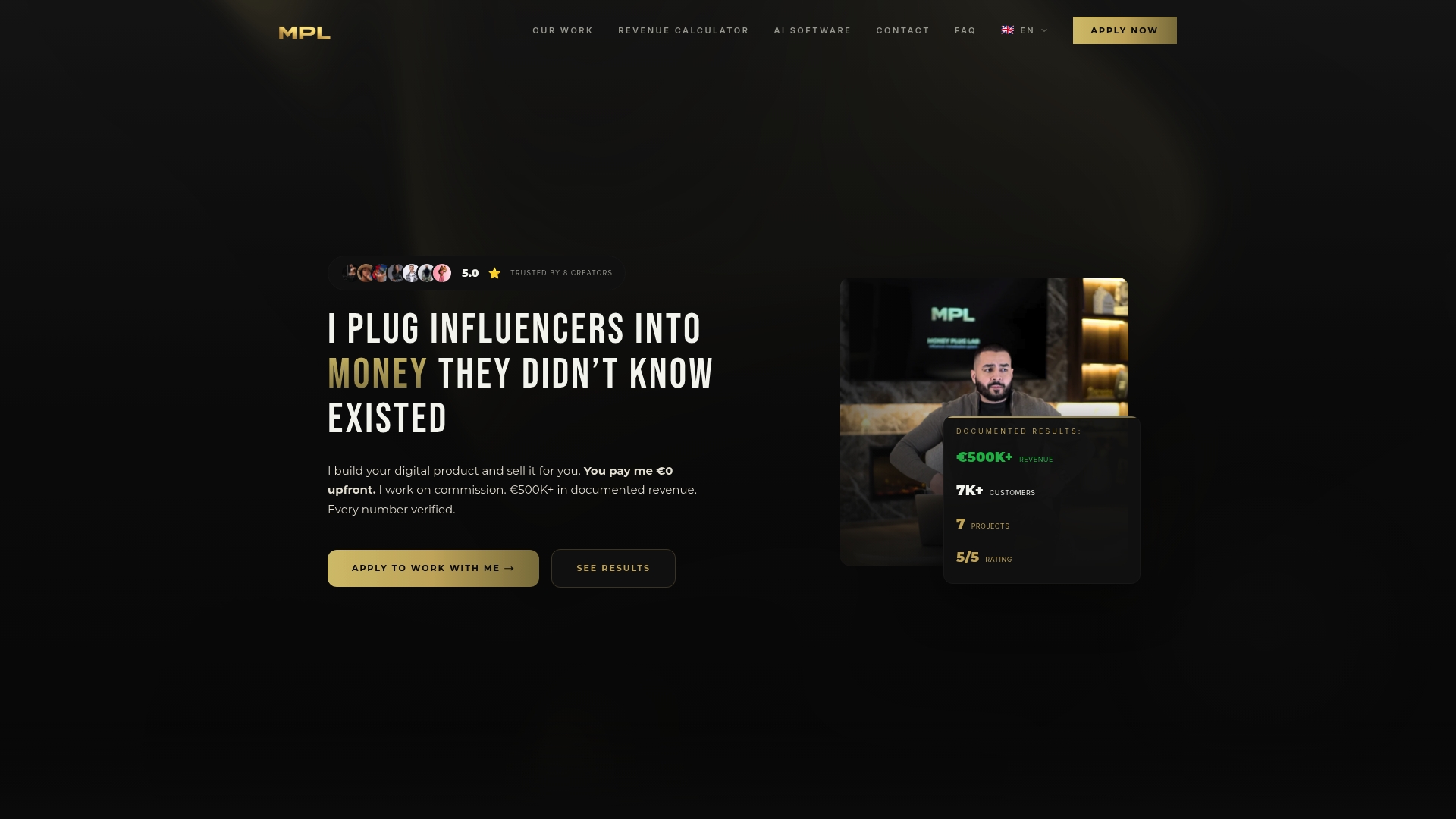
To talk through your audience and your idea, visit Money Plug Lab’s digital product monetization page.
FAQ
What does launch partner mean in simple terms?
A launch partner is someone who helps a product get to market and is tied to its release. They may bring reach, infrastructure or hands-on execution, and they usually share in the result. The exact role depends on the deal, so the agreement matters more than the label.
Is a launch partner the same as an affiliate?
No. An affiliate typically promotes through tracked links and earns a commission per sale or action. A launch partner is usually involved earlier, helps shape or run the launch, and may be paid through a revenue share or a mix of fee and commission.
What does a product launch partner do for a creator?
A launch partner for creators can research the audience, design the program, set the price, write the sales copy and videos, set up payments, run the campaign and track results afterward. The scope should be listed in writing so both sides know who handles what.
How is a launch partner paid?
Common models are a flat fee, a commission, a revenue share or a hybrid. With a revenue share, the partner earns a percentage of sales, so define whether the percentage applies to gross or net revenue, how refunds and fees are handled, and how long the share lasts.
What does “soft launch” mean, and is it related?
In dating slang, a soft launch hints at a new partner online without fully revealing them, and a hard launch is a clear public post. In business, a soft launch is a limited release to a small audience before the full launch, which is why we recommend a small beta first.
Sources
- How to launch a product, Product Marketing Alliance
- Product Launch glossary, ProductPlan
- What is a Product Launch, Amplitude
- Launch Partner definition, NHIMG glossary
- What is Brand Partnership, Brandwatch
- Partnership Marketing guide, Gen3 Marketing
- B2B partner guide, Pipedrive
- Partner Launch Playbook, GTM Playbook
- INTA Committee Report on Influencers
- Creator Terms, DYVA
- Influencer Marketing Code of Conduct, ISBA
- What Creator Brand Fit Really Means, Threshold
- Red Flags: How to Spot Brands You Shouldn’t Work With, CreatorsJet