Membership Retention for Creators: A Practical Playbook
Membership Retention for Creators: A Practical Playbook

Membership retention for a creator is the share of paying members who stay subscribed from one period to the next. You improve it by getting each new member a quick first win, showing up consistently, keeping the community active, and tracking cancellations by cohort so you can see what is working. This guide covers the math, realistic benchmarks, and the habits that keep members paying.
TL;DR
- Retention is the mirror image of churn: 92% retention means 8% churn. Track both monthly, and keep annual renewal rates separate.
- Creator subscriptions commonly lose 8–12% of members a month. Creators who post consistently every week can get to 4–6%.
- The biggest causes of cancellation are within your control: no early win, an absent creator, a quiet community and a mismatch between promise and outcome.
- Pick three metrics, define them in writing and review them on the same day every month.
- Price, onboarding and cadence work together, so fix them as one system, not as separate tasks.
Table of Contents
- What membership retention means for a creator
- What a good retention rate looks like
- Why members leave
- Onboard for a first win
- Keep delivering: content, presence and community
- Spot disengagement early
- Price and plan structure affect retention
- Measure whether it is working
- Win back former members
- Build retention in from the launch
- FAQ
- Sources
What membership retention means for a creator
Member retention measures how many members keep their membership active over time. It also describes how you keep people from canceling and make sure they find enough value in what you offer. Mighty Networks’ definition gives the formula ((ME − MN) / MS) × 100, where MS is members at the start of the period, ME is members at the end, and MN is new members who joined during it. Subtracting new joins matters. Without it, a strong launch week hides the people who quietly left.
A quick example: you start the month with 400 members, end it with 410, and 40 of those 410 joined this month. Retention is (410 − 40) / 400 × 100, or 92.5%. You grew, yet you lost 30 people.
The same source calls a rate above 75% a more doable target than 100%. Treat that as a floor to beat, not a ceiling.
Retention, churn and renewal rate
These three get mixed up constantly:
- Retention is the percentage of members active at the start of a period who are still active at the end.
- Churn is its mirror image. According to Roctify’s glossary, 92% retention equals 8% churn.
- Annual renewal rate is the share of annual members who renew after 12 months. The same glossary warns against mixing it with monthly figures.
If you sell both monthly and yearly plans, report them separately. A 70% annual renewal rate and a 92% monthly retention rate describe different things.
Member churn versus revenue churn
Monthly member churn is members lost during the month divided by members at the start, times 100. Revenue churn is recurring revenue lost during the month divided by recurring revenue at the start. Patron Page explains both formulas, and notes that revenue churn matters when higher-paying subscribers contribute more than the average. If you run a basic tier and a premium tier, losing ten premium members hurts far more than losing ten basic ones. Track both numbers.
What a good retention rate looks like
Benchmarks give you a reality check, though your own trend line matters more. RetentionCheck’s 2026 benchmark puts the creator-platform category average at 10.5% monthly churn, which compounds to roughly 73% annual. It reports a typical range of 8–12% monthly, and says individual creator pages with consistent weekly content can reach 4–6%.
The practical meaning is easy to picture. PV Story notes that a creator with 1,000 paying subscribers at 8–12% monthly churn could lose 80 to 120 of them every month. That is the hole you refill before you grow at all.
| Monthly churn | Members lost per 1,000 | What it suggests |
|---|---|---|
| 4–6% | 40–60 | Consistent weekly delivery, clear value |
| 8–12% | 80–120 | Typical creator subscription |
| Above 12% | 120+ | Look hard at onboarding, cadence and promise |
The same benchmark also shows what drives cancellations: the creator stopping posting or going inactive accounts for 42% of them. Consistency is the single most visible retention lever.
Subscription fatigue adds pressure from outside. PV Story cites a 2025 Deloitte survey in which 47% of consumers felt they subscribed to too many services and 34% planned to cancel at least one within three months, with creator subscriptions often among the first cut. Your offer has to feel essential, not optional.

Why members leave
AdvLaunch lists six causes of paid community churn: no first win in 30 days, an absent founder, a community that feels dead, a mismatch between promise and outcome, a life change, or a price hike. The first four are within the operator’s control. Life changes happen, and you can only make leaving easy and leave the door open.
Jay Clouse puts the underlying logic bluntly on the Growth In Reverse podcast. Paraphrased: if someone does not renew, their perception of value has dropped below the price of staying, and that price includes both the money and the effort needed to get the most out of the membership (episode summary). Two levers follow from that: raise the value members perceive, and lower the effort it takes to get it.
Onboard for a first win
The first 30 days decide most of your retention. A member who has not achieved something small and visible by then is already drifting. A strong onboarding path does four things:
- Confirms the promise. A welcome message restates the outcome the member bought and the quickest route to it.
- Defines one first action. Not ten. For a fitness program it might be completing day one and posting a check-in. For a coaching community, introducing themselves and sharing one goal.
- Introduces a person. AdvLaunch recommends that someone reply to every new-member post within 24 hours. A fast response tells newcomers the place is alive.
- Sets expectations for cadence. Tell members when live sessions, new lessons and challenges happen so they can build a habit around them.
Check the result at day 7 and day 30. Who started? Who finished the first action? Send a short personal message to anyone who did not.
Lowering effort is part of onboarding too. Put the best starting material in one pinned place, name it clearly, and cut the library down so a new member sees the path and not the pile.
Keep delivering: content, presence and community
Show up on a schedule
Because an inactive creator is the top cancellation driver, a predictable weekly rhythm beats occasional bursts. Decide what you can sustain for a year: one live Q&A, one new lesson, one challenge a month. AdvLaunch recommends a founder visibility minimum of 2–4 hours per week of real presence in the community. Put it in your calendar like a client meeting.
Make the community feel alive
A quiet space convinces members to leave faster than almost anything. Seed conversations with specific prompts, spotlight member wins, and run short group challenges with a start and an end. If you want a deeper list of tactics, our guide on how to increase community engagement walks through twelve of them.

Ask members what they need
Feedback gives you the reason behind the numbers. A two-question check-in at day 30 (“What has helped most?” and “What is getting in your way?”) shows where the effort is too high or the value is unclear. Platforms help here. YouTube, for example, shows cancellation feedback in the Memberships tab of YouTube Studio from predefined multiple-choice options, next to sign-ups, cancellations and members by level. Read those reasons monthly.
Keep the promise honest
A promise-outcome mismatch starts at the sales page. If your marketing promises a transformation in 30 days and the program delivers it in 90, members cancel in week five. Write the promise you can actually deliver, then deliver slightly more.
Spot disengagement early
Cancellation is the last step of a longer slide. Watch for these signals:
- No login or no program activity for 7 to 14 days
- Stopped posting or reacting after an active start
- Skipped live sessions two weeks in a row
- Opened support or billing questions without follow-up
Build a simple routine: once a week, list members who went quiet and send each a short, human message. Reference something specific, such as the lesson they were on or the goal they shared. One genuine message beats an automated “we miss you” blast.
Offering a pause is another option for members whose life got busy. A paused member who returns in a month is worth more than a canceled one who never comes back.
Price and plan structure affect retention
Price shapes how members judge value, so retention work does not stop at content. The more an offer costs in money and effort, the higher the value bar. Tie price to outcomes and test changes carefully, since a price hike is one of the six churn causes. Our article on membership pricing strategy covers how to tie prices to outcomes and test for churn. If you are deciding between a one-time program and a recurring one, high ticket versus low ticket helps you choose the right structure for your audience.
Annual plans give you a different retention profile: fewer decision points, but one big renewal moment. Prepare it with a recap of what the member achieved during the year.
Measure whether it is working
Do not track everything. Pick three metrics, define them in writing, and review them on the same day each month, as this analytics guide advises. Good candidates:
| Metric | How to calculate | What it tells you |
|---|---|---|
| Renewal rate | Members who renewed ÷ members whose term ended in the period, excluding new joins | Whether value holds at the decision point |
| Cohort retention | Share of one join month still active after 1, 2, 3 months | Whether onboarding changes helped |
| Revenue per member | MRR ÷ active members | Whether your mix is moving up or down |
| Involuntary churn | Lapses from failed or expired cards, tracked apart from voluntary cancellations | Billing problems you can fix |
The cohort view is the most useful one for retention work. If January’s cohort kept 80% at month three and March’s kept 88% after you changed onboarding, the change worked. A blended monthly average would hide that.
Separating involuntary churn matters because it needs a different fix. Failed cards call for reminder emails and card-update prompts, not content changes.
Win back former members
Some departures are not final. A simple win-back sequence:
- Ask why they left, with a one-question exit survey.
- Wait a few weeks, then send an update about what is new since they left.
- Offer an easy return, such as a re-entry into the current challenge or cohort.
- Fix the reason. If many say “too busy,” add a pause option. If many say “no results,” revisit the first-win path.
Treat former members as warm leads. They already trust you enough to have paid once.
Our perspective
We work with creators in the Balkans and the diaspora who want to launch paid programs and communities, and we see the same pattern again and again: retention is decided long before a member cancels. It is decided by the offer’s architecture, the clarity of the promise, the pricing and the first 30 days.
That is why we build these things together instead of in pieces. Audience research tells us what members actually want. Product architecture turns that into a path with an early win. Pricing and sales copy set expectations the product can meet. Launch campaigns and paid advertising bring in the right people, not just many people. Our model is revenue share with zero upfront cost to the creator, so we only earn when members buy and stay, which keeps our incentives lined up with yours.
If you are a creator with an engaged audience and no paid product yet, design for retention from the first day. A member who gets a result in week one is the best marketing you will have.
Money
Build retention in from the launch
If you have an audience of 20K to 500K followers and have never sold a product, the cheapest time to fix retention is before you launch. Money Plug Lab handles audience research, product architecture, pricing strategy, sales copy, video sales letters, launch campaigns, payment infrastructure and paid ad post-production on a pure revenue-share basis. You can see how digital product monetization with PlugReach works on our site.
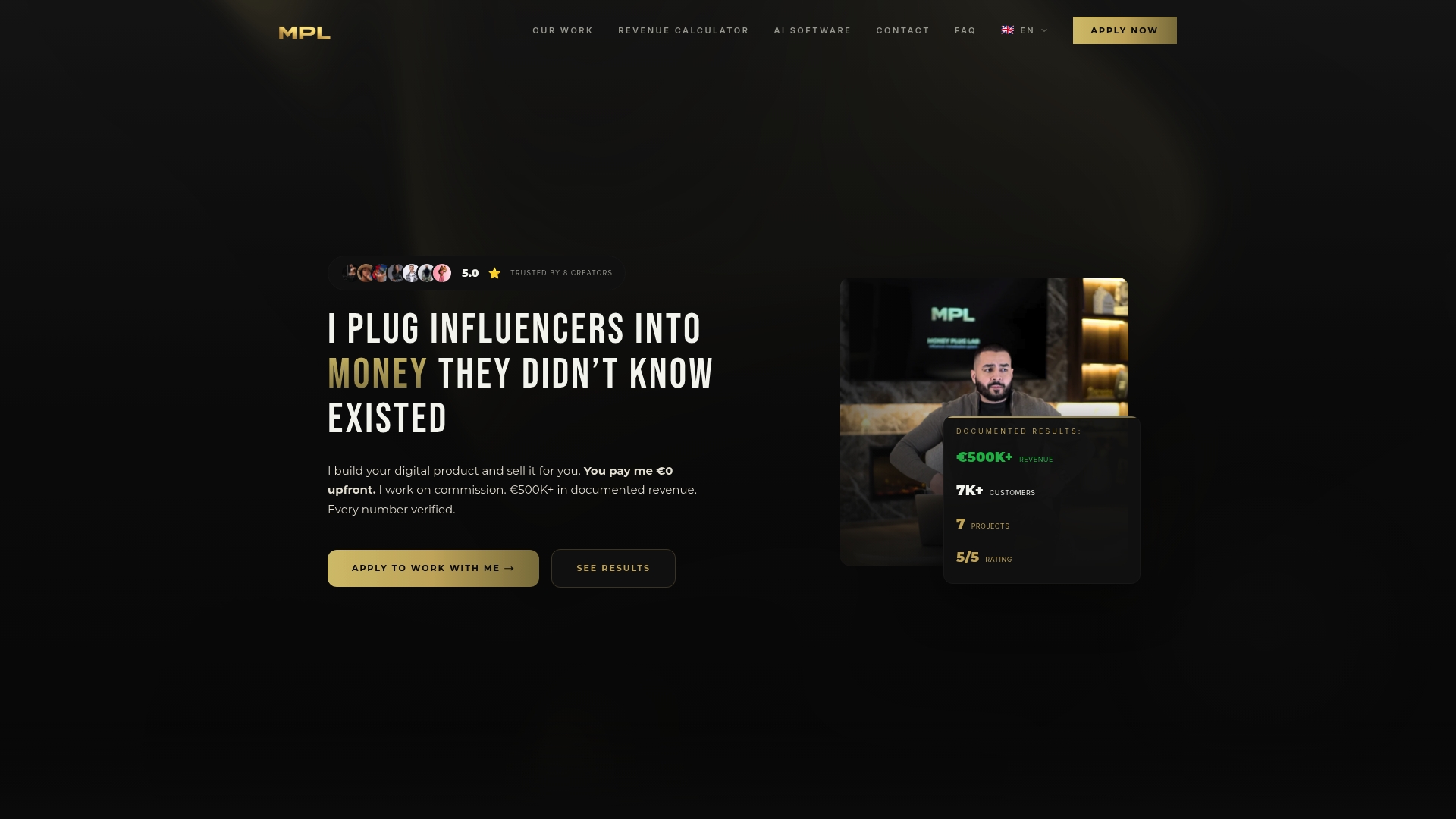
We write the offer, the launch and the member journey so that the people who buy are the people most likely to stay.
FAQ
What is a good membership retention rate for a creator?
Above 75% is a commonly cited, doable target. Benchmarks for creator subscriptions show about 8–12% monthly churn on average, and consistent weekly publishers can reach 4–6%. Compare yourself to your own cohorts first.
How do I calculate member retention?
Subtract the new members who joined during the period from your members at the end, divide by members at the start, and multiply by 100. Track annual renewal separately from monthly retention so the numbers do not blur.
Why do members cancel a paid community?
The common causes are no early win, an absent creator, a community that feels dead, a promise that does not match the result, a life change, or a price increase. The first four are fixable through onboarding, presence and honest positioning.
How often should I post to keep members?
Post on a rhythm you can keep for a full year. Benchmarks link consistent weekly content with lower churn, and creators going inactive is the top reason for cancellations. A weekly lesson or live session plus daily community presence is a solid base.
Can I win back members who canceled?
Yes. Ask why they left, wait a few weeks, and invite them back with news and an easy re-entry. Use their answers to fix the underlying cause for everyone else.
Sources
- Mighty Networks: What is Member Retention?
- Roctify: Member Retention, Formula and Benchmarks
- Patron Page: Recurring Revenue Metrics for Creators Explained
- RetentionCheck: Creator Platforms Churn Rate Benchmarks
- PV Story: The Subscription Fatigue Problem
- AdvLaunch: Why Paid Community Members Churn
- Growth In Reverse: How to Build a Successful Paid Community with Jay Clouse
- Member Forum Renewals: Audience analytics for a membership community
- YouTube Help: Analyze and manage your channel memberships program