MMA Community Launch: A Creator's Guide to Paid Membership
MMA Community Launch: A Creator’s Guide to Paid Membership

A focused, membership-first MMA community can go from idea to paying subscribers in 90 days if you combine three things: a clear tiered offer, a platform embedded in real training behavior, and a launch playbook that has already been tested. That’s the whole formula. Everything else is execution detail.
To pull it off, you need:
- Offer architecture — free, core, and premium tiers with distinct benefits
- Platform choice — software that handles billing, live streaming, and community threads in one place
- Prelaunch audience play — lead capture and beta testing before you ask anyone to pay
- Paid launch mechanics — a campaign window with urgency and a clean checkout
- Retention plan — onboarding, gamification, and staffing to keep churn low
The scale of the opportunity is not small. MMA.INC’s SEC filing frames the sport’s global fanbase at over 700 million, most of whom are passive consumers waiting for a reason to participate. On the platform side, BJJLink Connect has crossed more than 17,000 monthly active users by tying its community features directly to academy training days. And on the agency side, Money Plug Lab has helped creators generate over $500,000 in tracked revenue across seven launches, one of which drove more than 3,000 sales in ten days.
Key Takeaways
A monetized MMA community launch succeeds when a tiered membership offer, an academy-embedded platform, and a structured 30 to 90 day campaign work together instead of separately.
| Point | Details |
|---|---|
| Start with offer clarity | Build 2 to 3 tiers with distinct benefits before investing in more content production. |
| Run a real beta | Test with 50 to 200 users for two weeks before opening public checkout. |
| Track the right KPIs | Watch MRR, churn, LTV, CAC, and ARPM from week one, not just signups. |
| Embed community in training | Platforms tied to real academy behavior, like BJJLink’s over 17,000 monthly active users, drive stronger retention. |
| Get expert launch support | Money-plug runs audience research through payments on revenue share, with $500,000+ in tracked creator revenue. |
Table of Contents
- What Does a Successful MMA Community Launch Look Like?
- How Do You Launch an MMA Community Step by Step?
- What Are the Best Monetization Models for an MMA Community?
- How Do You Choose the Right Platform for an MMA Community?
- What Should a 30 to 60 Day Prelaunch Timeline Look Like?
- How Do You Keep Members From Canceling?
- What Does Payments, Legal, and Budget Setup Actually Cost?
- What Results Has Money Plug Lab Delivered for Creator Launches?
- How Do You Handle Conflict Inside an MMA Community?
- What Legal Disclaimers Does MMA Content Require?
- Why Offer Clarity Beats Content Volume
- How Money-Plug Helps You Launch a Paid MMA Community
- Frequently Asked Questions
- Sources
What Does a Successful MMA Community Launch Look Like?
Success has numbers attached to it, not vibes. Track monthly recurring revenue (MRR), lead-to-member conversion rate, churn, lifetime value (LTV), customer acquisition cost (CAC), and average revenue per member (ARPM) from week one.
- Early-stage MMA memberships with embedded distribution often see conversion rates in the low single digits from warm leads
- Churn under 8% monthly is a reasonable early target for content-heavy communities
- Watch engagement proxies like class attendance and event RSVPs. They predict renewal better than login counts do
MMA.INC reported strong year-on-year subscription revenue growth after removing onboarding friction, a reminder that acquisition mechanics move revenue as much as content quality does.
How Do You Launch an MMA Community Step by Step?
An MMA community launch works best as a sequence, not a scramble. Here’s the order that actually holds up.
- Pick your first-paid persona. Beginners, competition athletes, women entering the sport, or law enforcement and military trainees all buy differently. Women are a fast-growing participation segment in the sport, and a beginner-focused women’s cohort is often an underserved, easier first sell than a general “MMA fans” pitch.
- Build 2 to 3 membership tiers. A free tier for reach, a core monthly tier with live classes and an on-demand library, and a premium annual tier with 1:1 coaching access or discounts on camps or gear.
- Produce the core content assets. Record your on-demand library, set a weekly live class schedule, script a five-part onboarding series, and write moderation guidelines before you open the doors.
- Set up platform and payments. Recurring billing, a simple sign-up flow, and single sign-on if you’re tying the community to a physical gym’s existing system.
- Run a two-week closed beta. Fifty to two hundred testers, direct feedback loops, and one iteration cycle before public launch.
- Warm up the market. Lead magnets, an email list, an ambassador program, and one or two influencer or event tie-ins.
- Execute launch day. A limited-time founding-member price, a countdown, and a checkout flow with a downsell option for anyone who bails at the paywall.
- Follow up hard in week one. An onboarding sequence, an NPS check-in by day seven, and a clear upgrade path to the next tier.
Pro Tip: Run your beta cohort through the exact onboarding sequence you plan to use at launch. If testers get confused or drop off in week one, that’s your launch funnel failing in private instead of in public.
What Are the Best Monetization Models for an MMA Community?
Membership dues are the backbone, but they shouldn’t be the only line on your P&L. Monthly recurring pricing works well for the core tier, while annual pricing with a discount fits your premium tier and locks in cash flow up front.
Beyond membership, layer in:
- Pay-per-view seminars for high-profile guest coaches or technique breakdowns
- Merchandise drops timed to launches or major fight weekends
- Sponsorships from gear brands targeting your specific niche
- Affiliate and referral revenue from existing members who bring in friends
A useful gut-check on conversion assumptions: with 1,000 engaged fans in your funnel, a 2% to 5% paid conversion rate is realistic for a well-positioned offer, which puts you at 20 to 50 founding members before you’ve spent a dollar on ads. From there, a limited-time founding-member discount that converts to full price after 90 days is one of the more reliable ways to lift long-term LTV without discounting your evergreen price forever.
How Do You Choose the Right Platform for an MMA Community?
Your platform needs to do five jobs well, not fifty jobs badly. Run every option through this checklist:
- Recurring membership billing with tier support
- Video hosting for on-demand content plus reliable live streaming
- Asynchronous spaces (forums or threads) for training discussions between live sessions
- Event and ticketing tools for seminars or in-person camps
- Clean integration with your email platform and ad pixels for retargeting
Consider single sign-on if you’re linking to a physical gym’s existing scheduling system. MMA.INC’s ecosystem connects academy software, commerce, content, and rewards into one network, which is precisely why embedding a digital community into physical training workflows multiplies retention instead of just adding another app to check. Gyms exploring how in-person and digital touchpoints reinforce each other might also look at screen and signage systems that display training content on-site, which reinforces the same principle: meet members where they already show up. At minimum, your stack needs community software, a payment gateway, email automation, and a scheduling or booking tool.
What Should a 30 to 60 Day Prelaunch Timeline Look Like?
A prelaunch window without structure just becomes procrastination with a deadline. Break it into four phases.
- Weeks 1 to 2: Set up lead capture, lock in one or two partnerships (gyms, coaches, or influencers), and start a content drip that builds anticipation.
- Weeks 3 to 4: Open beta signups, run your closed beta, and collect testimonials from early users.
- Weeks 5 to 6: Send your nurture email sequence: value first, then social proof, then a cart-open announcement with a countdown, followed by a cart-close deadline and immediate onboarding for buyers.
- Launch week: Mix owned media (email and social) with earned media (partner shoutouts) and layer in paid ads once organic momentum is visible.
Time your public push around a moment of real attention. MMA.INC timed a site relaunch to UFC International Fight Week specifically to ride existing audience spikes rather than fight for attention on a quiet week. A free live workshop or coach Q&A in the final days before cart-close is one of the most reliable urgency levers you have.
How Do You Keep Members From Canceling?
Retention starts in the first seven days, not the first renewal cycle. Ship a welcome pack and a guided first-week plan immediately, so new members get a quick win before doubt sets in.
- Weekly live classes and cohort-based challenges create recurring reasons to log in
- Milestone badges and leaderboards tied to actual training behavior (classes attended, drills completed) turn effort into visible progress
- Event-based spikes around seminars or camps re-engage lapsed members
- Staff for it: a coach for content authority, a community manager for daily engagement, a moderator for conflict, and a support contact for billing questions
Pro Tip: Tie your gamification to real training milestones, not vanity metrics like login streaks. A leaderboard for “sparring sessions logged” builds habit; a leaderboard for “days opened the app” builds resentment.
What Does Payments, Legal, and Budget Setup Actually Cost?
Before launch day, lock down the boring stuff so it doesn’t blow up later.
Payments and legal checklist:
- A payment processor with recurring billing support
- Tax collection basics for your operating region
- A written refund policy posted before checkout, not after a complaint
- A liability waiver for physical training content and a copyright notice for your video library (get local counsel to review both. This is not something to freehand)
Sample 90-day budget and timeline:
- Days 1 to 30 (beta): Platform fees, minimal production costs, no ad spend yet
- Days 31 to 60 (launch): Production ramps up, ad spend begins, payment processing fees kick in at volume
- Days 61 to 90 (scale): Agency or onboarding costs if you’re outsourcing, plus increased ad spend on proven creative
Budget ranges vary widely by production quality and ad spend, so treat these as sequencing milestones rather than fixed dollar figures.
What Results Has Money Plug Lab Delivered for Creator Launches?
Money Plug Lab has run this exact playbook for creators across fitness, coaching, and niche training communities, applying the same audience-first approach that works in MMA.
- Audience research first. Segment the fanbase before writing a single sales page
- Tiered offer design. Free, core, and premium structures matched to willingness to pay
- High-conversion checkout. Downsells and urgency mechanics built into the cart flow
- Paid ads plus revenue share. No upfront cost to the creator, with Money-plug earning a cut of what it generates
Those aren’t projections. They’re outcomes from real launch windows with real ad spend behind them, and they map directly onto the same tiered-offer, embedded-community model outlined above.
How Do You Handle Conflict Inside an MMA Community?
Combat sports communities run hot. Competitive people, strong opinions on technique, and real physical risk mean disagreements escalate faster than in a typical hobby group. You need protocols before the first flare-up, not after it.

Set clear community guidelines at onboarding: what counts as constructive critique versus personal attack, how technique disagreements get resolved (defer to your coaching staff, not the loudest voice in the thread), and what happens on a first, second, and third violation. A three-strike system, posted publicly, removes ambiguity and protects you from accusations of favoritism.
Give your moderators a documented escalation path: private warning first, temporary mute second, removal third, with every action logged. Reserve permanent bans for safety threats, harassment, or content that promotes reckless training practices. Respond within 24 hours on flagged posts. Combat sports communities that let conflicts sit unaddressed for days lose trust fast, especially among competitive athletes who expect a coach’s authority to mean something.
Separate technique debates from personal conduct issues entirely. A member who disagrees with your striking mechanics is not the same problem as a member who is harassing another user, and treating both with the same moderation tool erodes credibility either way. Your community manager should have a direct line to your head coach for any dispute that touches technique or training safety, since that’s the one category where getting the ruling wrong carries real risk beyond hurt feelings.
What Legal Disclaimers Does MMA Content Require?
Physical training content carries liability exposure that a standard course on marketing or productivity does not. Every video, live class, and written program involving striking, grappling, or conditioning needs a visible disclaimer stating the content is for educational purposes and that members should consult a physician before starting any training program.
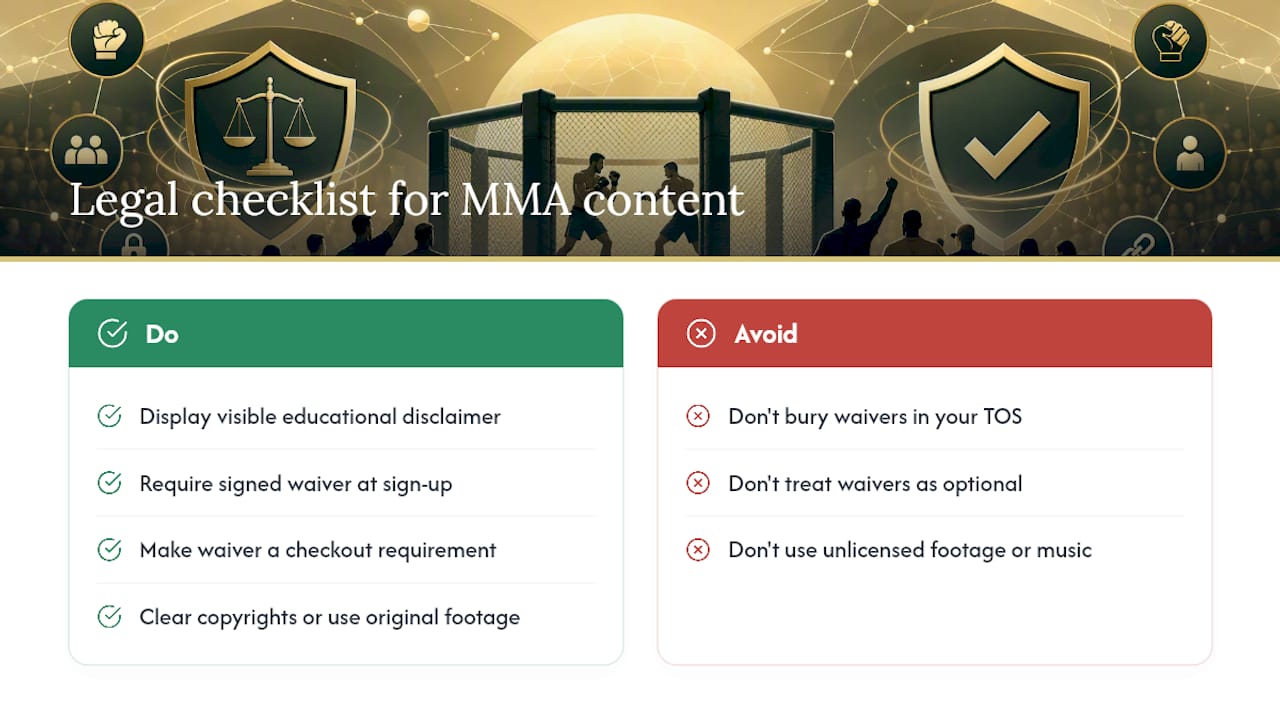
Require a signed waiver at sign-up for any tier that includes live coaching feedback or structured workout programming, not just for in-person events. A digital waiver acknowledging assumption of risk is standard practice across fitness and combat sports platforms, and it should be a checkout requirement, not an optional afterthought buried in your terms of service.
Copyright matters too. If you’re using footage from live events, other coaches’ techniques, or licensed music in your content library, get clearance or stick to original footage. This is one area where a quick, one-time consultation with a lawyer familiar with fitness or media liability in your jurisdiction is worth the cost. The specifics vary by country and by whether you’re operating as a sole proprietor or a registered business, so treat every disclaimer and waiver here as a starting checklist, not a substitute for that review.
Why Offer Clarity Beats Content Volume
The creators who win at this aren’t the ones with the most video content. They’re the ones whose offer is so clear a stranger could explain it back in one sentence. Get that right first, then worry about production value.
If I had to rank priorities for a first-time launch: offer clarity, delivery quality, and onboarding experience, in that order. Most creators flip it and obsess over camera gear while their pricing page confuses people.
On staffing, hire or outsource a community manager before you hire a second coach. One clear voice guiding new members through week one prevents more churn than another hour of content ever will. If you want a second opinion on your offer structure before you launch, Money-plug is worth a conversation.
How Money-Plug Helps You Launch a Paid MMA Community
Building the offer, the launch campaign, and the payment infrastructure yourself while also coaching and creating content is where most MMA creators stall out. Money-plug runs the entire monetization system for you on a pure revenue-share basis, so there’s no upfront cost before your first sale.
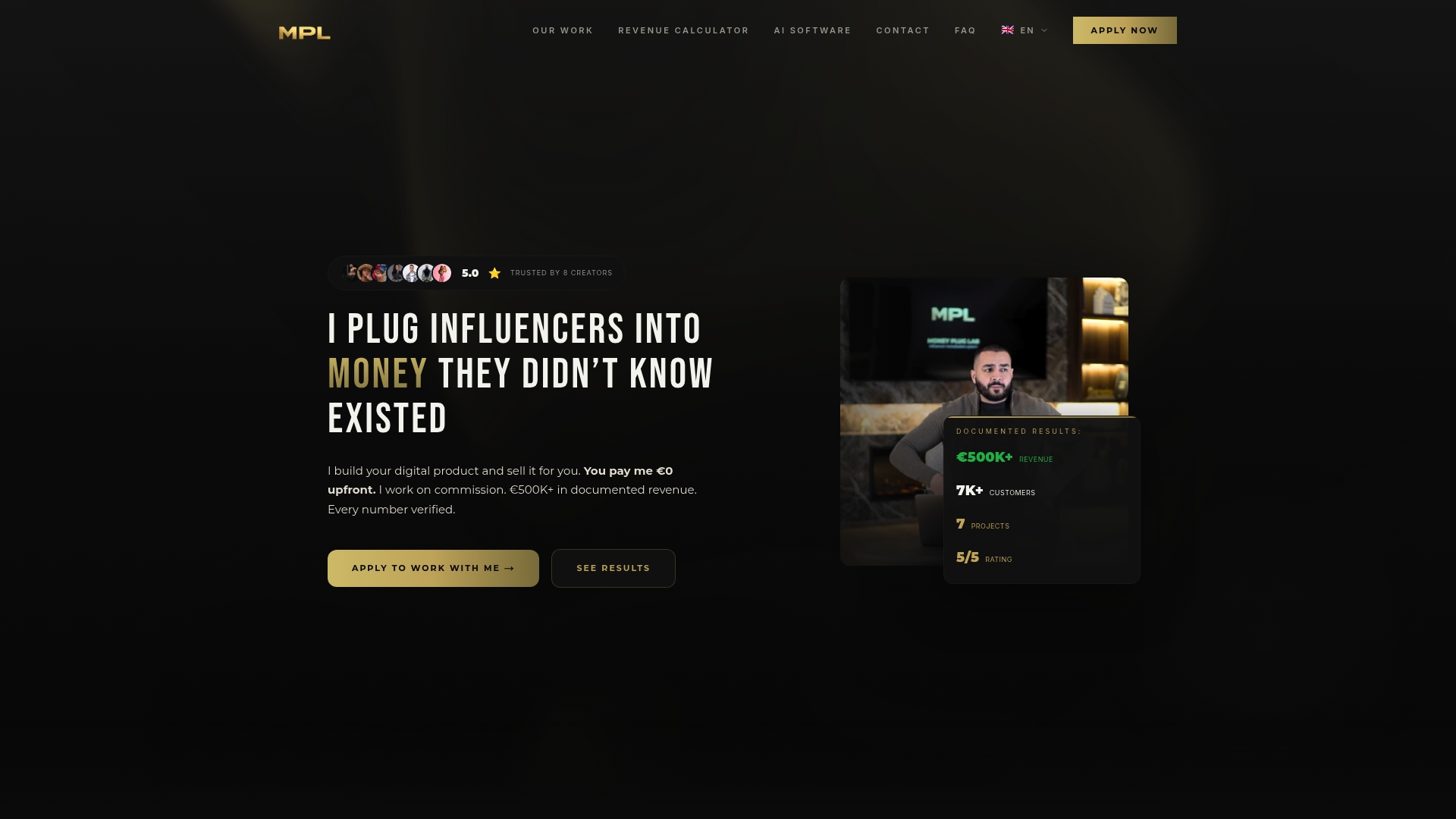
That means Money-plug handles audience research, tiered product architecture, sales copy, launch campaigns, and payment setup, while you stay focused on coaching and content. If you’re a Balkan or diaspora creator ready to turn your following into a paying community, book a discovery call with Money Plug and see what a revenue-share partnership looks like for your audience.
Frequently Asked Questions
How long does it take to launch a paid MMA community? Most focused launches run 30 to 90 days from offer design to first paying members, assuming you already have some audience to draw from.
How much revenue can an MMA community realistically generate? It depends heavily on audience size and conversion rate, but a 2% to 5% paid conversion from an engaged fan base of 1,000 people puts you at 20 to 50 founding members before any paid advertising.
Do I need my own app to launch an MMA community? No. Most creators launch on existing community and membership platforms rather than building custom software, which keeps upfront costs near zero.
What’s the biggest mistake creators make when launching an MMA community? Launching with vague positioning and no beta test. A confusing offer or an untested onboarding flow kills conversions before the content even gets evaluated.
Should I outsource my MMA community launch or do it myself? If you don’t have in-house experience in pricing strategy, sales copy, and paid ads, outsourcing to a revenue-share partner like Money-plug removes the upfront cost risk while you stay focused on coaching and content.