Creators: 5 Offer Stack Examples with Templates and Margin Rules
Creators: 5 Offer Stack Examples with Templates and Margin Rules

An offer stack is a core product wrapped in 3 to 7 named bonuses, each one built to knock down a specific reason someone hesitates to buy. Below you’ll find five ready-to-adapt examples, a step-by-step build process, and a one-page worksheet, so you can put a stack together before your next launch instead of guessing at bonuses on the fly.
TL;DR:
- Successful offer stacks should be built around objections, repurposing existing assets, and matching one bonus to one specific concern.
- Each bonus must be defensible in value and contribute to reducing buyer risk, time, or cost, avoiding clutter with ineffective extras.
- Pricing should reflect real, justifiable value for each component, with a clear gap between total value and sale price to highlight the deal.
- Limit stacks to three to seven components to maintain perceived value without feeling like padding, and avoid stacking discounts that can erode margins.
- Test each bonus’s impact by offering versions with and without it to determine if it genuinely increases conversions before adding it to the final stack.
Table of Contents
- Offer Stack Examples You Can Copy Today
- How Do You Build Your Own Offer Stack?
- How Do You Price a Stacked Offer So It Feels Like a Deal?
- Discount Stacking vs. Offer Stacking: Where Margin Gets Lost
- Templates and a One-Page Worksheet for Your Next Stack
- Money Plug Lab’s Evidence From Real Creator Launches
- When Offer Stacks Help, and When They Just Hide a Weak Offer
- Build the Stack, or Have Us Build It With You
- Where These Rules Come From
- Sources
Offer Stack Examples You Can Copy Today
Every effective stack answers one question over and over: what is this person afraid will go wrong? The examples below show the pattern across five formats creators and marketers actually use.
- Online course launch. Core product: a 6-module fitness course ($297 value). Bonuses: a private Q&A recording archive ($97, solves “I won’t get my questions answered”), a printable meal-tracking template ($47, solves “I won’t stay consistent”), and a 14-day accountability check-in via email ($67, solves “I’ll quit after week one”). Standalone value: $508. Real price: $147.
- Coaching offer. Core product: 8 weeks of group coaching ($997 value). Bonuses: a done-for-you client onboarding SOP ($197, solves “I won’t know where to start”), a swipe file of past client wins ($47, builds proof), and lifetime access to session replays ($147, solves fear of missing a live call). Standalone value: $1,388. Real price: $497.
- Low-ticket course. Core product: a $37 mini-course on batch-cooking. Bonuses: a printable shopping list template ($17), a 5-minute prep-time calculator ($12), and a private community thread for troubleshooting ($27). Standalone value: $93. Real price: $37, positioned as an easy first purchase that opens the door to a higher-ticket program later.
- Webinar-to-cart stack. During the pitch, the core offer ($497) appears first, with the price anchored high, then each bonus drops in one at a time. A “fast-action bonus” (a live implementation session, $147) disappears after the cart closes, which gives the audience a reason to buy inside the window instead of “thinking about it.”
- Creator sequencing stack. A creator sells 1:1 consulting first to validate demand, then repackages the same material into a digital product, then rolls repeat buyers into a paid membership. Each layer feeds the next: consulting calls surface the exact objections that become bonuses in the digital product, and the product buyers become the warmest membership leads. This kind of sequencing compounds demand because each offer generates the audience data the next one needs.
Notice what’s missing from all five: filler. Nothing gets added just because it sounds impressive on a sales page.
How Do You Build Your Own Offer Stack?
Start by listing every objection a buyer raises before checkout, not the bonuses you wish you could sell. Pull those objections from support messages, comment sections, or sales call notes. Common ones: “I don’t have time,” “I’ve tried this before and failed,” “I won’t know if I’m doing it right.”
Next, audit what you already have. Most creators sit on unbundled assets without realizing it: old Q&A recordings, internal SOPs, templates you built for yourself, spreadsheets you use privately. Repackaging existing content into named bonuses costs almost nothing to produce and often converts better than something built from scratch, because it’s already been tested on a real audience.
Match one bonus to one objection. Resist the urge to solve the same fear twice with two different bonuses. Then assign each bonus a credible dollar value, tied to what it would cost separately (a template you’d charge $47 for, a session you’d bill at your hourly rate).
Before a bonus makes the final cut, run it through this checklist:
- Does it shorten the time to a result?
- Does it reduce the buyer’s risk of getting it wrong?
- Does it save the buyer money they’d otherwise spend elsewhere?
If a bonus fails all three, it’s clutter. Cut it.
Pro Tip: Before your next launch, run a one-variable test: sell the same offer to two similar audiences, one with a specific bonus included and one without. The conversion difference tells you whether that bonus is actually pulling weight or just padding your value stack.
How Do You Price a Stacked Offer So It Feels Like a Deal?
The math is simple: add up what each component would cost on its own, then compare that total to what you’re actually charging. If your course is $297, your Q&A archive is worth $97, and your templates are worth $47, your stack totals $441. Selling it at $147 creates a visible gap between value and price, but only if every number in that sum is defensible.
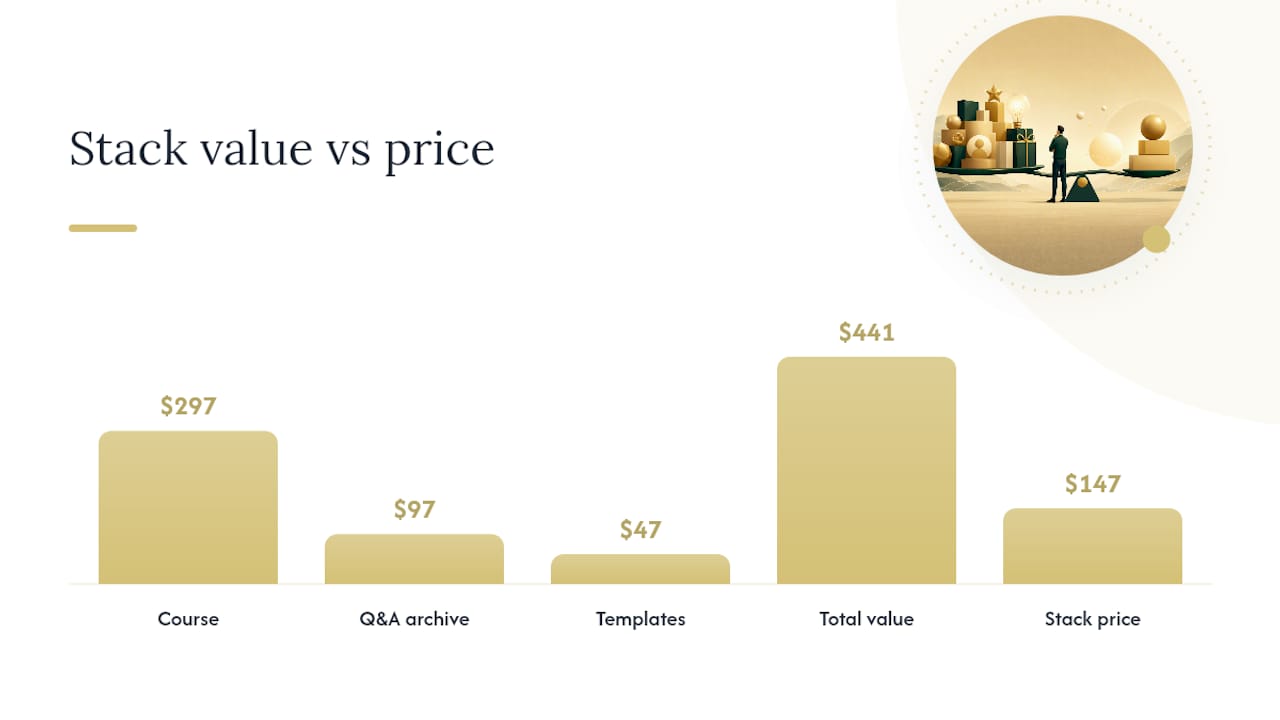
Tie each value to something real. A template’s value should reflect what a freelancer would charge to build it, or the hours it saves the buyer. A support call’s value should reflect your actual hourly rate. Invented numbers get spotted fast, and they undercut trust in the whole page.
A few presentation tactics do most of the work:
- A visible “total value” line above the price, so the gap registers before the buyer even sees the number.
- A crossed-out higher price sitting next to the real one.
- Price-per-result framing (“less than $5 a day” instead of “$147”).
Practitioners generally find that stacks with 3 to 7 components perform best. Fewer than three can feel thin; more than seven starts to feel like padding, and buyers notice.
Discount Stacking vs. Offer Stacking: Where Margin Gets Lost
Offer stacking bundles bonuses into a single price. Discount stacking is different: it’s when multiple price reductions, coupon codes, loyalty rewards, referral credits, apply to the same purchase at checkout. The two get confused constantly, and mixing them without rules is how margin quietly disappears.
Ecommerce platforms handle this with combinability settings. By default, most offer engines apply only the single best offer to an item; anything beyond that requires an explicit “stackable” flag or a combinability override. That default exists for a reason.
Common stacking scenarios worth knowing before you launch a promo:
- Promo code + automatic sitewide discount
- Voucher code + loyalty reward
- Partner or affiliate code + public promotion
- Bundle discount + basket-threshold offer
Left uncontrolled, these combinations erode margin and break attribution, since you can no longer tell which discount actually drove the sale. For a launch, set affiliate and partner codes as non-stackable with sitewide promos, so a partner’s audience doesn’t quietly stack a public discount on top of their code.
Templates and a One-Page Worksheet for Your Next Stack
Three naming formats work across most niches: “The [Result] Vault” (a template library, e.g. “The Client-Ready Templates Vault”), “[Timeframe] [Outcome] Sprint” (a fast-action bonus, e.g. “The 7-Day Launch Sprint”), and “[Audience] Only [Access Type]” (a community perk, e.g. “Members-Only Coaching Thread”).
Build your worksheet with five columns:
- Buyer objection, stated in the buyer’s own words.
- Named asset that answers it.
- One-line benefit, written as an outcome, not a feature.
- Standalone value, tied to a real benchmark.
- Stack position, meaning whether it’s a core deliverable, a fast-action bonus, or a retention perk.
Fill in every row before you write a word of sales copy, then test one variable at a time, a headline, a bonus, a price, rather than changing everything at once.
Money Plug Lab’s Evidence From Real Creator Launches
An agency has tracked over $500,000 in revenue across several launched creator programs, including one launch that produced more than 3,000 sales in ten days. That scale doesn’t come from guesswork; it comes from applying the same framework covered here: audience research to surface real objections, product architecture to sequence offers, and pricing built on defensible value rather than inflated numbers. Creators who want this handled end to end can see how the process works at Money Plug Lab.

When Offer Stacks Help, and When They Just Hide a Weak Offer
Stacking works when the core offer already converts and you’re removing friction, not when the core offer is weak and you’re trying to bury that with bonuses. Before adding a fourth or fifth component, ask whether a single, sharper improvement to the main product would move the needle more. Test one bonus at a time in your next launch and let the data, not your excitement, decide what stays.
— Money
Build the Stack, or Have Us Build It With You
If you’re a creator sitting on an audience but short on time to research objections, price a stack defensibly, and write the launch copy, that’s a gap some agencies close. Some agencies work on a revenue share basis, so there’s no upfront cost while the agency builds your product architecture, pricing strategy, sales copy, and launch campaign.
This fits creators in certain regions who have an engaged audience but no system yet for turning it into recurring revenue. If that’s where you are, get in touch through Money Plug Lab and tell us what you’re currently selling. We’ll tell you honestly whether a stack, a sequence, or a different offer entirely is the right next move.
Where These Rules Come From
The combinability and margin-protection rules in this article draw on Broadleaf Commerce’s developer documentation on stacking and combinability, Uniqodo’s glossary on discount stacking, and Crevio’s definition of an offer stack.
Sources
- Stacking and combinability — Broadleaf Commerce developer docs
- What is discount stacking? — Uniqodo glossary
- What is an offer stack? — Crevio glossary