How to Price Digital Products: A Creator's Playbook
How to Price Digital Products: A Creator’s Playbook

Start with value-based pricing, pick the nearest psychological price point (ending in 7 or 9), and run a one-week validation test before you commit. That’s the short answer. Pricing is the single biggest lever on a digital product business, yet most creators spend weeks building and minutes pricing — which is exactly why revenue underperforms.
The three inputs that set every price: the outcome-value your buyer gets, the realistic alternatives they’d pay for instead, and the positioning tier you want to occupy. Get those three right and the number almost picks itself.
Here’s how to act right now:
- Write the buyer outcome in one sentence. Not “you’ll learn email marketing” but “you’ll write a 5-email welcome sequence that converts cold subscribers in 48 hours.” The more specific the outcome, the more defensible your price.
- Map the closest paid alternative. A comparable coaching session, a competing course, or a done-for-you service. Your price should sit below the alternative’s cost but above the “free YouTube tutorial” floor.
- Pick the nearest clean price point and set a test. If your math says $87, price at $97. Run it for seven days, watch conversion rate, and adjust from there.
This approach works because it anchors price to buyer value, not your time or production cost. It protects margin from the start and positions your product in a tier rather than a discount bin.
Key Takeaways
| Point | Details |
|---|---|
| Anchor price to buyer outcome | Write the specific result in one sentence; that outcome is your pricing foundation, not your production cost. |
| Validate before full launch | Use a pre-sale, Van Westendorp survey, or A/B test with at least 200 visitors per variant before committing. |
| Protect net margin | Account for platform fees (5–10%) and processor fees (2.9% + $0.30 for Stripe) before setting any price. |
| Keep launch discounts under 30% | Deeper discounts train buyers to wait for sales and anchor the wrong price in the market. |
| Build a product ladder | Lead magnet → mini-course → flagship course → membership captures buyers at every commitment level. |
| Test on a 7-day cycle | Track conversion rate, ARPU, and refund rate for 7–30 days before making any price change. |
Table of Contents
- What pricing models for digital products actually work?
- How to calculate your minimum price and protect your margin
- How do you validate a price before and after launch?
- Tactics that move conversion and lifetime value
- Common pricing mistakes and a checklist to finalize your price
- A pricing worksheet you can use today
- How Money-plug runs pricing for creator launches
- How to estimate willingness to pay through audience research
- The value-based baseline is the right default
- Sources
What pricing models for digital products actually work?
Three frameworks dominate creator pricing decisions, and each has a distinct use case.
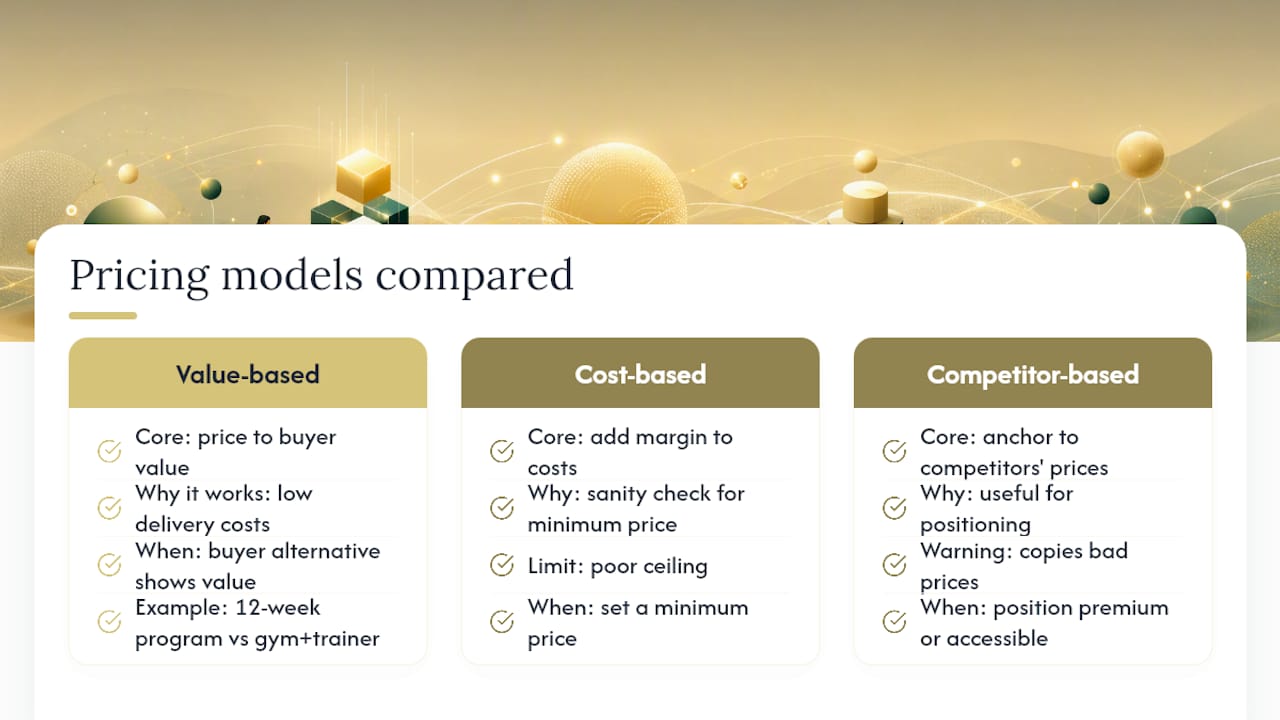
A fitness creator selling a 12-week transformation program can charge $297 because the buyer’s alternative is a $150/month gym membership plus a $100/month personal trainer. The product costs far less to deliver at scale, but the value is real and measurable.
Cost-based pricing adds a margin on top of your direct and indirect costs. It’s the right sanity check for minimum price, but a poor ceiling.
Competitor-based pricing anchors your number to what similar products charge. Useful for positioning (slightly above signals premium; slightly below signals accessibility), but dangerous when competitors have priced themselves wrong. Copying a bad price is still a bad price.
One-time vs. subscription vs. tiered: which fits your product?
The product type and the ongoing value it delivers should drive this decision more than anything else.
| Format | Best model | Why |
|---|---|---|
| Ebook, template, PDF | One-time | Defined deliverable; no ongoing value |
| Mini-course (under 4 hours) | One-time | Discrete transformation, low support burden |
| Flagship course (self-paced) | One-time or payment plan | Clear outcome; buyers prefer ownership |
| Cohort or live program | One-time (premium) | Higher completion rates justify a price premium |
| Paid community or membership | Recurring subscription | Ongoing access, content, and connection |
| Software tool or SaaS | Subscription or tiered | Continuous utility and updates |
Freemium works when your free tier genuinely demonstrates value and your paid tier removes a real friction. For most creators, it’s a distraction — it trains an audience to expect free content and makes the paid conversion harder.
A simple product ladder looks like this: a free lead magnet builds trust, a $27–$97 mini-course qualifies buyers, a $297–$997 flagship course converts committed students, and a $97–$197/month membership retains them. Kajabi’s platform data shows that creators who position flagship courses at $197–$497 and live/cohort programs at $497–$997+ see substantially higher lifetime earnings than those who cluster everything under $100.
How to calculate your minimum price and protect your margin
Before you pick a number, you need to know the floor — the price below which you lose money or work for free.
The inputs:
- Direct costs: recording software, editing, hosting, design assets
- Indirect costs: your time (valued at an hourly rate), tools, subscriptions
- Platform and payment fees: typically 2.9% + $0.30 per transaction for Stripe; platform cuts range from 0% (Gumroad’s free plan charges 10%) to 5–10% for course platforms
- Taxes: U.S. self-employment tax runs 15.3% on net profit; sales tax on digital goods varies by state and is increasingly enforced
The formula:
Sample calculation for a $297 course:
Suppose you spend $500 producing the course and expect to sell 50 units in the first 90 days.
- Production cost per unit: $500 ÷ 50 = $10
- Platform fee: $297 × 5% = $14.85
- Stripe fee: $297 × 2.9% + $0.30 = $8.91
- Total fees per sale: $23.76
- Net per sale: $297 − $10 − $23.76 = $263.24
- Margin: 88.6%
That’s healthy. Now run the same math at $97 and the fees eat a far larger slice. Platform and payment fees compound at scale — a 10% platform fee versus a 3% fee on 500 sales at $297 is a $10,395 difference in net revenue.
Teachable recommends a simple income-goal check: set your revenue target, pick a price band, and divide to find the number of sales required. If the math demands 2,000 sales from a 500-person email list, the price is too low or the launch window is too short.
How do you validate a price before and after launch?
Guessing a price and hoping is a plan. Testing a price and iterating is a business.
Step-by-step validation methods
-
Van Westendorp price sensitivity survey. Ask your audience four questions: At what price is this too cheap to trust? At what price is it a bargain? At what price does it start to feel expensive? At what price is it too expensive to consider? The overlap between “bargain” and “starting to feel expensive” is your acceptable price range. Run this with a minimum of 30–50 responses for a usable signal.
-
Gabor-Granger test. Show a random sample of respondents a single price and ask whether they’d buy at that price. Repeat across price points ($97, $147, $197, $297). Plot the demand curve. The point where revenue (price × % who’d buy) peaks is your optimal price.
-
Pre-sale or paid beta. Offer early access at a discount (20–30% off the planned launch price) before the product is finished. Real payment data beats survey data every time. If 15 people pay $197 for early access, you have proof of concept. If nobody buys at $97, you have a different problem — likely positioning, not price.
-
A/B price test on the sales page. Split traffic between two price points (e.g., $197 vs. $247) and measure conversion rate over a minimum of 200 visitors per variant. Use a tool like Google Optimize or a platform with built-in split testing. Don’t run the test for fewer than 7 days — day-of-week traffic patterns skew short tests badly.
Metrics to track and what they tell you
- Conversion rate: the percentage of page visitors who purchase. A healthy range for a warm audience is 2–5%; cold traffic typically converts at 0.5–2%.
- ARPU (average revenue per user): total revenue ÷ total customers. Rising ARPU with flat conversion usually means your upsells are working.
- LTV (lifetime value): total revenue a customer generates over their relationship with you. For memberships, LTV = average monthly revenue × average months retained.
- Churn rate: the percentage of subscribers who cancel each month. Under 5% monthly churn is manageable; above 10% signals a retention problem, not a pricing problem.
- Refund rate: above 5% usually signals a mismatch between sales copy and product delivery, not a price objection.
If conversion is high but ARPU is low, add an upsell or raise the floor price.
Tactics that move conversion and lifetime value
Getting the base price right is half the job. Packaging and presentation do the rest.
Tiered pricing: what goes in each tier
A three-tier structure (Lite / Core / Pro or similar) lets buyers self-select and anchors the middle option as the obvious choice. Structure it like this:
- Lite ($97–$147): core content only, no community, no live access, no bonuses
- Core ($197–$297): full course, community access, one bonus resource — this is your target seller
- Pro ($497–$997): everything in Core plus live Q&A calls, direct feedback, or done-with-you elements
The Pro tier’s job is partly to make Core look reasonable.
Bundling and payment plans
Bundles work when the combined perceived value exceeds the sum of individual prices. A course plus a template pack plus a private community, sold together at $397 when the individual prices total $594, converts better than any single product at $397 alone — because the buyer feels the math working in their favor.

Payment plans increase conversions for offers above $300. Charge a small premium on the installment total (3 × $197 = $591 vs. $497 one-time) to protect against partial-payment defaults and to reward buyers who commit upfront. Cohort programs in particular benefit from payment plans because the higher-ticket price creates a real friction point.
Psychological pricing that actually works
Charm pricing, anchoring, and urgency signals still move conversion when used with intention rather than desperation.
- End prices in 7 or 9 ($197, $297, $497) rather than round numbers — the psychological distance feels larger than the actual $3 difference.
- Show a crossed-out anchor price only when the discount is real and time-limited. “Was $497, now $297 through Friday” works. “Was $497” with no context trains buyers to wait for the next sale.
- Use a decoy tier: a middle option priced close to the premium tier makes the premium look like a deal.
- Scarcity copy (“12 spots remaining in this cohort”) only works when it’s true. Fake scarcity destroys trust faster than any price objection.
Pro Tip: When launching a premium offer, lead the sales page with the transformation outcome and the alternative cost comparison before you reveal the price. A buyer who has already agreed that a $3,000 coaching program is the alternative will read $497 as a bargain, not an expense.
Common pricing mistakes and a checklist to finalize your price
The mistakes that kill creator revenue aren’t exotic. They’re the same ones, repeated.
The six most damaging errors
- Pricing by time spent. Your 40 hours of course production is irrelevant to the buyer. What matters is the outcome they get. A 90-minute course that produces a $5,000 result is worth more than a 20-hour course that produces nothing measurable.
- Undercutting competitors without understanding their positioning. A lower price signals lower quality unless you explain the difference. Competing on price alone is a race you don’t want to win.
- Training buyers with early heavy discounts. A 70%-off launch discount sets a price anchor in the buyer’s mind. They’ll wait for the next sale. Keep launch discounts under 30% and frame them as early-access rewards, not desperation.
- Ignoring platform fees and payment processor cuts. A price that looks profitable before fees can be break-even after them. Run the net margin math before you publish.
- Ignoring churn in subscription pricing. A $47/month membership with 15% monthly churn has an average LTV of about $313. A $97/month membership with 6% churn has an LTV of about $1,617. The higher price with better retention wins by a factor of five.
- Overcomplicating the pricing page. More than three tiers confuses buyers and reduces conversion. Simplify.
Pre-launch checklist
Run through this before you publish any price:
- [ ] Written the buyer outcome in one specific sentence
- [ ] Identified the closest paid alternative and its price
- [ ] Calculated minimum price including all fees and a 15–20% margin buffer
- [ ] Chosen a validation method (pre-sale, survey, or A/B test) and set a timeline
- [ ] Confirmed platform fee structure and payment processor rates
- [ ] Set a launch discount policy (maximum 30% off, time-limited, reason stated)
- [ ] Defined the metrics you’ll track for the first 30 days
A pricing worksheet you can use today
The formula in plain steps
- State your income goal for the launch period (e.g., $10,000 in 60 days).
- Pick a price band based on product type (see table below).
- Divide income goal by price to find required sales (e.g., $10,000 ÷ $297 = 34 sales).
- Check audience math: do you have enough warm leads to convert 34 buyers at a 2–5% rate? (34 sales ÷ 3% = 1,133 page visitors needed.)
- Subtract fees: multiply your price by total fee percentage (platform + processor) and subtract from gross to get net per sale.
- Add margin buffer: if running ads, add 30% to your cost base before setting the floor.
Sample price bands by product type
| Product type | Typical price band | Notes |
|---|---|---|
| PDF guide / checklist | $7–$27 | Floor around $4; ceiling near $27 for unknown creators |
| Template or asset pack | $15–$47 | Higher end justified by time-saving utility |
| System or playbook | $49–$147 | Positions as a professional tool, not a freebie |
| Mini-course (under 4 hrs) | $27–$97 | Kajabi data supports $27–$97 for mini-course formats |
| Flagship self-paced course | $197–$497 | Sweet spot for creator lifetime earnings |
| Cohort or live program | $497–$997+ | Premium justified by completion rates and outcomes |
| Paid community / membership | $27–$197/month | Price to LTV, not monthly feel |
| Bundle (course + templates + community) | $297–$997 | Bundle discount of 20–30% off combined individual prices |
Mini-calculator logic for a spreadsheet:
- Cell A1: Gross price
- Cell A2: Platform fee % (e.g., 0.05 for 5%)
- Cell A3: Processor fee % (e.g., 0.029 for Stripe)
- Cell A4: Processor flat fee (e.g., 0.30)
- Cell A5: Production cost per unit
- Net per sale formula: =A1-(A1A2)-(A1A3)-A4-A5
How Money-plug runs pricing for creator launches
Money-plug uses a five-step sequence on every launch, and the pricing step happens before a single line of copy is written.
The agency workflow
-
Discovery and outcome mapping. The team interviews the creator to extract the specific, measurable outcome their audience gets. Not “you’ll get fit” but “you’ll lose 8–12 kg in 12 weeks following a structured meal and training plan.” That outcome sentence becomes the pricing anchor.
-
Alternative mapping and tier positioning. The team identifies what the buyer would pay for the same result elsewhere — a personal trainer, a gym program, a competitor course — and positions the creator’s product at a credible discount to that alternative while signaling a premium tier.
-
Price experiment before launch. A pre-sale or waitlist offer goes out to the creator’s warm audience at 20–25% below the planned launch price. Real payment data from 10–30 buyers sets the validated baseline. If the pre-sale converts, the launch price holds or increases. If it stalls, the team adjusts positioning before spending on ads.
-
Launch with psychological packaging. The sales page leads with the outcome, shows the alternative cost comparison, then reveals the price with a time-limited early-access frame. Tiers are set up so the Core offer is the obvious choice.
-
Post-launch iteration. The team tracks conversion rate, ARPU, and refund rate for 30 days. If conversion holds above 2% on cold traffic, the price stays. If refunds spike above 5%, the team audits copy-to-product alignment before touching the price.
Money-plug’s creators have generated over $500,000 in tracked revenue across seven launched programs. The agency operates on a pure revenue-share basis — no upfront cost to the creator — which means the team’s incentive is always to protect net margin, not just gross revenue.
The agency’s core pricing rule: never set a price you can’t defend with a one-sentence outcome statement and a one-sentence alternative comparison. If you can’t explain the value in two sentences, the price will always feel arbitrary to the buyer.
For creators who want help with launch attribution and revenue tracking, understanding which ad channels drive actual sales is the next layer after pricing is set.
How to estimate willingness to pay through audience research
Price validation doesn’t require a large audience or a sophisticated research budget. It requires asking the right questions to the right people before you commit to a number.
Qualitative interviews are the fastest signal. Talk to 5–10 people who match your buyer profile. Ask what they’ve paid for similar outcomes in the past, what they’d expect to pay for your specific result, and what would make them hesitate. You’re not asking them to set your price — you’re listening for the language they use to describe value and the anchors already in their head.
Surveys scale the signal. A Google Form or Typeform with four Van Westendorp questions sent to your email list or social followers gives you a distribution, not just anecdotes. Aim for 50+ responses before drawing conclusions. The acceptable price range — the overlap between “bargain” and “starting to feel expensive” — is your working zone.
Pre-sales are the gold standard because they involve real money. Ten paying customers at $197 is stronger evidence than 500 survey responses saying they’d pay $197.
Beta cohorts serve a dual purpose: they generate revenue and testimonials while you refine the product. The completion rate and outcome data from a beta cohort also justifies a higher price at full launch.
One pattern worth noting: audiences consistently underreport willingness to pay in surveys and overreport it in casual conversation. The pre-sale is the only method that cuts through both biases. If someone won’t pay $97 in a pre-sale, they almost certainly won’t pay $197 at launch — regardless of what they said in a survey.
The value-based baseline is the right default
Most creators who underprice do so because they’re anchoring to their own cost and effort rather than the buyer’s outcome. A course that took you 60 hours to build is not worth $60 to the buyer — it’s worth whatever transformation it reliably delivers.
The value-based baseline, combined with a psychological price point and a short validation test, is the approach that holds up across product types, audience sizes, and niches. It protects margin from day one, positions the product in a defensible tier, and gives you a data-driven reason to raise price over time rather than a gut feeling.
One thing worth protecting: your floor. Once you’ve run the margin math and set a minimum price, don’t let launch anxiety push you below it. A discounted price that doesn’t cover fees and ad spend isn’t a growth strategy — it’s a slow drain. Use the worksheet in this guide, run a one-week validation test, and let the data tell you whether to hold, raise, or reframe.
Sources
- How to Price Digital Products: The Complete Guide for Creators in 2026 | SellRamp Blog
- Nicheof
- How to Price Your Online Course In 3 Easy Steps | Teachable