Pricing Psychology: Tactics That Actually Lift Conversions
Pricing Psychology: Tactics That Actually Lift Conversions

Pricing psychology is the practice of structuring prices and their presentation to shift how buyers perceive value and make decisions. It works not by changing what a product is worth, but by changing what it feels worth at the moment of purchase. Used well, it lifts conversions, steers buyers toward higher-value tiers, and makes premium options feel like the obvious choice rather than an indulgence.
If you’re deciding whether this applies to you, here’s the short version:
- Try anchor + tier pricing when you sell more than one option: show the highest price first, then let the middle tier look reasonable by comparison.
- Test charm pricing ($97 instead of $100) on low-consideration purchases where speed of decision matters more than brand prestige.
- Bundle complementary items to reduce the psychological pain of paying and increase perceived value without cutting your unit price.
These three moves alone can shift conversion rates and average order value before you touch a single ad.
Key Takeaways
Pricing psychology works best when tactics are matched to your product category, tested with pre-specified metrics, and governed by transparent pricing rules that protect long-term trust.
| Point | Details |
|---|---|
| Start with one tactic | Pick anchor pricing or a three-tier structure first; test one change at a time. |
| Use RPV as your primary metric | Revenue per visitor captures both conversion rate and AOV in a single number. |
| Decoy design is sensitive | The decoy must be clearly inferior on at least one dimension or the effect weakens. |
| Transparency protects the brand | Document real original prices; fake anchors create legal risk and erode trust. |
| Money-plug applies these principles | Money-plug designs pricing architecture and runs A/B tests as part of a full revenue-share launch. |
Table of Contents
- What is psychological pricing?
- Why pricing psychology works: the core cognitive mechanisms
- Common psychological pricing tactics and when to use each
- How to implement and measure these tactics
- When pricing psychology backfires: ethics, trust, and brand risk
- Short examples and what the research actually shows
- Anonymized Money Plug Lab case study: applying pricing psychology to a creator launch
- A candid take on pricing psychology
- What Money-plug offers creators who want to get pricing right
- Sources
What is psychological pricing?
Psychological pricing is the deliberate choice to present prices in ways that exploit how human perception works, rather than simply setting a number based on cost or what competitors charge. Where cost-plus pricing asks “what do I need to charge to make money?” and competitive pricing asks “what is everyone else charging?”, psychological pricing asks “what price feels right to this buyer at this moment?”
The classic example: $9.99 versus $10.00. The difference is one cent, but the left digit drops from 10 to 9, and buyers mentally categorize $9.99 as “nine dollars and change” rather than “ten dollars.” That single-digit shift can meaningfully affect purchase rates in high-volume, low-consideration categories like grocery or fast fashion.
A few things this is not:
- It is not a substitute for a good product or fair value.
- It is not about tricking buyers into paying more than something is worth.
- It is not a one-size-fits-all system: the same tactic that works for a $12 app subscription may actively hurt a $5,000 coaching program.
Pro Tip: Before applying any tactic, write down what your price is supposed to communicate about your brand. A luxury fitness program priced at $997 sends a different signal than $999.99 — the latter reads as a discount brand trying to look premium.
Why pricing psychology works: the core cognitive mechanisms
Four well-documented effects explain most of what pricing psychology does in practice.
Left-digit bias (charm pricing). Buyers process prices left to right and anchor heavily on the first digit. A price of $79 registers as “seventy-something” before the buyer consciously processes the full number. Scanner-data research shows this effect is real in grocery and retail, though results are mixed across categories and depend on how prices are displayed and how numerate the buyer is.
Anchoring. When buyers see a reference price first, that number narrows the range they consider reasonable. Show a $500 option before a $200 option, and $200 feels like a bargain. The Program on Negotiation at Harvard Law School notes that anchoring is powerful but fragile: repeated artificial anchors and obvious fake discounts erode the effect and damage trust over time.
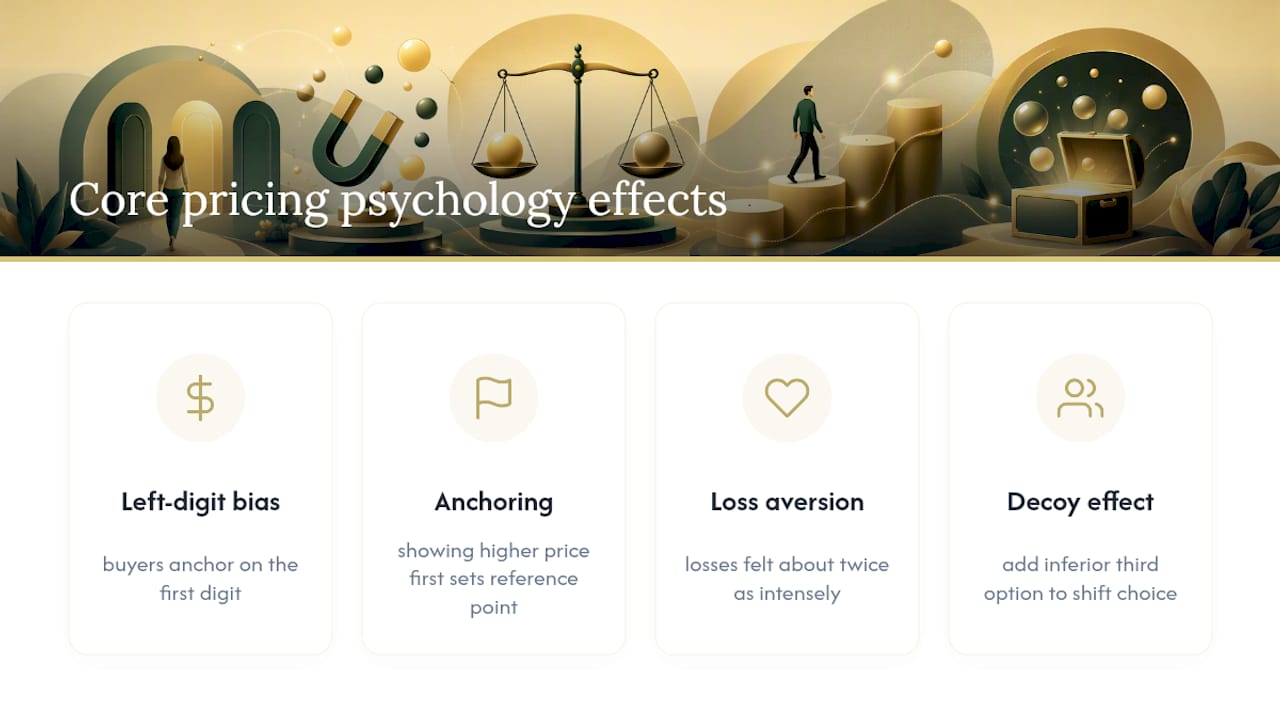
Prospect theory and loss aversion. People feel the pain of a loss roughly twice as intensely as the pleasure of an equivalent gain. This is why “you save $30” outperforms “get $30 off” in many tests, and why subscription framing (“cancel anytime”) reduces the perceived risk of committing. Framing a price as avoiding a loss rather than gaining a benefit consistently shifts willingness to pay.
The decoy effect. Add a third option that is clearly inferior to one choice but comparable to another, and buyers shift toward the option the decoy makes look good. RGM Academy’s breakdown of asymmetric dominance uses The Economist’s classic subscription structure as the canonical example: a print-only subscription priced the same as print+digital made the bundle look like an obvious win, dramatically increasing bundle uptake. The effect is one of the most replicated in choice psychology, but it depends on the decoy being genuinely dominated on at least one dimension.
Research note: Displaying prices in descending order (highest first) tends to increase willingness to pay because the highest price anchors the buyer’s reference point before they see the lower options.
Common psychological pricing tactics and when to use each
The tactics below are not equally useful in every context. Match each one to your situation.
| Tactic | Best for | Watch out for |
|---|---|---|
| Charm/odd-even pricing | High-volume, low-consideration purchases | Signals cheapness in luxury or high-trust categories |
| Price anchoring (crossed-out MSRP) | Product pages, email campaigns, landing pages | Fake or repeated anchors create skepticism |
| Decoy pricing | Three-option pricing pages, subscription tiers | Poorly designed decoys feel manipulative |
| Good–Better–Best tiers | Driving AOV and upgrade rates | Too many tiers cause decision paralysis |
| Bundling | Increasing perceived value without price cuts | Bundles can obscure individual item value |
| Subscription framing | Reducing payment pain on recurring offers | Churn risk if perceived value drops post-purchase |
| BOGO / discount framing | Short-term volume spikes | Conditions buyers to wait for the next sale |
| Prestige pricing | Premium positioning, high-trust categories | Fails if product quality doesn’t support the price |
Shopify’s practitioner guide treats these as a starting catalog to test and iterate, not a fixed menu to apply wholesale.
A few design rules worth knowing:
- Decoy placement matters. The decoy should sit between the entry option and the target option in price, and it should be clearly worse than the target on at least one visible dimension (fewer features, less content, shorter access).
- Tiered pricing works best when tiers are clearly differentiated. Vague differences between tiers (“Standard” vs. “Pro” with nearly identical feature lists) push buyers to the cheapest option. Harvard Business School research summarizing Elie Ofek’s work shows that transparent value communication across tiers helps customers accept price differences and steers them toward company-preferred options.
- Bundling reduces payment pain by replacing multiple small purchase decisions with one larger one. The total feels smaller than the sum of its parts because buyers only experience one moment of “paying.”
Pro Tip: For digital products and online courses, try listing your highest tier first on the pricing page. Buyers who scroll down from $497 to $197 feel like they’re getting a deal. Buyers who scroll up from $197 to $497 feel like they’re being upsold.
How to implement and measure these tactics
Running a pricing test without a plan is how you end up with data you can’t interpret. Here’s a repeatable process.
Implementation checklist:
- Write a specific hypothesis: “Changing the pricing page from single-price to three-tier will increase average order value by at least 10% with no decrease in conversion rate.”
- Define your segments: new visitors only, or all traffic? Mobile vs. desktop? Existing customers are usually excluded from pricing tests.
- Check your sample size before you start. Most pricing tests need at least 1,000 visitors per variant to detect a 5% conversion lift with 80% statistical power. Use a free calculator like Evan Miller’s A/B test tool.
- Set a fixed test duration of at least two weeks to capture weekly traffic patterns. Do not stop early because one variant looks better.
- QA the presentation: confirm prices display correctly across devices, currencies, and screen sizes before launching.
A/B test template:
| Element | Control | Variant |
|---|---|---|
| Offer structure | Single price ($197) | Three tiers ($97 / $197 / —) |
| Primary metric | Revenue per visitor (RPV) | Revenue per visitor (RPV) |
| Guardrail metrics | Conversion rate, refund rate | Conversion rate, refund rate |
| Min. detectable effect | 10% RPV lift | 10% RPV lift |
| Test duration | at least two weeks | at least two weeks |
Metrics to track:
- Conversion rate: Did more people buy?
- Average order value (AOV): Did buyers spend more per transaction?
- Revenue per visitor (RPV): The single most useful combined metric for pricing tests.
- Churn/retention: For subscriptions, a pricing change that lifts sign-ups but increases month-one churn is a net loss.
- Margin impact: A bundle that lifts AOV but cuts margin per unit may not be worth keeping.
Pro Tip: Pair your quantitative results with a short post-purchase survey. Ask buyers “what almost stopped you from buying?” — the answers reveal friction that no conversion metric can show you.
When pricing psychology backfires: ethics, trust, and brand risk
The tactics above work because they align with how buyers naturally think. When they’re misused, they work against the buyer, and buyers notice.
The most common failure modes:
- Fake anchors and inflated MSRPs. Showing a crossed-out “original price” that was never a real price is deceptive, and in many jurisdictions it is illegal. Beyond the legal risk, Harvard Law’s PON research documents that persistent fake discounts create consumer skepticism that outlasts the campaign.
- Charm pricing in the wrong category. A $9,997 coaching program priced that way to look like a deal reads as cheap. Prestige buyers expect round numbers or unusual price points that signal confidence, not a retailer trying to stay under $10,000.
- Decoys that feel like traps. If buyers feel the middle option exists only to make the expensive one look reasonable, they resent it. The decoy needs to be a real, purchasable offer with genuine (if limited) value.
A short governance checklist to reduce risk:
- Document your pricing rules in writing: what anchors are legitimate, how discounts are calculated, and what the real “original price” was and when it was active.
- Require sign-off from a senior stakeholder before making any permanent price change.
- Track customer complaints and refund requests as a leading indicator. A spike after a pricing change is a signal worth investigating before it becomes a pattern.
Pro Tip: HBS researcher Elie Ofek frames this well: the goal of pricing psychology is to help customers feel they made the right decision, not to manufacture a feeling that doesn’t survive the post-purchase experience. If your pricing tactic only works once per customer, it’s not a strategy.
Short examples and what the research actually shows
Effects vary more than most practitioner guides admit. Here’s what the evidence actually supports.
Decoy pricing in hospitality. Emerald Publishing’s hospitality research found that adding a decoy option increased selection of higher-priced bundles in several experiments, with shifts from roughly 45% to roughly 52% in some conditions. The effect was statistically significant but sensitive to how component prices were displayed and how large the price gaps were. Small gaps weakened the effect considerably.
Charm pricing: mixed signals. The left-digit effect is real in controlled studies, but scanner-data research shows results vary by category, presentation format, and buyer numeracy. In grocery, the effect is documented. In software subscriptions or high-ticket services, the evidence is thinner.
Tiered subscriptions. The Economist print-only/digital/bundle structure is the most cited real-world decoy example. The asymmetric dominance effect it exploited is among the most replicated findings in choice psychology, though the size of the shift depends on how the options are framed and whether buyers are actively comparing alternatives.
| Tactic | Evidence strength | Key condition |
|---|---|---|
| Decoy / asymmetric dominance | Strong (replicated) | Price gaps must be clear; decoy must be genuinely inferior |
| Anchoring | Strong | Weakens with repeated fake discounts |
| Left-digit / charm pricing | Moderate | Category and presentation dependent |
| Tiered pricing (Good–Better–Best) | Moderate–Strong | Tiers must be clearly differentiated |
| Bundling | Moderate | Works best when components are complementary |
Anonymized Money Plug Lab case study: applying pricing psychology to a creator launch
One of Money-plug’s fitness creator launches in Southeast Europe illustrates how these principles combine in practice.
Project snapshot:
- Offer type: online fitness program with three access tiers
- Audience: engaged social following in the mid-five-figures range
- Interventions: anchor pricing on the sales page (highest tier displayed first), a three-tier structure with a clear decoy middle option, and a limited-time early-bird discount of 15% on the top tier for the first 72 hours
What happened:
- The launch produced more than 3,000 sales in ten days.
- The campaign returned 18x on ad spend.
- The top tier (the anchor and the target of the decoy structure) accounted for a disproportionate share of total revenue relative to its price point.
What changed after the test:
- The 72-hour early-bird window was kept for future launches after it proved more effective at driving urgency than a longer discount window.
- The middle tier was repriced slightly upward after post-launch data showed buyers were not perceiving it as clearly inferior to the top tier, which weakened the decoy effect.
- Post-purchase survey responses confirmed that the “limited spots” framing (loss aversion) was cited more often than the discount itself as the reason buyers acted quickly.
Takeaways for other launches:
| What was tested | What the data showed | Practical implication |
|---|---|---|
| Three-tier anchor structure | Top tier drove outsized revenue share | Lead with your highest tier; let it anchor the page |
| 72-hour early-bird discount | Stronger urgency than longer windows | Short windows outperform extended “sales” |
| Middle-tier decoy design | Needed clearer inferiority to target tier | Decoy must be visibly worse on at least one dimension |
| Loss aversion framing | Cited more than discount in survey | “Limited spots” framing often outperforms discount framing |
A candid take on pricing psychology
The tactics in this article work. The research supports them, the case data supports them, and any marketer who has run a clean A/B test on a pricing page has probably seen at least one of them move a number. But there’s a version of this that goes wrong, and it’s more common than the practitioner guides admit.
The mistake is treating pricing psychology as a conversion optimization problem rather than a brand-building one. A charm price that lifts your first-purchase rate by 8% but signals cheapness to repeat buyers is a net loss over a 12-month customer lifetime. A decoy tier that steers buyers to your top option is great until buyers start talking to each other and realize the middle option exists only to make the top one look reasonable. Trust, once lost on pricing, is expensive to rebuild.
For most creators and founders with tight budgets, the fastest three experiments are: (1) switch to a three-tier structure if you’re currently selling one price, (2) test leading with your highest price first on the page, and (3) shorten any discount window you’re running to 48–72 hours. None of these require a development sprint or a new tool. All three are reversible if the data doesn’t support them.
Track margin and customer satisfaction alongside conversion rate. A pricing change that lifts revenue per visitor while increasing refund requests is not a win.
What Money-plug offers creators who want to get pricing right
Pricing strategy is one of the highest-leverage decisions in a creator launch, and it’s also one of the easiest to get wrong without a structured process. Money-plug works with creators in the Balkans and beyond on a pure revenue-share basis, meaning there’s no upfront cost to get started.
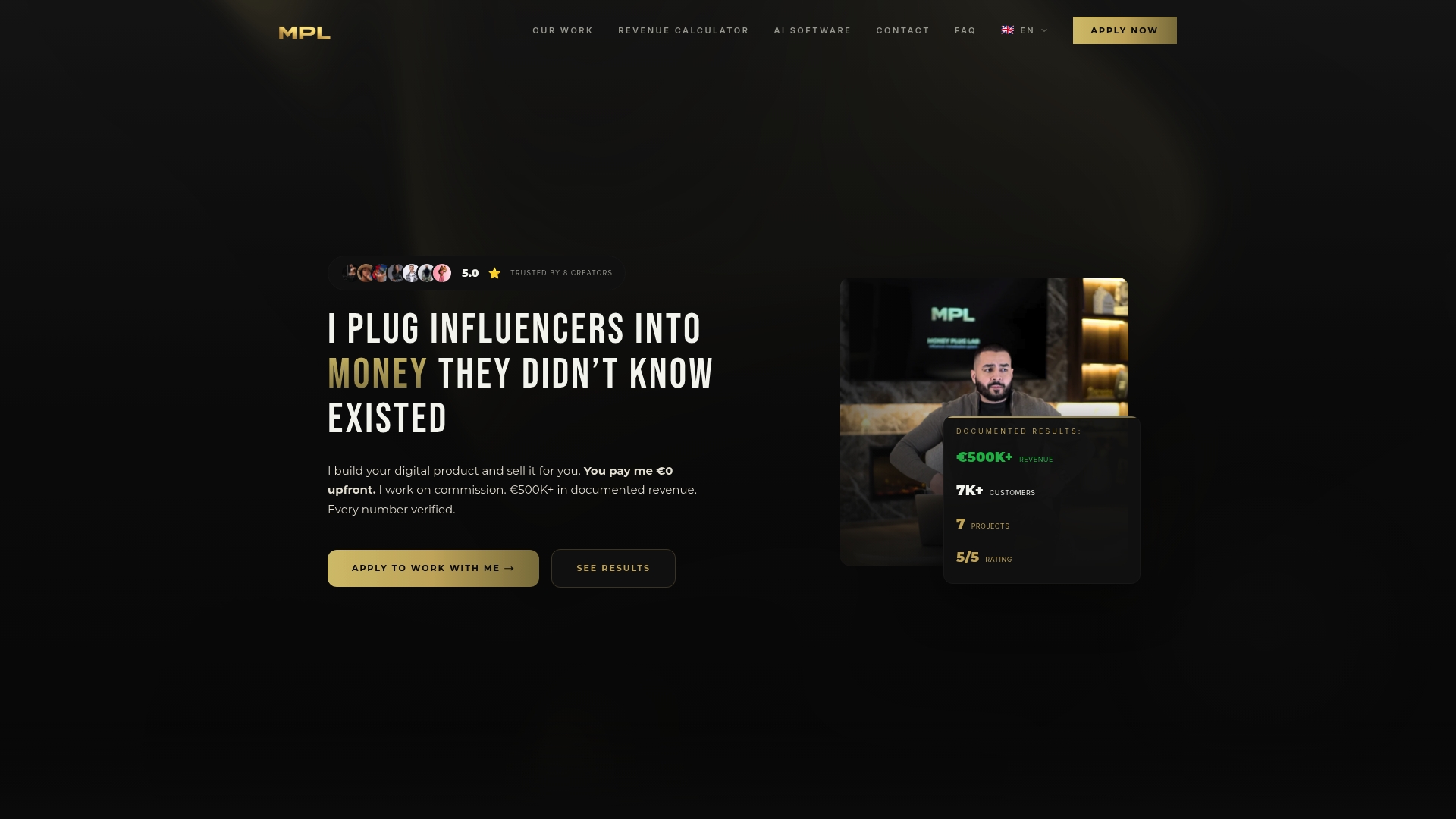
A first consultation covers your current offer structure, the audience data that should inform tier design, and a pricing architecture recommendation with a rationale for each price point. From there, Money-plug handles the full launch stack: sales copy, video sales letters, payment infrastructure, and the A/B test plan for the pricing page. Creators who have gone through this process have generated over $500,000 in tracked revenue across seven launched programs.
If you’re ready to apply these principles to your own launch, reach out to Money-plug to discuss what a revenue-share engagement looks like for your audience and offer.
Sources
- Psychological Pricing Tactics to Fight the Inflation Blues | Working Knowledge
- The Anchoring Bias: Consumers, Beware! - PON - Program on Negotiation at Harvard Law School
- Psychological Pricing: 10 Strategies to Boost Sales (2025) - Shopify
- Anchoring decisions: the role of decoy pricing in consumer choices | International Hospitality Review | Emerald Publishing
- Decoy Pricing: The Asymmetric Dominance Effect Explained | RGM Academy