Course Pricing Tiers: 3 Core Levels, Templates, and a Launch Checklist
Course Pricing Tiers: 3 Core Levels, Templates, and a Launch Checklist

Hobbyists and first-time creators tend to sit at the lower end, while creators with an engaged audience or a credential behind their name can anchor higher. An optional micro or flagship tier makes sense only for specialty niches or high-touch coaching offers.
TL;DR:
- Keep core lessons in every tier; place templates and community in the core offer, while reserving coaching, personal feedback, and credentials for premium buyers.
- Professional outcomes and warm audiences support higher starting points; cold audiences usually need the middle of the range and proof from testimonials or case studies.
- Anchor the core offer with a visible premium tier, and present upgrades by their added cost; research found this framing boosts higher tier selection.
- Test two prices on the same tier with similar traffic, judging total revenue rather than conversion alone; rising refunds can signal a value mismatch.
- Use subscriptions only when new content, live sessions, or community activity can sustain ongoing value, and display the full price beside installment amounts.
Table of Contents
- Common pricing tiers and practical price ranges
- How to structure features and access across tiers
- Pricing psychology and tactics creators should use
- A decision framework for choosing tier prices
- Testing and validating your tier pricing
- Pricing models: one-time, subscription, cohort, and payment plans
- Examples and sample tier templates you can copy
- Implementation checklist and platform/payment considerations
- Impact of pricing tiers on customer retention and lifetime value
- Legal and compliance considerations related to pricing and subscriptions in different markets
- How to align pricing tiers with different customer segments and their willingness to pay
- Strategies to upsell or cross-sell between pricing tiers
- Publisher perspective: how Money Plug Lab approaches tiered pricing for creator launches
- Launch your tiers with PlugReach instead of guessing alone
- FAQ
- Sources
Common pricing tiers and practical price ranges
Most successful course pricing follows a familiar pattern: an entry or basic tier, a core or mid tier, and a premium or VIP tier. Each one serves a distinct buyer, not just a different price point.
The entry tier is built for the curious, price-sensitive buyer who wants a taste of the transformation without much commitment. The core tier is where most revenue lands: it includes the full curriculum, some community access, and enough structure to get a motivated learner results. The premium tier adds direct access to the creator, whether through coaching calls, personalized feedback, or a certification path, and it exists as much to anchor the other two prices as to sell in volume.
A fourth tier, either a cheap micro offer or an expensive flagship package, only earns its place when there is a genuine use case. A low-cost micro-course or toolkit can work as a low-friction entry point that feeds into the main funnel. A higher-priced cohort or done-with-you program works when the creator has proof of results and an audience ready to pay for hands-on guidance.
Rough benchmarks by tier, adjustable for niche and audience sophistication:
- Entry/basic: A lower-priced option for a short course or single-topic training with limited support.
- Core/mid: A mid-priced option for a full curriculum, templates, and community or Q&A access.
- Premium/VIP: A higher-priced option for group coaching, personal feedback, or certification.
- Micro (optional): A low-cost mini-tool, checklist, or short workshop that funnels into the core offer.
- Flagship (optional): A higher-priced cohort-based or high-touch program with limited seats.
How to scale tier prices depends on two things: how professional the outcome is, and how big the audience already is. A course teaching a hobby skill, like home baking or hand lettering, generally sits at the lower end of each band because buyers compare it to entertainment spending. A course teaching a professional or income-generating skill, like freelance copywriting or a fitness certification, can sit at the higher end because buyers compare it to the income or savings the skill produces.
Audience size and warmth also shape where to start. A creator launching to a small, highly engaged list can test higher prices early because trust is already built. A creator launching to a cold audience or a new page usually needs to start closer to the middle of the range and raise prices as testimonials and case studies accumulate. Starting too low to “test demand” tends to anchor the audience permanently at that price; it is easier to launch a discount than to raise a price without pushback.
How to structure features and access across tiers
The price jump between tiers only feels fair when the included access clearly expands. Mapping features to tiers before setting prices keeps the structure logical instead of arbitrary.
- Content access starts everywhere: every tier should include the core lessons, since gating the main curriculum behind the top tier usually kills entry-tier conversions.
- Templates and resources (swipe files, worksheets, trackers) are a natural core-tier addition that increases perceived value without adding ongoing support cost.
- Community access (a private group or forum) fits well in the core tier as a low-cost way to add accountability and peer support.
- Office hours or group coaching calls belong in the premium tier, since they require the creator’s live time and scale poorly across a large buyer base.
- 1:1 support or feedback is one of the strongest premium-tier justifications because it is the most scarce resource a creator has.
- Certification or completion credentials work well as a premium add-on in professional or credential-driven niches, where a certificate has resale value to the learner’s own clients or employer.
The qualitative rule is simple: the more of the creator’s personal time a feature consumes, the higher up the tier ladder it belongs. Self-paced content scales infinitely, so it can live in every tier. Live coaching and personal feedback do not scale, so they justify the largest price multipliers.
When writing tier descriptions, focus on outcomes rather than features. Instead of listing a specific number of video modules or client projects, phrase the upgrade as “get direct feedback on your client projects” or “finish with a certificate you can show employers.” Buyers upgrade for a better result, not for more content hours.
Pricing psychology and tactics creators should use
Three-tier pricing works because of how people compare options, not just because of what each tier contains. Understanding two specific effects helps creators design tiers that guide buyers toward the price point that works best for the business.
The decoy effect describes how adding a third, strategically priced option changes how buyers perceive the other two. When a high-priced premium tier sits next to a core tier, the core tier suddenly looks like the sensible middle ground rather than the most expensive thing on the page. The premium tier does not need to sell in volume to do its job: its presence alone shifts buyer perception of the core tier’s value.
Differential price framing is a related but distinct tactic, and it has direct research behind it. A study on differential price framing found that presenting an upgrade as “for $X more” rather than showing the full price of the higher option increases the choice share of that higher-priced option, because it shifts the buyer’s attention to the smaller incremental cost instead of the total spend.
The study on differential price framing found that framing an upgrade as an incremental cost, rather than a full price, increases the choice share of the higher-priced option. That framing change, presenting the upgrade as an incremental cost rather than restating the full price, can shift which tier a buyer picks.
Practical rules for applying this on a pricing page:
- Always show an anchor: the highest tier should be visible even if it rarely sells on its own.
- Frame the premium upgrade as “for $X more” rather than restating its full price next to the core tier.
- Avoid mixed bundles that make the incremental value hard to calculate, since confusion pushes buyers toward the cheapest option by default.
- Keep the number of tiers manageable; too many options can stall decisions rather than improve them.
A decision framework for choosing tier prices
Picking tier prices works better as a process than a guess. Following a consistent process for every launch keeps pricing grounded in buyer value and business goals rather than competitor-watching.
- Define the transformation. Write down the specific before-and-after outcome the course delivers, since every tier price should trace back to how much that outcome is worth to the buyer.
- Estimate willingness to pay. Ask past customers, email subscribers, or social followers what they currently spend solving this problem, whether that is another course, a service provider, or lost time and income.
- Set revenue goals and buyer mix. Decide the launch revenue target and a rough split of buyers across tiers (for example, 60% entry or core, 30% mid, 10% premium) so the math is grounded in realistic volume, not best-case guesses.
- Back into tier prices. Divide the revenue goal by expected buyers per tier, then adjust each price until it matches both the willingness-to-pay data and the required margin after platform and ad costs.
- Check margins against delivery cost. Make sure premium tiers that include live coaching or 1:1 time still leave a healthy margin once the creator’s hours are accounted for.
Once the course is live, metrics such as conversion rate by tier, average revenue per buyer (ARPU), and customer acquisition cost (CAC) by channel can help you assess whether the pricing is working. A high conversion rate on the entry tier with almost no premium sales usually means the premium tier is overpriced relative to its perceived value, or underexplained. A low overall conversion rate with strong premium uptake can mean the entry price is set too high for the audience’s trust level.
Pro Tip: Launch at a conservative, sustainable price and add premium add-ons later rather than discounting your core price to drive sales. It is far easier to introduce a new upsell than to walk back a price cut.

Testing and validating your tier pricing
Price decisions get stronger with real buyer behavior, not just estimates. A few structured tests, run before and after launch, remove most of the guesswork.
Before launch, a short survey or a handful of customer interviews can validate whether the planned price range feels reasonable to the target buyer. During a staged or waitlist launch, offering the course to a smaller segment first at the planned price reveals real conversion data before a full public rollout.
- A/B test two price points on the same tier across similar traffic sources to see which produces higher total revenue, not just higher conversion.
- Compare different packaging at the same price (for example, more content versus more support) to learn which features buyers actually value.
- Run a short, clearly time-boxed promotion and track how much volume shifts, since large jumps suggest the regular price has room to move.
- Offer an installment plan alongside the single payment and watch what share of buyers choose it, which signals price sensitivity without a permanent discount.
After launch, track metrics such as conversion rate by price point, average revenue per buyer, refund rate, and customer acquisition cost by tier. A rising refund rate on a specific tier usually signals a mismatch between the price and the delivered value, which is a packaging problem more often than a pure pricing problem. Elasticity is easiest to measure through temporary promotions and payment plans, since both let you observe demand at a different effective price without resetting buyer expectations around a permanent discount.
Pricing models: one-time, subscription, cohort, and payment plans
The tier structure stays similar across pricing models, but how it is framed and billed changes buyer psychology and cash flow.
- One-time purchase is the simplest model: a buyer pays once for lifetime or long-term access, which suits self-paced, evergreen courses with clear start-and-finish structure.
- Membership or subscription charges monthly or annually for ongoing access to content, community, and updates, which fits creators who continually add new material or run an active community.
- Cohort or coaching programs run on a fixed schedule with limited seats and higher-touch support, which justifies premium pricing because scarcity and live interaction are part of the product.
- Installment or payment plans split a one-time or premium price into multiple payments, lowering the upfront barrier without lowering the total price.
Subscription tiers need extra care in framing: monthly plans should emphasize low commitment and flexibility, while annual plans should emphasize the total savings versus paying monthly, using a clear comparison rather than a raw discount percentage. Cohort tiers benefit from visible scarcity (seat counts, enrollment windows) since the higher price is justified by access and timing, not just content volume.
For installment displays, show the full price clearly alongside the per-payment amount, rather than hiding the total. This keeps the incremental-cost framing that supports higher-tier choices while avoiding the appearance of hidden fees, which damages trust faster than almost any other pricing mistake.
Examples and sample tier templates you can copy
These three templates map directly to common creator situations. Adjust the dollar ranges up or down based on niche value and audience purchasing power, but keep the tier logic intact.
- Template A, hobbyist or self-paced course: Entry includes the core video lessons; Core adds templates, a resource library, and community access; Premium adds a live Q&A session or a feedback review. This fits creative hobbies, lifestyle skills, or introductory topics where buyers compare the price to a single paid workshop or ticket.
- Template B, professional upskill or credential course: Entry includes self-paced lessons and templates; Core adds group coaching calls and a private professional community; Premium adds personal feedback, a certification, and direct access to the instructor. This fits skills tied to income, like coaching certifications, technical training, or client-acquisition courses, where buyers calculate return on investment rather than comparing to entertainment spending.
- Template C, cohort or flagship program with VIP option: The Core cohort is a scheduled, live, limited-seat program with group coaching; VIP adds personal sessions, done-with-you work, and priority access. Set seat limits to suit the program and make them clear to buyers. This fits creators with proven case studies and a warm audience ready for high-touch delivery.
Customizing any template starts with two questions: how much disposable income does this audience typically have, and how directly does the outcome translate into money or career advancement for the buyer? A credential-driven course aimed at working professionals can push every tier higher than a hobby course aimed at a general consumer audience, even with similar production quality.
Implementation checklist and platform/payment considerations
Getting tiered pricing live smoothly is mostly a configuration problem. A short pre-launch checklist avoids the most common technical headaches.
- Confirm the payment gateway supports the billing types needed: one-time charges, recurring subscriptions, and installment plans, since not every processor handles all three equally well.
- Set up coupon and discount logic carefully so time-limited promotions cannot be reused indefinitely or stacked unintentionally with other offers.
- Design the checkout page to reflect differential price framing: show the incremental upgrade cost between tiers rather than only the full price of each.
- Confirm tax handling settings match the buyer’s location, since digital products are taxed differently depending on where the buyer is based; course platforms generally apply automated tax rules that should be checked against the markets the audience is actually in.
- Decide and publish a clear refund policy before launch, since ambiguity here creates support friction and chargebacks later.
On the billing side, confirm invoices are generated automatically for every payment, including each installment in a payment plan, and that renewal dates for subscriptions are clearly communicated before a charge happens. Platform choice matters here: reviews on sites like G2 and Capterra give useful context on how different course platforms handle these billing and tiering features before committing to one.
A clear, visible refund policy and responsive support around billing questions protect both conversions and reputation. Buyers who feel confident a mistaken charge or a reasonable refund request will be handled fairly are more willing to choose a higher tier in the first place.
Impact of pricing tiers on customer retention and lifetime value
Tier structure shapes more than the first purchase. Buyers who choose a premium tier tend to engage more deeply with the content, which generally correlates with lower refund rates and stronger results, both of which feed future testimonials and referrals.
Subscription and membership tiers add a retention dimension that one-time tiers don’t have: the ongoing price has to keep earning its place every billing cycle. Creators running subscription tiers typically need a steady cadence of new content, live sessions, or community activity to justify continued payment and limit churn.
Premium and flagship tiers can produce higher lifetime value per buyer, not just a higher single transaction. A buyer who trusts a creator enough to pay for 1:1 coaching is also the most likely buyer to purchase the next program, upgrade to a future cohort, or renew a membership. Treating the premium tier as a relationship starting point, not just a one-time high-ticket sale, tends to pay off across future launches.
Legal and compliance considerations related to pricing and subscriptions in different markets
Pricing and subscription rules vary by country, and a structure that works in one market can create compliance issues in another. Many regions require clear disclosure of recurring charges, a simple cancellation path, and advance notice before a subscription renews or its price changes.
Tax treatment of digital products also differs by country and sometimes by state or province, so the price a buyer sees may need to reflect local tax rules automatically rather than a single flat price for everyone. Refund rights for digital goods are similarly inconsistent: some markets grant a mandatory cooling-off period for online purchases, including digital courses, while others leave refund policy entirely to the seller.
Because these rules depend on both the creator’s home country and the buyer’s location, checking the current requirements with a qualified professional or the relevant consumer protection authority before finalizing checkout and subscription terms is the safer path, especially once a course sells internationally.
How to align pricing tiers with different customer segments and their willingness to pay
Not every buyer in an audience values the same outcome the same way, which is exactly why tiers exist. Segmenting the audience before setting prices, rather than after, keeps each tier aligned with a real group of buyers instead of an arbitrary price ladder.
A useful starting split is by motivation and resources: curious beginners with limited budget and low commitment, serious learners who have budget but want proof before committing to the top price, and established professionals or businesses who have both budget and urgency. The entry tier should speak directly to the first group’s hesitation, the core tier to the second group’s need for completeness, and the premium tier to the third group’s need for speed and personal attention.

Surveys, past purchase behavior, and even informal audience polls on social platforms reveal a lot about where the willingness-to-pay line sits for each segment. A creator whose audience already pays for adjacent services, like personal training or consulting, usually has more room at the premium end than a creator whose audience is used to free content and low-cost tools.
Strategies to upsell or cross-sell between pricing tiers
The tier structure itself is the first upsell path: a well-designed entry tier should make the core tier’s added value obvious without needing a hard pitch. Showing what the core tier includes, right at the point where an entry-tier buyer finishes a milestone, is one of the simplest upgrade triggers available.
Post-purchase email sequences can offer the next tier at an incremental price after a buyer completes a course milestone or achieves an early win. Framing that offer as “upgrade for $X more” rather than the full premium price keeps the differential framing advantage in play even after the initial sale.
Cross-selling works best when it is a natural next step rather than an unrelated add-on: a completed entry-tier buyer is a strong candidate for a related course or a continuity membership, not necessarily for an unrelated product. Bundling a premium-tier feature, like a single coaching call, as a limited-time add-on to core-tier buyers is another low-friction way to move revenue upward without redesigning the whole tier structure.
Publisher perspective: how Money Plug Lab approaches tiered pricing for creator launches
We build pricing tiers around what a creator’s audience is actually ready to pay, then back a managed launch into that number rather than guessing a price and hoping it holds. Our revenue-share model means we only earn when a creator’s launch does, which keeps every tier recommendation tied to real conversion data instead of a flat consulting fee.
Across our launched programs, we have generated tracked revenue for creators through campaigns that test tier structure, price points, and offer framing. Those results come from testing tier structure, price points, and offer framing before and during launch, not from a single fixed template.
A managed partner makes the most sense for creators with a sizable or fast-growing audience, limited time to run pricing experiments alone, or a flagship launch where getting the tier structure wrong is costly. Creators with a small audience still building trust often benefit more from testing a simple two-tier structure on their own first.
— Money
Launch your tiers with PlugReach instead of guessing alone
We built PlugReach to take tiered pricing off a creator’s plate entirely, from research through checkout. We work on a pure revenue-share basis with zero upfront cost, which means we only get paid when your launch sells, and we handle audience research, product architecture, pricing strategy, sales copy, and the full launch campaign, including payment setup and paid advertising post-production.
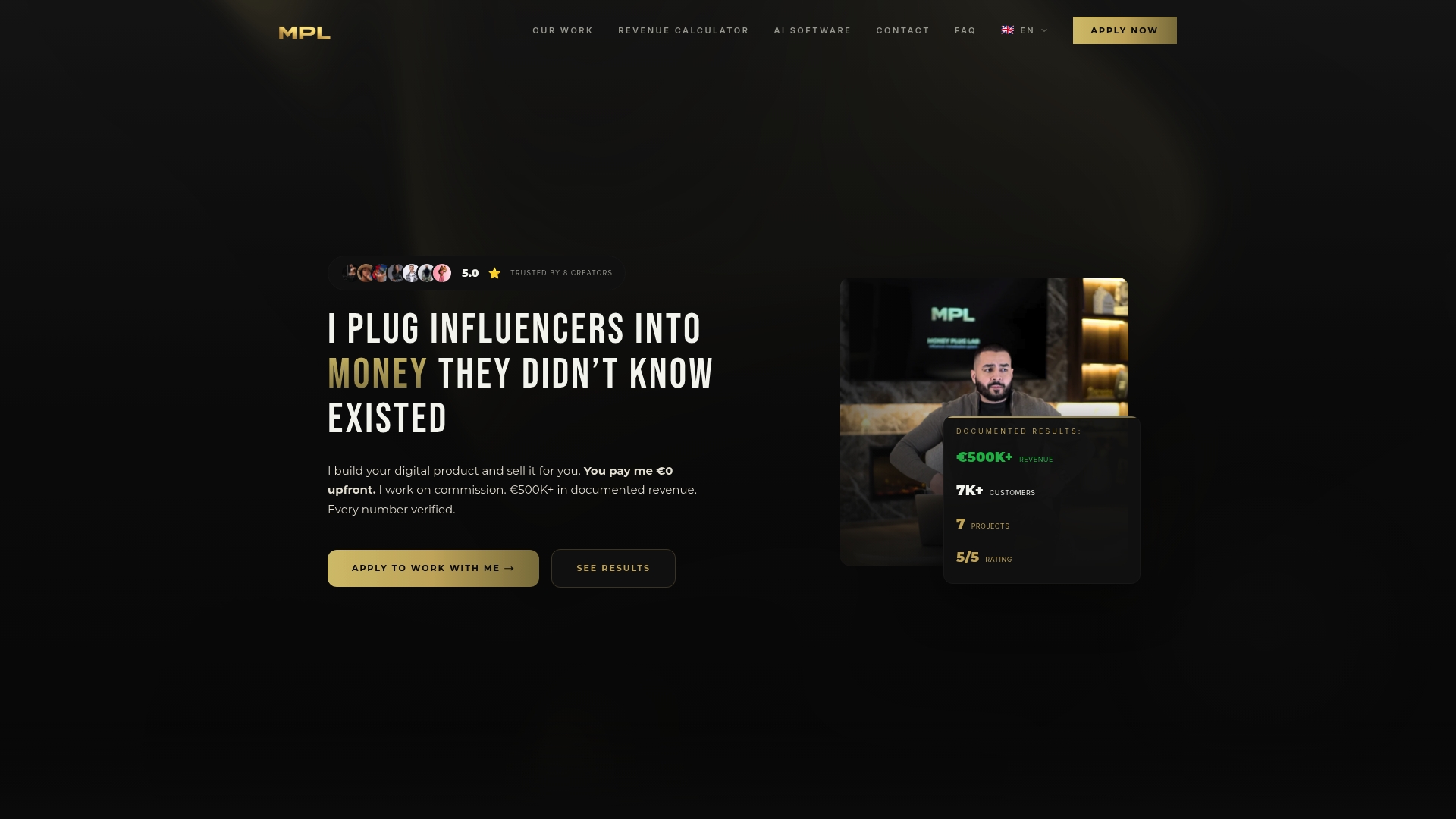
This path fits creators who are ready to scale past a first small launch or who are planning a flagship cohort and want the pricing, framing, and ad execution handled by a team that builds this for a living. We specialize in the Southeast European market, where audiences are highly engaged and acquisition costs run far lower than in Western markets, which gives tiered pricing more room to work.
- Zero upfront cost: we are paid only through revenue share on what we help launch.
- End-to-end service: research, pricing, copy, video sales letters, launch management, and payment infrastructure, all handled for you.
- Built for scale: suited to creators ready for a bigger launch or a flagship, higher-touch program.
If you are ready to turn your course idea into a priced, tiered offer without building the pricing and launch infrastructure yourself, visit the PlugReach page to start the conversation.
FAQ
What are the different tiers in pricing?
Most course pricing uses three tiers: an entry or basic tier with limited content and support, a core or mid tier with the full curriculum and some community access, and a premium or VIP tier with coaching, 1:1 feedback, or certification. Some creators add a micro tier below entry or a flagship tier above premium for specialty use cases.
What are the 7 types of pricing strategies?
Common pricing strategies include cost-plus pricing, value-based pricing, competitive pricing, penetration pricing, price skimming, dynamic pricing, and freemium pricing. Course creators most often rely on value-based pricing combined with tiered packaging rather than cost-plus models, since a digital course has no per-unit production cost to mark up.
What are the 5 C’s of pricing?
Definitions vary, but one version includes cost, customers, competition, channels, and company objectives as factors that shape a pricing decision. For course creators, customer willingness to pay and the specific transformation offered usually matter more than direct competitor pricing, since course value is tied to outcome rather than a standardized product.
What are the levels of pricing?
“Levels of pricing” typically refers to the tier structure itself: entry, core, and premium, sometimes with an added micro or flagship level. Each level corresponds to a different depth of content, support, and access, with price scaling alongside how much of the creator’s direct time and attention is included.
How do I know if my course is priced correctly?
Track conversion rate by tier, average revenue per buyer, and refund rate after launch, since a well-priced course usually shows steady conversion across tiers and a low refund rate. If the premium tier sees almost no sales, the perceived value likely needs clearer framing or the price needs adjusting rather than assuming the tier itself is wrong.
Sources
- When “More” Seems Like Less: Differential Price Framing Increases the Choice Share of Higher-Priced Options - Thomas Allard, David J. Hardisty, Dale Griffin, 2019
- G2
- Capterra