The 6-Beat UGC Ad Script You Can Shoot Today
The 6-Beat UGC Ad Script You Can Shoot Today

Use this six-beat, 20-second UGC script: Hook → Problem → Solution → Value → Proof → CTA. Script the hook and the CTA word-for-word. Let the middle four beats stay as talking points so the creator can deliver them like a real person, not a reader.
- Hook (0-3s): A pattern interrupt, scripted verbatim
- Problem/emotion (3-6s): The frustration your buyer already feels, talking points only
- Solution (6-10s): How the product fixes it, talking points only
- Value prop (10-13s): The one benefit that matters most, talking points only
- Social proof (13-16s): A result, a number, or a “this actually worked” moment, talking points only
- CTA (16-20s): One action, scripted verbatim
Run this at 15 to 25 seconds total. It’s built for cold-to-mid funnel paid social, where you have three seconds to earn the next three. This is the backbone structure behind most working ugc ad scripts, and it’s the one we hand every creator before a launch.
Key Takeaways
A six-beat UGC script with a scripted hook and CTA, tested across multiple creators and hooks, converts more reliably than a fully scripted or fully improvised approach.
| Point | Details |
|---|---|
| Script only two beats | Write the hook and CTA word-for-word; leave problem, solution, value, and proof as talking points. |
| Match runtime to funnel | Keep cold-traffic UGC ads between 15 and 25 seconds for the strongest completion rates. |
| Test hooks before anything else | Run three to five hook variants per batch since the hook decides whether beat two ever gets watched. |
| Separate boundaries from direction | A brief that splits hard rules from creative suggestions cuts revision cycles and legal risk. |
| Route winners to a pre-sell page | Sending proven creatives to a matching pre-sell page instead of a cold product page tends to lower acquisition cost. |
Table of Contents
- The UGC Ad Script Framework, Beat by Beat
- Fill-In-The-Blank UGC Script Templates You Can Use Now
- How Should You Adjust UGC Scripts by Platform?
- What Belongs in a Creator Brief for UGC Ads?
- How Do You Test UGC Ad Variants and What Should You Measure?
- The UGC Scripting Mistakes That Quietly Kill Performance
- What Money Plug Lab’s Launch Data Shows About UGC Scripting
- What Legal Issues Come Up in UGC Ads Beyond Usage Rights?
- How Do You Stay Creative Without Breaking Compliance Rules?
- What the Data Actually Tells Us About UGC Scripting
- Sources
The UGC Ad Script Framework, Beat by Beat
Each beat has one job. Miss the job, and the whole 20 seconds falls apart, no matter how charming the creator is on camera.
- Hook (0-3s): Stop the scroll. Success looks like a viewer who doesn’t reach for the next video. Script this exact line. Bad: “Hey guys, so today I want to talk about this product.” Good: “I returned this three times before it actually worked.”
- Problem (3-6s): Name the specific frustration, not the category. Talking point, not a script. “I hated how my skin looked in every photo this winter” beats “skincare is important.”
- Solution (6-10s): Introduce the product as the fix, briefly. This is where creators tend to over-explain. Give them the point, not the paragraph.
- Value prop (10-13s): One benefit only. Not five. The single reason this beats what the viewer is currently doing.
- Social proof (13-16s): A number, a before/after, or a specific outcome (“it’s been three weeks and I haven’t broken out once”).
- CTA (16-20s): One action, one destination. Script it word-for-word so it matches your landing page promise.
Pro Tip: Give creators the hook and CTA as fixed lines, but hand them the middle beats as bullet points, not a paragraph script. Clear, direct writing reads well on a page and terribly out loud when it’s memorized word for word.
Fill-In-The-Blank UGC Script Templates You Can Use Now
Six archetypes cover most of what performs in paid social right now, and structured templates like these are proven to cut revision cycles because creators know exactly what to fill in and where, according to Sideshift’s analysis of 12 UGC frameworks.
- Problem-solution: “I struggled with [problem] for [timeframe] until I found [product]. Now [specific result].” Runtime: 20-25s. A/B variant: swap the hook for a shock stat instead of a personal struggle.
- Testimonial: “I’ve used [product] for [duration] and here’s what actually changed: [result].” Runtime: 15-20s. Variant: test a skeptical opening (“I didn’t think this would work, but…”) against a straightforward one.
- Demo: “Watch me [use product] in real time. Here’s what happens: [outcome].” Runtime: 20-25s. Variant: swap the CTA from “shop now” to “link in bio” to see which drives more clicks.
- Unboxing: “I just got [product] and I’m opening it for the first time. First impression: [reaction].” Runtime: 15-20s. Variant: test with and without pricing mentioned on camera.
- Before/after: “This is what [problem area] looked like before. Here’s [duration] later using [product].” Runtime: 20-25s. Variant: try a visual-only proof cut against a spoken proof line.
- POV: “POV: you finally found [product category] that actually [does the thing].” Runtime: 15-20s. Variant: test first-person urgency versus a calmer, matter-of-fact tone.
Multiple high-converting archetypes, including problem-aware hooks, product demos, founder POV, and reaction testimonials, repeat across winning campaigns for a reason: they mirror how people already talk about things they like.
How Should You Adjust UGC Scripts by Platform?
The six-beat structure stays constant. What changes is pacing, captions, and how hard you lean into native behavior on each feed.
- TikTok: Prioritize the thumbstop hook and native-sounding audio over polish. Keep the whole thing at 15-22 seconds and write captions short and punchy.
- Instagram Reels/Facebook: Open visually tighter since the algorithm rewards early retention differently. Burn captions in for sound-off viewers, and say the CTA out loud AND put it in the on-screen text.
- YouTube Shorts: You can stretch proof and hold a beat longer here since completion rate matters more than instant stop rate. Give the social-proof section an extra second or two.
- Cross-platform checklist: Match aspect ratio to the feed (9:16 vertical for all three), burn in captions everywhere, and place any required disclosure both in the spoken script and in the caption text.
What Belongs in a Creator Brief for UGC Ads?
A one-page brief prevents the two things that waste the most time: reshoots and rights disputes. Build it around six blocks.
- Context: Who the brand is, who the audience is, and what problem the product solves in one paragraph.
- Deliverables and specs: Number of videos, aspect ratio, runtime target, and file format.
- Creative direction: Tone, setting, wardrobe notes, and any brand phrases to include naturally.
- Boundaries: What not to say, claim, or show, kept separate from creative direction so creators don’t confuse a hard rule with a suggestion.
- Rights and approval: Paid usage rights across specific channels, usage duration, and number of revision rounds included.
- Logistics: Deadline, payment terms, and delivery method.
Disclosure should appear in three places: a spoken line (“this is a paid partnership with…”), the on-screen caption, and a campaign hashtag. Ask for paid usage rights across the specific channels you’ll run ads on, a defined duration (six or twelve months is standard), and at least one revision round built into the fee, a pattern that lines up with how Shopify recommends brands structure creator collaborations.
How Do You Test UGC Ad Variants and What Should You Measure?
Run a 3×3 matrix: three hooks across three creators, holding the landing page and offer constant. Add CTA variants as a third axis if budget allows.
- Isolate the hook first. Testing hooks is the single highest-leverage move you can make in a creative batch, since it’s what determines whether anyone watches beat two at all, and running three to five hooks per batch is enough to find a clear signal.
- Watch four numbers: hook/stop rate, hold or completion rate, click-through rate, and creative-level CPA or ROAS.
- Set decision rules before you launch. Scale anything that clears your CPA target with headroom. Refresh anything that’s fatiguing (rising CPA, falling CTR) but still profitable. Kill anything that never cleared the bar in the first place.
Statistic Callout: A disciplined weekly testing cadence, paired with routing winning creatives into a matched pre-sell page instead of a cold product page, is a pattern DTC practitioners credit with meaningfully lower acquisition costs over time. Feed every result back into your next creator brief.
The UGC Scripting Mistakes That Quietly Kill Performance
Most underperforming UGC ads aren’t badly shot. They’re badly scripted.
- Over-scripting the middle beats. A memorized paragraph sounds like a memorized paragraph. Convert everything after the hook into bullet points.
- Burying the CTA or front-loading proof. Save your best proof point for the middle, not the opener, and put the CTA last, every time.
- Stacking multiple CTAs. “Shop now, follow us, check the link, comment below” gives the viewer zero clear next step. Pick one metric-driven action per ad.
- Promising something the landing page doesn’t deliver. If the ad promises a specific result the product page doesn’t reinforce, build a pre-sell page that bridges the gap instead of hoping viewers forgive the mismatch.
Pro Tip: If a script feels flat on review, read it out loud once. Anything you stumble over is a line the creator will stumble over too, so cut it before it reaches camera.
What Money Plug Lab’s Launch Data Shows About UGC Scripting
Money Plug Lab has generated over $500,000 in tracked revenue across seven launched programs for creators in the Balkans and Balkan diaspora, including one launch that produced more than 3,000 sales in ten days and a campaign that returned 18 times on ad spend. None of that came from one lucky video.
It came from running the same six-beat structure across a rotating roster of creator voices, testing three to five hooks against a single, unchanging landing page, and killing underperformers within the first 48 hours instead of waiting a full week to react.
The launches that hit outsized numbers all shared one habit: the team scripted the hook and CTA with total precision, then got out of the creator’s way for everything in between.
Map that into your next two weeks. Brief five creators on one core offer, script only their hooks and CTAs, let them talk through the middle beats in their own words, and review hold rate by day three. That loop, repeated, is what actually compounds.
What Legal Issues Come Up in UGC Ads Beyond Usage Rights?
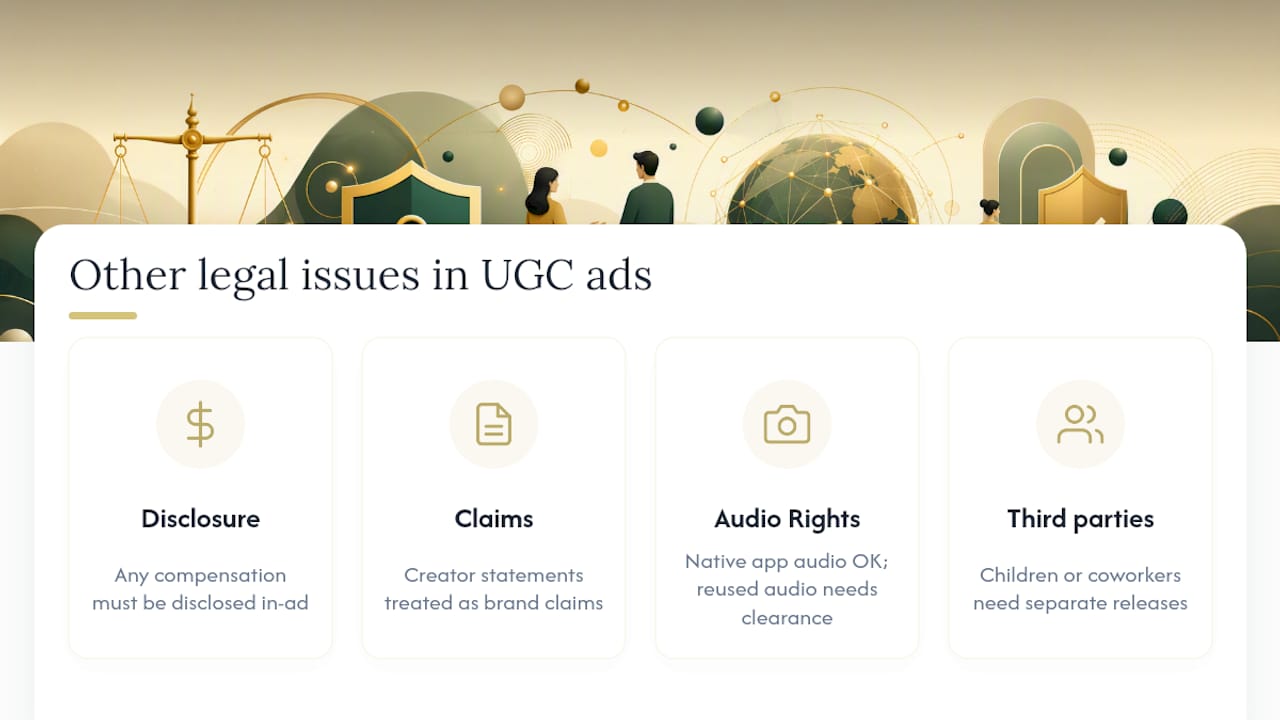
Usage rights get most of the attention, but three other legal issues show up just as often once a UGC ad starts spending real money.
Advertising disclosure rules apply regardless of payment structure. If a creator receives any compensation, including a revenue share or free product, that relationship generally needs disclosure in the ad itself, not buried in a bio or a one-time caption. Requirements differ by country, so confirm the applicable rule for the market where the ad actually runs rather than assuming one country’s standard.
Claims made on camera are still claims. A creator saying “this cleared my skin in a week” carries the same regulatory weight as if the brand said it in a commercial. Loose, off-script talking points increase the risk of a creator overstating a result the brand can’t substantiate, which is one more reason to keep boundaries explicit in the brief rather than assumed.
Music and third-party elements need their own clearance. Native platform audio used inside the app is usually fine. The same audio pulled out and reused in a paid ad, or a licensed song played in the background of a demo, is a separate rights question from the creator’s own footage.
Minors and identifiable third parties in the footage need separate consent. If a creator’s video shows a child, a coworker, or anyone else recognizable, that’s a distinct release from the creator’s own agreement, and it’s easy to miss when a brief only covers the creator’s rights.
How Do You Stay Creative Without Breaking Compliance Rules?

The tension is real: the ads that perform best sound the least like ads, but the looser the script, the higher the chance a creator says something you can’t defend later.
The fix isn’t tighter scripts. It’s clearer boundaries paired with looser talking points. A brief that separates “creative direction” from “boundaries” into two distinct sections, rather than blending them into one long note, tends to produce both more natural delivery and fewer compliance headaches, since creators stop guessing which instructions are suggestions and which are hard lines.
Give creators room to riff on tone, wording, and personal anecdotes. Hold the line hard on specific claims (results, timeframes, comparisons to competitors) and on disclosure placement. Those aren’t creative choices. They’re the two places where “authentic” and “unscripted” can turn into “legally exposed.”
One practical habit: review scripts for claims before the shoot, not after. Catching “this cured my…” in a brief review takes thirty seconds. Catching it in an edited final cut means a reshoot, a delay, and a creator who now feels micromanaged on their next project. The best UGC programs treat compliance as a pre-production filter, not a post-production penalty.
What the Data Actually Tells Us About UGC Scripting
Most advice on UGC ads treats the script like the whole game. It isn’t. The script is maybe 30 percent of what makes an ad convert. The other 70 percent is creator selection, hook volume, and how fast you kill what isn’t working.
Here’s where conventional wisdom gets it backward: brands spend weeks perfecting a single script and one hour choosing the creator who delivers it. That ratio should flip. A mediocre script delivered by the right person, with real conviction, consistently beats a perfect script delivered flat. The framework matters because it removes guesswork, not because the words themselves are magic.
If you take one thing from this, prioritize hook volume over script polish. Five decent hooks tested against one strong middle section will teach you more in a week than one “perfect” script ever will. Test fast, watch hold rate over hook rate once you’re past the first three seconds, and route anything that works into a landing experience that actually matches what the creator promised. That last part gets skipped constantly, and it’s often the reason a winning ad still underperforms on the back end.
— Money
Sources
- UGC Ad Script Template: Hook, Body, CTA (Fill-In) | Spark UGC
- 4 Types of UGC Ads and How To Collaborate on UGC Ads | Shopify
- 3 ways to make your writing clearer | Harvard Business Review