Waitlist Building Tactics That Turn Signups Into Buyers
Waitlist Building Tactics That Turn Signups Into Buyers

BLUF: the fastest path from zero to paying customers is a referral loop stacked on selective admission, run on a tight nurture cadence, released in cohorts instead of one big dump. Free-for-all opt-in pages fill a spreadsheet. This combination fills a bank account.
Here’s the shortlist to build this week:
- Set up a referral link with visible queue position (moves people to share within minutes of signing up)
- Add a small deposit or short application to the signup flow if your offer can support it
- Write four to six nurture emails before you need them, not after
- Plan cohort sizes at 5 to 10 percent of your list per wave, not 100 percent on day one
- Pick your seed channels now: your existing audience first, cold traffic last
Track referral velocity and engaged open rate before anything else. Total signups is a vanity number. These two tell you whether the list will actually buy.
Key Takeaways
A waitlist converts into paying customers when a referral loop, gated admission, and a disciplined cohort release work together instead of separately.
| Point | Details |
|---|---|
| Build the referral loop first | Generate a link and show queue position immediately after signup to capture the biggest share of conversion lift. |
| Add friction on purpose | A deposit or qualifying question filters for buyers and can lift conversion well above a free-for-all signup. |
| Release in small cohorts | Admit 5 to 10 percent per wave, starting with top referrers, to protect scarcity and catch issues early. |
| Track engagement over volume | Referral velocity, engaged open rate, and reply rate predict revenue better than total signup count. |
| Let Money-plug run it end to end | Money Plug Lab builds the referral mechanics, nurture emails, and cohort launch on a revenue-share basis with no upfront cost. |
Table of Contents
- Waitlist Building Tactics Worth Your Time First
- How Do You Design a Referral Loop That Scales?
- What Makes a Waitlist Landing Page Actually Convert?
- How Often Should You Email Your Waitlist?
- How Do Cohort Releases Prevent a Launch-Day Crash?
- Where Should You Seed Your Waitlist First?
- How Money-plug Runs Revenue-First Waitlists
- Segmenting Your List for Sharper Messaging
- Testing Your Way to a Better Signup Rate
- Handling Waitlist Data Under GDPR and CCPA
- Winning Back the People Who Went Quiet
- Editorial Take: What Most Waitlist Advice Gets Wrong
- Get a Revenue-Focused Waitlist Built for You
- Sources
Waitlist Building Tactics Worth Your Time First
Not every tactic deserves equal attention, and chasing all of them at once is how launches stall before they start. Four levers do most of the work: referral loops, gated admission, landing-page fundamentals, and cohort-based launches. Each has a different cost to build and a different payoff window.
A referral loop takes a few hours to wire up with a tool like KickoffLabs or a custom link generator, and it pays off immediately because referral-based waitlists convert better when paired with selective admission and a steady cadence. Gated admission (a deposit, an application, an invite code) takes longer to set up because you need payment infrastructure or a qualifying form, but it filters for buyers before you ever launch. Landing-page fundamentals are nearly free to fix and often produce the fastest lift of any tactic on this list. Cohort launches cost you almost nothing technically but require discipline: you have to resist releasing to everyone at once.
These tactics compound. A referral loop seeded into a tight community produces higher-quality traffic than a boosted post, and that higher-quality traffic converts better once it hits a gated signup. Here’s a simple decision rule:
- Early-stage, no audience yet: landing page plus referral loop, skip the deposit until you have proof of demand
- Existing audience, ready to sell: add a deposit or qualifying question immediately
- Creator-led launch with a community: cohort releases starting with your most engaged followers
Pro Tip: Build the referral mechanic before you build anything else. Every day you run without one, you’re leaving free distribution on the table.
How Do You Design a Referral Loop That Scales?
The mechanics are simpler than most people expect, and the mistake most founders make is treating the referral link as an afterthought instead of the centerpiece of the signup flow.
- Generate a unique link the instant someone signs up. Show it immediately, not in a follow-up email. The share moment right after signup produces the biggest conversion lift you’ll get, so don’t bury it.
- Display queue position and update it live. Robinhood used exactly this mechanic and hit 1 million signups in 24 hours by making access itself the reward.
- Match the reward to the audience. Developers respond to early API access or beta features. Consumers respond to queue-jump. Creators respond to recognition, like a leaderboard spot or a shoutout.
- Guard against fraud before it happens. Require email verification, throttle referral counting per IP, and manually audit anyone whose referral count spikes overnight.
Skip the anti-fraud step and you’ll admit a cohort full of fake accounts instead of real buyers.
What Makes a Waitlist Landing Page Actually Convert?
Your headline should follow one formula: [specific benefit] for [specific audience]. “Cut your grocery bill in half” beats “Smart shopping, reimagined” every time, because it tells a stranger exactly what they get and whether it’s for them.
Beyond the headline, the checklist is short:
- One form field if you can manage it: email only, nothing else
- One line of social proof above the fold (a follower count, a press mention, a founder credential)
- A single call-to-action button, no competing links or navigation
- An immediate referral-share prompt on the thank-you page, not an email that arrives an hour later
How Often Should You Email Your Waitlist?
A waitlist goes cold fast. Silence longer than three weeks can cost you 30 to 40 percent of your effective engagement, so the cadence matters as much as the content.
A workable sequence over six to eight weeks:
- Welcome email, day zero. Confirm the signup, hand them their referral link, set expectations for what’s coming.
- Progress update, week two. Share a build milestone or behind-the-scenes note. This is where pulling members into the process with feedback requests and mockups starts paying off.
- Product preview, week four. A screenshot, a short demo clip, or a sneak peek at pricing.
- Direct ask, week six. Invite replies, run a quick poll, or ask what they’re hoping the product solves.
- Urgency email, right before launch. Cohort details, countdown, final call for referrers to climb the queue.
Pro Tip: Tag anyone who replies, clicks a preview link, or refers more than two people. That’s your first cohort, not whoever signed up first.
How Do Cohort Releases Prevent a Launch-Day Crash?
Dumping your entire waitlist into checkout on day one looks impressive and usually backfires. Admitting too many users at once destroys perceived scarcity and strains infrastructure before you’ve had a chance to fix what breaks.
- Release your first cohort to top referrers and the most engaged email openers, roughly 5 to 10 percent of the list
- Write the invite with one clear action and the fewest possible steps between “you’re in” and “you paid”
- Watch activation and conversion in that first wave closely before you touch the next one
- Fix whatever broke, then release the next 5 to 10 percent
Cohort admission preserves scarcity and produces noticeably higher open rates on the admission email itself compared to a blanket “you’re in” blast to everyone at once.
Where Should You Seed Your Waitlist First?
The channel you seed from determines the quality of everyone who follows through referrals, so get this order right. Start with your own audience: email list, social following, past customers. Move next to your founder network and any community where your actual buyer already spends time, whether that’s a niche Discord, a subreddit, or a Product Hunt ship page. Paid traffic comes last, if at all, before launch.

Concentrated seeding from existing communities produces higher-converting signups than continuous paid traffic, because people who arrive through a trusted referral already have context on what you’re building.
Track these four numbers weekly:
- Referral velocity (new signups generated per existing member)
- Engaged open rate (opens plus clicks, not just opens)
- Reply rate on your direct-ask emails
- Qualified leads, meaning people who answered a screening question correctly, not just anyone who typed an email
How Money-plug Runs Revenue-First Waitlists
Most waitlist advice online optimizes for a big number on a dashboard. Money Plug Lab optimizes for the number that shows up in a bank account.
The difference shows up before launch day. Money-plug qualifies waitlist members with screening questions instead of counting raw signups, builds activation flows that move a new customer from “admitted” to “using the product” within the first session, and uses deposits or gated admission whenever the offer and audience support it.
A waitlist full of curious followers is not the same asset as a waitlist full of people who already told you they’ll pay. The gap between those two lists is where most launches lose money they never see.
Three templates worth stealing directly:
- Post-signup email 1: confirm the spot, hand over the referral link, ask one qualifying question
- Cohort timing: first wave at 48 hours post open, second wave 5 to 7 days later based on activation data
- Referral reward tiers: 1 referral moves up the queue, 3 referrals unlocks a bonus, 5+ triggers a personal follow-up
Segmenting Your List for Sharper Messaging
Not everyone on your waitlist deserves the same email. Sending identical content to a first-day signup and a five-time referrer wastes the goodwill of your best advocates and bores everyone else.
Split your list along three lines. First, behavior: who’s opened everything versus who hasn’t opened anything in three weeks. Second, source: someone who arrived through a trusted creator’s referral link is a different buyer than someone who found you through a cold ad, and your copy should reflect that origin. Third, intent signals from any qualifying question you asked at signup, like budget range, current tool usage, or stated urgency.
Once you have those splits, the message changes accordingly. Highly engaged referrers get early cohort invites and a more direct sales pitch. Cold openers get a re-engagement email built around your strongest social proof, not another product update they’ve already ignored. Anyone who answered a qualifying question indicating strong buying intent should skip the general nurture sequence entirely and move straight into a shorter, sales-focused path.
Most email platforms handle this with basic tags: referral count, source campaign, and a custom field for qualifying answers. You don’t need marketing automation software with a steep learning curve, just consistent tagging from day one so the segments exist when you need them.
Testing Your Way to a Better Signup Rate
Guessing at what converts wastes the small amount of traffic most pre-launch pages get. Test one variable at a time, and only run a test long enough to gather a meaningful sample; a headline swap tested on 40 visitors tells you nothing.
Start with the headline, since it does more conversion work than any other element on the page. Test a benefit-driven version against a curiosity-driven one, and let the data settle the argument your team is probably already having. Next, test the call-to-action button copy: “Join the waitlist” against something more specific like “Reserve my spot,” which often performs better because it implies scarcity.
Form length is worth a test too. Email-only versus email-plus-one-qualifying-question usually shows a drop in raw signups but a rise in lead quality, and that trade-off is worth measuring rather than assuming. On the post-signup side, test whether showing queue position immediately increases referral shares compared to a plain thank-you message.
Run these tests sequentially, not simultaneously, unless your traffic volume genuinely supports a proper multivariate setup. Most early-stage waitlists don’t have the volume for it, and running five tests at once just means you can’t attribute the result to anything specific. Give each test at least a week and a few hundred visitors before calling a winner.
Handling Waitlist Data Under GDPR and CCPA
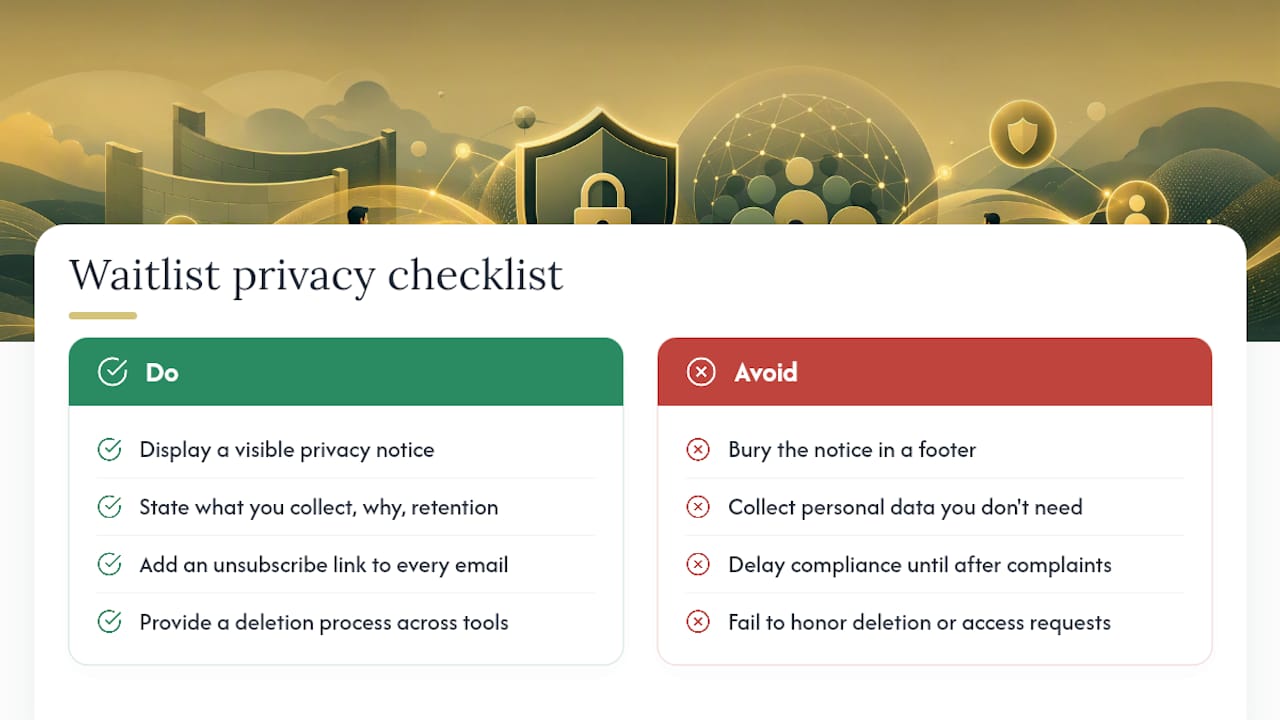
Collecting an email address is a data collection event, and that means privacy law applies even to a simple one-field signup form. If your list includes anyone in the EU or EEA, the General Data Protection Regulation requires a clear legal basis for collecting that email, usually consent, plus a straightforward way for someone to see what you’ve stored and delete it on request. If your list includes California residents, the California Consumer Privacy Act gives them similar rights to know what’s collected and to opt out of having it sold or shared.
In practice, this means your signup form needs a visible privacy notice, not a link buried in a footer nobody clicks. State plainly what you collect (usually just email, sometimes a qualifying answer), why you collect it (to notify them of launch and send updates), and how long you’ll keep it. Build an unsubscribe link into every email, and make sure whatever tool holds your waitlist data (a CRM, an email platform, a spreadsheet) has a real process for deleting a record when someone asks.
None of this is a substitute for legal advice specific to your business and the countries your list spans, but the baseline habit is simple: collect only what you need, say clearly what you’re doing with it, and make it easy to leave the list. A waitlist that respects this from day one avoids the scramble that comes from bolting on compliance after a complaint.
Winning Back the People Who Went Quiet
Drop-off is normal. Someone signs up with real interest, then three weeks pass and your emails stop landing in their attention at all. The mistake is treating a quiet subscriber the same as an engaged one, or worse, treating them as a lost cause and deleting them from future sends.
Watch for the warning signs early: no opens across two consecutive emails, or a click-through that never converts into a reply or referral. That’s your cue to shift tactics rather than repeat the same content that already failed to land. A re-engagement email works best when it does something different from your regular cadence, like asking a direct question (“still interested in early access?”) or offering something concrete, such as a preview clip they haven’t seen.
Give re-engaged subscribers a lower bar to clear. Instead of asking a cold subscriber to refer three friends, ask them to simply confirm interest with one click. That small action re-activates them in your segmentation and moves them back into the engaged pool for the next cohort invite. If someone shows no signal at all after a genuine re-engagement attempt, it’s fine to stop emailing them regularly. A smaller list of people who actually open and click will always outperform a bloated list padded with names who tuned out months ago.
Editorial Take: What Most Waitlist Advice Gets Wrong
Most waitlist guides treat every signup as equally valuable, and that’s the single biggest strategic error creators make before a launch. A list of 10,000 curious followers who never open an email is worth less than a list of 800 people who replied to your last update. The industry’s obsession with total signup count as the headline metric rewards vanity over revenue, and it’s why so many “successful” waitlists convert at rates that would embarrass anyone running the numbers seriously.
The conventional advice also underweights friction on purpose. Marketers assume every barrier (a deposit, a qualifying question, a gated cohort) costs you signups, and it does. But the signups it costs you were rarely going to buy anyway. Prioritize referral velocity and reply rate over raw list size from week one, not after a disappointing launch day forces the reckoning. Build the referral mechanic first, add a deposit or screening question the moment your offer can support it, and release in small cohorts even when it’s tempting to open the floodgates. The data on cohort admission and gated conversion isn’t subtle. It just requires resisting the urge to chase a bigger number that means nothing at checkout.
— Money
Get a Revenue-Focused Waitlist Built for You
If you’d rather skip building this system alone, Money-plug runs the entire waitlist-to-launch process for creators on a revenue-share basis, with zero upfront cost. That’s the real difference from doing it yourself or hiring a generalist marketer: you don’t pay for landing pages, email sequences, or ad management out of pocket, and the incentive stays aligned with actual sales, not signup counts.
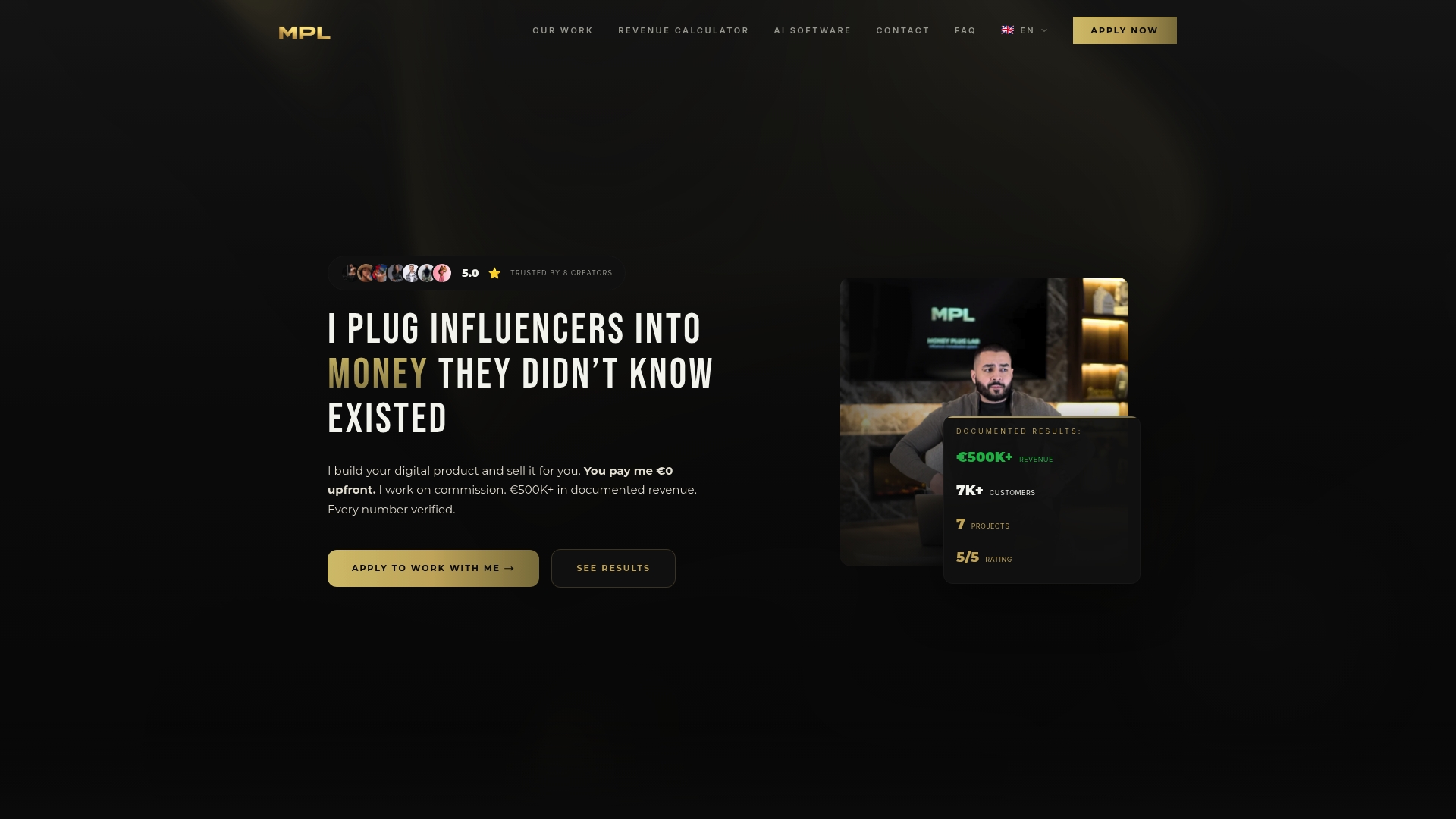
This fits creators and small teams in the Balkans, the Balkan diaspora, and beyond who have an audience but no time to build launch infrastructure from scratch. If you’re planning a launch and want the waitlist built by people who get paid only when you do, start a conversation with Money Plug Lab about your next cohort.
Sources
- How to Build a Waitlist That Creates Real Demand
- Set Up a Pre-Launch Waitlist That Converts | KickoffLabs
- How to Build a Viral Waitlist (2026) — PH LaunchKit
- Waitlist landing page / LaunchList