How to Launch a Wellness Membership That Pays Your Bills
How to Launch a Wellness Membership That Pays Your Bills

Start with a limited founding-member launch using tiered pricing, and switch to an evergreen model only once you have steady demand and the onboarding capacity to handle it. Most successful wellness memberships price within a broad range per month, depending on scope, without specifying exact figures., depending on scope, and a controlled first launch gives you real data before you commit to a permanent price. Money Plug Lab has observed well-run launches generate thousands of sales in a short period for creators, proof that scarcity and a hard deadline beat an “always open” cart when you’re starting from zero.
- Pick a founding-member price below your long-term rate to encourage early sign-ups.
- Cap the number of founding spots so demand outpaces supply.
- Open a waitlist before you open the cart.
Pro Tip: Announce your founding price publicly, with a countdown, before you have the full curriculum finished. Pressure builds better content than a blank calendar ever will.
Key Takeaways
A successful wellness membership launch pairs a capped founding-member price with a short enrollment window, then lets real churn and revenue data set the permanent price.
| Point | Details |
|---|---|
| Start with a launch window | Use a capped founding-member enrollment before considering an always-open evergreen model. |
| Price within market range | Most memberships charge $20 to $100+ per month depending on scope and personal attention. |
| Build the waitlist first | Grow an opt-in list for four to six weeks before opening the cart to create real demand. |
| Track six core metrics | Watch MRR, ARPU, churn, CAC, payback period, and LTV starting week one. |
| Match capacity to price | Confirm your delivery bandwidth before selling spots, since overdelivery promises drive early churn. |
Table of Contents
- Evergreen vs. Launch-Window Wellness Membership Models
- Step-by-Step Wellness Membership Launch Checklist
- How Should You Price a Wellness Membership?
- What Tier Structure Works for a Wellness Membership?
- How Do You Build a Waitlist That Converts?
- What Software and Payment Setup Does a Membership Need?
- What Metrics Actually Predict Membership Success?
- Money Plug Lab’s Launch Evidence and a Reusable Timeline
- What the Data Actually Tells Creators to Do Differently
- Frequently Asked Questions
- Sources
Evergreen vs. Launch-Window Wellness Membership Models
An evergreen wellness subscription service accepts new members any day of the year, usually through an automated funnel. A launch-window model opens enrollment for a set period, then closes the doors, sometimes for months. A hybrid model runs a big founding launch, then reopens briefly a few times a year rather than year round.
Evergreen keeps revenue steadier month to month, but it demands a marketing engine that never stops, and onboarding never lets up either. Launch windows concentrate your marketing effort into short, intense bursts, create real urgency, and give your team a breather between cohorts. The tradeoff: revenue arrives in spikes instead of a smooth curve, which complicates cashflow planning if you’re not ready for the gap between windows.
Three questions settle which model fits:
- Can you onboard new members continuously without your coaching or content quality slipping?
- Does your audience respond better to “join anytime” or to a deadline?
- Do you have the cash reserves to survive a quiet month between launch windows?
If you answered no to the first question, start with launch windows. Most first-time creators do, precisely because a hybrid approach: one big founding launch, followed by periodic reopenings, lets you build community momentum and evergreen infrastructure at the same time.
Step-by-Step Wellness Membership Launch Checklist
A wellness membership launch succeeds or fails based on sequencing, not just content quality. Here’s the order that works.
Prelaunch (weeks 1 to 4):
- Define the offer in one sentence: what members get, how often, and the outcome they’re paying for.
- Set your founding-member price and decide how many spots you’ll cap it at.
- Build a simple landing page with the offer, price, and a waitlist opt-in.
- Write three to five prelaunch emails that build anticipation without revealing everything.
- Confirm your tech stack: payment processor, member portal, community tool, email platform.
- Draft basic terms of service, a refund policy, and a privacy notice before you take a single payment.
Launch (days 1 to 10): 7. Send your enrollment sequence with a clear deadline and a bonus that disappears when the cart closes. 8. Schedule a live onboarding call or welcome sequence for the first cohort. 9. Assign one team member (or yourself, if solo) to handle support tickets during the launch window exclusively.
First 90 days post-launch: 10. Track onboarding completion in week one; anyone who hasn’t logged in by day seven needs a personal nudge. 11. Seed the community with a handful of active voices before the wider group sees empty channels. 12. Set a content and coaching cadence you can sustain, not just one you can survive during launch week. 13. Revisit your waitlist for a second, smaller enrollment window once the first cohort stabilizes.
Pro Tip: Build your welcome sequence and first two weeks of content before you launch, not during. Launches fail more often from operational scramble than from weak marketing.
How Should You Price a Wellness Membership?
Pricing comes down to three approaches. Value-based pricing charges for the transformation you deliver, not the hours you spend. Cost-plus pricing covers your time and tools, then adds margin. Competitor-aware pricing anchors your price against what similar offers charge, adjusted for your positioning.
Market ranges vary widely by scope:
- $9 to $20/month works for low-touch, high-volume access, often with paid upgrades sold separately, similar to how Mito Membership prices a low entry tier and monetizes diagnostics a la carte.
- $30 to $75/month fits most coaching-plus-community models with group calls, structured content, and moderate personal attention.
- $100 or more per month suits premium, high-touch, or integrated offerings, the kind combining diagnostics with ongoing coaching that Lifeforce and Pause built when they launched their combined longevity-wellness membership.
- Flat annual pricing can work too. BluMine Health charges $850 a year for a family membership, positioned explicitly to complement insurance rather than replace it, a useful model if your offer bundles multiple services under one household price.
That protects your cashflow during the vulnerable early months when churn risk is highest. As a rough payback rule: if your customer acquisition cost per member is $40, and your monthly price is $40, you need that member to stay roughly two months just to break even, before any margin. Price too low and even strong retention won’t cover what it costs you to find each new member.
What Tier Structure Works for a Wellness Membership?
A three-tier structure gives members a reason to upgrade without overwhelming them with choices.
- Entry ($20 to $35/month): Access to a content library, community channel, and monthly group call.
- Core ($50 to $75/month): Everything in entry, plus weekly live coaching and personalized check-ins.
- Premium ($100+/month): Everything in core, plus 1:1 sessions, priority support, and custom programming.
Price 1:1 add-ons separately from the subscription rather than folding them into a tier where they eat your time without a clear ceiling. A better structure sells a set number of 1:1 credits per quarter, then charges extra beyond that.
For founding members, cap spots publicly (say, the first 50 or 100), give them a locked-in rate for life or for a full year, and send a short, warm welcome sequence explaining what makes their spot different from the general public’s. Scarcity works only when the cap is real and communicated clearly.

How Do You Build a Waitlist That Converts?
A waitlist works when the opt-in offers something immediately useful: a free mini-series, a short workshop, or early access to founding pricing before the general public sees it. Elysium Health used exactly this mechanic, a capped waitlist paired with staged enrollment, to control scale and build urgency ahead of its longevity institute launch.
- Build the list through organic content, an email opt-in, and partner shoutouts for four to six weeks before you open the cart.
- Layer in paid ads only once your organic list has proven the offer resonates, then front-load spend into the first 48 hours of launch.
- Run a six-email sequence: problem, story, offer, testimonial or proof, urgency, and last call.
Pro Tip: Keep acquisition cost low by leaning on partner audiences first. A shoutout from someone with 5,000 engaged followers usually outperforms a cold ad to 50,000 strangers.
Not every launch needs a celebrity budget. Enterprise wellness rollouts sometimes hire global ambassadors, Lifefit brought on Neymar Jr. for its 2026 rollout, but a creator with a genuinely engaged audience of a few thousand people rarely needs that scale to hit a profitable founding cohort.
What Software and Payment Setup Does a Membership Need?
Your stack needs six things at minimum: recurring billing, a member portal, content gating, a community space, email automation, and basic analytics to track signups and cancellations. Platforms like MembershipSoft lay out these feature sets clearly if you want a reference for what a functioning setup looks like.
On payments, pick a subscription billing provider with built-in dunning (automatic retry on failed cards), decide your refund window in advance, and understand tax collection obligations in your market before you take your first dollar. For EU-facing creators, keep your terms and dispute process visible; the European Commission’s dispute resolution portal exists precisely because unclear membership terms create avoidable conflicts. Cap your first cohort size and roll out in phases rather than opening to everyone at once.
What Metrics Actually Predict Membership Success?
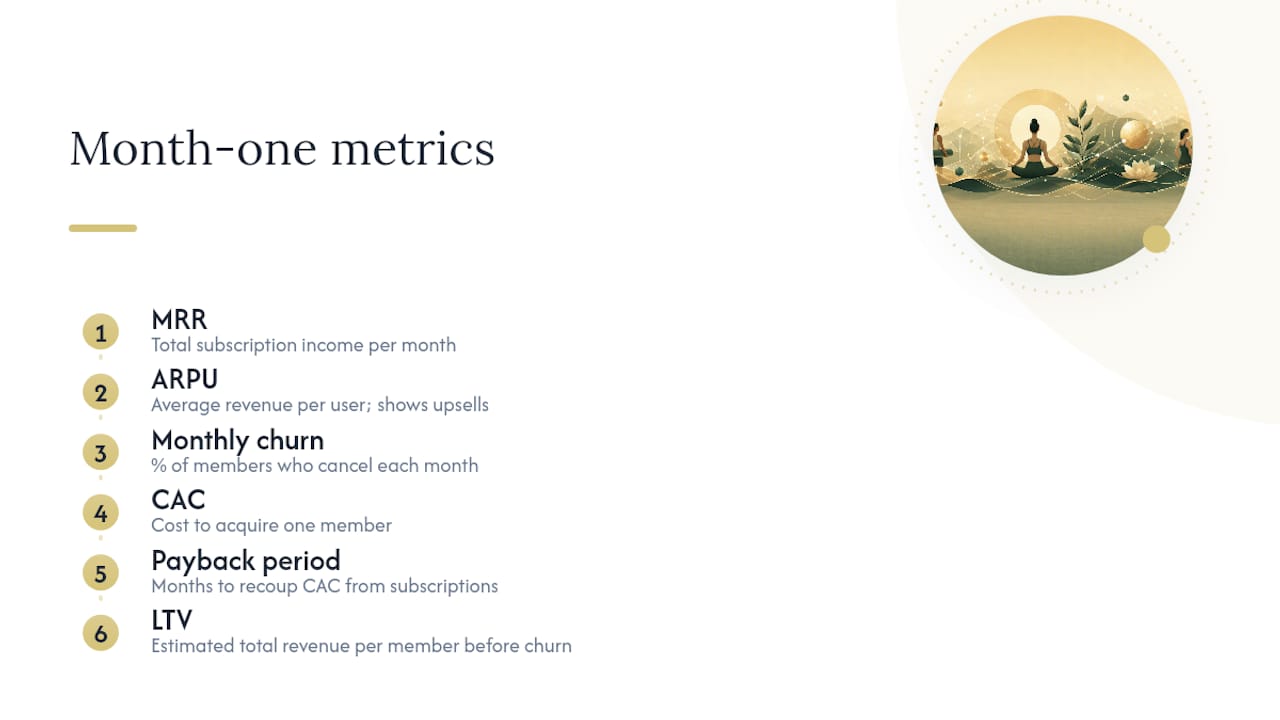
Six numbers matter more than anything else in month one. MRR (monthly recurring revenue) is your total subscription income. ARPU (average revenue per user) tells you if upsells are working. Monthly churn is the percentage of members who cancel. CAC is what you spend to acquire one member. Payback period is how many months of subscription revenue it takes to recoup that CAC. LTV estimates total revenue per member before they churn.
Three moves protect retention early: track onboarding completion in week one, seed community activity before members arrive to avoid a ghost town, and run one recurring monthly value event, a live Q&A or workshop, members can count on. Run cohort analysis once you have two full enrollment cycles; if churn spikes in month two specifically, that’s usually a delivery gap, not a pricing problem.
Money Plug Lab’s Launch Evidence and a Reusable Timeline
Those numbers hold a specific lesson: tight founding-member windows with real caps outperform open-ended enrollment for creators launching their first paid community.
The pattern across every high-performing launch we’ve run is the same: a capped founding tier, a short deadline, and a starter experience built before day one, not scrambled together during it.
A reusable 10-step version of that playbook: define the offer, set founding price, build the waitlist, write the launch sequence, prep onboarding content, open the cart, run the deadline sequence, onboard fast, seed the community, and revisit pricing after 90 days of real data.
What the Data Actually Tells Creators to Do Differently
Most launch advice treats pricing and marketing as separate problems. They aren’t. The price you set before day one determines how much marketing pressure you need to hit your numbers, and creators consistently set founding prices too low because they’re afraid to ask for real money on day one.
The bigger blind spot is operational capacity. Plenty of creators nail the marketing, sell out a founding cohort, and then can’t deliver the coaching or content cadence they promised, because they never mapped what 50 or 100 active members actually costs them in weekly hours. That’s where churn quietly starts, not in the pricing page.
If you take one thing from this: build your delivery capacity plan before your sales page. A membership that undersells and overdelivers in month one earns the right to raise prices in month four. A membership that oversells and underdelivers rarely gets a second launch.
Frequently Asked Questions
What is the best way to launch a wellness membership for the first time? Run a capped founding-member launch with tiered pricing rather than opening an always-available subscription. The deadline and scarcity drive faster decisions, and the cap protects your ability to deliver a good onboarding experience.
How much should a wellness membership cost per month? Wellness memberships typically range in price per month depending on the level of service and personal attention provided. Lower-priced tiers usually offer access to content only, while higher-priced tiers include coaching, community, and personalized attention.
Should I offer annual pricing for a wellness subscription service? Yes, once you’ve run at least one launch cycle and know your churn rate. Annual pricing with a discount, similar to flat-rate bundled models like BluMine Health’s $850 family plan, improves cashflow predictability and lowers your effective churn exposure.
How many founding-member spots should I cap a launch at? That depends on your onboarding capacity, not your marketing reach. If you can personally onboard and support 50 members well in month one, cap the launch there, even if your waitlist is larger.
What causes most wellness membership launches to underperform? Underpricing relative to acquisition cost and overpromising delivery relative to actual capacity are the two most common causes. Both get fixed before launch, not after, by mapping your real weekly hours against your promised cadence.
Sources
- Lifeforce and Pause team up to launch world’s first longevity-wellness membership
- BluMine Health membership
- Mito Membership
- Elysium Health announces launch of the Elysium Longevity Institute