Recruit 20–50 Founding Members: Paid Community Strategy for Creators
Recruit 20–50 Founding Members: Paid Community Strategy for Creators

If you already have an audience that trusts you and asks the same questions on repeat, yes, build the paid community, and start smaller than you think you should. The move that works: launch a free front-end to keep growing reach, then sell a founding-member paid tier to the 20 to 50 people who are already asking you for more. Track two numbers in week one: how many founding members you land, and whether they take a real action inside the first seven days. Everything else in your paid community strategy follows from those two moves.
TL;DR:
- Launching a paid community works best when you start small by recruiting 20 to 50 founding members willing to give early feedback and take initial actions within the first week.
- A community model should match your strength; content vaults, peer networks, and cohort programs each suit different types of value delivery and justify different pricing tiers.
- Validating demand requires a staged approach over 60 days, focusing on early outreach, simple tech setup, soft launch with founding members, and hosting a live event before scaling.
- Effective onboarding in the first month involves mandatory actions, community rituals, and regular live touchpoints to reduce early churn, with daily tracking of activation metrics.
- Building a layered revenue stack, from free content to high-ticket offers, stabilizes income streams, but requires initial focus on retention and predictable KPIs to ensure sustainability.
Table of Contents
- Free vs. Freemium vs. Paid: Which Community Model Actually Fits You?
- Paid Membership Product Shapes: Vaults, Networks, Cohorts, and Hybrids
- How Do You Validate Demand Before You Launch?
- What Should Onboarding Look Like in the First 30 Days?
- What Engagement Formats Actually Keep People Participating?
- How Do You Build a Revenue Stack Inside Your Community?
- What KPIs and Costs Determine If Your Community Is Sustainable?
- How Money Plug Lab Supports a Managed Community Launch
- What Legal and Terms of Service Basics Do Paid Memberships Need?
- How Do You Handle Conflict and Keep the Community Healthy?
- Author Perspective: A Short Checklist for Deciding and Acting Now
- How Money Plug Lab Turns This Playbook Into Revenue
- Sources
- FAQ
Free vs. Freemium vs. Paid: Which Community Model Actually Fits You?
Every creator community falls into one of three buckets, and picking the wrong one wastes months. A free community (a Discord server, a Facebook group) grows fast because there’s no friction, but moderation eats your time and almost nobody treats free access as valuable. A freemium community gates premium channels or content behind a paywall while keeping a free tier open, which widens your funnel but complicates your messaging. A paid membership community charges from day one, filters for people who are actually committed, and gives you revenue you can forecast.
The tradeoffs show up fast once you’re running one:
- Free communities grow quickest and cost nothing to join, but attract low-intent members and produce almost zero revenue signal about what people will actually pay for.
- Freemium communities convert warm leads into paying members over time, but require you to run two experiences at once and constantly defend the line between what’s free and what’s paid.
- Paid communities self-select for commitment and hand you predictable revenue, but the entry price kills casual sign-ups and puts pressure on you to deliver visible value immediately.
Here’s the decision checklist that actually matters. If your goal is audience size and brand reach, start free. If you have an existing audience willing to sample but not yet convinced, freemium buys you time to prove value before asking for a card number. If you already have people messaging you asking “where do I pay,” skip freemium entirely and launch paid. A membership community also behaves differently than a plain subscription: it centers member-to-member interaction and peer value, not just content access, which is why community features outperform simple subscriptions on retention.
Paid Membership Product Shapes: Vaults, Networks, Cohorts, and Hybrids
Not every paid community should look the same, because not every creator delivers value the same way. Four shapes cover almost every successful launch.
- Content vaults work when your strength is a library of tutorials, templates, or breakdowns. Members pay for depth and organization, not access to you personally, and price bands sit lower because ongoing delivery cost is low.
- Peer networks work when your audience wants each other more than they want you. Think mastermind-style groups where introductions and accountability partners are the real product. These justify mid-range pricing because facilitation takes real time.
- Cohort and coaching programs run on a calendar, with a start date, a curriculum, and direct access to you. These command the highest prices because they’re scarce and time-bound by design.
- Hybrids blend a content vault with live coaching calls or peer pods, which is where most mature communities eventually land once the format gets tested.
Pricing isn’t random. Successful paid communities typically charge between $26 and $97 per month, and where you land in that range depends on the shape: content-heavy vaults trend toward the lower end because there’s less ongoing labor, while connection-heavy and outcome-focused programs trend higher because members are paying for access and results, not just information. When you design tiers, keep the entry tier cheap enough to be an easy yes, and reserve premium tiers for outcomes: direct feedback, smaller group size, or faster response times. Don’t just add more content to the expensive tier. Add more of you.
How Do You Validate Demand Before You Launch?
You don’t need a big audience to validate a paid community. You need 20 to 50 people who already trust you enough to say yes before the product is finished. Here’s the sequence that gets you there in roughly 60 days.
- Days 1 to 10: Recruit founding members. Message your most engaged followers, email subscribers, and past customers directly. Offer a founding-member price locked for life (or for a full year) in exchange for early feedback and patience while you build.
- Days 11 to 20: Structure the offer. Decide the shape (vault, network, cohort, or hybrid) based on what your founding members actually asked for in your outreach conversations, not what you assumed they’d want.
- Days 21 to 30: Pick minimal tech. You don’t need custom software. A hosted platform (something like Circle or Skool) or even a paid Discord server with a billing integration gets you live fast. Owning your stack through WordPress with community plugins gives more control but demands real setup time, so only go that route if you’re already technical.
- Days 31 to 45: Soft launch to founding members only. Open the doors quietly. Let this group shape the first month of content and rituals before you open registration wider.
- Days 46 to 60: Run your first live event. A live kickoff call, AMA, or working session turns passive members into active ones and gives you direct proof of what resonates before you scale.
The founding-member discount isn’t just a sales tactic. It’s what lets early members feel like co-creators instead of customers, and that emotional stake is what keeps them through the rough early weeks when the community is still thin. This staged approach to launching, starting with a small founding cohort before opening wider registration, consistently reduces early churn compared to opening to everyone at once.
What Should Onboarding Look Like in the First 30 Days?
The first 30 days decide whether a member renews or quietly cancels, and the highest-risk window is the first week. People who don’t take a real action in their first seven days are the ones who vanish at billing time.
Build onboarding around forcing one action, not just welcoming people. That means:
- A required introduction post (name, goal, one thing they’re stuck on) before they can browse other channels.
- A buddy or pod pairing so no new member’s first experience is scrolling a silent feed alone.
- A specific first-week task tied to the community’s core promise, like submitting a draft, posting a before photo, or picking a weekly goal.
- A scheduled welcome call or live session within the first ten days, timed to catch the new-member wave.
Rituals are what convert a good first week into a good first month. A recurring live touchpoint, a weekly wins thread, or a rotating member spotlight all give people a reason to open the app again next Tuesday instead of forgetting the community exists. Purposeful onboarding that forces a first interaction, paired with regular live touchpoints, is consistently the strongest retention lever across successful paid communities.
Track activation daily for the first 30 days, not just at the end of the month. Watch the percentage of new members who post an introduction within 48 hours, who show up to the first live event, and who return to the platform in days 8 through 14. A drop in that second wave usually means your first week didn’t give people enough reason to come back.
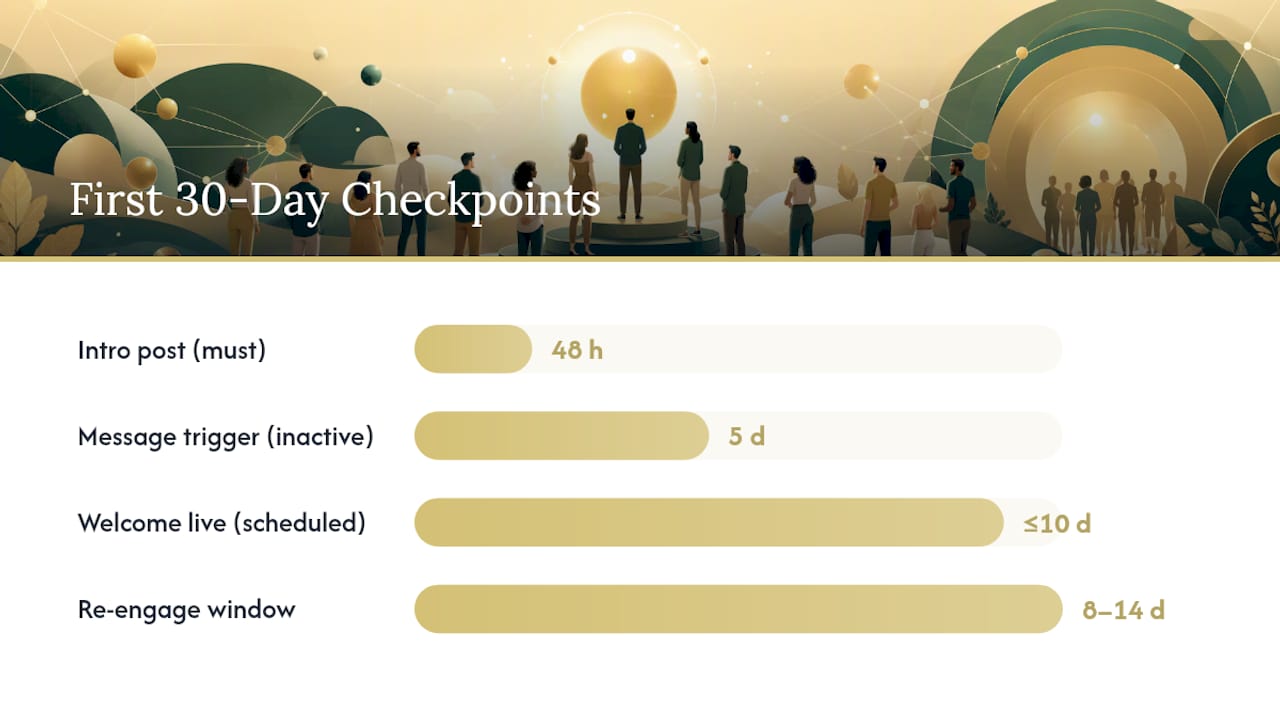
Pro Tip: Don’t wait until day 25 to check who’s gone quiet. Pull a list of members who haven’t logged in for five straight days and personally message them by day 10. A two-line “haven’t seen you around, everything good?” saves more renewals than any automated email sequence.
What Engagement Formats Actually Keep People Participating?
The formats that scale participation share one trait: they don’t depend on you showing up every single time. Build a repeatable calendar, and members start showing up for each other.
- Weekly rituals: an AMA, a wins thread, or a themed prompt that repeats every week so members know what to expect and when.
- Monthly rituals: a challenge, a live workshop, or a cohort kickoff that gives the calendar a bigger event to build toward.
- Small-group pods: breaking a large community into groups of six to ten keeps conversation from getting lost in a big feed and builds real accountability.
- Gamification done right: badges, levels, or early access should be earned through participation, not simply bought. Reserve paid perks for genuinely exclusive access, and use earned perks to reward the behavior you want more of.
- Member-led structures: invite advanced members to host a session, contribute a resource, or facilitate a pod. The moment members create value for each other, your job shifts from sole expert to facilitator, and retention gets far less dependent on your personal bandwidth.
The strongest paid membership programs mix earned perks with paid perks and layer in leveling systems precisely because that combination rewards activity, not just payment, which compounds lifetime value over pure content access.
How Do You Build a Revenue Stack Inside Your Community?
A single membership price caps your revenue per member. A revenue stack doesn’t. The pattern that works: free content pulls people in, a low-priced paid challenge converts warm leads, the core membership becomes the recurring backbone, and cohorts or high-ticket coaching sit at the top for the members who want more than the group can give them.
- Free acquisition layer: content, lead magnets, or a free community tier that grows reach without asking for money yet.
- Paid challenge: a short, cheap, outcome-focused offer (a 5 or 7 day challenge) that proves value fast and filters for buyers.
- Core paid membership: your recurring revenue engine, priced inside that $26 to $97 monthly band depending on your model.
- Cohort programs: time-boxed, higher-priced, and limited in seat count, which creates urgency without discounting.
- High-ticket offers: one-to-one coaching or intensive programs for the small percentage of members who want maximum access.
This kind of layered structure, moving members from free to challenge to membership to cohort to high-ticket, produces steadier lifetime value than a single flat price because every layer below feeds proof and prospects to the layer above. Limited cohort seats and outcome-first framing (results promised, not just access) are your strongest conversion levers when pushing members up the stack. Sponsorships and one-off paid events can add revenue too, but only introduce them once your core membership is stable. Bolting on a sponsor before you have retention figured out signals to members that you’re monetizing attention instead of building value.
What KPIs and Costs Determine If Your Community Is Sustainable?
Your costs are simpler than most creators expect: platform fees (usually $50 to a few hundred dollars a month depending on scale), whatever time or salary you put toward a community manager, and any ad spend you use to acquire new members.
The KPIs that matter most:
- MRR (monthly recurring revenue) tells you the size of the business, not just the size of the audience.
- Monthly churn tells you whether your retention playbook is working. Rising churn almost always traces back to a weak first 30 days.
- CAC payback period tells you how many months of membership revenue it takes to recover what you spent acquiring that member.
- Activation rate in the first week predicts churn before it happens.
- NPS or a simple satisfaction pulse tells you if members would recommend the community to a friend.
Hire a community manager once daily moderation eats more than a few hours of your own time. Invest in paid acquisition only after your onboarding and retention numbers are stable, otherwise you’re just paying to fill a leaky bucket faster.
How Money Plug Lab Supports a Managed Community Launch
Everything above works whether you build it yourself or bring in help, but building it alone means owning audience research, pricing, sales copy, launch campaigns, payment setup, and paid ads on top of actually running your community. That’s the gap Money Plug Lab was built to close.
The agency offers a revenue-share model with no upfront cost, handling full service including audience research, product architecture, pricing strategy, sales copy, video sales letters, launch campaigns, payment infrastructure, and paid advertising.
This approach aligns with the playbook in this article, including founding-member launches, pricing tier decisions, revenue stacking, and ad spending to fuel growth after retention is proven; such full execution is typically handled hands-on by specialized agencies serving creators in various markets.
The decision criteria are simple. If you have the time, the technical comfort, and the patience to run every piece of this yourself, DIY is a legitimate path, especially at the free or freemium stage. If you already have an audience and want someone else to carry the launch mechanics, pricing, and ad execution while you focus on the content and the community itself, that’s when a managed, revenue-share partner earns its keep.
What Legal and Terms of Service Basics Do Paid Memberships Need?
A paid community is a commercial product, and treating it casually on the legal side creates real exposure once money changes hands. At minimum, you need clear terms of service that spell out what members are paying for, refund policy, cancellation process, and rules for removal if a member violates community guidelines.
Membership terms should state pricing clearly, including whether founding-member pricing is locked for life or for a defined period, since ambiguity here is where most billing disputes start. If your community involves coaching, fitness, or wellness advice, add appropriate disclaimers making clear the content isn’t a substitute for professional medical or financial advice. Data handling matters too. If you’re collecting emails, payment details, or personal information through onboarding forms, your privacy policy needs to say plainly what you collect and how it’s used.
Payment processors like Stripe typically require a visible refund and cancellation policy before approving a subscription business, so this isn’t optional paperwork. It’s a launch requirement. Building these documents from a template is fine for most creators, but if your community touches regulated advice (health, legal, financial), it’s worth a short paid consultation with an actual attorney rather than guessing. The cost of fixing a dispute after the fact is almost always higher than the cost of getting the terms right before launch.
How Do You Handle Conflict and Keep the Community Healthy?
Every paid community eventually has a member who breaks the tone, whether through arguments, spam, or just relentless negativity. How you handle the first one sets the norm for everyone watching.
Publish clear community guidelines before you need them, not after the first incident, so enforcement never looks arbitrary. Set a private, direct process for handling complaints: a member reports an issue, you or a moderator addresses it privately first, and public callouts stay reserved for repeated or severe violations. A three-strike approach (private warning, temporary restriction, removal) gives you room to be fair without letting one person damage the group’s trust.

Moderator presence matters more than moderator rules. A community where a host or trained moderator is visibly active catches small tensions before they become public arguments. As communities grow past a hundred or so active members, self-moderation from senior members (the same people you should be turning into facilitators for engagement anyway) becomes essential, because you physically can’t read every thread yourself.
Community health also depends on removing people who don’t fit, even paying ones. A single toxic member who’s technically paying still costs you more in churn from everyone who leaves quietly than the subscription revenue they bring in. Refund them, remove them, and move on. Protecting the group’s tone is part of the product you’re selling.
Author Perspective: A Short Checklist for Deciding and Acting Now
Ask yourself three things. Do people already ask you questions you could answer once, inside a paid space, instead of repeatedly for free? Would 20 people pay before you’ve built anything, based on trust alone? Can you commit to a live touchpoint every week for the first two months?
If you answered yes to all three, start recruiting founding members this week, not after you’ve built the “perfect” product. The most common pitfall isn’t pricing or platform choice. It’s building six months of content before testing whether anyone will pay for month one.
— Money
How Money Plug Lab Turns This Playbook Into Revenue
Everything in this article works better with someone handling the mechanics while you handle the community itself. Money Plug Lab runs on a pure revenue-share basis, zero upfront cost, and takes on the parts that eat most creators’ time: pricing strategy, sales copy, launch campaigns, payment setup, and the paid advertising that fills your founding-member cohort fast.
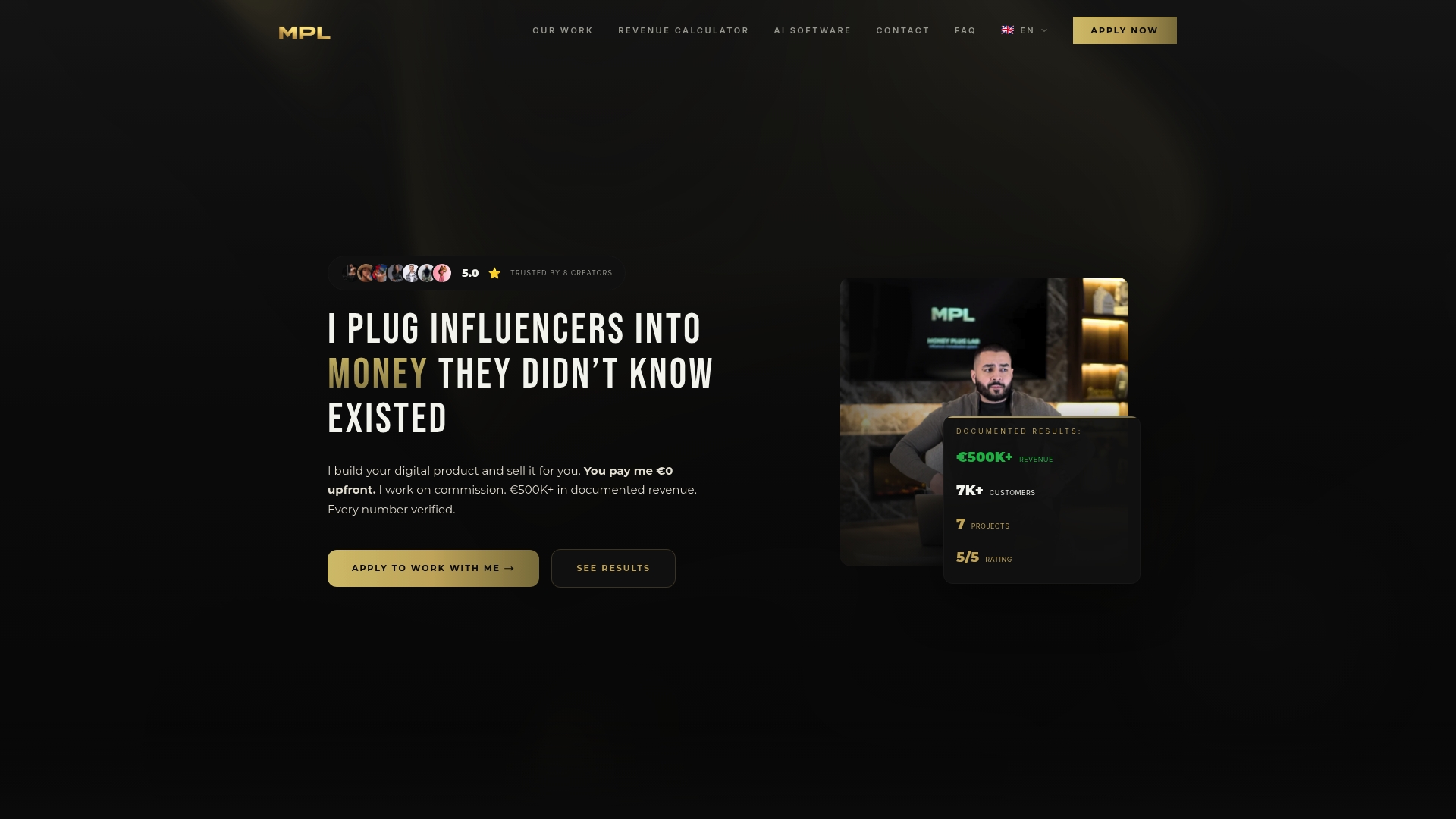
This fits best for creators who already have an engaged audience and want a hands-on partner to run the launch and ad side while they focus on content and coaching. Some specialized agencies have generated significant tracked revenue for creators across multiple launches, including programs achieving thousands of sales in a short period. If you’re ready to see whether a managed launch fits your community, check out PlugReach and start the conversation about what a founding-member launch could look like for your audience.
Sources
- How to build a winning paid membership program | Andreessen Horowitz
- How to Build A Paid Community That Makes Money | GreyJournal
- How to Build A Paid Membership or Community in 2026 | Digitenzy
- Membership communities vs subscription platforms | PeepSo
FAQ
What Are the 5 C’s of Community Engagement?
Definitions vary across sources, but a common version covers connection, communication, contribution, celebration, and consistency, reflecting the same ideas this article covers under onboarding, rituals, and member-led engagement.
What Are the Different Types of Online Communities?
Communities generally fall into categories like interest-based, action-based, place-based, circumstance-based, practice-based, and support communities, with paid membership models applying most cleanly to interest, practice, and support-based groups where members want ongoing access to expertise or peers.
What Are Some Ways to Make Money From a Community?
The most reliable paths are a recurring paid membership, paid challenges or workshops, cohort-based coaching programs, and high-ticket one-to-one offers, often layered together as a revenue stack rather than relying on a single price point.
What Are the Three C’s of Community?
A widely used shorthand is content, connection, and commerce, roughly mapping to what members consume, how they interact with each other, and how the creator monetizes the group.
How Much Should I Charge for a Paid Community?
Most successful paid communities charge between $26 and $97 per month, with content-heavy vaults trending lower and connection-heavy or cohort-based models trending higher.
Does Money Plug Lab Charge Upfront Fees?
No. Money Plug Lab works on a pure revenue-share basis with zero upfront cost, and current service details are available directly on the Money Plug Lab site.