Creators: Boost Course Launch ROAS 3–8x With Value Based Retargeting
Creators: Boost Course Launch ROAS 3–8x With Value Based Retargeting

The single biggest lever for course launch ROAS is bidding on later funnel stages, not leads. Feed your ad platform the real revenue value of applications, deposits, and enrollments instead of optimizing for cheap form fills, and cost-per-enrollment usually drops fast. Cold traffic still tends to land below 2x ROAS on a first launch, but retargeting can run 3 to 8 times higher once you’re uploading offline conversions and enrollment values consistently.
TL;DR:
- Bidding on downstream events like applications and enrollments with actual revenue values is crucial, as it shifts focus from volume to profitability.
- A hybrid launch model combining steady evergreen list building with targeted cohort pushes generally yields higher ROAS than pure evergreen or limited launches alone.
- Accurate offline conversion tracking using GCLID and platform-specific tools is essential for reliable measurement and effective value-based bidding.
- Campaigns need at least 50 valuable conversions monthly to optimize reliably with value-based strategies, and maintaining stable bid or value adjustments supports better ROAS.
- Building audience data before launch and sequencing retargeting based on audience engagement provides superior ROAS compared to broad prospecting alone.
Table of Contents
- What Drives Course Launch ROAS the Most?
- Should You Run an Evergreen, Cohort, or Hybrid Launch?
- How Do You Track Conversions Without Losing ROAS Accuracy?
- How Should You Structure Bidding and Campaigns for ROAS?
- Where Should Launch Ad Spend Go: Meta, Search, or YouTube?
- Which Retargeting Sequence Produces the Best ROAS?
- How Do Funnel and Pricing Decisions Change Your ROAS?
- How Do You Model Break-Even and ROAS Before You Launch?
- What’s the Week-by-Week Checklist to Protect ROAS?
- What Do Real Launch Numbers Actually Look Like?
- What’s the Practitioner’s Take on Launch ROAS?
- How Money Plug Lab Turns These Tactics Into Enrollments
- Sources
What Drives Course Launch ROAS the Most?
Course launch ROAS lives or dies on one decision: what event you’re telling the algorithm to chase. Most creators optimize toward “lead” or “checkout initiated,” which are cheap to trigger and terrible predictors of who actually pays. A course launch with strong lead volume and weak ROAS almost always traces back to this mismatch.
The fix is to bid on the outcomes that carry real dollar value: applications that convert to calls, deposits that convert to enrollments, enrollments that convert to paid-in-full students. When you upload those values back into Google Ads or Meta, the algorithm stops chasing volume and starts chasing revenue. That’s the core mechanic behind value-based bidding for course and bootcamp campaigns, and it’s the reason two launches with identical ad spend can produce wildly different profit.
None of this works without accurate tracking underneath it, and none of it works if your launch structure fights against the data you’re trying to collect. Those are the two threads this article pulls apart: how to choose a launch cadence that generates enough signal to optimize against, and how to build the measurement plumbing that makes value-based bidding possible in the first place.
Should You Run an Evergreen, Cohort, or Hybrid Launch?
Your launch structure sets the ceiling on your ROAS before you spend a single dollar on ads. Here’s the short version of each model:
- Evergreen: Enrollment stays open year round, driven by automated funnels and steady low-budget ad spend. ROAS tends to be stable but modest, because you’re always buying at market price with no urgency lever.
- Limited/cohort: Enrollment opens for a fixed window (often 5 to 14 days), tied to a start date or live cohort. ROAS spikes hard during the close, driven by scarcity and a compressed retargeting sequence, but spend has to ramp and fall off fast.
- Hybrid: An evergreen baseline runs quietly all year to build the email list and pixel data, then periodic cohort launches convert that warmed audience on a deadline.
The hybrid model tends to produce the best course launch ROAS of the three, and the reason is almost mechanical. A cohort launch with no evergreen backbone has to build its entire audience from cold traffic in a few weeks, which means your retargeting pools are thin and your average cost-per-lead is high going in. An evergreen baseline running at a steady modest daily budget for months feeds a warm list that a cohort launch can then activate on a deadline. That combination is what Meta’s recommended approach for course creators is built around: steady list building at low spend, then a 3 to 5 times scale during the actual launch window.
How do you decide which model fits your situation? A few practical filters help:
- List size. Under a few thousand engaged subscribers, cold cohort launches will struggle to hit break-even fast enough. Build evergreen first.
- Historical conversion rate. If a past launch converted leads to buyers at a healthy clip, a repeat cohort launch is lower risk than experimenting with evergreen from scratch.
- Average order value. Higher-ticket programs (above roughly $1,500) usually justify the operational overhead of a cohort launch with live urgency and sales calls. Lower-ticket, self-serve courses often do better evergreen, where the sales process doesn’t need a human touch.
- Your capacity to support live cohorts. Cohort launches demand real-time customer support, onboarding, and often live teaching. If you can’t staff that for two weeks straight, evergreen or hybrid keeps operations sane.
One pattern worth naming directly: a hybrid structure preserves list health while dramatically improving launch ROAS compared with cold-only ramps, because you’re never asking a brand-new audience to make a buying decision under a deadline. They’ve already seen your content for weeks or months before the countdown clock appears.
How Do You Track Conversions Without Losing ROAS Accuracy?
Cost-per-lead is close to a meaningless metric for launch profitability, because it stops measuring at the exact point where most of your revenue risk lives. A $12 lead that never books a call is worse than a $40 lead who enrolls, and reporting that only tracks the front end will tell you the opposite.
The events that actually predict revenue sit downstream: application submitted, call booked, call completed, deposit paid, enrollment finalized, payment plan completed. Each of those needs a dollar value assigned and reported back to your ad platform, or you’re optimizing blind.
Here’s the setup sequence that gets you there:
- Capture the GCLID at the moment of lead form submission. This is the click identifier Google Ads generates, and it’s the thread that connects an ad click to everything that happens after. Miss this step and offline conversion uploads have nothing to attach to.
- Store the GCLID in your CRM alongside the lead record. Most CRMs (HubSpot, GoHighLevel, Kajabi with a connector) support a custom field for this. It has to survive the handoff from ad platform to sales pipeline intact.
- Upload outcomes back to the platform as they happen. When a lead pays a deposit or completes enrollment, that event gets uploaded with its GCLID and dollar value, closing the loop between ad spend and real revenue.
- Use enhanced conversions as a fallback for missed GCLIDs. Hashed email and phone matching catches conversions where the click ID didn’t get captured cleanly, which happens more often than most creators expect, especially on mobile.
- Respect the 90-day conversion window. Google’s default lookback is 90 days, meaning any outcome recorded after that point won’t attribute back to the original click. If your sales cycle from lead to enrollment runs longer than three months, you need to bid heavier on the mid-funnel stages that land inside that window, like application or deposit, rather than waiting for final enrollment to show up in reporting.
Pro Tip: Map every stage of your funnel to a rough dollar value before launch, not during it. If you’re assigning values reactively while the campaign is live, you’re already bidding on guesses instead of data.
There’s a deadline attached to this that’s easy to miss if you’re not deep in ad platform documentation: Google’s enhanced conversions requirements tighten in June 2026, and campaigns still relying on basic conversion tracking will see measurement gaps widen. The practical checklist to stay compliant:
- Confirm your CRM or landing page tooling supports GCLID capture natively, or add a hidden field that pulls it from the URL parameter.
- Set up enhanced conversions for leads (hashed email/phone) as a redundant layer, not a replacement for GCLID tracking.
- Test your offline conversion upload format against Google’s schema before your launch, not during it.
- If you’re running Meta alongside Google, verify your CAPI (Conversions API) setup is passing the same downstream events, since Meta’s pixel alone misses a growing share of events due to browser restrictions.
A tool like Hyros or Triple Whale can automate a lot of this GCLID capture and offline upload plumbing if you’d rather not build it manually inside your CRM.
How Should You Structure Bidding and Campaigns for ROAS?
Value-based bidding only works if the values you feed it reflect reality, and building those values starts from the end of the funnel and works backward. Take your average enrollment value (say $1,800 for a mid-priced program), then assign fractional values to earlier stages based on their historical conversion rate to enrollment.
That backward math is what lets Google or Meta’s algorithm treat a $40 application the same way it would treat a $540 sale in terms of optimization signal, because you’ve told it what that application is statistically worth.
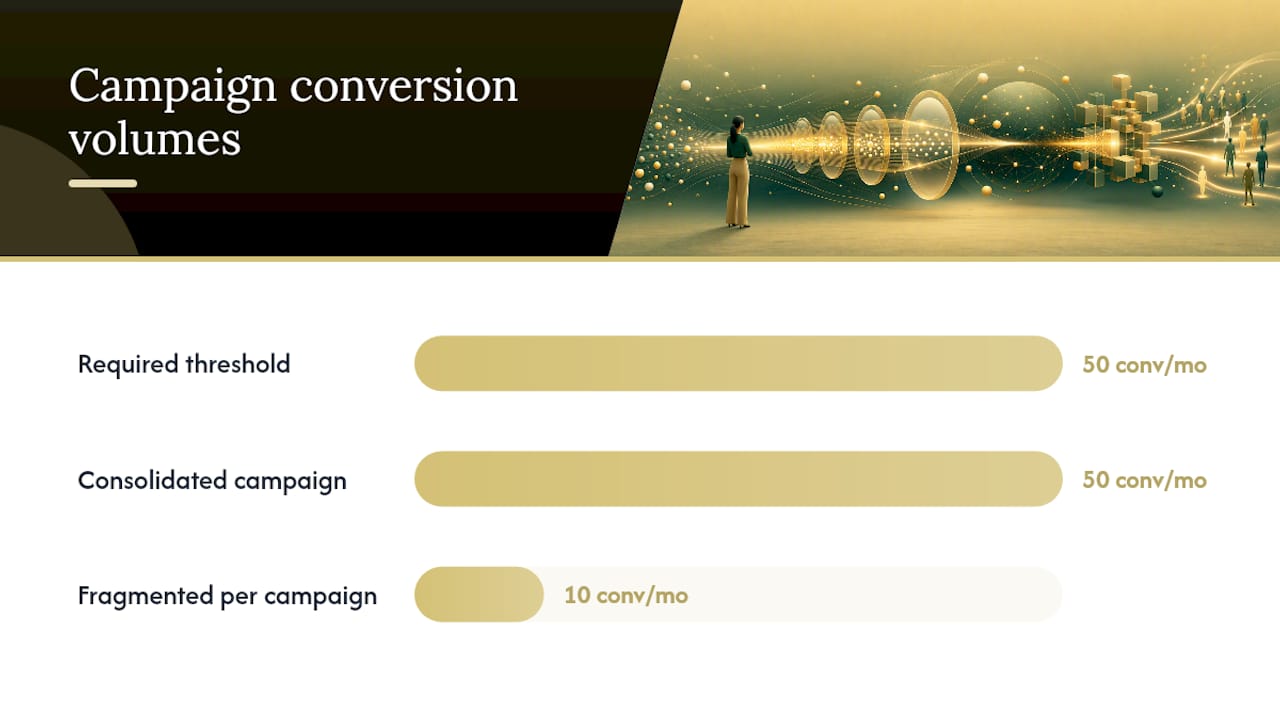
There’s a volume threshold that matters here, and it trips up a lot of creators who switch to value-based bidding too early. Both platforms need roughly 50 valued conversions a month per campaign to optimize reliably. Below that, the algorithm doesn’t have enough signal and performance gets erratic. If your funnel isn’t generating that volume yet, stack values across broader event categories (all applications, regardless of source) rather than fragmenting into narrow campaigns that each starve for data.
That threshold has a direct implication for campaign structure:
- Consolidate before you fragment. Five campaigns each getting 10 valued conversions a month will underperform one campaign getting 50, even with identical total spend, because the algorithm needs concentrated signal to learn.
- Respect the learning period. Every time you make a major change (new bid strategy, new value structure, new audience), the campaign resets its learning phase, typically 1 to 2 weeks of unstable performance before it stabilizes.
- Limit bid or value adjustments to roughly ±25% at a time. Bigger swings retrigger a fuller learning reset, which is the fastest way to torch a launch week’s ROAS chasing a false optimization.
- Avoid daily tinkering. Checking a value-based campaign every 24 hours and adjusting based on single-day noise is one of the most common ways creators sabotage their own bidding algorithm mid-launch.
Pro Tip: If you’re not yet hitting 50 valued conversions a month, don’t switch to strict target ROAS bidding. Run a maximize-conversion-value strategy with no target first, let the platform gather signal, then layer in a target once volume supports it.
Practical guardrails around consolidation and bid change frequency matter more during a launch than almost any other point in the year, because launch week is exactly when creators are most tempted to make daily changes chasing daily numbers.
Where Should Launch Ad Spend Go: Meta, Search, or YouTube?
Each channel plays a different role in launch ROAS, and treating them interchangeably wastes budget. Meta builds the list and nurtures mid-funnel engagement at a low cost per lead. Search captures people already searching with buying intent, which spikes hard around your launch deadline. YouTube works best for awareness and teaching content that primes cold prospects before they ever see an ad asking for money.
The sequencing that tends to work: build audience and warm the list on Meta for weeks or months before the launch, then let Search catch the deadline-driven intent that shows up in the final days.
A starting allocation that reflects this:
- Meta: 45 to 55% of budget. This is your list-building and mid-funnel workhorse, running steady during evergreen periods and scaling 3 to 5 times during the actual launch window, in line with Meta’s recommended campaign structure for course creators.
- Search: 25 to 35% of budget. Concentrated in the final week to 10 days, when branded and category searches spike as your deadline approaches.
- YouTube: 10 to 20% of budget. Best used earlier in the cycle for awareness, teaching-style pre-roll, and retargeting sequences built from video view audiences.
- Performance Max: variable, added later. Only turn this on after you’ve been uploading enrollment values for at least a few weeks. Feed it offline conversion values from the start, exclude branded search terms so it doesn’t cannibalize traffic you’d get for free, and expect it to behave unpredictably if launched cold with no value history behind it.
Cold audience ROAS during a first launch typically stays under 2x, sometimes well under, and that’s a normal, expected outcome rather than a sign something’s broken. Warm audiences, by contrast, routinely return several times that. The gap between those two numbers is the entire argument for spending months building list and pixel data before you ever expect a launch to be profitable on cold spend alone.
Which Retargeting Sequence Produces the Best ROAS?
Retargeting is where course launch ROAS actually gets won, and the audience hierarchy matters more than most creators realize. Someone who watched 75% of your webinar is a fundamentally different prospect than someone who clicked an ad three weeks ago and never opened an email since, but a lot of retargeting campaigns lump them into one audience and wonder why performance is inconsistent.
Priority order, roughly: webinar attendees and completers first, then email openers and clickers, then landing page visitors who didn’t opt in, then video view audiences from your awareness content, then general website visitors. Each tier down the list costs more to convert and returns a lower ROAS, which is exactly why retargeting typically converts 3 to 8 times better than cold prospecting but performance still varies enormously within “retargeting” as a category.
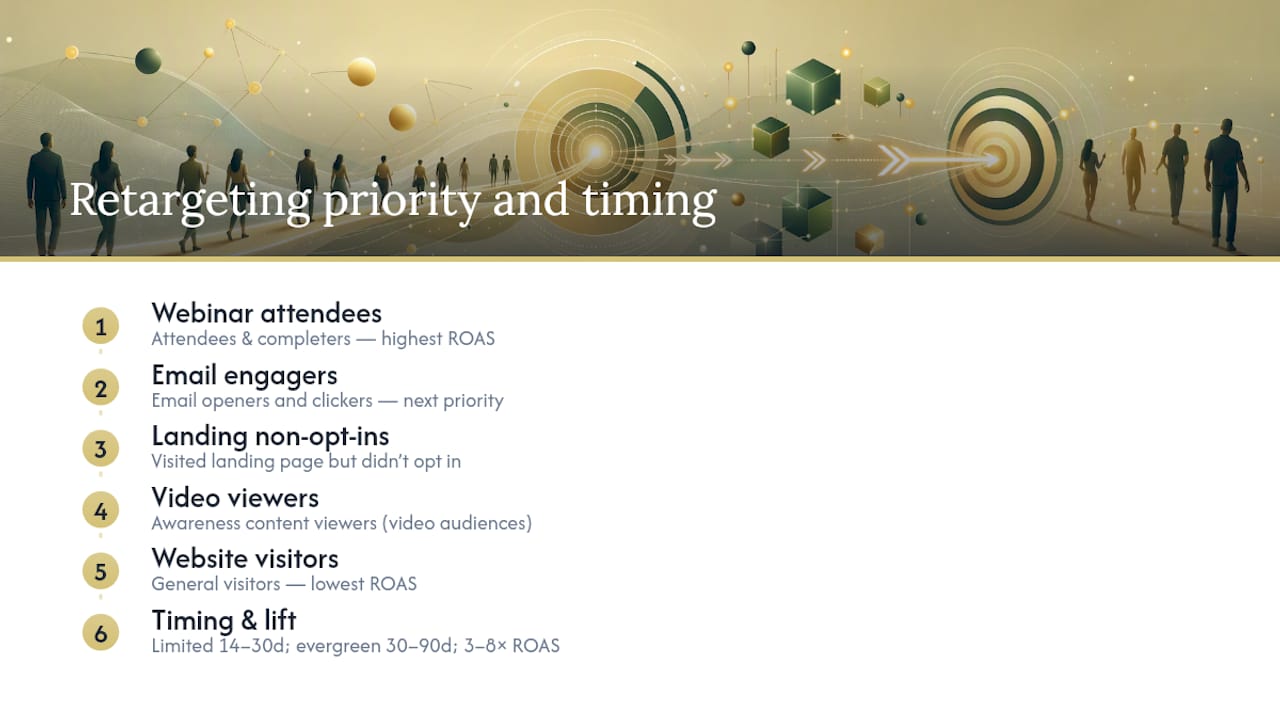
Window length depends on your launch structure. A limited cohort launch should run retargeting windows of 14 to 30 days, tight enough that the audience still remembers your ad. An evergreen funnel can stretch that to 30 to 90 days, since there’s no deadline pressure forcing a shorter attention span.
Creative sequencing during a launch usually follows a pattern: open with teaching content that delivers a real insight, follow with a webinar or masterclass invitation, layer in testimonial or results-based proof once they’ve engaged, then close with a deadline-driven urgency piece in the final 48 to 72 hours. Skipping straight to the urgency pitch on someone who’s never seen your teaching content is the single fastest way to burn a warm audience’s goodwill.
Budget allocation for retargeting overall should sit at a quarter to two-fifths of total ad spend during a launch, with the remainder going toward cold prospecting to keep the top of funnel fed for the next cycle.
How Do Funnel and Pricing Decisions Change Your ROAS?
Every dollar of revenue per click you can add without raising ad spend flows directly into your ROAS number, and offer architecture is where most of that upside hides. A tripwire, low-ticket offer priced anywhere from $17 to $47, gives cold traffic a low-friction first purchase that partially or fully funds the ad spend that acquired them, while simultaneously building your email list with buyers rather than freebie-seekers.
One documented example makes the mechanic concrete: a $27 tripwire course generated $30,000 in about 41 days with a reported ROAS of 2.5, driven partly by a checkout conversion rate in the 35 to 41% range and a one-click upsell converting at 23%. That upsell lifted average order value meaningfully above the $27 sticker price, which is the real lesson: the front-end offer doesn’t need to be the profit center if the upsell sequence is doing its job.
A few pricing shapes that tend to help launch ROAS specifically:
- Deposits instead of full payment upfront. Lowering the initial commitment increases top-of-funnel conversion, and you’re only bidding on deposit value anyway if your tracking is set up right.
- Payment plans. Splitting a $2,000 program into four payments of $500 often converts noticeably better than the lump sum, without changing total revenue per enrollment.
- Limited seats or cohort caps. Real scarcity, not manufactured, gives retargeting creative a legitimate urgency angle in the final days.
Pro Tip: Scarcity only helps ROAS when it’s true. A “closing soon” message on an evergreen funnel that reopens next week trains your list to ignore your deadlines, and that erosion shows up as declining open and click rates on every future launch.
How Do You Model Break-Even and ROAS Before You Launch?
Modeling break-even before spending a dollar on ads keeps a launch’s ROAS expectations grounded in your actual numbers instead of hope. The essential inputs are price, total ad spend budget, production cost, email list size and its conversion rate, average cost-per-click, ad-driven conversion rate, and platform or payment processing fees.
The step most people skip is weighting earlier funnel values by their real downstream conversion rate rather than treating every lead as equally valuable, which is the same value-based bidding logic applied to your own planning spreadsheet before it ever touches an ad platform.
A simplified worked example: a $997 course, $5,000 ad budget, average CPC of $1.20, and a 2% ad-to-sale conversion rate. That budget buys roughly 4,166 clicks, which at 2% conversion produces about 83 sales, or $82,751 in gross revenue against $5,000 in spend.
That example is optimistic on purpose, to show the mechanic. In practice, most first-time launches don’t clear 2x ROAS on cold ads alone, and email or owned-audience revenue often accounts for the majority of launch profit rather than paid traffic. Running your own numbers through a break-even calculator built for course launches before committing budget lets you stress-test conversion rate assumptions instead of discovering they were wrong mid-launch.
The modeling mistakes that wreck projections most often:
- Assuming a cold-traffic conversion rate that matches your warm email list’s historical performance.
- Ignoring email and owned-audience revenue entirely, which understates total launch ROAS and can make a genuinely profitable launch look like a failure on the ad platform’s numbers alone.
- Failing to account for refunds and payment plan drop-off when calculating net revenue against ad spend.
What’s the Week-by-Week Checklist to Protect ROAS?
Protecting ROAS through a launch comes down to sequencing your operational work so tracking and creative are ready before spend ramps, not scrambling to fix them mid-flight.
- Pre-launch (2 to 4 weeks out): Confirm pixel and GCLID capture are firing correctly, seed retargeting audiences with teaching content, produce enough creative variations to avoid fatigue, and map every funnel stage to a dollar value for bidding.
- Launch week 1 (cart open): Ramp Meta spend 3 to 5 times your evergreen baseline, layer Search spend in as deadline searches begin appearing, rotate creative every 3 to 5 days to fight fatigue, and upload offline conversions daily without exception.
- Launch week 2 (final push and close): Shift retargeting creative toward testimonials and urgency, tighten retargeting windows, and keep bid or value adjustments within that ±25% guardrail even under pressure to chase last-minute numbers.
- Post-launch reconciliation: Calculate true cost per enrolled student (not per lead), review cohort fill rate against your break-even model, and break out ROAS by audience layer, cold versus warm versus hot, to see exactly where the launch actually made its money.
Scale spend when a layer is holding ROAS above your break-even target with enough volume to trust the signal. Pause or cut a layer when cost-per-enrollment climbs well past your modeled break-even for two consecutive days with no recovery, rather than waiting out a full week hoping it corrects itself.
What Do Real Launch Numbers Actually Look Like?
Those aren’t outlier claims pulled from a single lucky week. They come from applying the same mechanics covered above: value-based bidding, disciplined offline conversion uploads, and retargeting sequences built around actual audience temperature rather than guesswork.
One recurring lesson across those launches maps directly to the measurement section above. A campaign that looked mediocre on cost-per-lead was actually one of the strongest performers once deposit and enrollment values got uploaded and bidding shifted to optimize against them, because the algorithm had spent weeks chasing a cheap-lead objective that had almost nothing to do with who actually enrolled.
The pattern shows up almost every time a creator hands us a launch that “isn’t working”: the ad account is optimizing for the wrong event, and nobody’s told the algorithm what a real customer is worth.
The most common measurement mistake the agency sees isn’t a broken pixel. It’s incomplete offline conversion mapping, where GCLIDs get captured but the loop back to the ad platform breaks somewhere between the CRM and the final enrollment record, quietly starving the bidding algorithm of the exact signal it needs to work.
What’s the Practitioner’s Take on Launch ROAS?
Bid on value, not volume. Upload every outcome you can track, not just the ones that are convenient. Consolidate campaigns for signal rather than fragmenting them for tidy reporting. And once a campaign is optimizing correctly, leave it alone more than instinct tells you to.
The mistakes I see most often aren’t exotic. A creator switches to target ROAS bidding at 15 valued conversions a month, watches performance wobble, and blames the algorithm instead of the volume threshold. A third checks the ad account three times a day during launch week and adjusts bids on single-day noise, resetting learning every time performance dips for one afternoon.
The habit that fixes most of this: map your funnel values before launch, upload conversions daily without fail, check performance on a 3 to 4 day cadence instead of hourly, and trust the data enough to let campaigns run through a full learning cycle before touching them again.
— Money
How Money Plug Lab Turns These Tactics Into Enrollments
Everything above works better with a team building the tracking, offer, and creative around it rather than bolting value-based bidding onto a funnel that was never designed for it. Money Plug Lab is the option for creators who’d rather hand off the plumbing than build it themselves: no upfront cost, pure revenue share, and the agency only earns when your launch does. That structure means the incentive to get offline conversion tracking, value mapping, and retargeting sequencing right isn’t theoretical. It’s tied to the same number this article has been walking through.
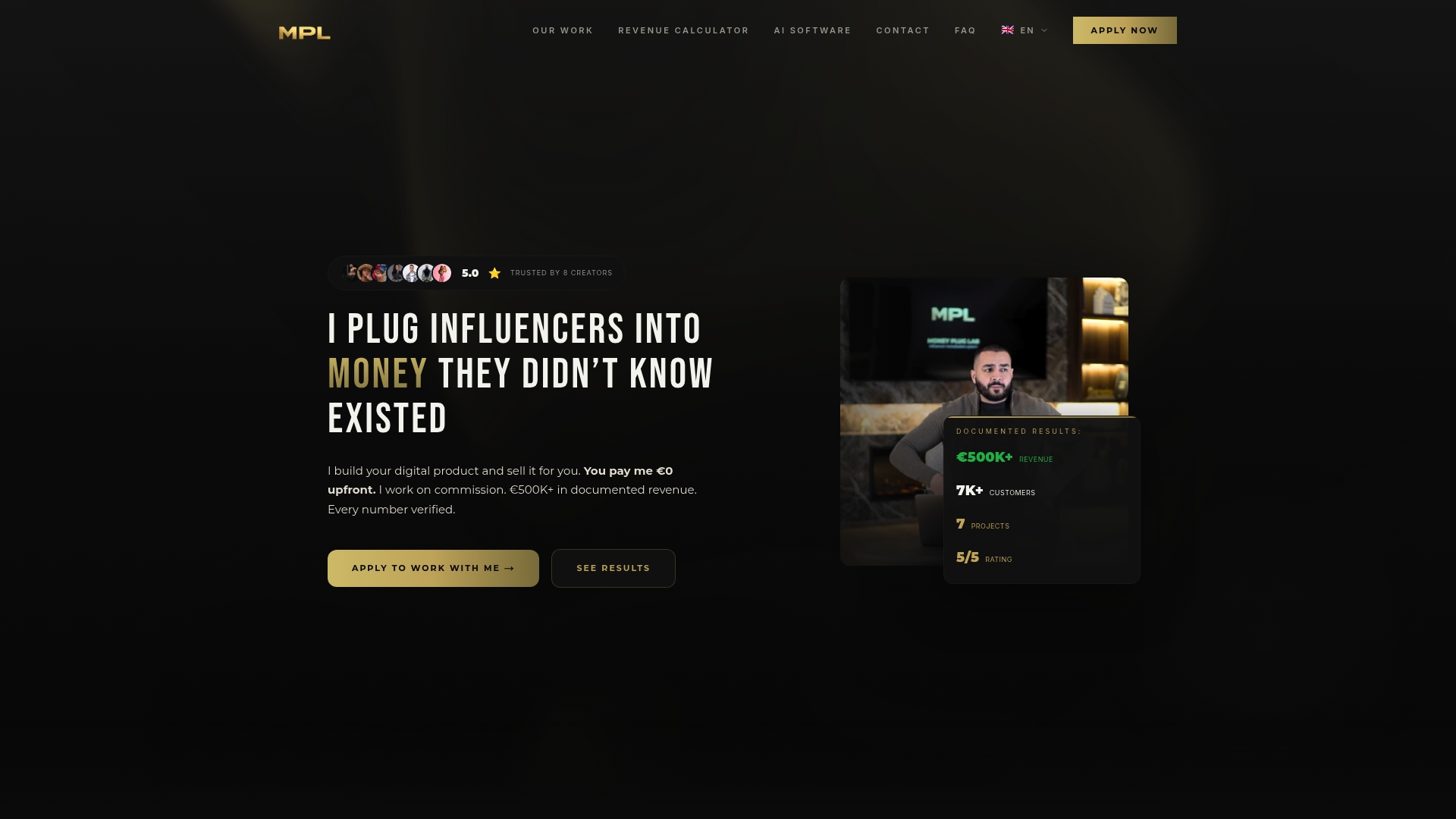
The team handles audience research, product architecture, pricing strategy, sales copy, video sales letters, launch campaign management, payment infrastructure, and the paid advertising post-production work that sits behind every tactic covered here. A discovery call walks through your current funnel, where your tracking gaps are, and whether your list and offer are ready for a launch built around value-based bidding rather than cheap leads. Start there: visit the Money Plug™ landing page and book a call to see what a launch built for ROAS from day one looks like for your program.
Sources
- Google Ads for bootcamps (NN Partners)
- Course launch break-even calculator — Kompozy
- Meta ads for online courses: the full-funnel enrollment engine — AdBloom