Regional Pricing Strategy: How to Set Prices by Market
Regional Pricing Strategy: How to Set Prices by Market

A regional pricing strategy means charging different prices for the same product in different places, based on what each market can pay and what it expects to pay. For a creator selling a course, coaching program or paid community, the practical version is simple: group countries into a few price bands, set one price per band, charge by the buyer’s billing country, and review the results every quarter. Showing a converted price in a local currency is not the same thing, and the difference matters for your revenue.
TL;DR
- Regional pricing changes what a market is charged. Currency conversion only changes how the same price is displayed.
- Use a small number of bands (three or four), not a custom price for every country.
- Research income levels, local competitor prices and your own analytics before you pick numbers.
- Tie the price to the billing country or card country, not only to the visitor’s IP address, to limit VPN abuse.
- Start with a few markets, track conversions and revenue, then expand.
Table of Contents
- What regional pricing is, and what it is not
- Why it matters for creators selling digital products
- Examples of regional pricing for digital products
- How to research your markets
- Build bands, not a price for every country
- Set up the payment side properly
- Protect the system from abuse
- Roll out in stages
- Measure whether it works
- Regional pricing for membership and recurring offers
- Our perspective
- Work with us on your pricing and launch
- FAQ
- Sources
What regional pricing is, and what it is not
Geographic pricing, also called regional pricing, is charging different prices in different locations to reflect differences in demand, income, local competition and operating costs. A creator who sells one program at one price worldwide is using uniform pricing. A creator who sells the same program at a lower price in markets with lower incomes, and the full price in wealthier ones, is using regional pricing.
The confusion usually comes from currency. A checkout can display your base price in euros, Swiss francs or Bosnian convertible marks through automatic conversion. Paddle’s documentation explains that this keeps the underlying base price intact. Localizing the currency solves clarity, foreign exchange fees and payment approval problems. It does not make the offer more affordable. Country-specific prices are the tool that addresses purchasing power and willingness to pay.
There is also a stability difference. Waffo’s documentation notes that a uniformly priced product shows local amounts that move with exchange rates, while per-country prices show fixed local amounts. Fixed amounts are easier to sell. A buyer in Zagreb who sees the same round number every week trusts it more than one that drifts by a few cents.
You can and often should use both. Convert for clarity, then set the commercial price for each region on purpose.
Why it matters for creators selling digital products
Digital programs have almost no marginal cost per buyer. Serving one more person in Sarajevo costs about the same as serving one more in Zurich. That is why creator products are a natural fit for regional pricing: the price can follow the buyer’s means without hurting your cost structure the way it might for a physical product with shipping and import costs.
The other reason is audience geography. Many creators have followers split across home markets and diaspora communities. A Balkan fitness creator, for example, might have buyers in Bosnia, Serbia and Croatia, and a second group living in Germany, Austria and Switzerland. One flat price will either be too high for the first group or leave money on the table with the second.
Pricing consultancy Simon-Kucher points out that geographical pricing helps maximize profit and accessibility, but only when you manage differences in competitive landscapes and in how customers use the product in each region. That is the real work: not discounting, but understanding each market.
Examples of regional pricing for digital products
Real examples help you see the shapes this takes.
A course creator with discounts by location. Kevin Markham of Data School offers online courses with discounts from 25% to 75% depending on the buyer’s location. The discount reflects average purchasing power compared with the US, and a banner appears automatically for visitors in qualifying countries.
A published tier ladder. One practitioner’s course was offered at $50 in Switzerland or Denmark, $25 in Romania or Albania, and $5 in Somalia or Liberia. It is an extreme spread, and a useful reminder that the lowest tier is a business decision, not a formula.
A software company with three tiers. Evernote built a three-tier structure: list price for English-speaking countries and the DACH region, two thirds of that for Japan and EMEA, and half for China and Latin America. The tiers came from measuring regional willingness to pay, user activity and conversion rates, not from guesswork.
A subscription giant. Streaming is the best-known consumer case. One creator’s write-up cites a standard Netflix plan at roughly $13.80 a month in Germany against $6.02 in India. Treat figures like these as a snapshot, since subscription prices change often.
Notice what the examples share. Each uses a handful of levels. None prices every country individually.

How to research your markets
Good regional prices start with data, not instinct. Work through four inputs.
1. Income and purchasing power
Start with a purchasing-power benchmark. The team at Drupalize.Me used World Bank price-level data and Google Analytics, looking for countries with heavy site use but no paying users. Then they grouped countries into three discount tiers instead of calculating a rate for each one. That analytics filter is useful for any creator: it shows where you have an audience that cannot yet buy at your current price.
2. Local competitor prices
Stripe advises auditing demand, local competitor pricing and average income in each target market before you set anything. For a creator, “competitors” means the realistic alternatives your buyer has: a local gym membership, an in-person coach, a free YouTube channel, another creator’s program. Write down what each costs in local currency. Your price should make sense next to those, not next to a US benchmark.
3. Willingness to pay
If you have enough volume, measure it. Practitioners such as Ian Clark recommend Van Westendorp or conjoint studies to measure willingness to pay by geography rather than guess. Most creators launching a first product will not run a conjoint study. A short survey to your list in each region, asking what price feels too cheap, fair, expensive and too expensive, gets you a useful approximation.
4. Your own audience behavior
Look at where your followers, email subscribers and past buyers live. A market with 3% of your audience will not justify its own price band. A market with 25% might.
Build bands, not a price for every country
The most repeated advice across practitioners is to keep the structure small. Membergate recommends a few regional bands instead of a price for every country, comparing the cost of realistic local alternatives and using clean rounded prices.
Here is an illustrative structure for a creator with a base price of 100 in the home currency unit. These percentages are a planning example, not a benchmark, and you should replace them with your own research.
| Band | Example markets | Share of base price | Why |
|---|---|---|---|
| 1 | Germany, Austria, Switzerland, US | 100% | Highest incomes, diaspora with strong earning power |
| 2 | Croatia, Slovenia | 70% | Mid-range incomes, strong regional ties |
| 3 | Serbia, Bosnia and Herzegovina, North Macedonia | 45% | Lower local incomes, price-sensitive buyers |
Then set rounding rules. Pick clean local numbers (for example 49 or 29 rather than 47.83) so the price looks deliberate. Decide once and apply the same rule in every band.
Finally, define your guardrails before you launch: the lowest price you will accept, the number of bands you will support, and who is eligible. A floor protects your margin, particularly once you account for ad spend and payment fees.

Set up the payment side properly
Pricing and payment are one decision. A great price table fails if your checkout cannot charge it.
- Local currencies and overrides. Use a checkout that supports local currencies and country-specific price overrides. Paddle’s documentation also advises letting customers choose their country at checkout.
- Transparent display. Show both the local price and your base currency so buyers are never surprised. A technical guide from PurchaseParity lists IP geolocation, multi-currency payments and clear display of both currencies as the usual building blocks.
- Payment methods. Markets with constrained purchasing power may need different payment arrangements, so decide what to charge and how to collect it together. For a premium program, an installment option in a lower band can matter as much as the headline price.
This is also where many first launches stumble. If you want a deeper look at keeping checkout smooth, our payment processing optimization articles cover it in detail.
Protect the system from abuse
The main risk is arbitrage. Stripe notes that a primary risk is users in high-price regions using VPNs to appear to be in low-price regions, and that companies often respond by binding the price to the billing address or the country of the payment method.
Membergate gives the same guidance: check the card’s country or billing address instead of relying only on visitor geolocation. In practice:
- Use IP detection to show a likely price, as a convenience.
- Confirm the price at payment using the card’s country or billing address.
- Keep an eye on unusual patterns, such as many low-band purchases with cards issued elsewhere.
You will never remove abuse entirely. The goal is to make it inconvenient enough that it stays a small share of sales.
Roll out in stages
Do not launch twenty markets at once. Drupalize.Me started with a limited set of countries, tracked participation and planned to expand if the system worked. That is a sensible pattern for a creator too.
A staged plan could look like this:
- Choose your two or three largest non-home markets by audience size.
- Set a price band for each, with a floor.
- Launch to a defined cohort, such as one email list segment or one ad campaign.
- Compare conversion rate and revenue per visitor against your base-price market.
- Add markets only after the first ones are stable.
Vlad Sedenko describes a similar phased approach: research first, rules design next, then bounded cohorts to limit risk. He also flags managing migration for existing customers. If people already paid the full price, decide in advance how you will treat them, so a lower price in their country does not feel like a betrayal.
Notion Mastery runs its parity pricing with a custom spreadsheet system that pulls currency data and recalculates purchasing-power percentages, reviewed every quarter. A quarterly review is a good rhythm for a creator as well: frequent enough to catch currency moves, rare enough to avoid constant changes.
Measure whether it works
Track four numbers per region:
- Conversion rate from page visit to purchase
- Revenue per visitor (this matters more than conversion alone, because a lower price can raise conversion while lowering revenue)
- Refund rate
- Share of sales from VPN-suspect or mismatched-card purchases
Published results are encouraging but come from vendors and should be treated as illustrations. A guide from PurchaseParity reports a small SaaS product with 43% more conversions from India and Brazil and 38% higher overall revenue, and a meditation app with 67% more subscription revenue over six months after PPP-based pricing across 15 countries. Your results depend on your audience, so run your own comparison against your own baseline.
If a band converts well but brings little revenue, raise it. If it converts poorly even at a deep discount, the problem may be the offer, the language or the trust signals, not the price.
Regional pricing for membership and recurring offers
Recurring products add a wrinkle: a price you set today is a price you may honor for years. For paid communities and memberships, set the band carefully and tie each tier to outcomes the member can feel. We cover that in our guide to membership pricing strategy, including how to test for churn. Regional bands then become a layer on top of a price you already trust.
Our perspective
We work with creators in the Balkans and the Balkan diaspora, so regional pricing is not theory for us. It is the first question that comes up when a creator with a large Instagram following has never sold anything.
Our view is that the price should be built around the audience you actually have. In Southeast Europe, audiences are highly engaged and the cost of acquiring a buyer is a fraction of Western markets. A creator who prices only for Germany or the US ignores the people who already watch every story. A creator who prices only for the home market underprices the diaspora in DACH. Two or three bands, tested on a real launch, is how we approach it.
We work on a pure revenue share basis with zero upfront cost, which means we only earn when your price converts. That keeps us honest about the numbers. Our creators have generated over $500,000 in tracked revenue across seven launched programs, including a single launch with more than 3,000 sales in ten days and a campaign that returned 18x on ad spend. Pricing, sales copy, video sales letters, payment setup and paid ads are handled together, because a good price table does nothing if the page and checkout do not carry it.
Money
Work with us on your pricing and launch
If you have an audience but no product yet, you do not need to solve audience research, pricing, copy, payments and ads alone. Money Plug Lab partners with creators to build, launch and scale paid programs, from fitness and coaching to beauty, nutrition and paid communities. We work on revenue share with no upfront cost to you, and we set regional prices as part of the launch plan.
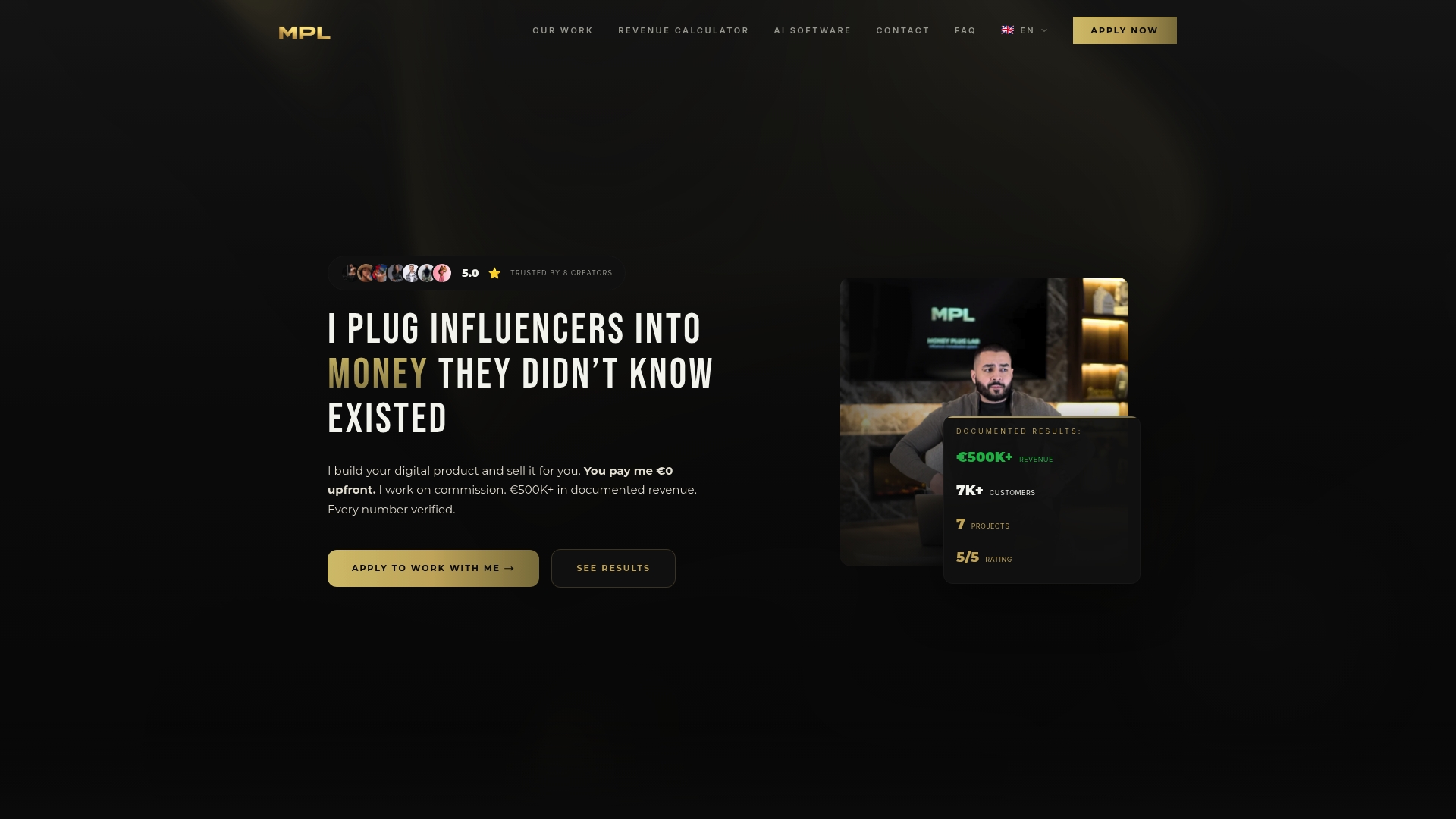
See how our digital product monetization service works and tell us about your audience.
FAQ
What is the difference between regional pricing and currency conversion?
Currency conversion shows the same price in another currency using exchange rates. Regional pricing sets a different price for a market based on factors such as income, demand and competition. Both can be used together, but only regional pricing changes how affordable the offer is.
How many price tiers should I use?
Use as few as your research supports, usually three or four. Practitioners consistently recommend grouping countries into bands rather than pricing every country, as in the three-tier Evernote structure and the three discount tiers used by Drupalize.Me. Fewer tiers are easier to explain, test and maintain.
Will people use a VPN to get the lower price?
Some will. The common safeguard is to bind the price to the billing address or the country of the payment method, rather than relying only on IP location. This keeps abuse limited without making honest buyers jump through hoops.
Is regional pricing fair to buyers in higher-price markets?
Most buyers accept it when the logic is clear: prices follow local incomes and local alternatives. Be transparent at checkout, show the local price clearly, and decide in advance how you will treat existing customers who paid more earlier.
Sources
- How to use geographic pricing, Stripe
- Localize prices, Paddle documentation
- Pricing currency strategy, Waffo documentation
- Unlocking the Potential of Geographical Pricing, Simon-Kucher
- Why I offer location-based pricing for my courses, Data School
- Implement PPP fair pricing for your product
- How to: set international prices, Crescendo Partners
- Parity Pricing: My Experience as an Online Course Creator
- Experimenting with Purchasing Power Parity, Drupalize.Me
- Regional pricing for members in different countries, Membergate
- The Complete Guide to Regional Pricing for Digital Products, PurchaseParity
- Regional Pricing, UPG Reference
- Localized pricing, Vlad Sedenko
- Parity Pricing for Students Worldwide, Notion Mastery
- Regional pricing vs currency conversion, Evendeals