Warm vs Cold Traffic: What It Means for Creators
Warm vs Cold Traffic: What It Means for Creators

Warm traffic is people who already know you: followers, email subscribers, past visitors and anyone who has engaged with your content. Cold traffic is people who have never heard of you. The difference matters because the two groups need different messages, different offers and different expectations. A creator who pitches a paid program to strangers the way they would to loyal followers usually gets silence, and the fix is rarely a better ad. It is a better match between audience temperature and what you ask for.
TL;DR
- Cold traffic has no history with you. Warm traffic has seen, followed, clicked or joined something of yours. Hot traffic is ready to buy.
- Cold audiences need an introduction and a free win. Warm audiences need proof, specifics and a clear next step.
- Check behavior to tell them apart: repeat visits, comments, saves, DMs and returning viewers signal warmth.
- Plan a warm-up of roughly 3 weeks to 3 months before a launch, depending on how engaged your audience already is.
- Run two tracks at once: keep bringing in strangers while you nurture the people who already know you.
Table of Contents
- Cold and warm traffic in plain terms
- Where hot traffic fits
- How to tell whether your audience is cold or warm
- Why cold and warm audiences respond differently to a paid offer
- How to attract cold traffic and build familiarity
- How to turn warm traffic into program buyers
- Our perspective on audience temperature
- Launching your first program with us
- FAQ
- Sources
Cold and warm traffic in plain terms
Cold traffic is someone who is not familiar with you, your brand or your product. They might arrive from a paid ad, a search result, a podcast or a post that got pushed to people outside your following. Cold traffic can come from ads, SEO, podcasts or publications, and the job at this stage is to earn attention and a little trust, not to close a sale.
Warm traffic is people with some history with you. A prior visit, content engagement, an ad click, an email click or a referral all count. They know who you are, they have not necessarily bought, and they are open to hearing more.
A simple way to hold the difference: cold audiences need clarity, education, proof and relevance. Warm audiences already have the basics, so they need specific proof, good timing and one obvious next step.
For a creator, the picture is concrete:
- Cold: a stranger who sees your Reel because it was shown beyond your followers, or a person who lands on your YouTube video from search.
- Warm: a follower who watches your Stories, someone who joined your email list for a free guide, a person who has visited your sales page twice.
- Hot: someone who DMs you asking when the program opens, or who started checkout and left.
Where hot traffic fits
Most guides describe three temperatures, not two. Hot traffic sits closest to purchase: repeat visitors, people who viewed pricing or checkout, cart abandoners and people who asked about the offer directly. They do not need an introduction. They need a clear offer, an answer to their last objection and a reason to act now.
Another way to see the ladder is by funnel position. Cold leads sit at the top, warm leads in the middle and hot leads at the bottom, described as unaware, aware and ready to buy.
One popular framing gives each temperature a verb. Cold traffic gets contact, warm traffic gets context and hot traffic gets the close. Contact means getting attention and a first piece of content consumed. Context means going deeper, for example with a webinar or a nurture sequence. The close is the direct pitch.

How to tell whether your audience is cold or warm
You do not need special software to read temperature. Look at behavior.
Signs of a cold audience
- First-time visitors and broad, informational searches
- Short time on the page
- Visits that only touch educational content
- Little response to your posts and no clear idea of what you actually do
Signs of a warm audience
- Repeat visits and multiple pageviews in a single session
- Searches for your name
- Views of pricing, contact or service pages
- People who return after earlier research
These behavior markers come from a breakdown of cold and warm traffic signals. On the creator side, warm audiences reference your content and show steady interest, while hot audiences ask when the offer opens.
A quick check on YouTube
If you publish on YouTube, one cut of your analytics does most of the work: new versus returning viewers. A high click-through rate built almost entirely on returning viewers is a loyal-audience win, while one that holds up among people who have never seen you suggests you are reaching cold viewers well.
A quick check on Instagram
The same logic applies. Compare how many people who saw a post follow you with how many who already follow you saved, shared or messaged you. Followers who save and DM are warm. Non-followers who watch to the end are cold but promising. The ratio tells you which track needs more attention before you launch anything paid.
Why cold and warm audiences respond differently to a paid offer
Cold prospects have no prior trust or context, so a hard sales offer can feel like noise. Warm prospects have already shown interest, so they need proof, fit, timing and a simple next step instead of a generic introduction.
The central principle is the relationship metaphor: cold traffic should get an introduction and value before a serious sales ask, not the treatment you would give an existing customer. You would not propose on a first date, and a stranger will not buy a 12-week program from one ad.
This changes what you write and what you measure.
| Cold traffic | Warm traffic | Hot traffic | |
|---|---|---|---|
| Who they are | Strangers, no brand familiarity | Followers, subscribers, past visitors | Pricing viewers, cart abandoners, buyers |
| What they need | Introduction, relevance, a hook | Proof, specifics, next step | Objection removal, urgency |
| Typical ask | Follow, watch, claim a free resource | Save, share, DM, join a waitlist | Click, DM, buy |
| Useful success measure | Relevance and progression | Movement toward a purchase | Purchases |
The measurement row deserves attention. Cold and warm audiences should not be judged by the same KPI: judge cold traffic by relevance and progression, and warm traffic by movement toward a purchase. If you judge a cold campaign by immediate sales, you will switch off something that was doing its job.
Format follows the same rule. Long-form sales pages or video sales letters suit cold traffic because they can build credibility, explain the mechanism, show proof and handle objections from zero. For warm traffic, medium-length sales pages, email sequences and short video sales letters work, with more weight on offer specifics, differentiation and urgency than on basic credibility.
Captions and calls to action should shift too. Follows or comments suit cold audiences, saves, shares or DMs suit warm ones, and DMs, clicks or purchases suit hot ones. The same source recommends simple, benefit-led language for cold audiences and proof and specifics for warm ones.
If you are using paid ads, warm audiences typically convert better than cold ones because prior familiarity lowers trust barriers. That is a reason to build warm audiences deliberately, not a reason to ignore cold reach.
How to attract cold traffic and build familiarity
The goal is not to sell. It is to be useful enough that a stranger takes one small step.
- Make content that solves one problem. Blog posts, social updates, videos, podcasts, case studies, quizzes and lead magnets all work as entry points when they educate or solve something specific for your target audience.
- Lead with a hook and a sharp problem. For paid reach, cold prospecting works with a hook, a sharp problem or useful content, followed by a low-friction action such as reading, watching or claiming a free resource.
- Offer a free win. A free checklist, template, short training or toolkit lets a prospect get a useful result before you offer the paid product.
- Connect the freebie to the paid offer. A self-assessment that reveals the exact gap your program is designed to close is a stronger bridge than a random giveaway.
- Track interests and follow up. Offer value first, track what people engage with, then present more relevant follow-up offers.
A fitness creator might publish a short video on why a knee hurts during squats, offer a free mobility checklist, then follow up by email with a deeper lesson. A makeup creator might share a five-minute routine for a specific skin tone and offer a product guide. In both cases the stranger gets help first.
How to turn warm traffic into program buyers
Warm traffic is where most creators with an existing following should start, because the trust already exists. The work is to give those people proof and a clear path.
Warm up before you open the doors
How long you need depends on where you start. One creator-focused guide suggests a minimum of 2 to 3 months for a cold audience that is just building, 6 to 8 weeks for a warm audience that follows but does not always engage, and 3 to 4 weeks for a hot audience. Another suggests a 30 to 90 day framework: discovery, free-offer lead capture, waitlist nurturing and proof-led pre-sale preparation, while you keep attracting new prospects.
Use the channels they already trust
Place offers where your audience already pays attention. Telegram, WhatsApp, Discord, Instagram DMs and email communities work well, using a value email, a social proof email and then a pitch email after a lead magnet download. In the Balkans and the diaspora, messaging apps often carry more weight than any other channel, so build your list there as well as in your inbox.
Give each stage one next step
A coach funnel can run from short-form content to a relevant lead magnet, email or SMS nurture, a strategy call, enrollment, onboarding and testimonials. Every stage needs one clear next step. If you sell higher-ticket coaching, our guide to building an application funnel for coaching shows how to qualify warm leads without wasting your calendar.
Launch with a deadline and proof
For a well-nurtured waitlist, a focused 5 to 7 day email sequence with a founding-member offer, a capped number of spots and a clear deadline is a sensible shape. If people need more warming, add a 7 to 10 day pre-launch sequence that explains the problem, shows the transformation with proof and presents the program blueprint.
For retargeting, video viewers, page visitors, ad engagers, email openers and followers are your warm pools. Show testimonials, results, demos and a founder explanation to close the trust gap.
Because most followers will see your sales page on a phone, check it there first. Our piece on mobile-first sales pages covers what to fix.
Match the offer to the temperature
One practical progression: a 60 to 90 minute masterclass or low-priced offer for warm audiences, and a multi-day challenge or strategy event for cold audiences, with content, email and direct outreach for hot ones. The common thread is a smaller commitment for people who know you less.
Our perspective on audience temperature
We work with creators in Southeast Europe and the Balkan diaspora, and the pattern we see most often is simple: creators with 20K to 500K followers assume they have an audience problem, when what they have is a temperature problem. The followers are there. The trust is there. What is missing is a product, an offer and a sales path designed for people who already like them.
That is why we build the whole system with the creator: audience research to learn what their followers actually want, product architecture, pricing, sales copy, video sales letters, launch campaigns, payment setup and paid ads. Warm followers get proof and a clear offer. Cold reach gets an introduction through ad creative produced for that purpose.
Our model is revenue share only, with zero upfront cost to the creator, so we only earn when the program sells. Our tracked results include over $500,000 in revenue across seven launched programs, a single launch with more than 3,000 sales in ten days, and a campaign that returned 18x on ad spend. These are our own figures from our own projects, and we believe the Southeast European market, where creator audiences are highly engaged, is one of the best places to apply the warm-first approach.
Money
Launching your first program with us
If you have an engaged following and have never sold a product, we handle the work between your audience and your first sale: research, product design, pricing, sales page copy, video sales letters, launch campaigns, payment infrastructure and paid advertising. You share revenue only when sales come in.
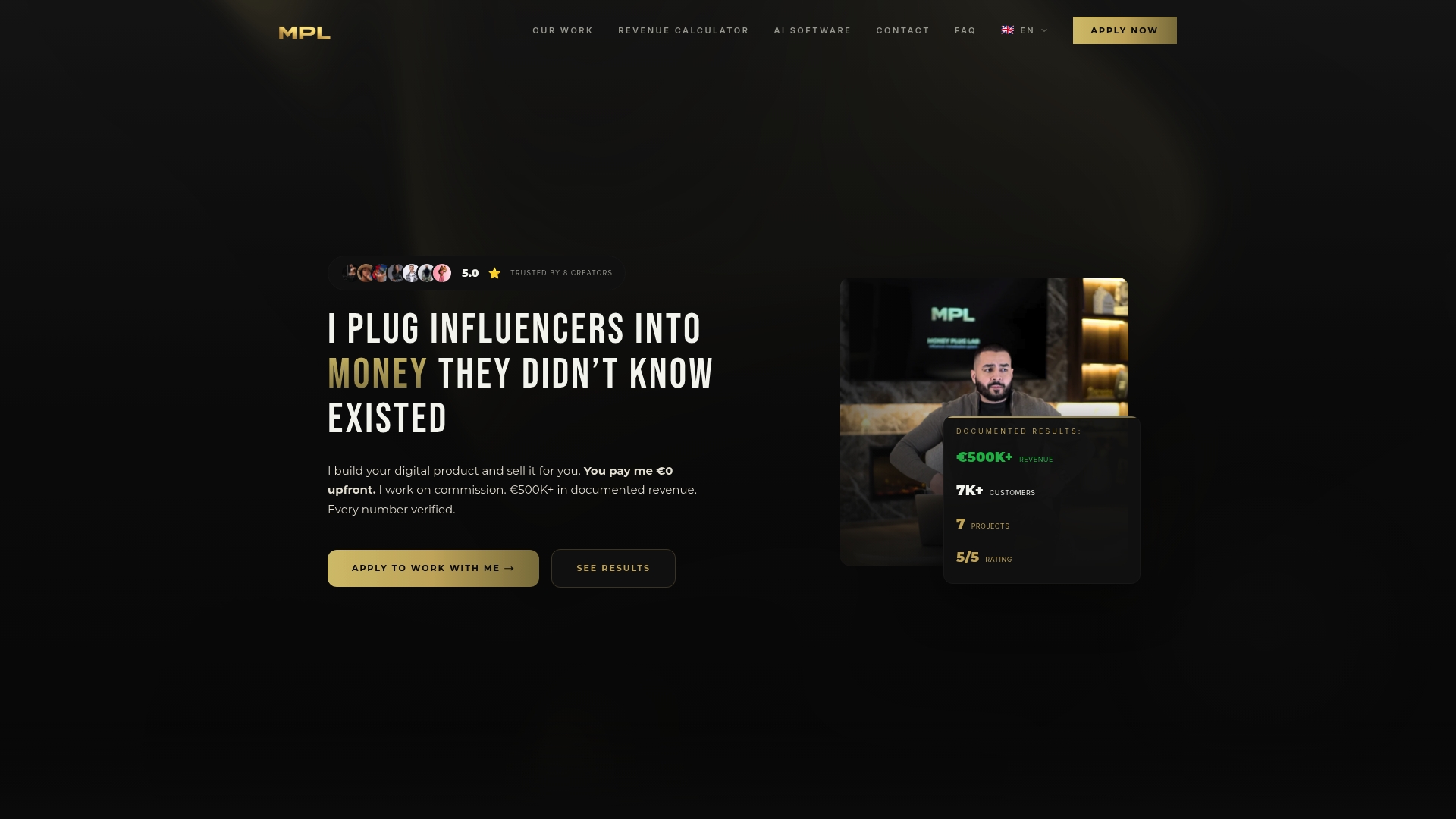
Tell us about your audience and your niche on Money Plug Lab’s monetization page, and we will work out whether your followers are ready for a launch or need a warm-up first.
FAQ
What does cold traffic mean?
Cold traffic is people who reach your site, ads or content without knowing your brand or having any built-up trust. They are strangers who may have found you through ads, search or a shared post. The aim is to introduce yourself and give them a reason to follow, subscribe or come back.
Is warm traffic always better than cold traffic?
Warm traffic usually converts more readily because people already trust you, but the two do different jobs. Cold traffic grows your reach and feeds the warm pool. Creators who run both tracks at once keep a steady supply of new prospects while nurturing existing ones toward a sale.
How long should I warm up my audience before a launch?
It depends on engagement. Guidance for creators ranges from about 3 to 4 weeks for an audience that already engages and trusts you, up to 2 to 3 months for one that is just starting to build. A 30 to 90 day plan with a waitlist is a common middle path.
Can I sell a paid program straight to cold traffic?
Yes, but the format needs to do more work. Long-form sales pages or video sales letters can build credibility and handle objections from zero, and a low-priced entry offer or free resource lowers the risk for someone who has never heard of you. Expect to measure progress by relevance first and sales second.
Sources
- Cold Traffic, glossary
- Understanding the Difference between Cold and Warm Traffic
- Cold vs Warm vs Hot Audiences: How to Structure Ads
- Warm leads: how to identify, generate and nurture them
- The difference between cold, warm, and hot traffic, podcast episode 131
- How to Warm Up Your Audience Before You Launch an Offer
- Why Your Videos Only Reach People Who Already Watch You
- How to Build Real Relationships with Automated Campaigns
- Direct Response Decision Framework: Pick the Right Format
- Captions by audience: Cold, warm, hot IG templates
- The Best Traffic Sources for Affiliate Marketing
- What is Cold Traffic? Cold Traffic Defined
- How to Sell Digital Products Online in 2026
- How to Build a Coaching Funnel in GoHighLevel
- How to Warm Up Your Audience Before a Launch
- Waitlist Launch Playbook
- How to Sell to Cold, Warm and Hot Audiences