AIDA vs PAS for Creator Launches in 2026: AI Prompts and Channel Picks
AIDA vs PAS for Creator Launches in 2026: AI Prompts and Channel Picks

Use AIDA when you’re talking to a cold, distracted audience who doesn’t know they have a problem yet. Use PAS when you’re talking to someone who already feels the pain and just needs a reason to act. The exception: skip PAS on desire-unaware audiences (there’s no pain to agitate yet), and skip AIDA on short-form ads where you don’t have room for a slow buildup. Beyond that, hybridize and test both.
TL;DR:
- Cold audiences generally respond better to AIDA-based copy that builds curiosity and desire over a longer sequence.
- Warm or problem-aware audiences convert more efficiently with PAS, which directly addresses their existing pain and offers quick relief.
- AI tools produce more reliable PAS drafts with fewer edits, especially for short-form content like ads and retargeting messages.
- Mixing both frameworks in a campaign can be effective, using PAS to quickly hook warm traffic and AIDA to warm up cold audiences.
- Matching the copy framework to the audience’s awareness level and channel type is crucial for maximizing conversion and performance.
Table of Contents
- AIDA vs PAS: What AIDA Actually Is and How It Works
- AIDA vs PAS: What PAS Actually Is and How It Works
- Same Offer, Two Frameworks: AIDA vs PAS Side by Side
- Which Framework to Pick: A Decision Matrix by Audience and Channel
- Adapting AIDA and PAS for AI-Assisted Copy and Modern Channels
- Copy-Ready Templates and AI Prompts for AIDA and PAS
- The Bottom Line: AIDA vs PAS Comes Down to Audience Temperature
- What Launch Data Taught Us About Choosing Between AIDA and PAS
- Turn the Right Framework Into a Launch That Actually Sells
- Sources
AIDA vs PAS: What AIDA Actually Is and How It Works
AIDA breaks a sale into four psychological stages: Attention, Interest, Desire, Action. You grab attention with something visually or verbally arresting, build interest by making the reader curious about a specific benefit, create desire by showing what life looks like with the problem solved, then close with a direct action step.
The model dates back over a century and shows up in nearly every marketing textbook because it maps to something real: people don’t jump straight from “never heard of this” to “buying it.” They move through stages, even if those stages blur together in seconds. AIDA’s own literature acknowledges the framework is a hierarchy, not a strict checklist, and that real buyer behavior doesn’t always march through the steps in order.
AIDA’s emotional lever is aspiration. It sells the upgrade, the transformation, the “you, but better” version of the reader. That’s why it tends to dominate top-of-funnel ads, long-form sales pages, and multi-touch email sequences where you have room to build a case slowly. HubSpot’s breakdown of the model notes it still works across nearly every channel despite being decades old, largely because the stages map cleanly onto how people actually browse before they buy.
A tight AIDA sequence looks like this:
- Attention: “Most creators lose 40% of their launch revenue to bad timing.”
- Interest: “The difference isn’t luck. It’s a sequence most creators never see.”
- Desire: “Imagine your next launch selling out before the cart even opens.”
- Action: “Get the launch calendar free this week.”
Some marketers now teach an extended version, AIDAS, tacking on “Satisfaction” as a fifth stage to account for post-purchase retention. Mailchimp’s guide to the model covers this addition and treats it as a useful patch for subscription and membership offers where the sale isn’t the finish line.
AIDA vs PAS: What PAS Actually Is and How It Works
PAS strips the funnel down to three moves: Problem, Agitate, Solution. Name the problem the reader already has, twist the knife a little so they feel the cost of ignoring it, then hand them the fix.
Where AIDA sells aspiration, PAS sells relief. The emotional lever is loss aversion: people move faster to escape pain than to chase a reward, and PAS is built entirely around that instinct. That makes it the natural fit for retargeting, search ads, and any warm audience that already knows they have an issue. You’re not introducing a problem. You’re reminding them it’s still unsolved.
Agitation done right isn’t manipulation. It’s specificity. Instead of vague fear (“this could be bad”), you name the exact cost: the wasted hours, the missed revenue, the launch that flopped because nobody had a plan. That specificity is what separates ethical agitation from cheap scare tactics.
A short PAS sequence:
- Problem: “Your last launch made sales, but not enough to cover the ad spend.”
- Agitate: “Every week you wait to fix the funnel is another batch of cold leads that never convert.”
- Solution: “Book a 20-minute audit and see exactly where the leak is.”
PAS tends to outperform in retargeting and search because those audiences are already problem-aware. You don’t need three paragraphs of buildup. You need one sentence that says “yes, that’s my problem” and a fast path to the fix. Practitioner comparisons back this up: PAS often wins on warm traffic precisely because the pain-to-relief sequence is shorter and matches where the reader already is mentally, while AIDA tends to perform better on cold audiences that need more runway to build desire.
Same Offer, Two Frameworks: AIDA vs PAS Side by Side
Take a generic offer: a paid course teaching creators how to plan a product launch. Here’s the same offer written both ways.
AIDA version:
Attention: “Most creators plan their launch backward, and it costs them thousands.” Interest: “There’s a five-step sequence top creators use before they ever open the cart.” Desire: “Picture your next launch selling through inventory in 48 hours instead of two weeks.” Action: “Enroll in the Launch Blueprint before the cohort closes Friday.”
PAS version:
Problem: “Your launches take weeks to plan and still underperform.” Agitate: “Every day spent guessing at pricing and timing is a day competitors are eating your audience’s attention.” Solution: “The Launch Blueprint gives you the exact sequence in under three hours. Enroll now.”
Both versions sell the same course. The difference is where they start and how much runway they need.
- Opening move: AIDA opens with a curiosity gap. PAS opens with a mirror held up to a pain the reader already has.
- Emotional tone: AIDA stays aspirational start to finish. PAS is tense in the middle, relieved at the end.
- Ideal audience: AIDA works better on people who haven’t identified the problem as urgent yet. PAS works better on people who’ve already tried to solve it and failed.
- CTR vs CPA tendencies: Cold traffic tends to click AIDA hooks at a slightly higher rate because curiosity is a broader net; PAS tends to convert better once someone clicks, because the reader self-selects as already in pain. Aggregated campaign comparisons back this pattern, showing structured frameworks beating unstructured copy on both metrics, with the winning framework depending on funnel stage.
- Editing effort for AI drafts: PAS drafts from AI tools generally need fewer edits to stay on-topic. The three-step structure gives the model less room to wander than AIDA’s four-part arc, where the “desire” stage often drifts into generic fluff if you don’t prompt it tightly.
Neither version is “better” in the abstract. The AIDA draft would likely underperform on a retargeting audience that’s already seen three of your ads. The PAS draft would likely underperform as a cold Facebook ad to someone who’s never heard of the course, because there’s no problem established yet, just agitation with nothing to anchor it.
Which Framework to Pick: A Decision Matrix by Audience and Channel
Match the framework to where the reader already stands, not to whichever one you personally prefer writing.
- Unaware audience (doesn’t know the problem exists): AIDA, full sequence, longer copy. You need all four stages to walk them from zero to interested.
- Problem-aware audience (knows the problem, hasn’t found a fix): PAS. Skip the attention-grabbing setup; they’re already paying attention.
- Desire-aware audience (wants a result but not aware of a mechanism): AIDA’s desire and action stages, compressed. Skip lengthy problem framing.
- Product-aware audience (knows your product, hasn’t bought): PAS or a short AIDA action-only close. Agitate the cost of delay, or just remove friction from the CTA.
Channel matters as much as awareness. Cold social ads (Facebook, Instagram, TikTok prospecting) generally favor AIDA because the algorithm serves them to people who’ve never seen your brand. Search ads favor PAS, since someone typing a query has already identified a problem. Retargeting is almost always PAS territory. Email sequences split: top-of-list welcome emails lean AIDA, win-back and cart-abandonment emails lean PAS. Video sales letters (VSLs) tend to open with a PAS hook, then shift into an AIDA-style desire build for the middle section, because a 15-minute VSL has room for both.
Pro Tip: Don’t force a hybrid on a 15-second ad. If you only have one sentence before someone scrolls past, pick the single move that matches their awareness level and cut everything else. Hybrids work in long-form; they usually just add clutter in short-form.
Adapting AIDA and PAS for AI-Assisted Copy and Modern Channels
AI tools handle PAS more reliably than AIDA. Testing on AI-generated marketing copy has found PAS produces less tonal drift than AIDA, largely because its three-step structure gives the model fewer places to wander off-message. AIDA’s “desire” stage is the usual failure point. Left unprompted, most models default to generic aspirational language that could describe any product.
The fix is stage-by-stage prompting instead of one long request. Ask for the headline separately from the interest line, separately from the desire line, separately from the CTA. This forces the model to commit to each stage rather than blending them into a vague paragraph.
- For short-form (search ads, retargeting primary text, SMS): PAS almost always wins on both clarity and AI reliability.
- For long-form (landing pages, VSL scripts, nurture sequences): AIDA earns its length, and AI output holds up better because there’s room to build each stage properly.
- Track CTR to judge the attention stage and CPA or ROAS to judge the conversion stage. Read-through rate on long-form matters most for AIDA, since a weak desire section shows up as a drop-off mid-page.
For a quick test, run identical visuals across both frameworks and change only the copy. An equalized budget over a short run, with no other variable changed, tends to surface a directional winner fast. Money-plug’s own creative testing framework follows this same logic: isolate one variable, run it long enough to get signal, kill the loser fast.
Copy-Ready Templates and AI Prompts for AIDA and PAS
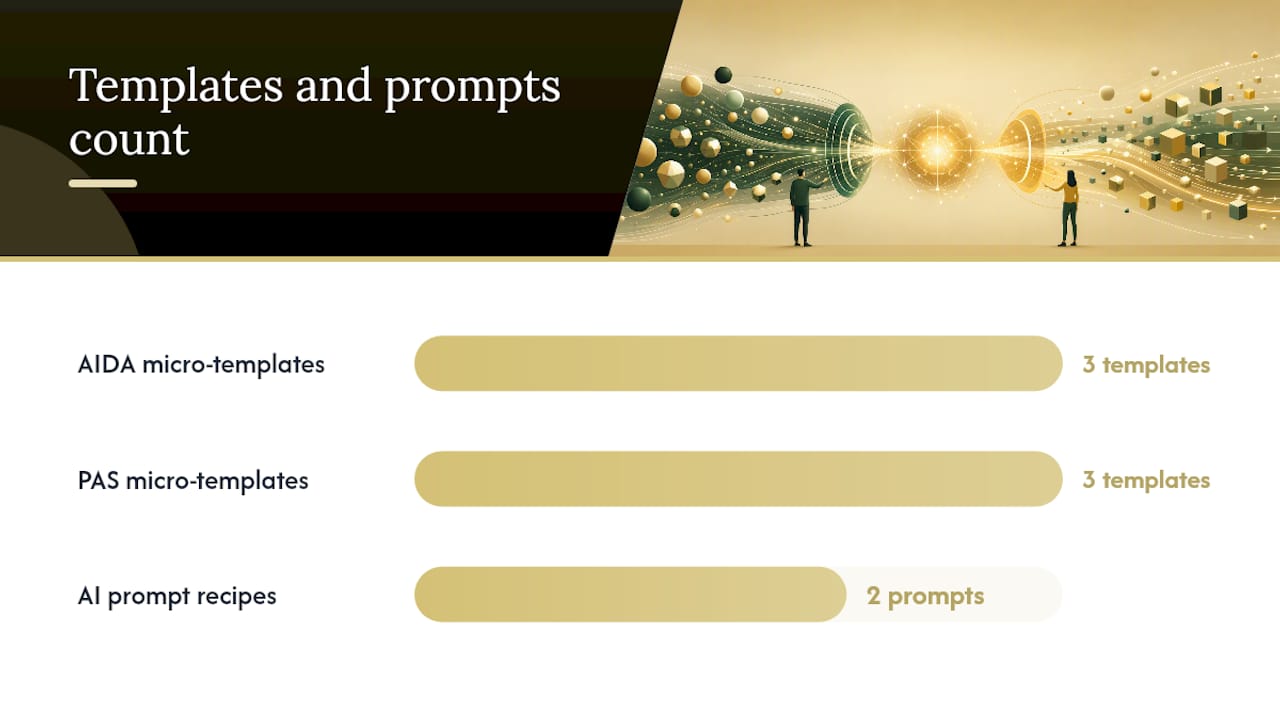
Three AIDA micro-templates:
- Ad: Attention line naming a specific mistake → Interest line hinting at a fix → Desire line painting the outcome → CTA with urgency.
- Email subject/body: Subject asks a curiosity question → opening line agitates gently → body paints the after-state → CTA button.
- Landing hero: Headline states the transformation → subhead names who it’s for → three bullet benefits → CTA above the fold.
Three PAS micro-templates:
- Search ad: Headline names the problem verbatim (matches search intent) → description agitates the cost of inaction → CTA.
- Retargeting primary text: One-line problem callback → one-line cost of waiting → direct offer link.
- Short email: Subject names the pain → two-sentence agitation → one-line solution with link.
Two AI prompt recipes:
- AIDA prompt: “Write four separate lines for an ad targeting [audience]: (1) a 6 to 10 word attention-grabbing headline about [problem], (2) one sentence building interest around [mechanism], (3) one sentence building desire around [outcome], (4) a direct call to action for [offer]. Label each line.”
- PAS prompt: “Write three separate lines for [audience] who already knows they have [problem]: (1) one sentence naming the problem plainly, (2) one sentence agitating the cost of not solving it, (3) one sentence presenting [offer] as the solution with a direct CTA. Label each line.”
Pro Tip: Always check the output for “AI drift,” meaning the desire or agitation line drifts into generic claims that could apply to any product. If a line could get copy-pasted into a competitor’s ad without changing a word, rewrite it with a specific number, name, or detail from your actual offer.
Minimal edits to make AI output sound on-brand: swap generic nouns for your actual product name, add one real number or detail the model couldn’t have guessed, and cut any sentence that starts with “In today’s” or “Imagine a world where.”
The Bottom Line: AIDA vs PAS Comes Down to Audience Temperature
The rule of thumb holds: AIDA for cold, aspirational selling; PAS for warm, pain-driven selling. Most high-performing launches don’t pick one and stop. They open with a PAS hook to earn attention fast, then shift into an AIDA-style desire build for the body, which is exactly the kind of blend top practitioners default to rather than treating either model as a rigid law.
Before you publish anything, run it against six checks:
- Does the copy match the reader’s actual awareness stage, not just the offer?
- Is the framework choice (AIDA or PAS) deliberate, not a coin flip?
- Is the CTA a single, unambiguous next step?
- Does the copy include at least one concrete proof point (number, specific outcome, named detail)?
- Does the length and structure fit the channel format (short-form vs long-form)?
- Is there a test plan in place, or are you just guessing which version wins?
What Launch Data Taught Us About Choosing Between AIDA and PAS
Most creator launches don’t fail because the copy is bad. They fail because the framework doesn’t match where the audience actually is. We’ve seen cold ads underperform when they open with agitation the reader hasn’t earned yet, and we’ve seen retargeting sequences fall flat because they spend three lines building desire the reader already has.
In practice, we default to hybrids more often than either pure model. A cold Facebook ad might open with a PAS-style pain line because it grabs attention faster than a slow AIDA build, then hand off to an AIDA-style desire section on the landing page once the reader has clicked through and earned the longer pitch. The framework matters less than matching it to the exact moment the reader is in.
If you’re planning a launch and aren’t sure which structure fits your audience, that’s the first conversation worth having before a single word gets written.
— Money
Turn the Right Framework Into a Launch That Actually Sells
Knowing whether to open with AIDA or PAS solves half the problem. The other half is turning that choice into a full sequence: ads, emails, landing pages, and a launch calendar that all reinforce the same structure instead of fighting each other. That’s the gap Money-plug exists to close for creators who don’t have time to test four frameworks across six channels alone.
We work on a pure revenue share basis, meaning there’s no upfront cost while the agency builds out the audience research, product architecture, sales copy, and paid ad execution behind a launch. That includes deciding, offer by offer, whether a cold-traffic ad needs the full AIDA build or a retargeting sequence needs a tighter PAS close, then testing both before spending real budget. If you’re a creator in the Balkans, the diaspora, or expanding into new markets and want a team that handles the framework decisions alongside the execution, Money-plug’s team can map out what a launch built around your audience actually looks like.