Creators: Qualify First to Convert in Instagram DMs Within 24 Hours
Creators: Qualify First to Convert in Instagram DMs Within 24 Hours

Yes, Instagram DM selling works when you treat each message thread as a structured micro sales conversation rather than a place to drop a link and wait. The framework is four stages: Trigger, Qualify, Convert, Follow up. The two levers that determine whether it works for you are reply speed and giving the buyer exactly one clear next step, whether that’s a checkout link or a booked call. Get those two things right and conversion rates land in a wide but predictable range.
TL;DR:
- Reply speed of under 60 seconds significantly improves conversion rates, making automation essential for timely responses.
- A clear, single next step in each message, preferably a checkout or booking link, boosts sales by reducing decision fatigue.
- Responding within 24 hours and using a four-stage framework—Trigger, Qualify, Convert, Follow-up—is key to maintaining momentum.
- Running content triggers like Stories, comments, and user-generated posts can generate high-volume DM inbound leads.
- Tracking response time, DM click-throughs, and follow-up recovery rates helps optimize the entire Instagram DM selling process.
Table of Contents
- Why Instagram DMs Convert Better Than Other Channels
- The 4-Stage DM Sales Framework
- DM Scripts and Message Templates by Use Case
- Automation, AI Agents, and the 24-Hour API Constraint
- Payment and Checkout Options That Reduce Friction
- How to Generate DM Leads: Content Triggers That Work
- Follow-Up Sequences That Recover Lost DM Sales
- Metrics to Track and Benchmarks for DM Selling
- Common Mistakes and Quick Compliance Notes
- Money Plug Lab: Firsthand Proof and How We Apply DM Selling
- When DM Selling Is the Right Strategy (and When It Isn’t)
- Get DM Selling Built and Running for Your Launch
- Sources
Why Instagram DMs Convert Better Than Other Channels
A DM is an inbound signal. Someone replied to your Story, commented “link” under a Reel, or messaged you directly, which means they already raised their hand before you said a word. Compare that to cold email or a paid ad click, where you’re guessing at intent. That difference shows up in the numbers.
Open rates on Instagram DMs run around 90%, compared to roughly 20 to 25% for email, according to CreatorFlow’s DM sales playbook. People check their Instagram inbox the way they check texts, not the way they check a promotions folder.
DMs also sit at the exact hinge point of the discovery-to-conversion funnel. A Reel or Story creates curiosity, the DM is where that curiosity gets resolved into a decision, and the close happens in the same thread, no redirect to a website that loses half your traffic along the way. Well-run DM funnels convert somewhere between 7% and 20% depending on the offer and how tight the execution is, per the same CreatorFlow data. Response speed is the biggest lever inside that range: replies under 60 seconds consistently outperform anything slower, which is why automation matters even for sellers who’d rather keep things personal.
The 4-Stage DM Sales Framework
Every DM sale, from a $30 skincare kit to a $2,000 coaching package, moves through the same four stages. Skip one and the thread stalls.
- Trigger. Something prompts the DM. This could be a Story sticker reply, a comment on a Reel with a “DM me” call to action, or someone messaging your bio link directly. The trigger sets the tone. A Story reply about a specific product carries far more intent than a generic “hey” from a new follower.
- Qualify. Before you pitch anything, ask one question. Not five. One. “Are you looking for the eyeshadow palette or the brush set?” does more work than a paragraph of features because it forces a micro-commitment and tells you exactly what to sell next.
- Convert. This is where a pre-loaded cart link or a single-step order form does the heavy lifting. State the price plainly in the chat, don’t make them guess, and send one link that handles product selection and payment in one motion. Jotform’s guide to selling on Instagram without a website makes the same case: a single payment or order form link beats a multistep handoff every time.
- Follow up. Most buyers who go quiet after seeing a checkout link aren’t gone, they’re distracted. A 3-touch recovery sequence inside the 24-hour reply window is what brings a meaningful share of them back.
A few operational rules hold the whole thing together:
- Keep messages short. Three sentences beat three paragraphs almost every time.
- Ask permission before pitching. “Mind if I send you the details?” costs you nothing and raises the odds they actually read what comes next.
- Give exactly one next step per message. Two links or two calls to action in the same DM splits attention and kills momentum.
- Never let a thread sit unanswered past the point where the buyer’s intent cools off.
DM Scripts and Message Templates by Use Case
Scripts don’t need to sound scripted. They need to be fast to send and easy to customize on the fly. Here’s a working set organized by trigger type and offer.
Inbound openers
- Story reply: “Hey! Saw you replied about the [product] — are you looking at it for yourself or as a gift?”
- Comment to DM: “Thanks for the comment! Quick one: are you more interested in [Option A] or [Option B]?”
- Bio link request: “Hi! What are you hoping to get out of [program/product] so I can point you to the right one?”
One-question qualifiers by product type
- Physical product: “What size are you usually between, S or M?”
- Digital product: “Are you newer to [skill] or looking to level up something you already do?”
- Service or coaching: “What’s the main thing you’re trying to fix right now, [problem A] or [problem B]?”
Convert messages
- “Here’s the link, it’s preloaded with the [item] you asked about: [link]. Takes about 30 seconds to check out.”
- “For something at this level I’d rather talk it through first, got 15 minutes this week? Here’s my calendar: [link].”
Objection handling, kept short
- Price pushback: “Totally fair, want me to break down what’s included so it’s clear what you’re getting?”
- Hesitation: “No rush. Want me to hold this for 24 hours while you decide?”
Pro Tip: Never send two questions in one message. Buyers answer the first one and ignore the second, and you’ll waste a whole reply cycle finding that out.
Automation, AI Agents, and the 24-Hour API Constraint
Instagram’s Messaging API enforces a 24-hour window for free-form replies. Once a conversation goes quiet past that window, you’re limited to template messages, which is why instant automated replies aren’t a nice-to-have, they’re what keeps the window open in the first place, according to Reepli’s Instagram business messaging guide.
Not everything should be automated. A useful split looks like this:
- Automate: first acknowledgment, simple qualifying questions, delivering the checkout or booking link.
- Keep human: price negotiation, high-ticket closes, anything involving a genuinely upset customer.
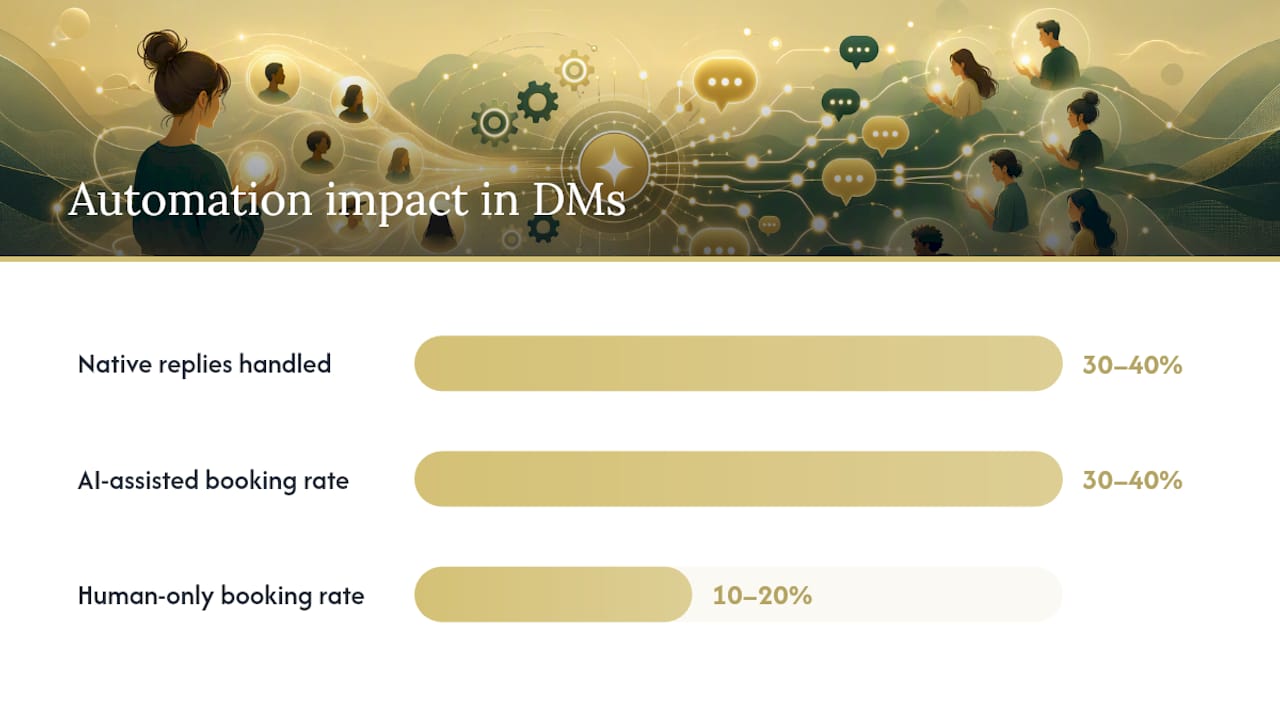
Native Instagram tools like quick replies and welcome messages can handle roughly 30 to 40% of common questions on their own, per Reepli’s data, with the rest needing a personalized reply or routing to a person. On the higher end, AI-assisted setter workflows have been reported to push lead-to-booking rates to 30 to 40%, compared to 10 to 20% for slower human-only handling, according to SellByChat’s DM sales guide.
A simple way to manage this at scale is tagging every thread by lifecycle stage inside a lightweight CRM, Lead, Qualified, Booked, Paid, so nothing falls through when volume picks up. And if a bot is doing the first reply, say so plainly rather than letting someone think they’re talking to a person for ten messages before finding out otherwise.
Payment and Checkout Options That Reduce Friction
The rule that matters most here: one link, not three. A single link that handles the product, the variant, and the payment beats sending a product photo, then a size chart, then a separate PayPal request.
Practical options that follow this rule:
- A pre-loaded cart link with the item and variant already selected.
- A hosted order form that captures size, color, or customization in one screen.
- A simple payment link or invoice for services and digital products.
Instagram’s native checkout, where available, keeps buyers inside the app entirely, which is convenient but not universally available depending on region and account setup. Third-party order forms and payment links work everywhere and give you more control over what information you collect, shipping address, custom engraving text, session preferences, without adding extra back-and-forth in the thread.
For anything above a mid-ticket threshold, roughly the point where a buyer wants reassurance before paying, move the conversation from DM to a quick call. A $40 product doesn’t need a Zoom call. A $1,500 coaching package usually does.
How to Generate DM Leads: Content Triggers That Work
DM volume doesn’t happen by accident. It’s engineered through specific content patterns.
- Story replies. Post a Story with a poll, slider, or direct question tied to your offer. Story replies convert at two to three times the rate of cold DMs and deserve a response within minutes, not hours, per InstantReply’s 2026 DM sales strategy guide.
- Comment to DM flows. Ask viewers to comment a keyword under a Reel, then use an opt-in automation to send them a DM. Keep the keyword specific (“comment KIT”) so you’re not flooding your inbox with low-intent replies.
- New follower sorting messages. A short “this or that” message to new followers, “Are you here for the fitness plans or the recipe guides?”, sorts intent before you spend time writing a pitch.
- User-generated content. Reposting a customer’s Story or tagged photo creates social proof that prompts other followers to ask “where’d you get that” in your DMs without you lifting a finger.
Follow-Up Sequences That Recover Lost DM Sales
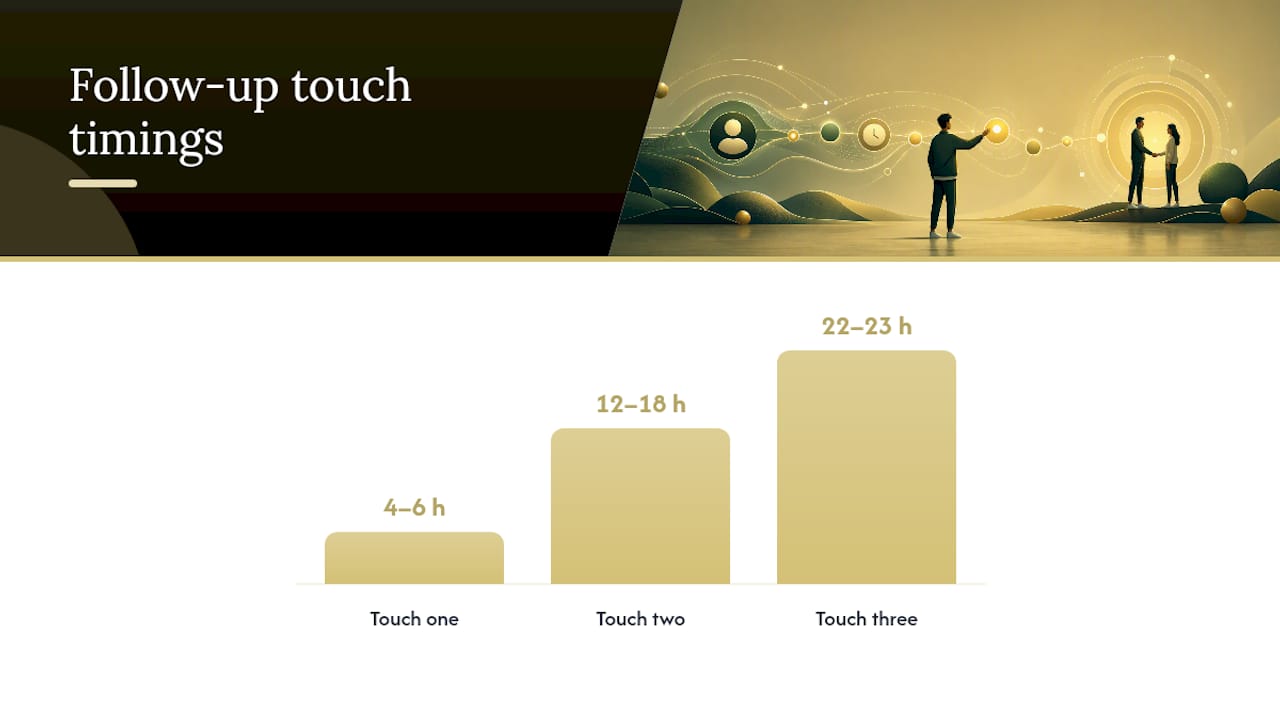
Most sellers give up after one unanswered message. That’s the mistake. A structured 3-touch sequence, timed inside the 24-hour window, recovers a meaningful share of buyers who saw a checkout link and didn’t act.
- Touch one, 4 to 6 hours later. A value-add check-in, not a nag. “Quick tip while you’re deciding: most people go with the medium size for this one.”
- Touch two, 12 to 18 hours later. Address the likely objection directly or drop a small piece of social proof. “A lot of people ask about shipping time, it’s 3 to 5 days. Let me know if that changes anything.”
- Touch three, 22 to 23 hours later. A final nudge with a graceful exit. “No worries if the timing’s off, just let me know and I’ll close this out.”
Pro Tip: Stop the sequence the moment someone replies with a clear no. Continuing past that point doesn’t recover a sale, it just burns goodwill.
Structured follow-up sequences like this recover roughly 20 to 30% of buyers who went quiet after receiving a link, per CreatorFlow’s data. Track recovery rate by dividing follow-up conversions by total abandoned threads each week.
Metrics to Track and Benchmarks for DM Selling
You don’t need a dashboard to run this well. You need to track six numbers consistently.
| Metric | What it measures | Benchmark |
|---|---|---|
| Response time | Time from first message to your reply | Under 60 seconds ideal |
| Trigger to DM rate | Story/comment views that turn into a DM | Varies by content, track your own baseline |
| Qualification response rate | Buyers who answer your one qualifying question | Higher is healthier thread quality |
| DM to click rate | Threads that reach a checkout link | Depends on offer clarity |
| Checkout to purchase | Clicks that complete payment | Drops sharply with extra steps |
| Follow-up recovery rate | Abandoned threads recovered via follow-up | 20 to 30% |
Overall DM conversion, trigger to paid customer, tends to land between
and 20% depending on offer and execution quality. A spreadsheet is enough for the first few hundred conversations; once volume climbs, a lightweight CRM tagging system saves you from losing track of who’s mid-conversation. If you can only optimize one number, make it response time. Every other metric improves when that one does.
Common Mistakes and Quick Compliance Notes
The most common failure is pitching before qualifying, sending a price and a link in message one before anyone’s said what they want. That reads as spam, even when it isn’t.
- Don’t treat the DM as a link-delivery service; it’s a conversation with one clarifying question first.
- Don’t cold-DM people who haven’t engaged with your content, it violates the spirit of Instagram’s promotional messaging norms and tanks your reply rates.
- Don’t let a thread sit unanswered past a few hours, it cools fast.
- Do disclose automation when a bot is doing the replying.
Money Plug Lab: Firsthand Proof and How We Apply DM Selling
Money-plug has generated over $500,000 in tracked revenue across seven launched creator programs, including one launch that produced more than 3,000 sales in ten days and a campaign that returned 18x on ad spend. That scale doesn’t happen by accident, it happens because every DM in a launch follows the same Trigger to Qualify to Convert to Follow up structure, built into the launch’s messaging sequences before the first ad ever runs.
A launch lives or dies on how fast the first reply lands and how few steps stand between a qualified buyer and a completed checkout. Everything else is optimization.
When an agency runs a DM-driven campaign for a creator, it includes pre-built qualifier scripts, checkout links loaded before launch day, and a follow-up cadence timed to the platform’s own reply window, not built afterward as an afterthought.
When DM Selling Is the Right Strategy (and When It Isn’t)
DM selling fits creators, small catalogs, and service providers selling at low to mid ticket, where a short conversation can resolve most buying hesitation. It fits less well for complex product configurators or tightly regulated categories where a real form and disclosures matter more than a fast reply.
If you’re unsure, run a 30-day pilot: one content trigger, instant replies, a single qualifying question, and a pre-loaded checkout link. Track your DM-to-purchase rate weekly. If it’s climbing, scale it. If it’s flat after 30 days, the offer needs work before the messaging does.
— Money
Get DM Selling Built and Running for Your Launch
Running this framework well takes discipline every single day, scripts written, qualifiers tested, follow-ups timed to the hour. Money-plug builds and runs it for creators instead, on a revenue-share basis with zero upfront cost, so the entire DM sales system, from trigger content to checkout link to follow-up sequence, is live before your launch day instead of assembled on the fly.
That matters most for creators juggling content creation and customer replies at the same time, since a missed 60-second reply window on launch day can cost more sales than a week of ad spend recovers. An experienced team handles the qualifier scripts, the payment infrastructure, and the launch campaign around them, drawing on a proven structure used across previous program launches. If you’re a creator weighing a DIY DM funnel against a done-for-you launch, visit the Money Plug landing page to see what a pilot launch could look like for your audience.
Sources
- How to Sell in Instagram DMs: The E-Commerce Playbook
- How to sell things on Instagram without a website (Jotform AI Agents)
- Sellbychat