Launch an Online Coaching Offer in 90 Days: DIY or Revenue Share?
Launch an Online Coaching Offer in 90 Days: DIY or Revenue Share?

If you sell 1:1 or small-group coaching, an all-in-one course-and-coaching platform like Teachable or a community-first platform like Circle gets you to market fastest. If you’re building cohort programs around member interaction, Mighty Networks fits better. If you’d rather skip the platform decision entirely and hand the build, pricing, and launch to someone else, a revenue-share agency is the third path.
TL;DR:
- Coaches should select platforms based on the specific coaching format, such as Teachable for courses, Circle for community programs, or Mighty Networks for ongoing interaction.
- Subscription-based platforms like Teachable and Kajabi are best for solo coaches selling structured content, while fixed-package services like IMD are suited for enterprise clients.
- Validating price points through real conversations before building content and recruiting beta clients is essential to avoid launching unprofitable offers.
- Track key metrics such as conversion rate, client retention, and customer acquisition cost to ensure the coaching offer remains sustainable and scalable.
- A revenue-share agency can be a low-risk option for scaling proven offers when audience engagement exists but internal capacity is limited.
Table of Contents
- What Kind of Online Coaching Offer Are You Actually Building?
- How Do Coaching Platform Categories Compare?
- How Do You Choose the Right Coaching Platform?
- What Tools Do You Actually Need to Run a Coaching Offer?
- What Should You Charge for a Coaching Offer?
- How Do You Launch an Online Coaching Offer in 90 Days?
- How Does a Done-for-You Launch Partner Actually Work?
- How Do You Keep Coaching Clients Engaged and Renewing?
- What Happens When Your Coaching Platform Breaks?
- What I’ve Learned Watching Coaching Offers Launch and Fail
- When a Done-for-You Launch Makes More Sense Than DIY Platforms
- Where to Learn More About Coaching Platforms
- Sources
What Kind of Online Coaching Offer Are You Actually Building?
Before picking software, decide what you’re selling. That sounds obvious, but most coaches skip this step and end up bolting a coaching offer onto whatever platform they already had for something else. The format you choose (1:1, group, cohort, hybrid course-plus-calls) should drive the platform choice, not the other way around.
Here’s a shortlist of platform approaches, with real examples of who tends to use each one well:
- Teachable packages courses and coaching together with built-in sales pages and payment processing, which makes it a fit for coaches who want a simple checkout flow without stitching together three separate tools. G2 reviewers consistently point to its course-and-coaching product creation as a core strength.
- Circle is built around community and cohort engagement first, content delivery second. Coaches running paid communities or cohort-based programs where peer interaction matters as much as the curriculum tend to gravitate here, and G2 user reviews back up its reputation for membership tools.
- Thinkific leans toward structured curriculum. If your coaching offer is really a course with office hours attached, Thinkific’s course-building features support that kind of sequencing well.
- Kajabi bundles marketing automation and sales funnels with content hosting, appealing to coaches who want email sequences and landing pages built into the same system that hosts their calls and modules.
- Mighty Networks is closer to Circle in spirit, weighted toward events, sub-groups, and ongoing member interaction rather than a linear curriculum.
- Trainerize serves a narrower lane: fitness and health coaches who need workout programming, habit tracking, and client check-ins baked into the app experience itself.
- IMD Virtual Executive Coaching shows what the high end of the market looks like: fixed-session packages sold directly by an institution, not a self-serve platform at all.
None of these platforms actually own your client relationships or your audience data in the way a plain email list does. Whatever you pick, you’re renting infrastructure, not buying a permanent home for your business. Export your client list and payment history regularly, and treat the platform choice as changeable rather than permanent.
How Do Coaching Platform Categories Compare?
Once you know your format, the decision usually comes down to four categories rather than 20 individual products. Coaches spend more time agonizing over feature checklists than the categories actually differ.
| Category | Best for | Pricing model | Standout features | Ease of setup | Payment support |
|---|---|---|---|---|---|
| All-in-one course+coaching (Teachable, Thinkific, Kajabi) | Solo coaches selling structured programs with a defined curriculum | Monthly subscription tiers, often with transaction fees on lower plans | Sales pages, course sequencing, funnel automation | Fast for basic setup, slower to customize deeply | Built-in checkout, usually Stripe or PayPal integration |
| Community-first (Circle, Mighty Networks) | Cohort-based coaching where member-to-member interaction drives retention | Monthly subscription, sometimes usage-based tiers | Events, sub-groups, discussion spaces, live rooms | Moderate. Community structure takes longer to configure well | Native payments plus some third-party billing add-ons |
| Fitness and training platforms (Trainerize) | Personal trainers and health coaches running programmed workouts | Per-client or tiered subscription pricing | Workout builders, habit tracking, in-app messaging | Fast for standard programs, slower for custom protocols | Integrated billing tied to client rosters |
| Executive and enterprise services (IMD Virtual Executive Coaching) | Corporate clients and senior leaders buying fixed coaching engagements | Fixed package pricing per engagement, not a subscription | Vetted, credentialed coaches; bespoke calibration to the client’s role | Not self-serve. Sold and onboarded manually | Invoiced directly, often through procurement |
Read the pricing model column carefully. A subscription platform charges you whether or not you sell a single coaching seat that month, while a fixed-package model like IMD’s approach ties cost directly to delivery. If you’re just starting out and cash flow is tight, that distinction matters more than any feature list.
The “ease of setup” column deserves more weight than most coaches give it. A platform that takes three weeks to configure properly delays your first sale by three weeks. If you’re testing whether an offer even sells, speed to launch should outrank long-term feature depth. You can always migrate to a more powerful platform once you have paying clients and know what they actually use.
How Do You Choose the Right Coaching Platform?
Run through this checklist before you sign up for anything, and treat a “no” on more than one or two items as a real warning sign rather than a minor inconvenience.
- What’s your coaching format, honestly? 1:1 calls, group cohorts, async messaging, or some hybrid. Pick the platform category that matches, not the one with the flashiest homepage.
- Who owns your client contact list? Some platforms make exporting emails and phone numbers easy; others bury it behind support tickets. Ask this before you build anything.
- How complex is your billing? A single monthly fee is simple everywhere. Tiered packages, split payments, or refund windows longer than 14 days need a platform that handles that natively, not through a workaround.
- What has to integrate? Calendar syncing, email marketing, a CRM you already use. Check the actual integration list, not the marketing page’s claim of “seamless integrations.”
- What’s your 12-month scale plan? A platform that’s perfect for 10 clients can charge dramatically more or break entirely at 200. Ask about pricing tiers at scale before you commit.
During any free trial, actually test three things: build a full mock client journey from signup to first session, process a test payment end to end, and message support with a real question to time their response. A 48-hour response window on a billing question is a red flag, not a minor annoyance.
Ask vendors directly: “What happens to my client data if I cancel?” and “Can I export my contact list in a usable format?” Vague answers to either question should disqualify a platform regardless of how good its interface looks.
Pro Tip: Book demo calls for your top two platform choices in the same week, and ask the exact same five questions on both calls. Side-by-side answers expose gaps that marketing copy hides.
Red flags that should end the evaluation immediately: no clear data export option, support that only responds through a ticket queue with no stated response time, and pricing pages that hide transaction fees until checkout.
What Tools Do You Actually Need to Run a Coaching Offer?
Every online coaching offer needs the same functional pieces regardless of which platform hosts it. The question is which pieces live on your main platform and which you run separately.
The core categories:
- Content delivery — modules, videos, worksheets, whatever your curriculum actually contains.
- Session scheduling — booking links, calendar syncing, time zone handling for clients spread across regions.
- Intake and onboarding — forms, welcome sequences, goal-setting questionnaires before the first session.
- Live calls — video conferencing, whether built into the platform or run through a separate tool.
- Messaging — async check-ins between sessions, often the retention glue for high-touch offers.
- Payment and refunds — checkout, recurring billing, and a clear refund policy applied consistently.
- Analytics — completion rates, engagement data, and renewal signals that tell you who’s about to churn.
Pro Tip: Don’t centralize everything on one platform just because it’s technically possible. Keep scheduling and payments modular where you can, so a platform migration later doesn’t force you to rebuild your entire client pipeline.
Some of these categories are worth running off-platform even when your main tool supports them. Scheduling tools built specifically for that job tend to handle time zones and rescheduling more gracefully than a bolted-on calendar feature. The same goes for payment processing. Platforms like Teachable and Thinkific integrate directly with Stripe rather than building proprietary billing, and that’s usually the safer bet since Stripe’s dispute handling and tax tools are more mature than anything a coaching platform builds in-house.
Messaging is the category coaches most often underestimate. A high-touch offer that promises “direct access to your coach” needs a real answer for which app handles that. WhatsApp, SMS, or an in-platform inbox each carry different response-time expectations, and mismatched expectations here are a common source of client complaints.
The integration principle that holds up over time: centralize what’s core to the client experience (content and community), and keep the commodity functions (payments, scheduling) modular so you’re never trapped by one vendor’s roadmap.
What Should You Charge for a Coaching Offer?
Packaging shapes pricing more than any competitor analysis will. The four common shapes each carry different tradeoffs.
- Single session — lowest commitment, easiest to sell cold, but the weakest for recurring revenue since every client is a fresh sale.
- Monthly subscription — predictable revenue, works well for ongoing accountability coaching, but requires constant value delivery to avoid churn.
- Cohort program — fixed start date, fixed price, strong for building urgency and community, but limited by how many cohorts you can run per year.
- VIP retained package — highest price point, direct access, lowest volume. This is where margin lives if you can deliver it without burning out.
Fitness and running coaches show this play out concretely. RunFitCoach publishes tiered monthly pricing, with a Core plan around $159 per month and a Premium tier around $199 per month [RunFitCoach], differentiated mainly by support level and deliverables rather than by the underlying training content. That’s a useful benchmark: the jump in price buys more access, not a fundamentally different product.
At the premium end, IMD’s Virtual Executive Coaching sells fixed packages of multiple one-hour sessions for a flat institutional fee [IMD Virtual Executive Coaching], illustrating how executive coaching justifies its price through credentialed expertise and bespoke calibration rather than volume of content. That’s the opposite end of the spectrum from a $159 monthly running plan, and both models work for their respective audiences.
Tiered support structures show up across the coaching world for a reason: a low-touch app-based tier captures price-sensitive clients, while a high-touch tier with direct messaging access captures clients willing to pay for proximity to the coach. Fitness platforms and specialized coaching products commonly split access this way, using different communication channels like WhatsApp, email, or scheduled weekly calls to differentiate tiers without building entirely separate products.
For trials and refunds, keep the structure simple: a short paid trial period (one week to one month) converts better than a free trial because clients who’ve paid something are statistically more likely to stick around. Cap refund windows at 14 days for subscriptions, and be explicit about what a refund covers for cohort programs where a seat has already been allocated. Limited-time launch pricing works, but only if you actually enforce the deadline. Coaches who extend “final” deadlines repeatedly train their audience to ignore future urgency entirely.
How Do You Launch an Online Coaching Offer in 90 Days?
Most coaching offers fail not because the coaching is bad, but because the launch sequence skipped steps. Here’s the order that actually works.
- Define the client outcome in one sentence. Not “I help people get fit,” but “I get busy professionals running a 5K in 8 weeks without injury.” Specificity sells; vagueness doesn’t.
- Pick your format. 1:1, small group, or cohort, based on how much personal attention the outcome actually requires.
- Outline your signature session and curriculum. What happens in session one, and what’s the arc across the full engagement?
- Price test before you build everything. Talk to five potential clients about the price point before building the full curriculum. Adjust based on real reactions, not guesses.
- Build onboarding. Intake forms, welcome sequence, first-session prep. This is where clients decide if they made the right call.
- Recruit beta clients. Aim for three to five people at a discounted rate in exchange for feedback and a testimonial.
- Run the pilot. Deliver exactly what you promised, and document what worked and what clients struggled with.
- Iterate and set standard pricing. Fix the gaps the pilot exposed, then raise price to your real target for the next cohort or intake round.
| Timeframe | Focus | Key action |
|---|---|---|
| Days 1 to 90 | Definition and validation | Nail the outcome statement, price test with real conversations |
| Days 1 to 90 | Build and recruit | Build curriculum and onboarding, recruit beta clients |
| Days 1 to 90 | Pilot and iterate | Deliver the pilot, collect feedback, adjust pricing and packaging |
Track four numbers through this process: conversion rate (how many prospects who saw your offer actually bought), retention (how many clients renew or complete the full engagement), average revenue per client, and the ratio between customer acquisition cost and early lifetime value. If your CAC is higher than what a client pays in their first 60 days, you have a packaging or pricing problem, not a marketing problem.
How Does a Done-for-You Launch Partner Actually Work?
A done-for-you launch partner operates on a straightforward model: audience research, product architecture, pricing strategy, sales copy, video sales letters, launch campaign management, payment infrastructure, and post-production for paid advertising, all handled for the creator, with the agency paid through a share of the revenue those launches generate rather than an upfront fee.
The proof points are specific rather than aspirational. Creators have generated over $500,000 in tracked revenue across several launched programs. One single launch produced thousands of sales in ten days. A separate ad campaign returned a high multiple of the amount spent on it. These are case-level results from specific launches, not projections, and they reflect a creator market with lower audience acquisition costs compared to Western markets.
Here’s when this model makes sense versus building it yourself:
- Hire an agency when you have an engaged audience but no time or internal skill to handle ad production, sales copy, and payment setup simultaneously.
- Hire an agency when you want to scale a proven offer quickly and the bottleneck is execution capacity, not audience size.
- DIY makes more sense when your audience is still small and unproven, since a revenue-share partnership works best once there’s real revenue to share.
- DIY makes more sense when you have the time and interest to learn platform mechanics yourself and want full control over every launch decision.
The zero-upfront-cost structure removes the financial risk of hiring help before you know an offer will sell, which is precisely the stage where most coaches can’t afford a traditional agency retainer.
How Do You Keep Coaching Clients Engaged and Renewing?
Retention in online coaching lives or dies on the gap between sessions, not during them. Clients rarely churn because a session went badly. They churn because the three weeks between sessions felt like silence.
Build a light-touch check-in cadence between calls, even something as simple as a two-line message asking how a specific action item went. This works better than a generic “how’s it going” because it references something concrete from the last conversation. Coaches running cohort programs get an advantage here that 1:1 coaches don’t: peer accountability inside a group can carry engagement between sessions without the coach doing anything at all, which is exactly why community-first platforms built around this dynamic tend to hold attention well.
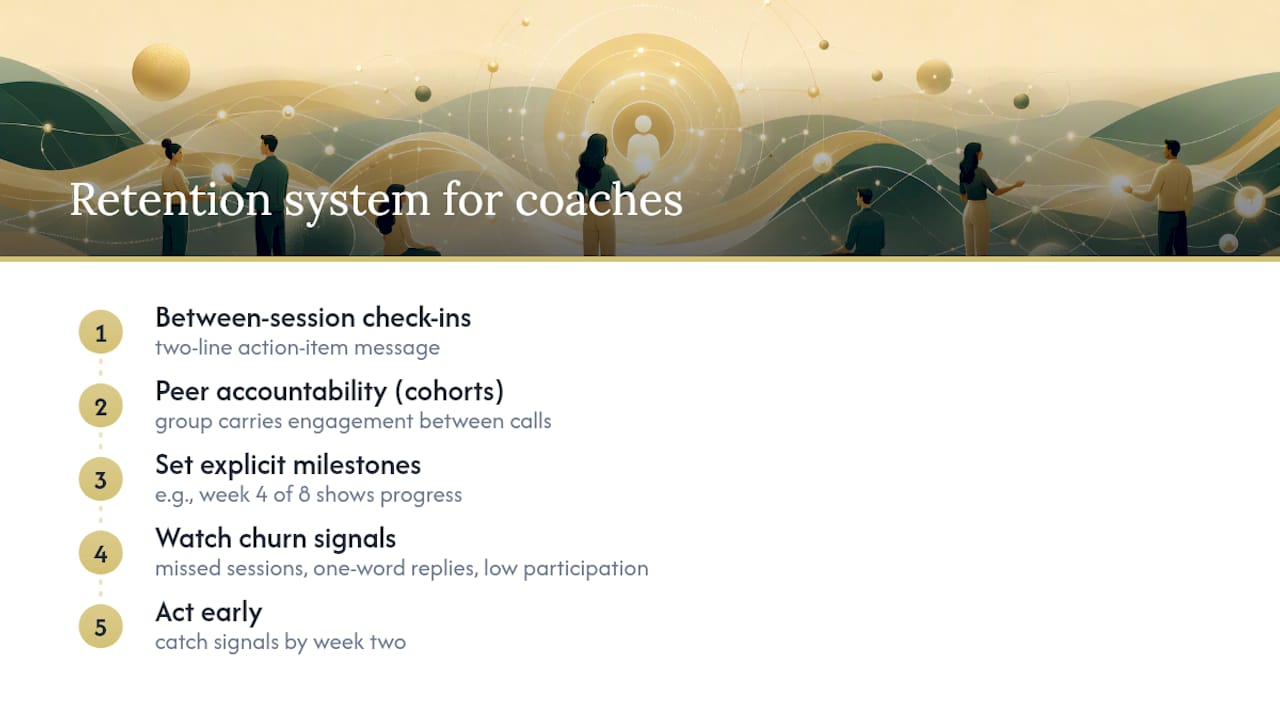
Set explicit milestones early. A client who can see they’ve hit week four of an eight-week plan feels progress, even before the outcome fully lands. Vague, open-ended coaching relationships without checkpoints are the ones most likely to quietly fade.
Watch for early churn signals: missed sessions without rescheduling, one-word responses to check-ins, and declining participation in group spaces if you’re running a cohort. Catching these in week two beats catching them in week six, when the client has already mentally checked out and a renewal conversation becomes much harder to have.
What Happens When Your Coaching Platform Breaks?
Every platform has outages, glitches, or confusing support flows eventually. What separates a manageable hiccup from a client-losing crisis is how fast you can respond and how much you depend on the platform for real-time delivery.
Before you commit to any platform, find its actual support channel and response time, not the one listed on the pricing page. Test it with a real question during your trial period. A platform that takes 72 hours to answer a billing question during evaluation will behave the same way when a paying client can’t access their content.
Build a manual fallback for anything mission-critical. If your live calls run through the platform’s built-in video tool and it goes down mid-session, have a backup link (Zoom or Google Meet) ready to send instantly. If checkout breaks during a launch window, have a simple payment link as backup so a sale doesn’t die because of a technical glitch on your side.
Keep a running list of common client-facing issues and their fixes: login problems, missed session notifications, payment failures. A short, written troubleshooting guide you can send clients within minutes builds more trust than a perfect platform ever would, because it shows clients that hiccups get handled fast rather than ignored.
Finally, separate what you can fix from what only the platform’s support team can fix. Coaches who spend hours trying to solve a backend billing bug themselves waste time they should spend coaching. Escalate fast, communicate the delay to your client honestly, and move on.
What I’ve Learned Watching Coaching Offers Launch and Fail
Packaging clarity beats production value every time. Coaches spend weeks polishing video intros while their actual offer, what’s included, how long it runs, what happens after session one, stays vague on the sales page. Clients don’t hesitate because your camera work is amateur. They hesitate because they can’t tell what they’re buying.
Launch cadence matters more than most coaches expect. A coaching offer that launches once and then sits static for a year loses the urgency that drove its first wave of buyers. Cohort-based launches, even informal ones, create natural re-engagement points that a static “buy anytime” offer never generates on its own.
Retention hooks need to exist before day one, not get invented after the first churn wave. Build the check-in cadence, the milestone structure, and the community touchpoints into the offer’s design from the start, not as a patch once clients start disappearing.
My caution to any coach evaluating platforms: feature-chasing is a trap. The platform with the most integrations rarely wins. The one that gets your specific offer live fastest, with a client journey clients actually understand, wins. Chasing features you won’t use for the first six months just delays your launch.
Pro Tip: Scale by fixing your onboarding before you fix your marketing. A coaching offer that keeps clients past month two scales itself through referrals. One that churns fast needs new ad spend forever just to stay flat.
— Money
When a Done-for-You Launch Makes More Sense Than DIY Platforms
Building your own coaching offer on Teachable, Circle, or Thinkific works well when you have the time to learn the platform, the audience to price-test with, and the bandwidth to write your own sales copy and run your own ad campaigns. Plenty of coaches do this successfully. But if your audience is engaged and growing and the thing standing between you and a real launch is execution capacity, not audience size, that’s a different problem than a platform can solve.
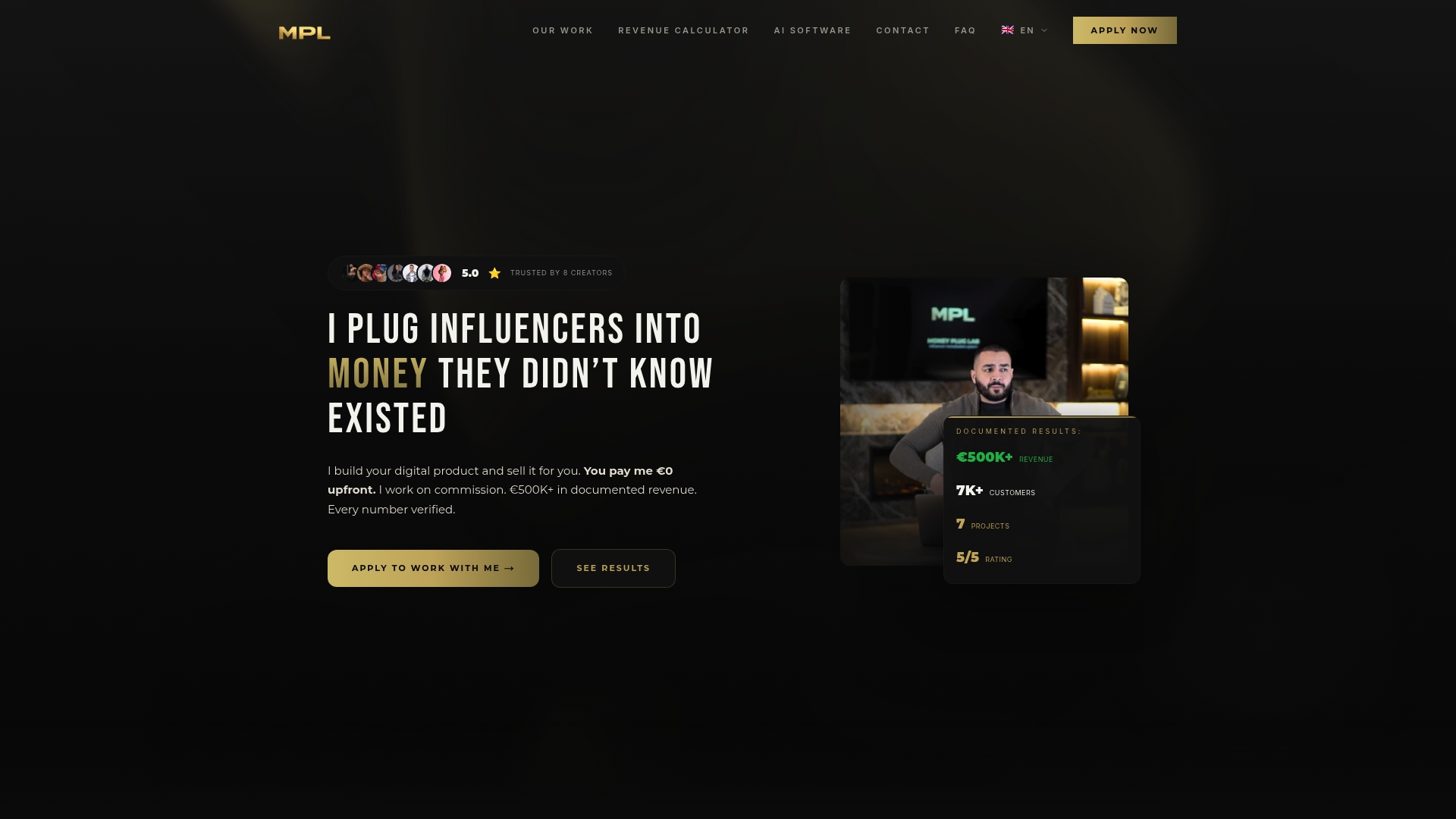
A revenue-share agency exists for that exact gap. There’s no upfront cost: the agency works on a revenue-share basis, so it only earns when your launch actually sells. That removes the financial risk of hiring outside help before you know an offer will convert, which matters most for creators who haven’t launched a paid product before and don’t want to gamble a retainer on an unproven idea. Such agencies handle the full stack, audience research, product architecture, pricing, sales copy, video sales letters, campaign management, and payment infrastructure, so you’re not stitching together multiple tools and freelancers on your own.
The specialization matters too. Money-plug works primarily with creators in the Balkans and the Balkan diaspora, where engaged audiences and lower acquisition costs create real leverage for a launch. If you fit that audience and you’re ready to turn engagement into a real coaching offer, start with Money-plug and get a sense of what a managed launch could look like for your specific numbers.
Where to Learn More About Coaching Platforms
A short list worth bookmarking if you’re still comparing platforms after reading this:
- Circle’s G2 review page for a candid look at how real users rate its community and cohort tools.
- Teachable’s G2 review page for feedback on its course-and-coaching product setup and checkout flow.
- Thinkific’s G2 review page for insight into its curriculum-building strengths.
- IMD’s Virtual Executive Coaching page for a real example of premium, fixed-session executive coaching packaging.
Each one reflects actual user experience or published packaging rather than marketing copy, which makes them worth a direct read before you commit to any platform.