Founder First Paid Community Launch: 4 Week MVP, 90 Day Activation
Founder First Paid Community Launch: 4 Week MVP, 90 Day Activation

A valid paid community launch needs exactly three things: a specific paid offer, at least one committed founding member, and a scheduled first live event. Everything else, including the platform, branding, and content library, can start minimal and improve after launch. The fastest path is to write your one-sentence promise, personally recruit 10 to 20 founding members at a locked-in price, and put the Welcome Party on the calendar before you build anything else.
TL;DR:
- Recruiting 10 to 30 engaged founding members from your existing network ensures social proof and helps solve initial growth challenges.
- Launching a paid community within four weeks relies on clear promise, direct outreach, and scheduled live events, without needing polished content or branding upfront.
- Setting a locked-in founding member price at the low end of your tier promotes loyalty, with gradual price increases supported by grandfathering early members.
- Active community management involves regular check-ins, targeted onboarding, and scalable event formats to maintain high engagement early on.
- Tracking five core metrics—monthly recurring revenue, active member rate, event attendance, churn, and cohort lifetime value—guides ongoing optimization and growth.
Table of Contents
- What Should Your Paid Community Promise Members?
- How Do You Launch a Paid Community in 30 Days?
- How Do You Recruit Founding Members Before Launch?
- What Tech Setup Do You Actually Need to Launch?
- What Should Happen on a Member’s First Day?
- What Should Your First 90 Days Look Like?
- What Should You Charge for a Paid Community?
- What Metrics Actually Matter After Launch?
- What Does a Full-Service Paid Community Launch Look Like?
- What Legal Basics Does a Paid Community Need?
- How Do You Promote a Paid Community Before Launch?
- How Do You Scale a Community After Launch?
- How Do You Collect and Use Member Feedback?
- How Do You Make Money Beyond the Initial Membership Fee?
- Who Should Run Your Community Day to Day?
- Perspective: When Launching Is the Right Call
- How Money Plug Lab Can Take the Launch Off Your Plate
- Sources
- FAQ
What Should Your Paid Community Promise Members?
The single biggest mistake first-time community builders make is describing a topic instead of a result. “A community for fitness enthusiasts” tells a stranger nothing about why they should pay you monthly. “Lose your first 10 pounds in 8 weeks without giving up carbs, with weekly accountability calls” tells them exactly what changes in their life.
Communities built around access alone (a group chat, a forum, “exclusive content”) lose members within a few months because there’s no finish line to work toward. Communities built around a specific transformation give members a reason to renew: they’re still chasing the result.
Use this structure to write your promise:
- Who: name the exact person (new mom returning to running, not “athletes”)
- Result: the specific outcome, ideally measurable
- Timeframe: a real deadline, not “eventually”
- Objection removed: the thing that’s stopped them before (“without a gym membership,” “even with a full-time job”)
Try rewriting your current pitch twice: once cutting it to under 15 words, and once reading it back as if a skeptical friend just asked, “So what do I actually get?” If the answer doesn’t include a number or a timeframe, it isn’t ready yet.
How Do You Launch a Paid Community in 30 Days?
You don’t need a polished app or a content vault before you charge anyone. You need four disciplined weeks. A structured 4-week launch framework gets you to real member feedback fast, instead of guessing in isolation for months.
- Week 1: Clarify. Nail the one-sentence promise, pick your founding-member price, and identify 30 to 50 people you can contact directly.
- Week 2: Build. Set up payments, create a pinned Start Here space, write your welcome message, and put the first live event on the calendar.
- Week 3: Warm. Message your list personally, run a short paid waitlist if you want proof of demand, and close your first founding members.
- Week 4: Launch. Run the Welcome Party, get every member to take one action, and lock attendance for the next event before people log off.
| Week | Primary goal | Key deliverable |
|---|---|---|
| Week 1 | Clarify offer and audience | One-sentence promise, founding price set |
| Week 2 | Build minimum infrastructure | Payments live, Start Here space, event scheduled |
| Week 3 | Generate demand | 10–20 founding members recruited |
| Week 4 | Activate members | Welcome Party held, next event booked |
Notice what’s missing: no custom app, no 12-module curriculum, no branding agency. Those come later, funded by revenue you haven’t earned yet.
How Do You Recruit Founding Members Before Launch?
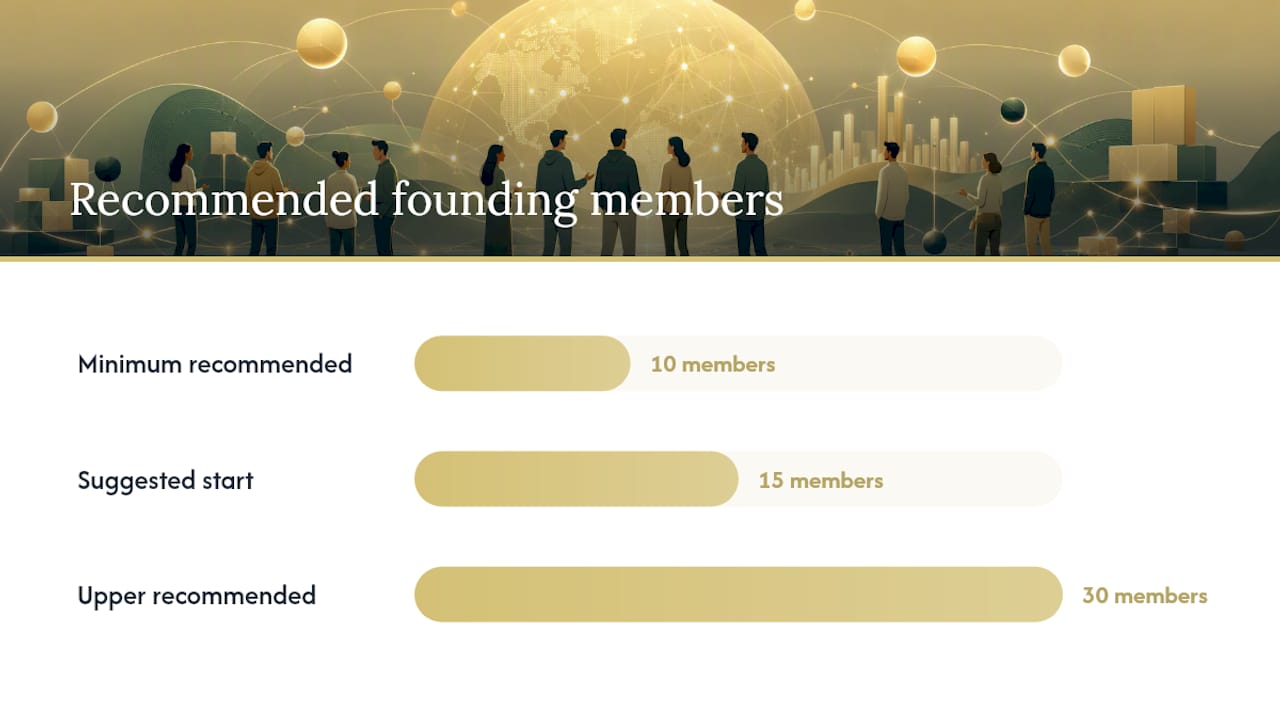
Founding members solve the cold-start problem. A community that launches with zero members asks strangers to be the first ones in an empty room; a community that launches with 15 engaged founders gives new visitors social proof from day one. Guides on paid community launches consistently recommend seeding with 10 to 30 founding members before opening to the public.
Start with people who already know you: past clients, engaged followers, email subscribers who reply to you, and anyone who’s asked “do you have something I can pay for?” Rank them by how much trust you’ve already built, not by follower count.
Run a simple three-step outreach cadence:
- Message: a personal note (not a mass DM) explaining the promise and the founding price.
- Follow-up: a check-in 2 to 3 days later addressing their specific hesitation.
- Close: a direct ask with a real deadline, tied to when the Welcome Party happens.
Expect a moderate conversion rate from warm contacts if your promise is sharp and your price feels fair. If you want to test demand before doing full outreach, a short paid waitlist works. Frame it as reserving a spot at the founding price, not as a discount. A locked-in founding price converts better than a countdown-timer promo because it feels like a permanent benefit instead of a sales trick.
Pro Tip: Ask your first three founding members to record a 30-second voice memo about why they joined. Use their exact words in your next round of outreach messages.
What Tech Setup Do You Actually Need to Launch?
You need four things working before you take a single payment: a way to charge cards, a place to post a pinned welcome guide, a scheduling tool for your first live event, and a channel for direct member messages. Nothing else is required on day one.
Three practical setup paths exist:
- Integrated community platform: payments, events, and messaging in one login. Fastest to launch, least flexible on branding.
- Website plus payment processor: more control over look and pricing, but you’re stitching together two or three tools yourself.
- Simple toolchain (payment link plus group chat plus calendar invite): cheapest and fastest, but manual and harder to scale past a few dozen members.
Integrated platforms reduce setup friction; toolchains trade that speed for flexibility and cost. Recent platform comparisons suggest matching the choice to your goals rather than defaulting to whatever’s trending.
Before you open the doors, confirm you can do all of this same day: accept a real payment, post a pinned Start Here message, send a calendar invite for your first event, and message a new member directly. If any of those four is missing, you’re not ready to launch yet.
What Should Happen on a Member’s First Day?
The first hour after someone joins determines whether they come back. A generic welcome message that says “glad to have you!” does nothing. A welcome sequence that gives one clear action does everything.
- Send a short welcome message naming the transformation they signed up for.
- Point them to a pinned quick-start guide with three steps, not fifteen.
- Ask for one specific first post (introduce yourself, share your starting point, or answer a prompt).
- Confirm the date and time of the next live event directly in the welcome flow.
The Welcome Party, your first live event, should do three things: get members introducing themselves out loud, create at least one direct connection between two members, and end with the next event already on the calendar. A room where members talk to each other, not just to you. This is what makes them stay past month one.
Follow up within 24 hours with a direct message to anyone who didn’t post, pin the best highlights from the call, and send a separate notice about the next event to anyone who missed it live.
What Should Your First 90 Days Look Like?
The first 90 days decide whether your community becomes a business or a slow leak. Weekly rhythm matters more than any single feature: one live call every week, a reply window you actually hit (same day, not “eventually”), and small rituals like a weekly wins thread or a hot seat session where one member gets focused help.
Retention, not raw membership count, is what determines whether a paid community survives past its first quarter. Research on customer retention economics shows that focusing on your most engaged members, not the biggest headcount, is what protects long-term revenue.
Track these numbers weekly:
- Active member rate: members who posted, attended, or messaged in the last 7 days
- Event attendance: percentage of members who show up live, not just RSVP
- 30/60/90-day churn: cancellations by cohort age, tracked separately
If attendance drops below half your members two weeks in a row, that’s your earliest churn warning, well before cancellations show up on a billing report. Common early-churn causes are usually fixable: members who never posted (fix with a direct DM), members who missed the Welcome Party (fix with a personal recap call), and members who don’t see progress (fix with a visible milestone or small win to celebrate).
What Should You Charge for a Paid Community?
Pricing depends on what level of access and support justifies the cost, not on what feels comfortable to charge. Guides on community pricing generally group offers into three bands, and the access level, not the price alone, determines which one fits.
| Tier | Typical price | What it must include |
|---|---|---|
| Starter | $9–$29/month | Community access, basic content library, group chat |
| Professional | $19–$99/month | Weekly live calls, structured curriculum, direct feedback |
| Premium/cohort | $300–$2,000+ | Small group size, 1:1 touchpoints, defined outcome and timeline |
Founding-member pricing should sit at the low end of your target tier, locked in permanently rather than offered as a temporary discount. When you raise prices for new members later, grandfather existing founders at their original rate. It rewards the people who took a risk on you first and gives you social proof to point to when the price goes up.
During your first 90 days, run small pricing experiments rather than guessing once and hoping: test a $10 gap between two price points with new signups, or test annual pricing against monthly to see which attracts more committed members.
What Metrics Actually Matter After Launch?
Five numbers tell you almost everything you need to know: monthly recurring revenue (MRR), active member rate, event attendance, churn at the 30/60/90-day marks, and cohort lifetime value. Everything else is noise until you’ve got these dialed in.
- MRR tells you if the business is growing, flat, or shrinking.
- Active member rate below 40% in month one usually means onboarding is too passive.
- Event attendance under 50% signals your live event isn’t valuable enough yet, or it’s scheduled badly.
- Churn rising sharply between day 30 and day 60 usually points to a weak first-week experience, not a pricing problem.
- Cohort LTV shows whether your retention economics actually support your acquisition costs.
Review these numbers weekly, and change exactly one thing based on what you see, whether that’s a new onboarding message or a different event time. Chasing five fixes at once makes it impossible to know which one worked.
What Does a Full-Service Paid Community Launch Look Like?
Those numbers came from specific, repeatable operational work: audience research to define the exact promise before a single ad ran, launch sequencing that matched the same clarify-build-warm-launch structure outlined above, and paid creative built and retargeted post-launch to keep momentum going past the first week.
The trade-off between doing it yourself and hiring a full-service partner comes down to time and risk tolerance. DIY gives you full control and no revenue share, but every week spent figuring out ad creative or payment plumbing is a week not spent talking to members. A revenue-share model shifts that operational load elsewhere, at the cost of a percentage of what you earn.
A few practices from those launches apply regardless of who runs your launch: personal outreach before any paid ads, a locked founding price, and retargeting the people who almost bought instead of only chasing new cold traffic.
What Legal Basics Does a Paid Community Need?
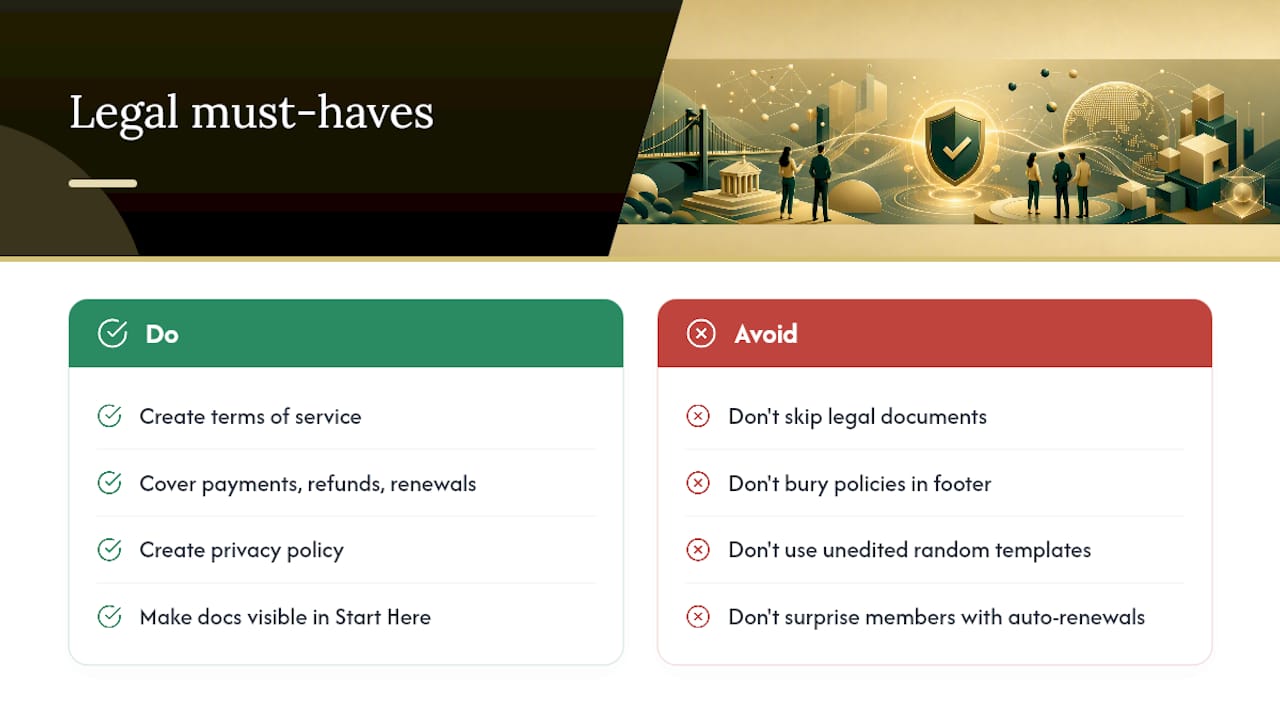
You need two documents before you take a single payment: a terms of service and a privacy policy. Neither needs to be complicated for a first launch, but skipping them entirely creates real risk once you’re handling money and personal data.
Your terms of service should cover what members are paying for, your refund policy, rules for behavior in the community, and your right to remove someone who violates them. Be specific about renewal terms, especially if you’re running monthly billing. Members who get surprised by an auto-renewal charge they didn’t expect are far more likely to file a chargeback than to email you first.
Your privacy policy needs to state what data you collect (email, payment details, any content members post), how you use it, and whether you share it with third parties like your email provider or payment processor. If you have members in the European Union, GDPR rules around consent and data deletion requests apply regardless of where your business is based. If you have members in California, similar disclosure obligations apply under state privacy law.
Most community platforms and payment processors have baseline templates you can adapt, but a generic template pulled from a random website online won’t reflect your specific refund policy or community rules. A few hundred dollars spent having a lawyer review your terms once, early on, is cheaper than a dispute later. Keep both documents visible in your Start Here space, not buried in a footer link nobody clicks.
How Do You Promote a Paid Community Before Launch?
Promotion starts weeks before you open the doors, not the day you do. Your email list, even a small one, is your highest-converting channel because those people already opted in to hear from you. Send a short sequence: one email announcing what’s coming, one email explaining the specific transformation, and one email with a clear deadline to join as a founding member.
Social media works best as a proof engine, not a hard sell. Post about the problem your community solves, share small wins from your one-on-one work if you have any, and use countdown-style posts sparingly, since your locked founding price already creates urgency without a fake clock. Short-form video showing you actually explaining the promise, rather than a polished ad, tends to build more trust for a first launch.
Direct message outreach on the platforms where your audience already spends time (Instagram, a Facebook group, a newsletter reply thread) usually outperforms public posts alone in the first two weeks. A public post gets likes; a direct message gets a decision. Combine both: use public content to build awareness, then follow up privately with people who engaged.
Avoid announcing an exact launch date more than three or four weeks out. A long runway gives people time to forget, not time to get excited.
How Do You Scale a Community After Launch?
Scaling too early is the most common way a promising launch stalls out. The instinct after a successful first cohort is to open the doors wide immediately, but a community that doubles in size before its rituals and staff can support it usually sees attendance and engagement drop within a month.
Scale in stages instead. Once your first 20 to 30 founding members are consistently active and attendance holds above 50%, open a second wave at a slightly higher price. Each new wave should absorb into your existing rituals (the weekly call, the wins thread) rather than getting its own separate track, which fragments engagement instead of growing it.
Content and event formats need to flex as headcount grows. A single weekly call works for 30 members; at 150, you likely need smaller breakout sessions or topic-specific calls so members still get seen. Engagement tactics like rotating hosts, member spotlights, and themed weeks help keep a larger group from feeling anonymous.
Bring in help before you’re overwhelmed, not after. A part-time community manager handling day-to-day questions frees you to focus on content and higher-level strategy once member count crosses roughly 100, though the exact threshold depends on how hands-on your format is.
How Do You Collect and Use Member Feedback?
Feedback should flow through at least three channels: a short survey sent at day 30, direct conversations during live events, and passive signals like which posts get the most replies. Relying on only one of these gives you a distorted picture, since the members most likely to fill out a survey aren’t always the ones closest to churning.
Ask specific questions, not “how’s it going?” Good prompts include “what’s the one thing that would make you renew without hesitation?” and “what almost made you leave in the first two weeks?” The second question surfaces friction points people rarely volunteer unprompted.
Close the loop publicly when you act on feedback. If three members mention the call time doesn’t work, and you move it, say so out loud in the community. That single act (visibly acting on what someone said) does more for retention than almost any content you could post, because it proves the community actually listens.
Set a light cadence: a quick survey every 30 days, a deeper conversation with a handful of long-term members every 90 days, and ongoing passive tracking of which topics or formats get the most engagement. Don’t survey more often than that. Members grow fatigued answering the same questions monthly with nothing visibly changing.
How Do You Make Money Beyond the Initial Membership Fee?
The membership fee is only the first revenue layer. Renewals are the foundation: a member who renews for six months is worth far more than three members who each cancel after one. Protecting that renewal rate matters more than chasing new signups once you’re past your first cohort.
Upsells work best when they solve a problem your core offer intentionally doesn’t cover. If your community teaches a skill in a group setting, a limited-availability 1:1 coaching add-on or a small intensive cohort at a premium price gives your most invested members a next step without diluting the core promise for everyone else.
Micro-products, a single workshop, a template pack, a one-time challenge, give you revenue between renewal cycles and give members a reason to stay engaged even if the main content library feels familiar. Price these separately from the membership, usually somewhere between $20 and $150 depending on scope, so they don’t cannibalize your recurring revenue.
Annual plans, offered after a member has been active for a few months, convert well because by that point they’ve already seen the value. Frame the annual option as a savings versus paying monthly, not as a new product, and offer it to engaged members directly rather than blasting it to everyone at once.
Who Should Run Your Community Day to Day?
A one-person launch can run everything alone for the first month or two, but roles need to split as the community grows, even if the same person wears multiple hats.
The core roles are the promise-keeper (usually you, the creator, responsible for content quality and the main live event), the community manager (day-to-day questions, welcoming new members, moderating discussion), and the operations lead (payments, event scheduling, tech troubleshooting). In a small launch, one person can hold all three. Past roughly 100 active members, most creators find at least the community manager role needs a dedicated person.
Clear ownership prevents the most common failure mode: a new member asks a question, nobody responds for three days because everyone assumed someone else would answer, and that member quietly cancels next billing cycle. Assign a specific person to specific response windows, even if that person is you, and write it down somewhere visible to your team, not just in your head.
Perspective: When Launching Is the Right Call
Launch now if you can name your promise, name ten people who’d pay for it today, and hold a live call within two weeks. Wait if you can’t answer any of those three plainly.
Speed beats polish at this stage. A rough Welcome Party with real members teaches you more in one hour than a month of solo planning ever will. Treat the launch itself as product development: your founding members are giving you the market research a bigger company would pay for.
— Money
How Money Plug Lab Can Take the Launch Off Your Plate
Running audience research, pricing strategy, sales copy, and paid ad production alone while also trying to show up for your first members is a lot to carry at once, and it’s usually where a promising launch stalls. A full-service launch provider can handle that entire operation, from defining the offer to running the paid creative that fills your founding cohort, often on a revenue-share basis with no upfront cost to you.
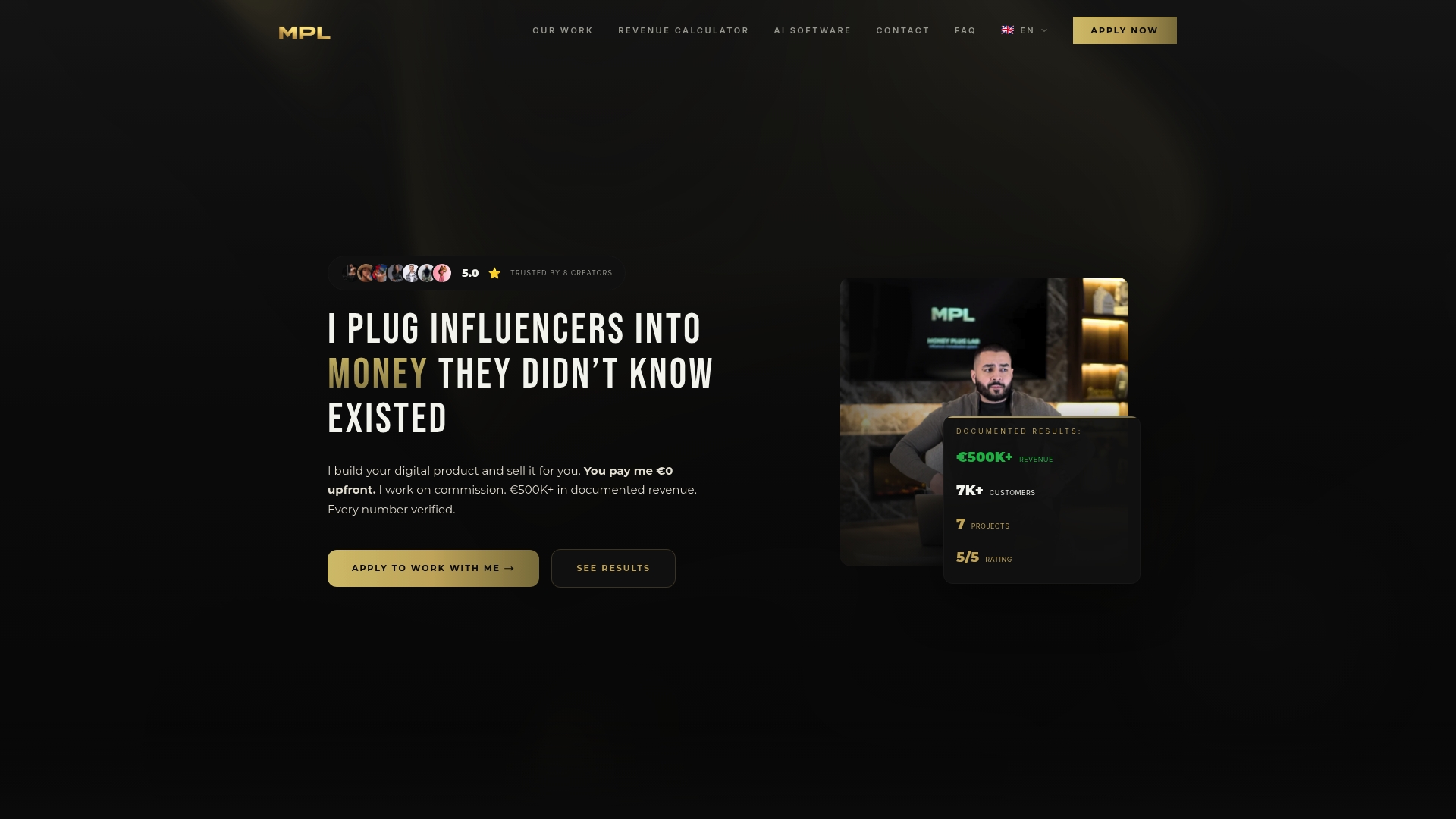
This model makes the most sense for creators who already have an engaged audience and a clear skill or result to sell, but don’t have the time or team to build sales copy, launch campaigns, and payment infrastructure from scratch. If you’d rather spend your hours coaching members than fighting with a checkout page, a managed launch closes that gap. If you genuinely enjoy the operational side and have the hours to spare, DIY with the framework above works fine too.
For creators who want the full-service route, Money Plug Lab’s launch system covers everything from product architecture to post-launch retargeting. Reach out through the Money Plug Lab site to talk through whether a revenue-share launch fits your audience and timeline.
Sources
For the week-by-week mechanics, read Heartbeat’s 4-week launch framework. For founding-member recruitment tactics, see SkillScouter’s step-by-step guide. For pricing tier examples, check Sense Central’s launch breakdown. For the retention economics behind why founding members matter long-term, read Harvard Business Review.
- How to launch a paid community in 4 weeks - Heartbeat
- How to Start a Paid Community in 2026: A Step-by-Step Guide - SkillScouter
- The value of keeping the right customers - Harvard Business Review
FAQ
How Many Founding Members Do You Need to Launch?
Most launch guides recommend recruiting 10 to 30 founding members before opening to the public. That number is enough to create real conversation and social proof without requiring a large audience.
How Long Does It Take to Launch a Paid Community?
A focused launch takes about four weeks using a clarify, build, warm, launch structure. Rushing past validation to build extensive content first usually wastes time on features members never asked for.
What Should I Charge for My First Paid Community?
Starter tiers typically run $9 to $29 a month, professional tiers $19 to $99 a month, and premium cohorts $300 to $2,000 or more, based on access level and support. Founding members should get the lowest price in your target tier, locked in permanently.
Do I Need a Big Following to Launch a Paid Community?
No. A narrow, engaged audience of a few hundred people who trust you converts better than a large passive following. Twenty engaged founding members who get real results matter more than 200 people who never show up.
How Much Does Money Plug Lab Charge to Launch a Community?
Money Plug Lab works on a revenue-share basis with zero upfront cost, so pricing depends on the specific launch and program. Current details are available directly through the Money Plug Lab site.