First 30 Days: Creator Launch Optimization Strategy and Enterprise Ops
First 30 Days: Creator Launch Optimization Strategy and Enterprise Ops

A launch optimization strategy is a repeatable system, not a checklist you close out after opening week. The first move: pick one to three outcome KPIs (activation, retention, revenue) and launch a single prioritized experiment against the biggest friction point in your funnel today. Treat the next 30 days as the highest-leverage window you’ll get.
TL;DR:
- Small, iterative fixes in the first 30 days post-launch significantly impact revenue, emphasizing focused experimentation and tracking.
- Organizing cross-functional teams with clear ownership improves launch performance and maintains momentum beyond the initial week.
- Prioritizing fixes like hero-path optimization and soft launches reduces risks before testing offers or prices.
- Consistent, documented testing with structured hypotheses and a shared registry prevents repeated failures and enhances decision-making.
- Regular weekly audits and a dedicated launch owner are crucial to fixing measurement gaps, creative churn, and over-correction issues.
Table of Contents
- Why Post-Launch Optimization Matters (and What Launch Drift Costs You)
- Which Metrics Actually Predict Launch Success?
- How Do You Build a Repeatable Testing Process?
- How Should You Prioritize and Sequence Launch Fixes?
- Who Should Own Launch Optimization on Your Team?
- What Goes Wrong After Launch, and How Do You Fix It?
- How Creator Launches Actually Apply This Playbook
- Adopt the System, Not the Stunt
- How Money-plug Turns This Playbook Into a Managed Pilot
- Sources
- FAQ
Why Post-Launch Optimization Matters (and What Launch Drift Costs You)
Most teams pour months into the launch date, then quietly stop working the day after it happens. That drop in attention has a name worth knowing: launch drift, the slow decay of performance that sets in once the launch team disbands and nobody owns the follow-through.
The 30 to 90 day window after launch is when small, iterative fixes compound into real revenue or get ignored until the ad account is bleeding money. HubSpot’s research on digital marketing optimization points to a specific shift among effective teams: they stop running one-off A/B tests and move to a quarterly-reviewed experimentation cadence, tracking both quick signals like CTR and slower ones like activation and retention.
Ad-hoc fixes fail for a predictable reason: they solve the loudest complaint, not the biggest leak. A system beats improvisation because it forces you to:
- Rank problems by revenue impact instead of who complained last
- Keep a record of what you already tried, so you stop repeating failed tests
- Separate a genuine strategy problem (wrong offer, wrong price) from a simple execution bug
McKinsey’s research on launch performance backs this up directly: the strongest predictor of a successful launch isn’t the product itself but organized team capability and cross-functional coordination. A system is what makes that coordination possible past week one.
Which Metrics Actually Predict Launch Success?
Two categories matter, and confusing them is where most measurement plans fall apart. Leading indicators tell you something is wrong within days. Lagging indicators tell you whether the fix actually worked, usually weeks later.
Leading indicators to watch daily:
- Click-through rate on ads and landing page headlines
- Landing-page engagement (scroll depth, time on hero section)
- Funnel drop-off points, ideally mapped with heatmap or session-recording tools
Lagging indicators to review weekly or monthly:
- Activation rate (the percentage of buyers who actually use or start what they bought)
- 7 to 30 day retention, tracked by cohort, not by blended average
- Repeat purchase rate or feature adoption depth
Statistic Callout: Amplitude’s guidance on campaign optimization makes a point most launch teams miss: campaign metadata means little on its own. Linking UTM tags to downstream cohort outcomes, not just clicks, is what turns ad spend data into a real budget-reallocation decision.
The minimum instrumentation checklist before you launch anything: tag every campaign with consistent UTM parameters, define what “activation” means in a single sentence your whole team agrees on, set a cohort window (7 and 30 days is standard), and confirm your analytics tool actually fires events on checkout, signup, and first use. Skipping that last step is the single most common reason launch data looks fine for a week, then falls apart the moment someone asks why retention is soft.
How Do You Build a Repeatable Testing Process?
Every solid experiment moves through six stages, in order, without skipping the documentation step because it feels slow.
- Hypothesis: state what you believe is broken and why, in one sentence (“Checkout drop-off is high because shipping cost appears too late”)
- Prioritization: score it against other candidate tests before touching anything
- Plan: define sample size, test duration, and the one variable you’re isolating
- Execution: run the test without touching a second variable mid-flight
- Analysis: check statistical confidence before declaring a winner
- Rollout or rollback: scale what works, kill what doesn’t, and log both outcomes
Use one-variable-at-a-time A/B tests for most launch-stage decisions. Reach for multivariate testing only once traffic volume is high enough to support several combinations without dragging the test out for months. Guardrail rule of thumb: don’t call a test before it has enough conversions per variant to trust the result, and don’t extend it past four weeks just because the number hasn’t moved yet.
Pro Tip: Keep a living test registry, even a shared spreadsheet works, logging the hypothesis, dates, sample size, and result for every test. Six months from now, that registry is the only thing standing between your team and re-running an experiment you already ran and already failed.

Cadence matters as much as method. Monitor active tests weekly. Review the full experimentation program quarterly, the same rhythm HubSpot recommends for teams that outgrow opportunistic testing. That quarterly review is where you decide whether your whole testing focus needs to shift, not just which button color won.
How Should You Prioritize and Sequence Launch Fixes?
Not every idea deserves a test slot. Score each candidate with a simple triage formula: impact times confidence, divided by effort.
- Run a soft launch first. A small cohort, sometimes as few as 25 high-intent users, surfaces onboarding friction before it burns paid traffic. Set a defined feedback loop and commit to weekly fixes based on what that cohort tells you.
- Fix the hero path before anything else. Headline clarity, page speed, and the primary call to action account for more lost conversions than most secondary elements combined.
- Test offer and pricing only after the hero path is clean. Changing your price against a broken headline just muddies which variable actually moved the number.
- Scale only confirmed winners. A pre-launch audience, sometimes called a minimum viable audience, is one of the strongest predictors of day-one performance, which is exactly why soft launches beat cold full-scale rollouts.
Who Should Own Launch Optimization on Your Team?
Optimization dies quietly when everyone assumes someone else owns it. Assign these roles explicitly, even if one person wears two hats on a small team:
- Launch owner: final call on scope, budget, and go/no-go decisions
- Analytics owner: guards event definitions and cohort accuracy
- Experimentation lead: runs the test registry and enforces one-variable discipline
- Creative owner: manages ad and creative rotation without letting churn outpace the data
- Product liaison: feeds real user friction back into the roadmap
McKinsey calls the mature version of this a launch center of excellence, a standing group that reuses the same playbook and decision log across every launch instead of reinventing process each time. The artifacts that make this work: a test registry, a decision log explaining why each call was made, a launch ROI dashboard visible to the whole team, and a written playbook. Set a budget threshold below which the experimentation lead can approve a fix without escalation, so small corrections don’t wait a week for a meeting.
What Goes Wrong After Launch, and How Do You Fix It?
Three problems show up in almost every post-launch review, and each has a specific fix rather than a general one.
- Measurement gaps. Different tools define “conversion” differently across your stack. Align event definitions across every platform, use consistent cohort windows, and spot-check a sample of raw data against your dashboard before trusting either.
- Creative churn. Swapping creative too fast makes it impossible to tell what actually worked. Keep a control variant running at all times and freeze declared winners before scaling spend behind them.
- Over-correction. Reacting to a three-day dip with a full pivot usually means you moved before the sample size supported a decision. Set a minimum confidence interval before any test result changes strategy, and roll out big changes in stages, not all at once.
Pro Tip: Run a 20-minute weekly audit: pull activation and retention by cohort, check for any event that silently stopped firing, and confirm your top three tests still have a live control. If your team lacks the analytics depth to run this audit consistently, bringing in outside help for a short pilot often costs less than the ad spend wasted diagnosing the problem yourselves.
How Creator Launches Actually Apply This Playbook
An agency’s work with creators across the Balkans and diaspora follows this system directly, not as theory but as the operating rhythm behind several launched programs and significant tracked revenue, including a launch closing thousands of sales in ten days. The process runs in a fixed order: audience research, a soft launch to a small warm cohort, creative testing against a live control, value-based retargeting once early buyer data exists, then scaling only what’s confirmed.
- Audience research sets the offer before a single ad runs
- Soft launch to a limited cohort catches onboarding friction early
- Creative testing rotates variants against a frozen control, never blind
- Value-based retargeting targets spend toward the buyer segments already showing the highest downstream value, the same tactic behind an 18x return on one client campaign
- Scale only after the test registry confirms a real winner
Adopt the System, Not the Stunt
Launches fail slower than they succeed, usually in the quiet weeks after the big push, when nobody’s watching the dashboard anymore. Teams that win aren’t the ones with the cleverest launch day stunt. They’re the ones who committed to a test registry, gave one person clear ownership of the numbers, and kept showing up to the data every week whether it was exciting or not.
That’s a cultural shift more than a technical one. Pilot a 30-day optimization sprint on your next launch, one owner, one KPI set, one registry, and see what changes.
— Money
How Money-plug Turns This Playbook Into a Managed Pilot
Some agencies bill you upfront whether the launch works or not. This agency runs on a pure revenue share, meaning the incentive to keep optimizing past week one is built into how the agency gets paid at all. The service includes audience research, pricing strategy, sales copy, video sales letters, paid ad production, and the full post-launch testing cycle described above, applied specifically to creator-led programs, coaching offers, and paid communities in markets where acquisition costs run far below Western norms.
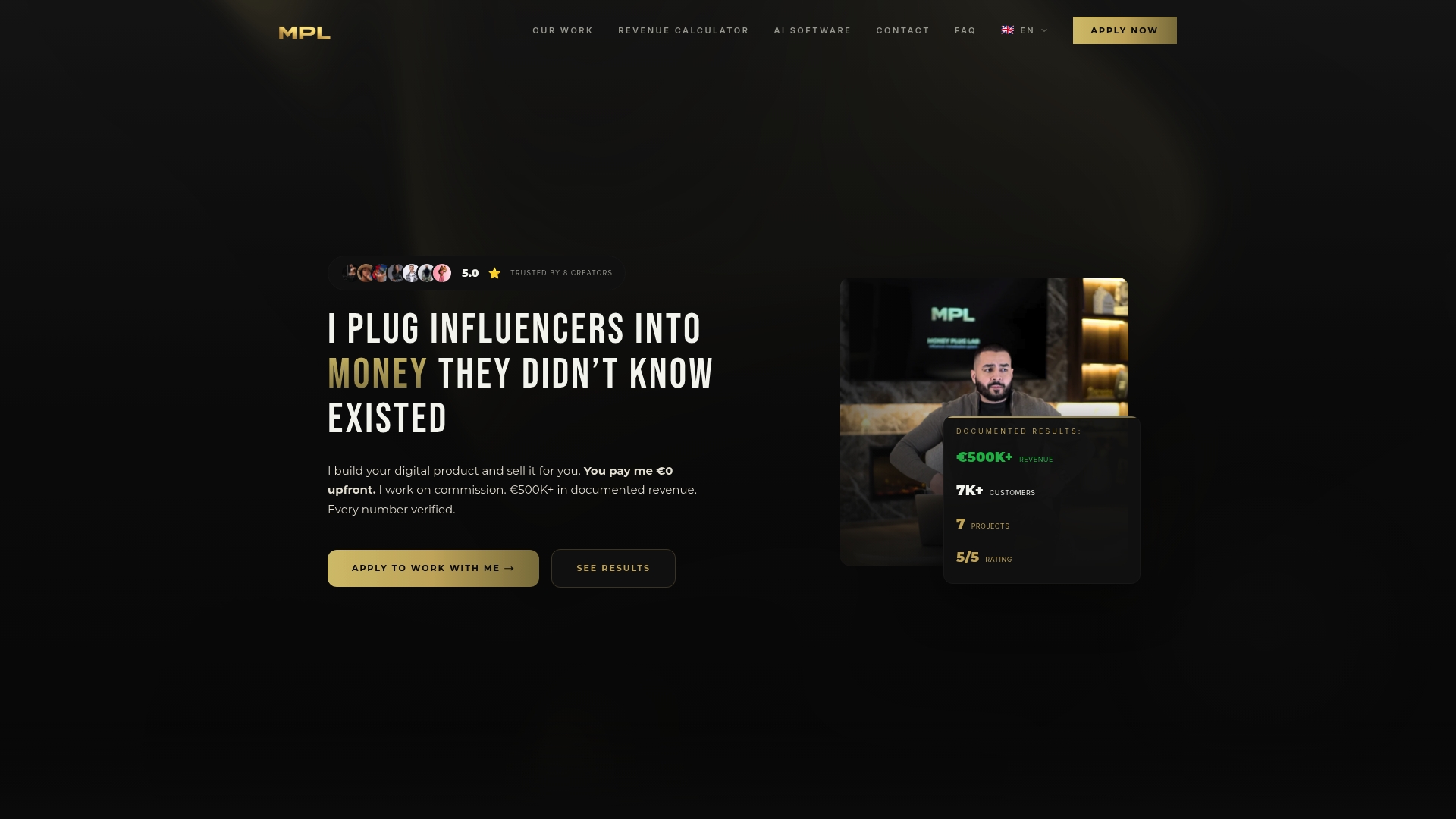
If you’re a creator or coach sitting on an audience but no system for turning it into recurring revenue, the next step is a discovery call, not a redesign. Money-plug will walk through your funnel, flag the highest-friction step, and outline what a soft-launch pilot would look like before either side commits to anything. Start that conversation at Money-plug.
Sources
- Digital marketing optimization
- How to make sure your next product or service launch drives growth (McKinsey)
- Campaign optimization strategies
FAQ
What Is a Launch Optimization Strategy?
It’s a repeatable system for improving product or campaign performance after launch, built on defined KPIs, a structured testing cadence, and clear ownership, rather than a one-time push that ends on launch day.
What Is an Optimization Strategy in Marketing?
An optimization strategy in marketing is a structured process for testing and improving specific metrics, usually conversion, activation, or retention, through hypothesis-driven experiments run on a consistent schedule rather than reactive tweaks.
What Are the Top SEO or Optimization Strategies for a New Launch?
The highest-impact moves are fixing hero-path friction first (headlines, load speed, call to action), instrumenting UTM tracking tied to downstream outcomes, and running a soft launch before full-scale paid promotion.
How Long Should a Post-Launch Optimization Window Last?
Most of the highest-leverage fixes happen in the first 30 days after launch, with a full quarterly review cycle after that to catch slower-moving retention and adoption trends.
Can a Creator or Small Team Run This Without a Big Analytics Department?
Yes. A single owner tracking one to three KPIs, a shared test registry, and a soft launch to a small warm cohort covers most of what a launch optimization strategy needs, and agencies like Money-plug run this exact process for creators without in-house analytics teams.