Founding Cohort: Launch to Retain for Recurring Revenue Creators
Founding Cohort: Launch to Retain for Recurring Revenue Creators

The fastest route to predictable creator income is a recurring revenue base, built through memberships or subscriptions, validated with a founding-member presell before you build anything else. Retention and pricing decisions matter more than audience size in the first 90 days. Skip the content vault. Talk to 10 to 20 people, cap a founding cohort, set a deadline, and let their feedback shape what you build next.
TL;DR:
- Building a recurring revenue base requires a founding-member presell and focuses on retention and pricing over audience size in the first 90 days.
- Optimal models vary: community memberships suit ongoing transformation, subscriptions fit high-output creators, and hybrid offers combine both approaches for broader audiences.
- A strong onboarding sequence that delivers quick wins within the first week is crucial to reduce churn, especially during the first 30 days.
- Monitoring metrics like monthly recurring revenue, churn rate, and average revenue per user helps track growth and informs pricing adjustments.
- Validating demand through early interviews, waitlists, and initial offers prevents wasted effort and ensures product-market fit before building a full product.
Table of Contents
- Why Recurring Revenue Creators Outperform One-Time Sellers
- Memberships, Subscriptions, or Hybrid: Which Model Fits You?
- Building a Retention System That Actually Reduces Churn
- Pricing and the Metrics That Tell You What’s Working
- How to Validate Demand Before You Build Anything
- Adding One-Time Offers Without Wrecking Your Recurring Base
- Money Plug Lab: What Working With an Agency Actually Looks Like
- The Real Test Isn’t the Launch. It’s Month Two.
- An Optional Managed Path for Scaling Faster
- Where to Learn More About Recurring Revenue Models
- Sources
Why Recurring Revenue Creators Outperform One-Time Sellers
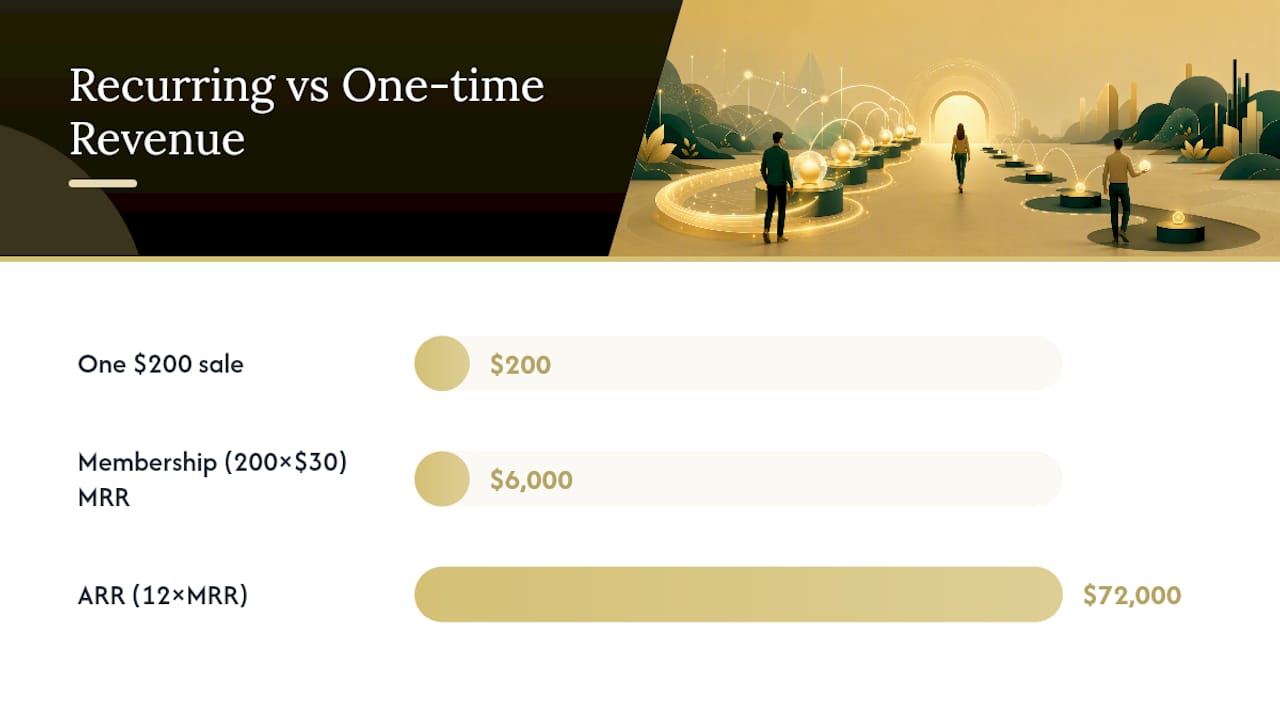
A creator selling one $200 course has to find a new buyer every single month to hit the same number twice. A creator running a $30 membership with 200 members wakes up every month already at $6,000, before a single new sale. That’s the entire argument for recurring revenue, and it’s why recurring revenue creates a predictable, compounding income base that keeps building on what you’ve already earned.
Monthly recurring revenue (MRR) is your operating number. Annual recurring revenue (ARR) is MRR multiplied by 12, useful for forecasting and for conversations with lenders or investors, but not something you should manage week to week. Each member you keep raises your floor for the following month. Each member you lose lowers it. That’s the compounding effect, and it’s also the thing most new creators underestimate: growth without retention is just a treadmill.
Here’s the myth worth killing outright: recurring revenue is not passive income. A membership is an ongoing value exchange, not a set-and-forget asset. You owe members something new, useful, or engaging every month, or they cancel.
What a predictable floor actually buys you:
- Room to invest in product quality instead of chasing the next launch
- Cash flow stability that supports better business planning and hiring decisions
- Leverage to say no to bad-fit sponsorships or rushed launches
The number that matters most early on: compounding becomes visible once you cross roughly 100 retained members. Below that, growth feels slow because churn eats a bigger share of your gains.
Memberships, Subscriptions, or Hybrid: Which Model Fits You?
Not every creator should run the same offer. The model needs to match how you create and how your audience wants to engage.
- Community-first memberships. These work best when the transformation is ongoing: fitness, habit change, skill-building, or peer accountability. Retention comes from belonging, not just content drops. Members stick around mainly for the people and the sense of belonging, which is why a quiet Discord with no engagement rituals churns faster than a smaller, louder one.
- Content and access subscriptions. If you publish frequently, whether that’s a newsletter, a video series, or weekly templates, a straight access subscription usually beats a community model. There’s less overhead, and the value proposition is simpler to explain: pay monthly, get the drop.
- Hybrid models. Many creators blend a base membership with a cohort-based course launched quarterly, or add usage-based components like extra coaching calls or premium templates. Hybrid pricing that pairs a subscription base with usage or outcome components is now common precisely because it protects the predictable floor while still capturing upside from your most engaged members.
If your audience craves connection and accountability, start with community. If you’re already a high-output publisher, subscriptions are the lower-effort path. If you have both a loyal core and a broader casual audience, hybrid usually wins, but only after you’ve proven the base model works.
Building a Retention System That Actually Reduces Churn
Acquisition gets the attention, but retention is where the real margin lives. Losing a member costs you far more than the value of one month’s fee, because you also lose everything they might have paid over the following year. That’s why the first 30 days deserve more design work than almost any other part of the business.
Build an onboarding sequence that delivers a genuine early win within the first week, not just a welcome email. A fitness membership might assign a first workout and a check-in call. A writing community might pair new members with a peer for feedback on their first draft. That early win is what determines whether someone renews at day 30.

Cadence matters just as much as content quality. Live sessions build urgency and connection but demand your time every week. Evergreen content scales better but can feel impersonal if it’s the only thing members get. Most successful memberships run a hybrid cadence: one live touchpoint monthly, evergreen resources filling the gaps.
Community mechanics worth building early:
- Clear member roles (new, established, veteran) with visible status
- Accountability pairs or small pods instead of one giant feed
- A referral mechanic that rewards members for bringing in people who’ll actually engage
- Payment recovery flows that catch failed cards before a member silently churns
Pro Tip: Segment your renewal communications by tenure. A member on month one needs onboarding nudges. A member on month eleven needs a “look how far you’ve come” recap. Sending the same email to both is how you lose the ones closest to their renewal decision.
Pricing and the Metrics That Tell You What’s Working
Four numbers should live on your dashboard, whether that’s a spreadsheet or a proper analytics tool.
| Metric | What it measures | Why it matters |
|---|---|---|
| MRR | Total recurring revenue collected per month | Your real-time operating number |
| ARR | MRR annualized (MRR × 12) | Long-term forecasting, not week-to-week decisions |
| Churn rate | Percentage of members who cancel in a given period | The single biggest lever on compounding growth |
| ARPU | Average revenue per user | Tells you if pricing or upsells are working |
Pricing your first cohort is less about finding the “correct” number and more about finding a price that filters for committed members. A founding-member rate, often 20 to 40% below your eventual list price, rewards early trust and gives you a group willing to give real feedback. After that presell window closes, raise the price for new members and grandfather the founders in.
Monthly versus annual billing is a real trade-off, not just a preference. Monthly plans lower the barrier to join but expose you to more churn events. Annual plans lock in cash and reduce churn exposure, but you need a strong enough onboarding experience to justify the bigger upfront ask.
Billing mechanics you cannot ignore:
- Free or discounted trials that convert into paid without friction
- Automated card recovery. Payment recovery tools recovered $6.5 billion in failed transactions in 2024, which shows how much revenue involuntary churn quietly eats
- A clear refund policy that protects trust without inviting abuse
Add hybrid or usage-based pricing only after your base subscription is stable. Layering complexity onto an unproven offer just confuses new buyers.
How to Validate Demand Before You Build Anything
You do not need a finished product, a content library, or a slick app to test whether people will pay you monthly. You need proof that a specific group wants a specific outcome badly enough to commit money before it exists.
- Interview 10 to 20 people from your existing audience. Ask what they’ve tried, what failed, and what result they’d pay monthly to get. Founders who skip this step and build first usually end up guessing at what members actually want.
- Open a waitlist, then a capped founding-member presale with a real deadline. A cap creates urgency without gimmicks. Founding-member offers with a deadline and immediate value consistently convert better than open-ended enrollment.
- Deliver a live onboarding experience immediately, even if the full product isn’t built yet. A kickoff call or a first live session buys you time to build the rest around what this cohort actually needs.
- Track three numbers religiously: presale conversion rate, refund rate, and 30-day retention. Those three tell you more about product-market fit than any survey ever will.
If your founding cohort converts well but churns fast at day 30, the problem isn’t your offer. It’s your onboarding.
Adding One-Time Offers Without Wrecking Your Recurring Base
A healthy membership doesn’t live on subscription revenue alone. Layering the occasional one-time offer, a workshop, a template pack, an intensive, adds upside in three ways: it upsells your most engaged members, reactivates people who lapsed, and creates natural urgency that a standing subscription can’t generate on its own.
The offers that convert best inside an existing community are usually narrow and outcome-specific: a 5-day challenge, a done-with-you session, a physical or digital add-on tied directly to what the membership already promises. Timing matters. Present these offers to segments, not your whole list. New members need time to get value from the core offer before you pitch anything extra.
Price one-time offers high enough that they don’t look like a shortcut around the membership itself:
- Keep the core recurring price untouched when a launch is live
- Offer launch pricing to non-members, not steep discounts to current ones
- Cap launch windows so they don’t quietly become a second subscription
Money Plug Lab: What Working With an Agency Actually Looks Like
Some creators want to run every piece of this themselves. Others would rather hand off the mechanics and focus on the audience relationship. Money Plug Lab exists for the second group.
The agency’s scope covers audience research, product architecture, pricing strategy, sales copy, video sales letters, full launch campaigns, and payment infrastructure setup, all on a revenue-share basis with no upfront cost to the creator. That structure only works if the launch performs, which keeps incentives aligned on both sides.
Proof points from programs the agency has launched:
- A significant amount of tracked revenue generated across multiple launched programs
- A single launch that produced thousands of sales in a short period
- A campaign that returned a high multiple on ad spend
Creators who already have an engaged audience but lack the time or systems to turn that audience into recurring revenue are the ones who benefit most from a managed partnership. The work is the same either way: research, pricing, retention design, and launch execution. The only question is who does it.
If you’re comfortable running interviews, writing your own sales page, and managing a payment processor, the founding-cohort approach above works fine solo. If any of that feels like the part that would stall your launch for months, that’s the signal to bring in help.
The Real Test Isn’t the Launch. It’s Month Two.
Most creators obsess over the first sale and barely plan for the thirtieth day. That’s backwards. A launch with a mediocre offer but a strong onboarding sequence will beat a brilliant offer with a weak one, every time, because retention compounds and launches don’t.
Start smaller than feels comfortable. Validate with a founding cohort before you build anything permanent. Then spend your first month obsessed with one number: how many of those founding members are still active and paying on day 30. Everything else, pricing tweaks, new content, bigger launches, only works once that number holds steady.
Treat recurring revenue as a system you build and tune, not a feature you bolt onto an existing audience.
— Money
An Optional Managed Path for Scaling Faster
Running the founding-cohort playbook solo works, but it takes real hours: interviews, pricing tests, copywriting, and building payment infrastructure from scratch. Money-plug offers a different route to the same outcome, one where the research, product architecture, sales copy, and launch campaign get built around your audience instead of you piecing it together between content deadlines.
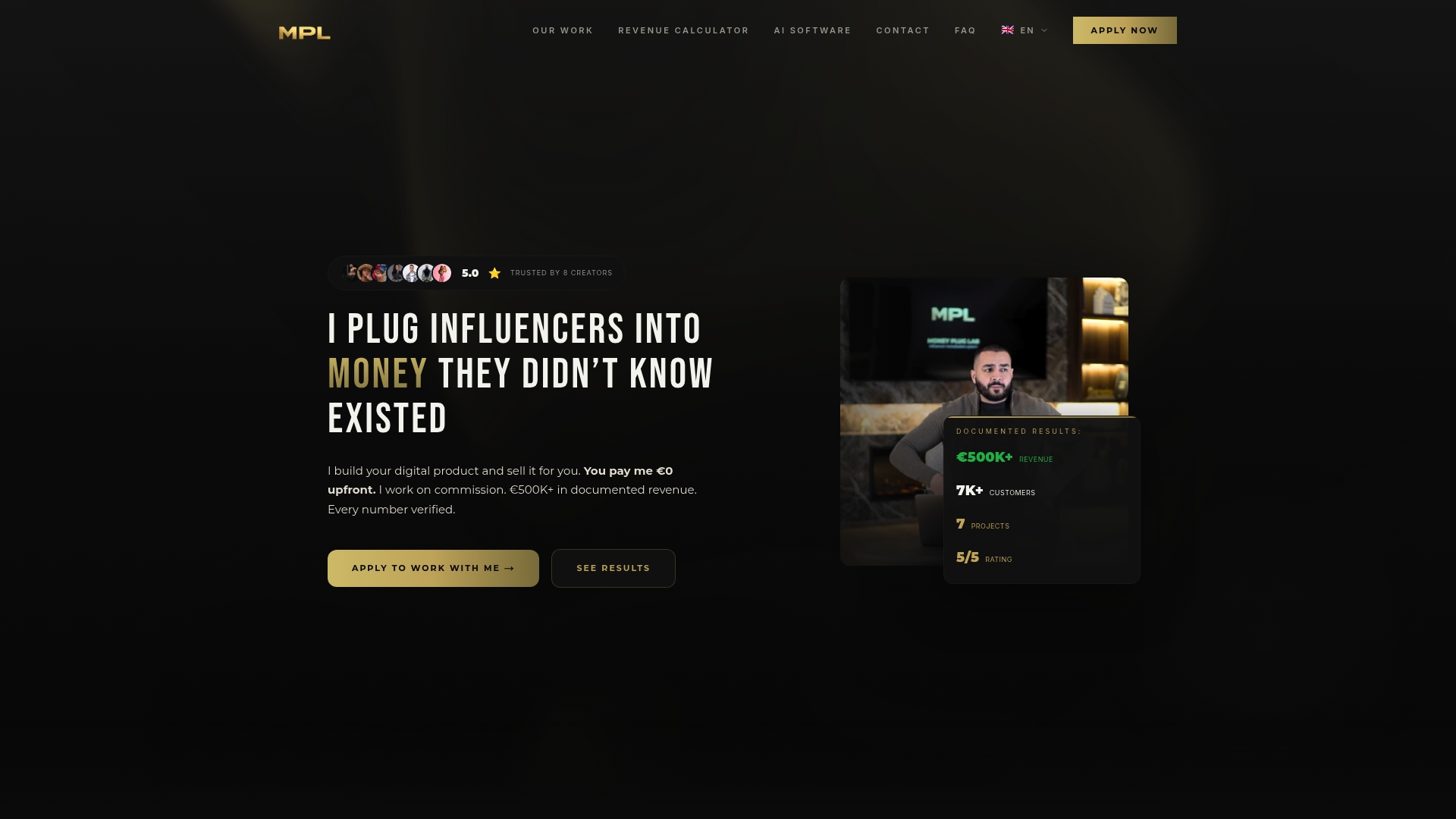
The agency operates on a pure revenue-share model, so there’s no upfront cost regardless of how the launch performs. That structure tends to fit creators who already have an engaged audience but haven’t had the bandwidth to turn that audience into a paying membership or subscription base. Money-plug handles the mechanics, from payment infrastructure to post-production on paid ads, while you stay focused on the relationship with your audience.
If a managed launch sounds like the faster path for your situation, visit the Money Plug™ site to see how the revenue-share partnership works and what a launch plan would look like for your audience.
Where to Learn More About Recurring Revenue Models
For deeper reading on pricing structures and hybrid models, Chargebee’s breakdown of subscription business models covers the shift toward usage-based pricing in detail. Circle’s posts on monthly recurring revenue and recurring versus one-time sales go further into retention mechanics, while Stripe’s subscription resources explain the billing infrastructure side.
Sources
- Recurring revenue vs one-time sales: why smart creators use both
- What Creator Businesses Should Know About The Recurring Revenue Model
- Subscription Business Models: Types, Pricing, And The Shift To Hybrid
- Subscription revenue models: types, how they work and how to choose one