Nine Launch Tested Refund Clauses for Digital Products
Nine Launch Tested Refund Clauses for Digital Products

Delivered digital products (courses, ebooks, software downloads) are generally treated as final sales once accessed, but that default breaks down fast: faulty files, misdescribed content, and platform-specific windows can force a refund regardless of what your policy says. Subscriptions and consumables follow different math, usually prorated rather than fully refunded. The safest default for most creators is a short no-refund policy with clear fault exceptions and a brief preview or trial window built in before the sale locks.
TL;DR:
- Refunds are legally required for faulty digital products or those that do not match their description, regardless of your no-refund policy.
- Digital content consumption rights can be waived by buyers at checkout, but missing this step may obligate refunds even after access begins.
- Tax and VAT obligations depend on the buyer’s location and can require precise invoicing and documentation, especially for cross-border digital sales.
- Effective refund policies should specify scope, eligibility, fault exceptions, trial windows, proration rules, and clear request procedures to prevent disputes.
- Major platforms like Steam, PlayStation, and Ubisoft have specific refund windows and exceptions that sellers must match in their product descriptions to avoid surprises.
Table of Contents
- When Does the Law Actually Require a Refund?
- What Should a Digital Product Refund Policy Include?
- How Should You Handle a Refund Request?
- How Do Major Platforms Handle Digital Refunds?
- What Has Money-plug Learned From Launch-Tested Refund Policies?
- Where Should Your Refund Policy Actually Appear?
- Why the Standard Refund Advice Sells Creators Short
- Sources
When Does the Law Actually Require a Refund?
Consumer-protection law almost always wins over your stated policy when a digital product is faulty, doesn’t match its description, or fails to work as advertised. That’s true whether you sell to a buyer in Ohio, Ontario, or Berlin. A “no refunds, ever” clause has no legal weight against a defective download.
Where things get complicated is the cooling-off period. Many countries give consumers a right to cancel physical and some digital purchases within a set window, but most carve out an exception once the buyer has started downloading or streaming digital content and acknowledged that the right disappears at that point. That’s why so many checkout flows include a small checkbox confirming the buyer understands they’re waiving cancellation rights by starting the download immediately. Skip that step and you may owe a refund even on content the customer has already consumed.
Tax obligations follow the sale, not just the refund. For digital services sold to private consumers, VAT treatment generally follows the customer’s location rather than the seller’s, according to UK guidance on VAT rules for digital services. That means a creator based in one country selling a course to a buyer in another still has to think about vat on online courses and vat on digital services in the buyer’s jurisdiction, not just their own. Recent EU reform pushes this further: Directive (EU) 2025/516 tightens electronic invoicing and reporting standards for cross-border digital supplies, which raises the bar on how precisely you need to document every refund and reversed invoice. Many countries also treat electronically supplied services as taxable regardless of where the seller sits, and track registration thresholds sellers need to watch, per Avalara’s global VAT and GST guide.
Practical takeaways for your policy:
- Never advertise “no refunds” as an absolute; add a fault and misdescription exception every time.
- Log every refund against its original invoice, especially for EU or UK buyers, since incorrect VAT records can trigger audits independent of the refund itself.
- If more than a small share of your revenue comes from cross-border buyers, get a tax advisor to check your invoicing setup before your next launch, not after a dispute.
What Should a Digital Product Refund Policy Include?
A refund policy that actually protects you covers nine things. Miss one, and you’re improvising during a dispute, which is when creators say things they regret in writing.
- Scope — which products the policy covers (courses, templates, software, memberships) and whether different products get different rules.
- Eligibility — the conditions under which a buyer qualifies (unopened, undownloaded, within X days).
- Fault exceptions — a plain statement that broken files, missing content, or major misdescription always qualify for a refund.
- Trial or preview window — how much of the course or software the buyer can sample before the no-refund clause kicks in.
- Subscriptions and proration — whether canceling mid-cycle gets a partial refund or just stops future billing.
- Request process — exactly how to ask (email, form, support ticket) and what proof is needed.
- Timeline — how many business days you take to decide and to process the money back.
- Refund method — original payment method, store credit, or platform wallet.
- Contact and dispute path — who to escalate to if the buyer disagrees with your decision.
Here are copy-ready clauses to adapt:
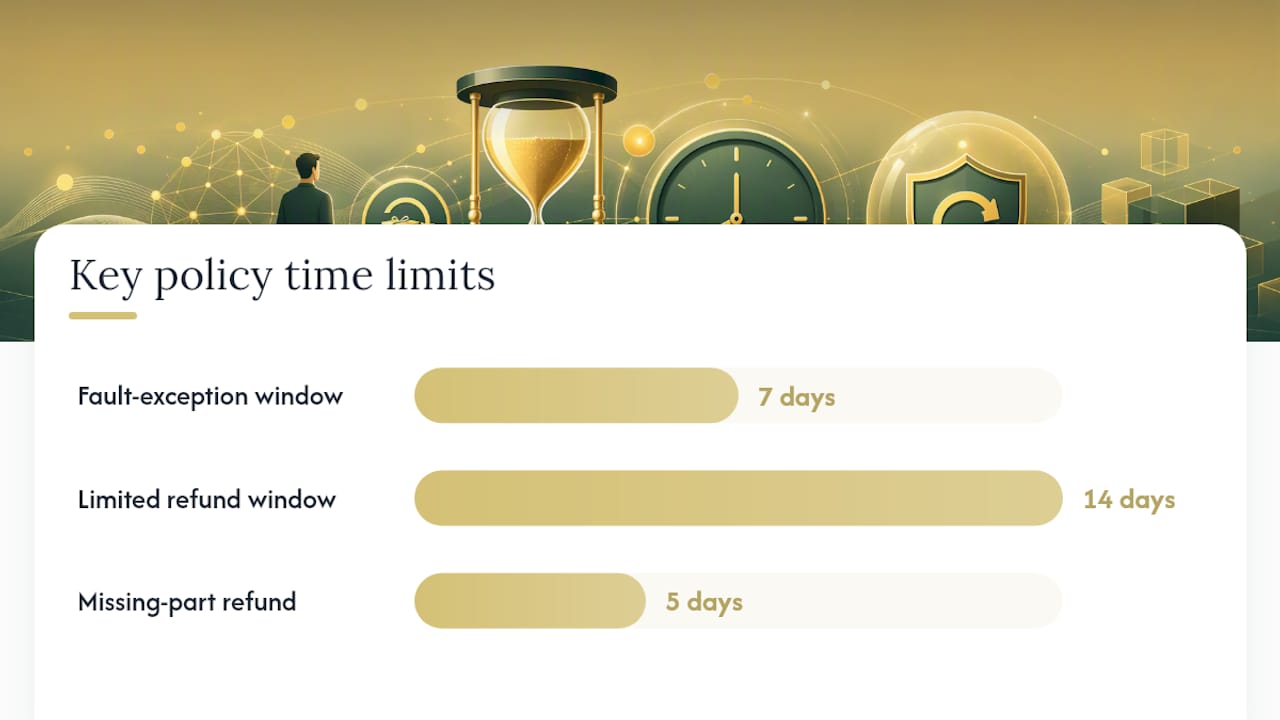
Full no-refund with fault exception: “All sales are final once course materials are accessed. If content is missing, corrupted, or materially different from what was advertised, contact support within 7 days for a full refund.”
14-day limited window: “You may request a refund within 14 days of purchase if you have completed less than 20% of the course.”
Subscription proration: “Canceling mid-cycle stops future billing immediately; the current billing period is non-refundable but remains active until it ends.”
Partial refund for incomplete delivery: “If only part of a bundled product was delivered, we’ll refund the value of the missing component within 5 business days.”
Pro Tip: Avoid vague words like “reasonable time” or “significant issue” in your policy. Vague language is exactly what buyers and payment processors exploit during a dispute, because it invites their interpretation instead of yours.
How Should You Handle a Refund Request?
Treat every request the same way, every time. Consistency is what protects you if a buyer escalates to a chargeback.
Start with a first-response checklist: pull the order ID, payment receipt, download or access logs, and any prior support messages before you reply. Logging delivery timestamps and access records at the point of sale makes this step fast instead of a scramble, and it’s the single biggest lever for winning disputes later.
Then apply a simple decision rubric:
- Full refund when the product is genuinely faulty, misdescribed, or undelivered.
- Partial refund when only part of a bundle failed, or a subscriber cancels mid-cycle under a proration clause.
- Denial with a documented reason when the buyer simply changed their mind after consuming most of the content, and your policy clearly excludes that case.
Write down the reasoning for every decision, not just the outcome. That record is what you’ll need if the buyer files a chargeback instead of accepting your answer.
Digital product chargebacks are harder to win than refunds because the payment provider, not you, makes the call. Respond to chargeback notices with your logged evidence: delivery timestamps, the buyer’s own acceptance of your terms at checkout, and your support thread. Contest only when your evidence is clean; a weak contest costs you the dispute fee on top of the original sale. Standardize your response templates and set a firm internal timeline (say, 3 business days to decide, 5 to process the refund) so nothing sits unresolved long enough to become a chargeback in the first place.
How Do Major Platforms Handle Digital Refunds?
Selling through a marketplace means their refund rules can override yours, so it pays to know the patterns before you list a product there.
- Steam refunds most purchases within 14 days of purchase if the title has been played less than two hours, no reason required, according to Steam’s refund policy.
- PlayStation Store and Ubisoft Store generally allow refunds within 14 days if content hasn’t been downloaded, streamed, or consumed, per the Ubisoft Store refund policy; wallet funds and virtual currency usually become non-refundable once added or spent, per PlayStation’s own refund guidance.
- Shopify and similar marketplaces run their own chargeback and dispute flow that can process a refund independent of your posted policy.
| Platform type | Typical refund window | Common exception |
|---|---|---|
| Game stores (Steam) | 14 days | Played over 2 hours |
| Console/publisher stores | 14 days | Content downloaded or wallet funds spent |
| Subscription services | Prorated, varies | Current billing period non-refundable |
If you sell through any of these channels, write your product page copy to match their rules, not just your own, so buyers aren’t surprised twice.
What Has Money-plug Learned From Launch-Tested Refund Policies?
Across the launches Money-plug has run for creators in fitness, coaching, and wellness niches, the policy structure that holds up best is short and specific: a clear no-refund-for-change-of-mind clause paired with a brief preview and a fault-based exception. Buyers who can sample a module before committing rarely file a dispute over content they never previewed.
Operationally, a few habits scale better than ad hoc handling:
- Require buyers to contact support first, with a defined 24 to 72 hour response window, before any refund is considered.
- Log every delivery receipt and access timestamp automatically, so refund decisions don’t depend on memory or a buyer’s version of events.
- Standardize refund documentation the same way you’d standardize invoices, since revenue-share accounting depends on clean records.
The launches with the clearest upfront preview and refund wording consistently saw fewer disputes than those that buried the policy in fine print.
Where Should Your Refund Policy Actually Appear?
A policy nobody reads before checkout is a policy that generates disputes after checkout. It needs to show up in four places minimum.
- Product page — a one-line summary near the buy button, not buried in a linked page.
- Checkout — a checkbox or short line confirming the buyer has read the terms.
- Confirmation email — a repeat of the policy sent right after purchase, while it’s still fresh.
- Footer or legal page — the full, detailed version for anyone who wants specifics.
Pro Tip: Pair your refund policy with a short onboarding email showing buyers how to get their first win inside the product. Buyers who succeed early rarely think about refunds at all.
Why the Standard Refund Advice Sells Creators Short
Most refund guidance treats the topic like a legal formality: paste a template, publish it, move on. That misses the actual lever. The policy wording matters less than what happens in the 48 hours after a buyer opens the product for the first time. A clean preview window and a fast support response do more to prevent disputes than any clause buried in a footer.
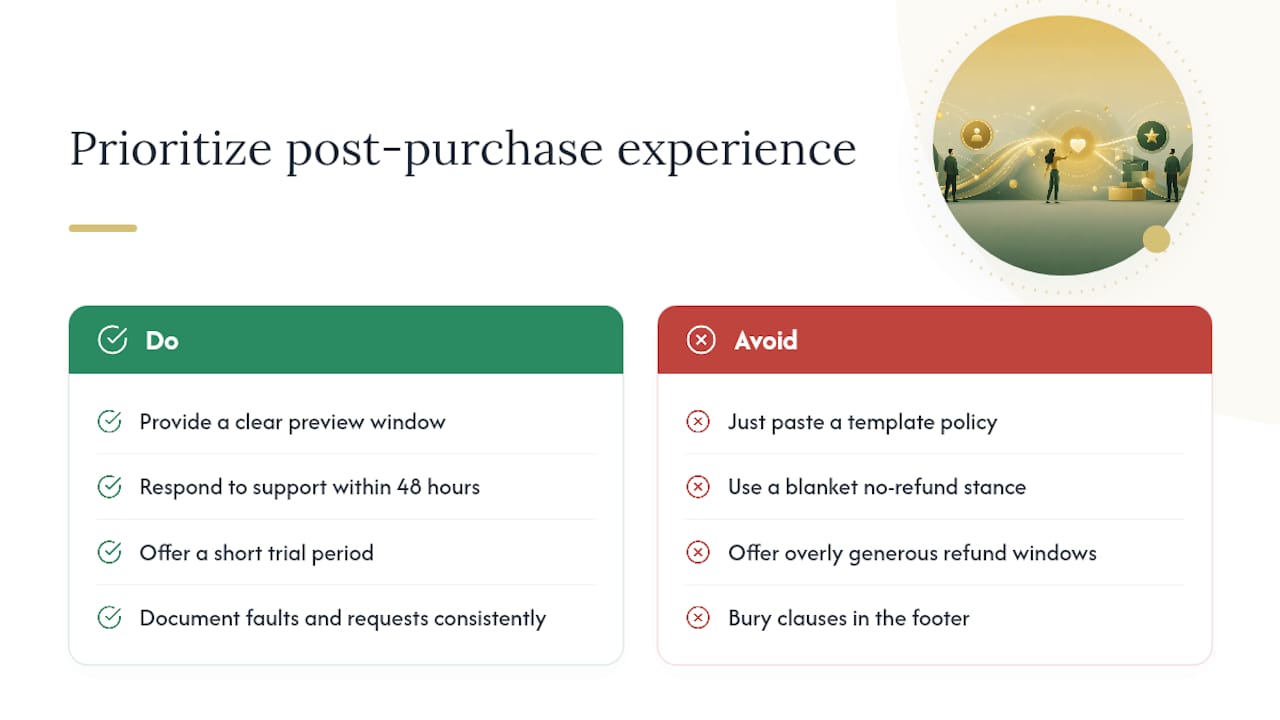
The conventional advice also overcorrects toward either extreme: either a blanket no-refund stance that ignores statutory fault exceptions, or an overly generous window that invites abuse from buyers who consume the whole course before requesting money back. Neither protects the seller. The middle position, a short trial, a fault-based exception, and consistent documentation, holds up better under both legal scrutiny and chargeback disputes.
If you’re building or rebuilding a policy, prioritize the preview window and the support response time before you touch the legal wording. The clause matters. The experience before the buyer even thinks about refunding matters more.
— Money
Creators who want this handled end to end, from policy wording to the sales page it sits on, can see how Money-plug structures full launches at Money Plug™ | Creator Monetization Systems & Revenue Engineering.
This article is general information, not a substitute for advice from a qualified lawyer. Consult a qualified legal professional about your own circumstances before acting on anything here.
Sources
- Steam refunds policy
- Directive (EU) 2025/516 (Digital VAT and reporting reforms)
- UK guidance on VAT rules for digital services