Match Method to Decision: Audience Research for Creators and Marketing Teams
Match Method to Decision: Audience Research for Creators and Marketing Teams

Six methods matter: interviews, surveys, analytics, social listening, focus groups, and A/B testing. The rule that makes them work is triangulation. Pick a decision you need to make, then combine at least one qualitative method with one quantitative method so you’re validating attitudes against actual behavior. Skip that pairing and you’ll build a persona that describes how people want to be seen, not how they act. Start now: name the decision, then choose your pair.
TL;DR:
- Combining qualitative methods like interviews with quantitative tools such as surveys or analytics reduces the risk of building personas based on desired rather than actual behavior.
- Focus groups and co-creation sessions are most effective early in development for raw concepts, but they require skilled moderation to prevent dominant voices from skewing insights.
- A/B testing and behavioral analytics can establish causation and reveal actual drivers of change, exemplified by a 16% subscription lift from a single tested variant.
- Research should be tightly linked to a specific decision and KPI, with a full cycle including existing data audit, method pairing, stratified sampling, and rapid synthesis within 48 hours.
- Ongoing, lightweight research inputs, such as micro-surveys and social listening, help maintain fresh insights that inform continuous campaign optimization and rapid experimentation.
Table of Contents
- Core Audience Research Methods and What Each One Actually Tells You
- A Six-Step Workflow for Running Audience Research That Answers a Real Decision
- Which Method Fits Which Marketing Decision
- Sampling, Recruitment, and the Biases That Quietly Wreck Your Data
- Turning Raw Data Into Segments and Decisions Stakeholders Will Act On
- Building Audience Research Into an Ongoing Habit, Not a One-Time Project
- The Trade-Off Nobody Talks About in Audience Research
- Money-plug Turns Research Into a Launch, Not Just a Report
- Where to Go Deeper on Audience Research
- Sources
Core Audience Research Methods and What Each One Actually Tells You
Every method answers a different question, and confusing them is how teams end up with data they can’t use. A survey tells you what people say they want. Behavioral analytics tells you what they actually did. Neither is wrong, but treating one as a substitute for the other is the single most common mistake in audience work.
Surveys are fast and cheap to scale, which makes them the default choice for board reporting and longitudinal tracking. They’re strong on stated preference metrics, brand perception scores, and satisfaction trends over time. The catch: surveys are useful for benchmarking but weaker at predicting future behavior than observed data. Use a survey when you need directional numbers fast, not when you need to predict what someone will actually buy.
Interviews dig into motivation in a way no closed-ended question can. A good interview uses jobs-to-be-done framing: not “do you like this product” but “what were you trying to accomplish when you looked for something like this.” The skill is in the probing. A flat question gets a flat answer; a follow-up like “tell me about the last time that happened” gets the real story. Plan on 8 to 12 interviews per segment before patterns stop surprising you.
Focus groups and co-creation sessions work best early, when you’re testing a raw concept rather than a finished product. Group dynamics cut both ways: they surface consensus fast, but a dominant voice in the room can flatten everyone else’s opinion. A skilled moderator matters more here than in any other method on this list.
A/B testing and controlled experiments are the only method that proves causation instead of correlation. One publisher tested different value-proposition phrasing and saw a 16% increase in subscriptions from the change alone. That’s the power of experiments: they isolate one variable and tell you, with actual evidence, what moved the needle. Our creative testing framework breaks down how to structure these tests so results hold up.
Behavioral analytics and CRM data reveal patterns people won’t tell you themselves, like drop-off points in a funnel or cohorts that churn after 40 days. This is revealed preference, and it’s often more honest than anything captured in a survey.
Social listening and community mapping track cultural signals and the language a community actually uses. Diary studies and observational research capture behavior in context, which is invaluable for anything involving daily habits or long purchase cycles.
A Six-Step Workflow for Running Audience Research That Answers a Real Decision
Research without a decision attached to it produces a report nobody reads. Here’s the sequence that keeps it useful.
- Define the decision and the KPI it will move. Are you deciding on a price point, a headline, a feature to build? Write the decision down before you write a single question.
- Audit what you already have. Support tickets, churn data, past survey results, and CRM notes often answer half your question before you run anything new.
- Pick methods that cover two lenses. Combine at least one qualitative and one quantitative method, matching demographic, psychographic, behavioral, and community data where you can, since most teams overweight the easy lenses and skip psychographics and community analysis entirely despite fuller pictures needing all four.
- Recruit a sample that reflects your actual audience, stratified by the variables that matter to your decision (usage frequency, tenure, spend tier), not just whoever answers first.
- Run collection with a pilot batch first. Test your screener and your questions on five people before you commit budget to fifty.
- Synthesize into personas, segments, and a short list of prioritized recommendations, not a fifty-slide deck nobody opens.
Pro Tip: Time-box synthesis to 48 hours after your last data point comes in. Insights lose urgency fast, and a synthesis session held two weeks later produces vaguer recommendations than one held the same week.
Which Method Fits Which Marketing Decision
The method should follow the decision, not the other way around. Teams that default to “let’s run a survey” for every question waste both time and budget.
- Brand positioning or messaging strategy: Interviews plus social listening. You need language and emotional context, which numbers alone won’t give you.
- Conversion or landing page performance: A/B testing plus behavioral analytics. This is a causation question, and only an experiment answers it cleanly.
- Feature prioritization for a product roadmap: Surveys for reach, paired with a smaller round of interviews to understand the “why” behind the top-voted requests.
- Community or audience growth strategy: Community mapping and social listening carry more predictive weight here than demographic segmentation alone, since network-based clusters surface actionable audience groups that broad demographic slices tend to miss.
Budget and timeline decide how deep you can go. A quick pulse check (a five-question micro-survey plus a scan of recent social mentions) can turn around in three days. A full segmentation study with stratified interviews and a validated survey wave usually needs three to six weeks. If the decision carries real financial risk, like a pricing change or a new product line, lean toward experiments over pure qualitative exploration. Experiments give you a number you can defend in a budget meeting; interviews give you a story that’s harder to act on alone.
Sampling, Recruitment, and the Biases That Quietly Wreck Your Data
A sample that isn’t representative produces confident conclusions about the wrong people. Define eligibility criteria before you post a single recruitment ad, and stratify by the variables that matter for your decision, such as tenure, spend tier, or platform used.
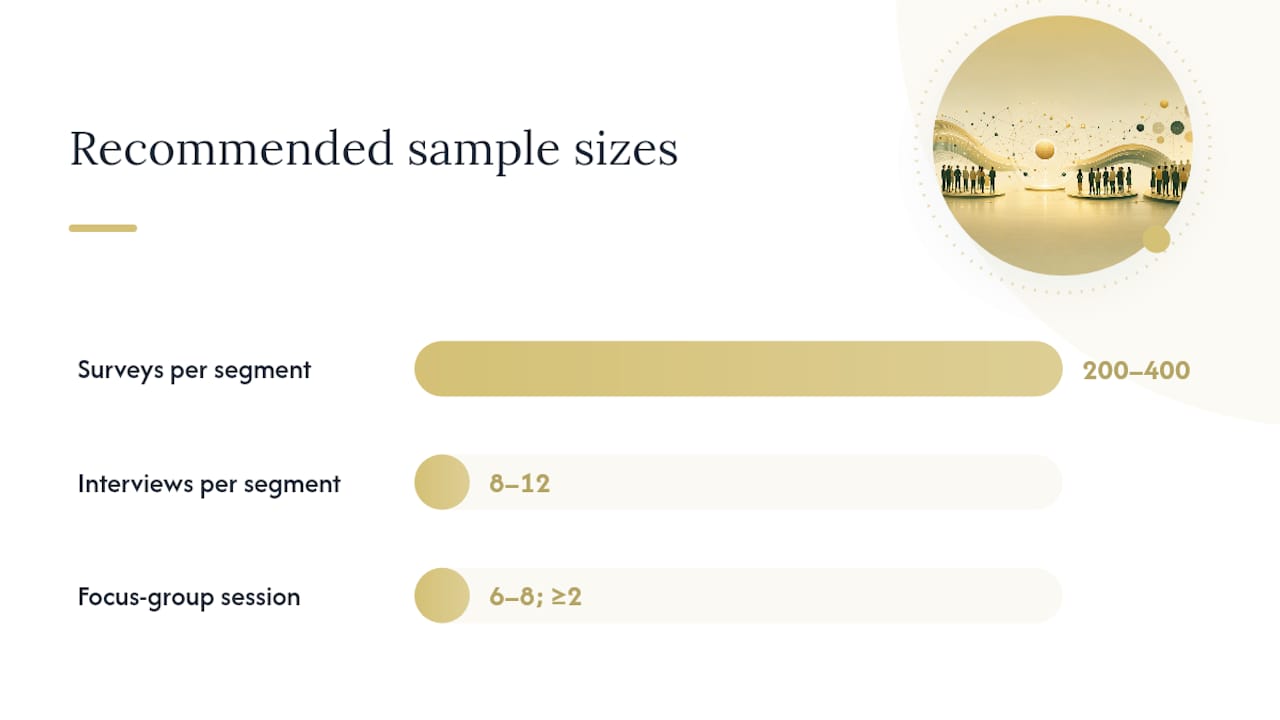
Sample-size guidance varies by method: surveys generally need 200 to 400 responses per segment for directional confidence, interviews need 8 to 12 per segment before themes stop shifting, and focus groups work best at 6 to 8 participants per session, run across at least two sessions to catch group-dynamic outliers.
Incentives should match effort, not manipulate answers. A flat gift card for a 10 minute survey works; an incentive tied to giving a positive review does not.
- Screen out professional survey-takers and employees of competitors before they skew your data.
- Pilot every script with five people before the full run to catch leading or confusing questions.
- Write moderation scripts that avoid suggestive framing (“wouldn’t you agree that…”).
- Rotate question order across survey waves to control for order bias.
One documented result worth remembering here: a single value-proposition change on subscription copy produced a 16% lift once tested properly, a number that would have looked like noise in an unstratified sample.
Turning Raw Data Into Segments and Decisions Stakeholders Will Act On
Triangulation is where research earns its keep. Cross-check what analytics reveal about behavior against what people say in interviews and what social listening shows about sentiment. When all three line up, you’ve found a real pattern. When they conflict, that conflict is often the most useful finding in the whole project, since combining survey data with observed behavior catches segments that look real on paper but don’t hold up in practice.
Every segment should be tested against four criteria before you spend activation budget on it:
| Criterion | What it means |
|---|---|
| Observable | You can identify who belongs to it using data you actually have |
| Meaningful | It predicts a real difference in behavior or response |
| Accessible | You can actually reach it through a channel or campaign |
| Stable | It holds up over a few months, not just one survey wave |
Deliverables should drive a decision, not decorate a slide deck: a one-page persona summary, a handful of annotated quotes tied to specific findings, a journey map flagging drop-off points, and a prioritized backlog ranked by expected impact. Set a refresh cadence, quarterly for most teams, and monitor a handful of always-on signals between full studies so a segment profile doesn’t quietly go stale.
Building Audience Research Into an Ongoing Habit, Not a One-Time Project
The teams getting the most value out of research have stopped treating it as a discrete project with a start and end date. Instead, they keep light, always-on inputs running between the bigger studies: exit-intent surveys, a two-question post-purchase poll, quarterly refreshes of segment profiles.
- Automate the small stuff: trigger micro-polls after key actions instead of waiting for a formal research cycle.
- Feed fresh findings directly into campaign planning and launch briefs so insight doesn’t sit in a shared drive nobody opens.
- Track ROI by tying specific insights to the campaign or launch decision they influenced, not just to open rates on a research report.
Money Plug Lab has applied this operating model across seven launched creator programs, generating over $500,000 in tracked revenue, including one launch that produced more than 3,000 sales in ten days.
Pro Tip: Attach one research finding to every launch brief you write. If you can’t name which insight shaped the campaign, the research probably wasn’t used.
The Trade-Off Nobody Talks About in Audience Research
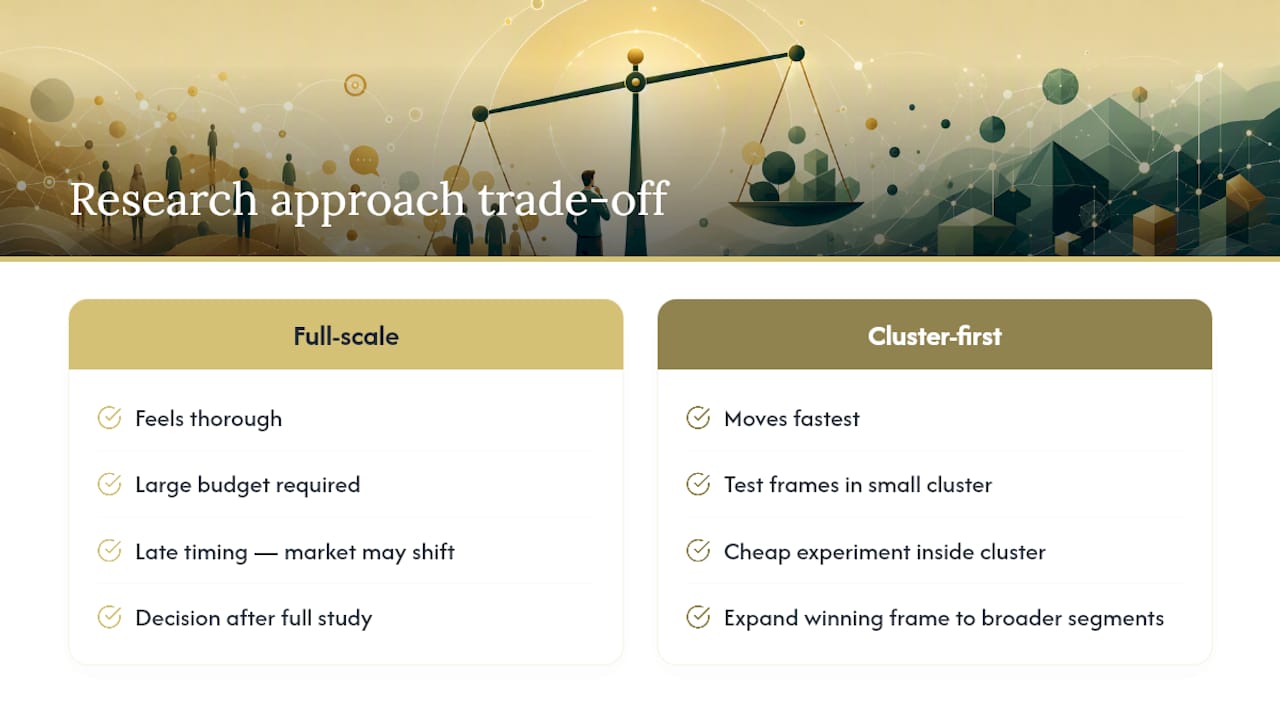
Most guides tell you to research everything before you launch anything. In practice, the teams that move fastest test creative frames on a small community cluster first, then expand the winning frame to broader segments. Full-scale segmentation studies feel thorough, but they often arrive after the market has already shifted.
The better sequence: identify one observable, accessible cluster, run a cheap experiment inside it, and let that result decide whether the bigger study is even worth the budget. Case-specific results and author credentials for this kind of applied testing will be added here as more launches complete.
— Money
Money-plug Turns Research Into a Launch, Not Just a Report
Running interviews, surveys, and A/B tests takes time most creators and small marketing teams don’t have between content schedules and client work. The chain from audience research through pricing, sales copy, and paid launch campaigns can be handled on a pure revenue-share basis with zero upfront cost to the creator.
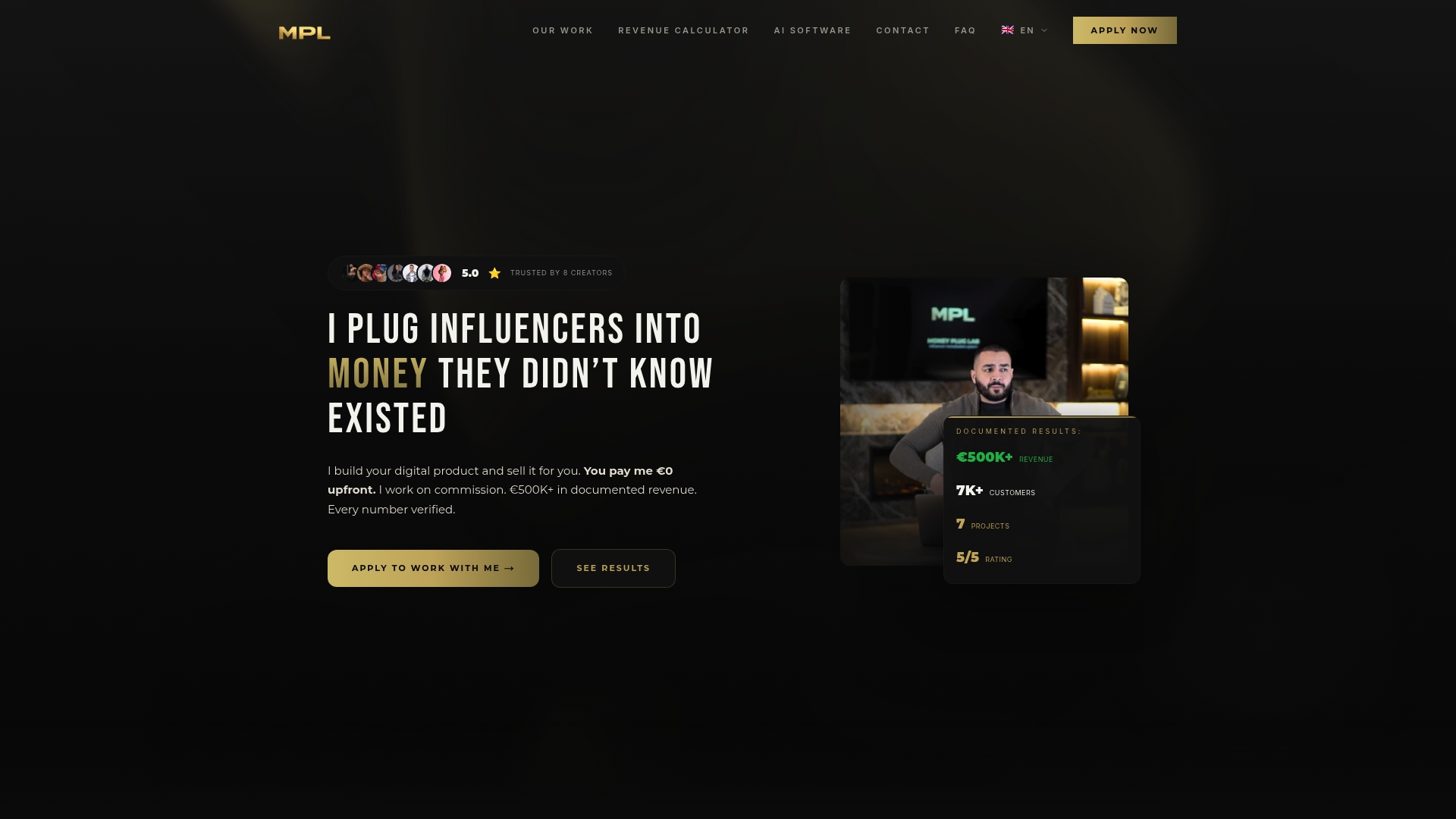
That model matters most for creators who have an engaged audience but no bandwidth to turn insight into a structured offer. This model is often used in markets where acquisition costs run far below Western markets and engaged niche communities are already primed to buy. If you’ve been sitting on audience data with no plan to act on it, or a launch idea with no system behind it, the Money-plug landing page is where to start that conversation and see if a revenue-share partnership fits your audience.
Where to Go Deeper on Audience Research
For readers who want the primary sources behind these methods: the IMS step-by-step guide to audience research walks through building research into ongoing workflows. Pulsar’s audience analysis guide and its segmentation strategy piece both cover community-based segmentation in more depth. For demographic and trend benchmarking, Pew Research Center remains one of the most cited third-party datasets in the field.
Sources
You don’t need an expensive stack to run good research, but you do need the right tool for each method. Survey platforms should support skip logic and randomized question order so you’re not accidentally leading respondents. Analytics tools that track cohorts across platforms matter more than single-channel dashboards, since audience behavior rarely stays on one platform.
Social listening and community-mapping tools help you cluster shared vocabulary and identify which voices a community actually trusts, a technique worth operationalizing by mapping follow-graphs and profiling each cluster for language and activation paths. AI-moderated interview platforms now let teams scale qualitative collection, structuring open-ended answers into themes an analyst can code quickly instead of manually.
Four templates worth building once and reusing forever:
- What Is Audience Analysis? A Practical Guide for Marketers • Pulsar Platform
- Audience Research Resource Pack — Media Support