Creators: 4–7 Launch Email Sequence with Copy Ready Jobs
Creators: 4–7 Launch Email Sequence with Copy Ready Jobs
Use a 4 to 7 email sequence mapped to anticipation, activation, and urgency, starting 7 to 10 days before launch and closing 24 to 48 hours after doors shut. That structure covers teaser, story, proof, launch, objection handling, and last call without overwhelming your list. Pick your runway today, sketch each email’s job on a single page, and start writing the teaser first.
TL;DR:
- A three or four-email launch sequence suits low-price offers or highly engaged audiences, while a seven-email plan aligns with high-ticket, longer sales cycles.
- Sending emails at specific times—such as teasers seven to ten days out and last calls 24 to 48 hours before closing—maximizes open and conversion rates.
- Segmentation into highly engaged, warm, and cold lists enhances email relevance and significantly improves click-through and sales performance.
- Personalizing each email to serve a single purpose, whether building curiosity or handling objections, increases engagement and avoids message dilution.
- Resending unopened emails with new subject lines after six hours can recover up to 30% of missed opens with minimal additional effort.
Table of Contents
- How Do You Choose the Right Launch Email Sequence Length?
- When Should You Send Each Launch Email?
- How Should You Segment Your List Before Launch?
- What Should Each Launch Email Actually Say?
- What Subject Lines and CTAs Convert Best?
- How Do You Test and Track Your Launch Sequence?
- What Our Creator Launches Show About Sequence Structure
- A Done-for-You Launch Option for Creators Who Want to Scale
- Sources
- FAQ
How Do You Choose the Right Launch Email Sequence Length?
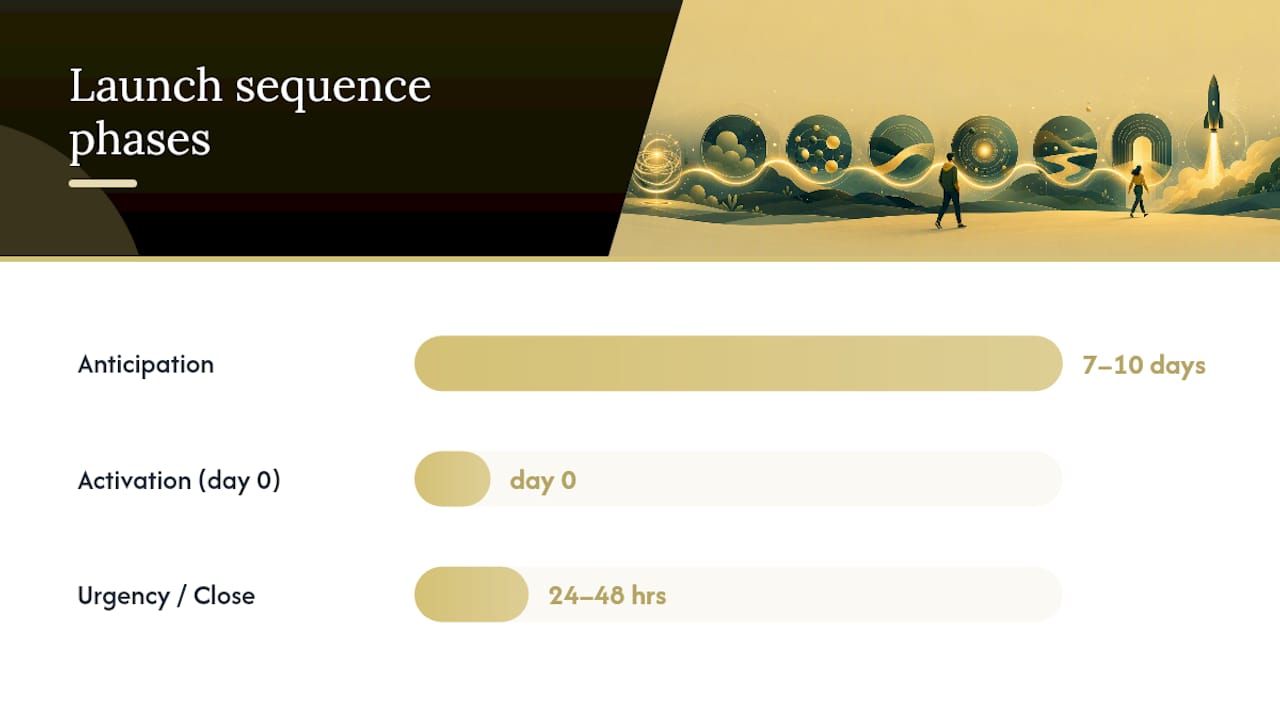
Every launch email sequence breaks into three phases: anticipation before the cart opens, activation on launch day, and urgency in the final stretch. Anticipation typically runs 7 to 10 days, activation happens on day zero, and urgency or close covers the 24 to 48 hours after doors shut. That’s the skeleton. What changes is how many emails you hang on it.
A 4 email core sequence works well for low-price offers or for audiences who already know and trust you. Think teaser, launch, reminder, last call.
A 5 email standard sequence fits most course and coaching launches. Add a proof or story email between the teaser and the launch announcement to build more trust before you ask for money.
A 7 email extended sequence makes sense for higher-ticket programs (think $300 and up) or longer decision cycles, where buyers need multiple angles before committing.
- 4 emails: fast, low-consideration, small list
- 5 emails: standard course or program launch
- 7 emails: high-ticket, longer sales cycle, cold or mixed audience
Whichever length you choose, cover three jobs at minimum: build curiosity, prove the offer works, and create a real reason to buy now.
When Should You Send Each Launch Email?
Timing decides whether people open your emails or ignore them. Here’s a cadence you can copy directly into your scheduler:
- Teaser email: send 7 to 10 days before launch, mid morning (9 to 11 AM in your audience’s time zone). For high-consideration offers, push this to 14 days.
- Story or proof email: 4 to 5 days before launch, early afternoon.
- Launch day announcement: morning of day zero, ideally before 10 AM so it lands before inboxes fill up.
- Follow-up and objection handler: afternoon of day one or two, spaced at least 24 hours from the previous send.
- Last call: 24 to 48 hours before the cart closes, then a final email on close day itself.
If your launch window runs 3 to 5 days, compress spacing to once a day. For 10 plus day launches, space emails every 2 to 3 days to avoid fatigue.
One resend tactic multiplies results with almost no extra work: resend to non-openers about six hours later with a new subject line. That single move typically recovers 20 to 30% of the opens you missed on the first send.
How Should You Segment Your List Before Launch?
Not everyone on your list deserves the same email. Split your audience into three buckets before you write a single word of copy.
- Notify or highly engaged: subscribers who opened your last three emails or joined a “notify me” waitlist. They get early access and softer urgency because they’re already leaning in.
- Warm: subscribers who engage occasionally. They get the full sequence, standard timing.
- Cold: subscribers who haven’t opened anything in 90 plus days. Send them fewer emails, or exclude them from the launch entirely to protect your sender reputation.
This matters more than most creators think. Segmented campaigns see materially higher click rates than a general broadcast, which is a difference big enough to change whether your launch hits its number.
Before you send anything, run a quick list hygiene pass: remove subscribers inactive for six months or more, reconfirm addresses that bounced softly in the past, and suppress hard bounces outright. Launching to an unclean list drags down engagement and can damage your deliverability for every email you send after.
Pro Tip: Build a “notify me / early access” sign-up two to three weeks before your teaser goes out. It gives you a genuine high-intent segment, and it lets you test your offer’s core message on the people most likely to buy.
What Should Each Launch Email Actually Say?
Every email in your sequence has exactly one job. Trying to cram three asks into one message is the fastest way to kill your click rate, since emails built around a single CTA convert more clearly than multi-ask emails.
Here’s the job, structure, and a usable starter line for each stage.
-
Teaser (send 7 to 10 days out). Job: spark curiosity without revealing the offer. Structure: hint at the problem, tease the solution, promise more soon. Starter subject: “Something’s coming for [specific outcome].” CTA: “Reply and tell me if this sounds like you.”
-
Story or proof (4 to 5 days out). Job: build trust through a real result or transformation. Structure: set the scene, show the struggle, reveal the outcome. Starter opening line: “A year ago, [name] was stuck on exactly this.” CTA: “Want the same result? Stay tuned.”
-
Launch announcement (day zero, morning). Job: open the cart and state the offer plainly. Structure: name the problem, present the solution, give the price and deadline. CTA: “Enroll now” or “Grab your spot.”
-
Social proof or objection handler (day one or two). Job: answer the top three reasons people hesitate. Structure: name the objection, address it directly, reinforce the outcome. CTA: repeat the same enrollment link.
-
Last call (24 to 48 hours before close). Job: create a real, explained deadline. Structure: remind what’s at stake, state the exact close time, remove friction. CTA: single link, repeated once if the email runs long.
Once someone buys, pull them out of the remaining sequence immediately. A tag-based automation rule in your email platform handles this cleanly, and it stops you from pitching an offer to someone who already owns it.
What Subject Lines and CTAs Convert Best?
Subject lines carry more weight than most creators give them credit for, since a great email with a weak subject line never gets opened. Four formulas cover almost every stage of a launch sequence:
- Curiosity: “The thing I’ve been hiding for two weeks”
- Benefit or value: “How to [outcome] without [common obstacle]”
- Social proof: “How [number] people got [result] in [timeframe]”
- Deadline urgency: “Closes tonight at midnight”
Place your primary CTA where it’s visible without scrolling. If the email runs long, repeat the same link once near the bottom rather than adding a second, different action. Sticking to one CTA per email isn’t just cleaner copy. It also makes your click data easier to read, since you’re not splitting attention across competing links.
How Do You Test and Track Your Launch Sequence?
Run a short preflight check before every send: click every link, preview the email in both desktop and mobile inboxes, confirm your tracking parameters are attached, and test the unsubscribe and preference links to make sure they actually work.
For live testing, A/B test subject lines on your teaser and launch day emails, and test send times if your list spans multiple time zones. Call a winner once you’ve got a meaningful gap in open rate, usually after the first few hours of data rather than waiting the full day.
During the launch itself, watch four numbers in real time: open rate, click rate, conversion rate, and revenue per email. A resend to non-openers with a fresh subject line six hours later typically recovers 20 to 30% of missed opens, which is often the single highest-leverage move you’ll make during launch week.
What Our Creator Launches Show About Sequence Structure
Across seven launches, Money-plug’s creator partners have generated more than $500,000 in tracked revenue, including one launch that produced over 3,000 sales in ten days and a campaign that returned 18x on ad spend. The pattern behind those numbers: structured, multi-email sequences outperform a single announcement blast every time. Founders who hand off the operational grind, list management, copy, timing, tend to convert better and burn out less.
— Money
A Done-for-You Launch Option for Creators Who Want to Scale
If mapping, writing, and scheduling a full launch email sequence sounds like more than you want to handle alone, a done-for-you launch service is an alternative to building it solo. Instead of piecing together your own teaser copy, segmentation rules, and send calendar, such a service can run the entire operation on a revenue-share basis, with zero upfront cost to you.
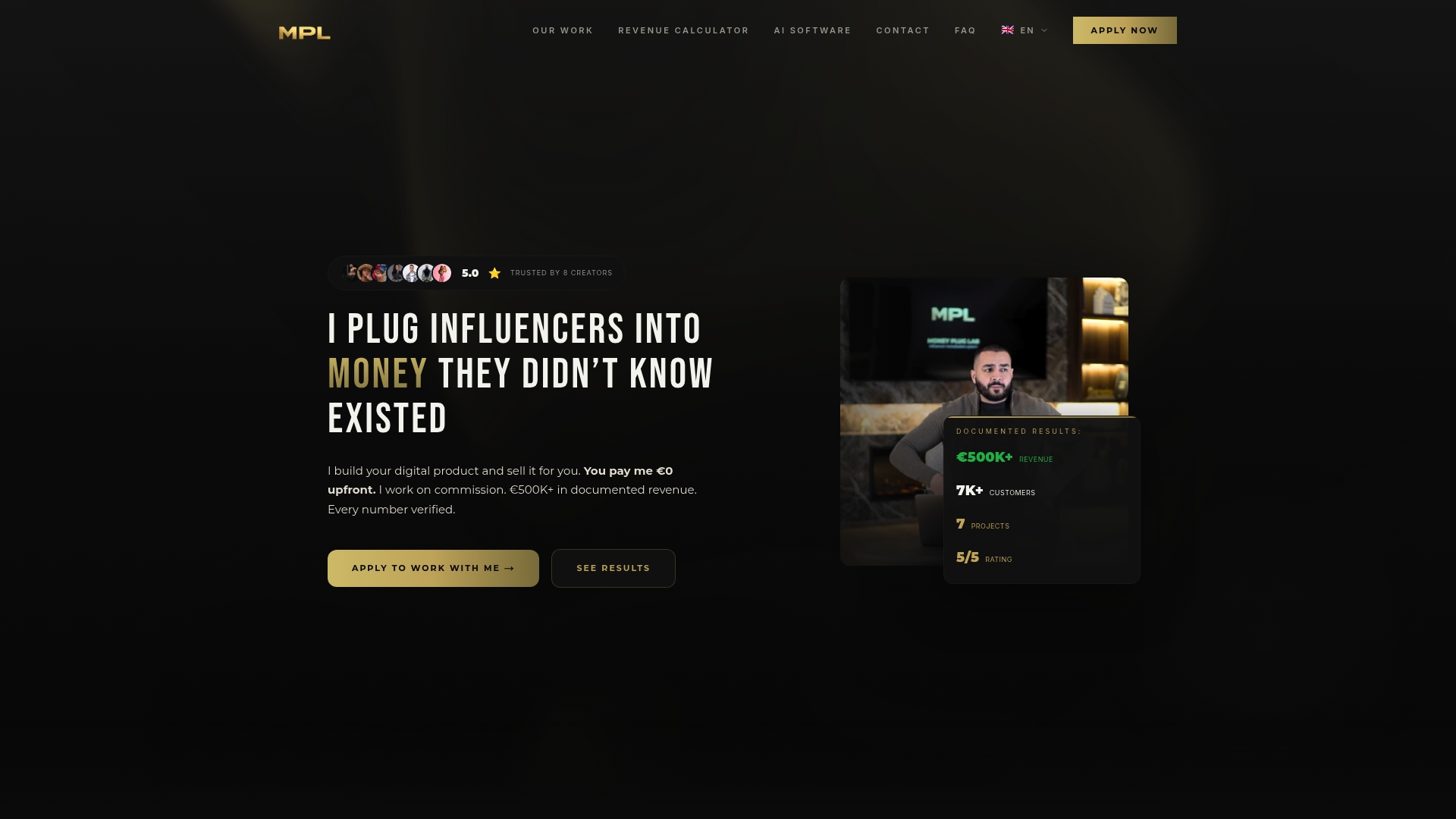
That includes audience research, product pricing, sales copy, video sales letters, full launch campaign management, payment setup, and post-production for paid ads. Such services are built for creators with a limited runway before launch day, a real scale goal, or simply not enough internal hands to run every email on schedule. If your list needs a notify segment built from teaser signups before you roll out to the rest of your audience, that’s the kind of operational sequencing handled in this approach.
Check your fit at Money-plug and see what a full-service launch could generate for your next offer.
Sources
- Product launch email examples and timing
- Email segmentation statistics and impact on engagement
- Building and nurturing an email list prior to a product launch
- Product launch email sequence: what actually works
FAQ
What Are the 7 Steps of a Product Launch?
Most product launches follow research, positioning, pre-launch buzz, a teaser sequence, the launch announcement, active selling with objection handling, and a final urgency push before close. The email sequence covers the last four steps directly.
Can You Give an Example of an Email Sequence?
A standard 5 email sequence runs: teaser (day minus 7), story or proof (day minus 4), launch announcement (day 0), objection handler (day 1 or 2), and last call (24 to 48 hours before close).
What Is an Email Sequence?
A launch email sequence is a series of timed, purpose-built emails that move a subscriber from curiosity to purchase, each with one clear job and one call to action.
How Do I Get My Launch Emails in the Right Order?
Map each email to a phase first, anticipation, activation, urgency, then assign one job per email within that phase before you write any copy. Building the timeline before the words keeps the sequence from feeling repetitive or out of order.